


The Curious Death of Adlai Stevenson – LewRockwell
Posted by M. C. on October 24, 2018
In the summer of 1965, one of President Johnson’s most secretive plots—in collaboration with Israeli leaders—was well underway: A plan to join Israel in a long-planned war with their neighbors, Egypt, Jordan and Syria, a supposedly “spontaneous war” scheduled well in advance for June 15, 1967 (that would be inadvertently jump-started ten days early).
From the beginning of the last half of the 20th Century through the recent past, several national leaders have died at suspiciously-critical points in their careers, many by heart attacks which were presumed, but conveniently never subjected to autopsy confirmation. The ones occurring prior to January 20, 1969, the end of his presidency (even up to his death four years later) might have been added to the official “hit list” by the most likely culprit for such terminations, President Lyndon B. Johnson.
Despite the fact that he had never been caught “red-handed” for any murders, there are numerous cases—still open and unresolved—of which he has been accused of being the sole, or primary instigator. Among the accusers, the late Texas Ranger (later U.S. Marshal) Clint Peoples, one of the most honored, respected and impeccably credentialed of Texas lawmen, had pursued a number of such leads (including JFK’s assassination) for decades, always impeded by Johnson’s gossamer web of political, law enforcement and judiciary connections throughout the state and nation.
In 1984 (when Johnson had been dead for over a decade) Peoples convinced a Texas grand jury to change the cause of death of one of those victims, Henry Marshall—who in 1961 had been viciously beaten to death, forced to inhale a lethal dose of carbon monoxide and shot five times in his chest—from “suicide” to “homicide.” That Johnson was able to have that absurd “C.O.D.” stick, for twenty-three years, is the best illustration of his political power within Texas throughout his reign and for many years afterward.
The Still-Mysterious Death of Adlai Stevenson

Arguably one of the most prominent, highly-placed persons who suddenly, enigmatically died, on July 14, 1965, was U.N. ambassador Adlai Stevenson; he had twice (1952, 1956) been the Democratic party’s presidential nominee. According to a contemporaneous London news report, Stevenson “collapsed and died of an apparent heart attack Wednesday near the American Embassy in Grosvenor Square.” His surprising death, as an active man who still played an aggressive style of tennis at age 65, was the subject of rumors and speculations at the time, as evidenced by documents in the Harold Weisberg collection. [1]
In lengthy 1975 memoranda (prompted by the news of the CIA’s previously-secret development of the “heart attack gun”) between Weisberg and a colleague that referenced numerous other suspicious deaths the U.N. ambassador’s name was added: “One of the best-known victims could have been Adlai Stevenson, who was about to meet with NLF [National Liberation Front] and North Vietnam leaders in Paris when he was stricken on a London sidewalk.” This exchange of correspondence was prompted by the then-recent release, by the CIA, of numerous secrets, including the stunning news of a special gun that would cause the victim to have a massive heart attack that would not be noticed during an autopsy (to be further reviewed, below).
His death occurred at a time when Stevenson had become very upset with Lyndon Johnson’s Vietnam policies, and that would have caused Johnson to become very upset with him, as it was well known by all of his highest-level aides that the new president demanded absolute loyalty from all of them. Furthermore, it was also at a time when Johnson was planning to persuade Arthur Goldberg to leave the Supreme Court so that he could put his old friend Abe Fortas on it…
But there was another reason that Johnson wanted the hardline Zionist Goldberg in the UN at that point in time, and for the too-pacifist, non-doctrinaire Stevenson to be out. In the summer of 1965, one of President Johnson’s most secretive plots—in collaboration with Israeli leaders—was well underway: A plan to join Israel in a long-planned war with their neighbors, Egypt, Jordan and Syria, a supposedly “spontaneous war” scheduled well in advance for June 15, 1967 (that would be inadvertently jump-started ten days early). Johnson undoubtedly knew that a critically important sub-plot—the sinking of a U.S. naval vessel as a pretext for an attack against Egypt—would require the presence of a U.N. ambassador with unquestioned loyalty to both himself and the Zionist Israeli leadership. [3]
Senator Daniel Patrick Moynihan’s Doubts
Traces of President Johnson’s manipulative acts had become visible in the immediate aftermath of Stevenson’s death: According to the account of New York Senator Daniel P. Moynihan, what followed was one of Johnson’s most enigmatic, cunning and deceitful maneuvers—of the numerous others—one that the highly regarded senator termed “an inexplicable disservice” to Arthur J. Goldberg, to leave his position on the Supreme Court against his wishes.
Johnson’s deceitful maneuvers were exposed by Senator Moynihan when he wrote a long “To the Editor” letter to the New York Times, which was printed on November 1, 1971. Moynihan stated: “Neither is this a service to the Court, nor yet to the confidence with which the public will read The Vantage Point” (the title of Johnson’s recently published 1971 memoirs).
On Monday, July 12, 1965, Sevareid had a lengthy, heartfelt conversation with Stevenson at the U.S. embassy in London. After Stevenson’s death, the CBS newsman offered readers of Look magazine a candid profile of the statesman two days before his sudden death. Sevareid’s biographer, Raymond A. Schroth, summarized it thusly:
“Stevenson poured out his complaints about the U.N. job, his frustrations with the Vietnam peace process—giving the impression that the Johnson administration was sabotaging rather than really seeking a settlement—and said he wanted to go back to Libertyville, Illinois, see the grandchildren, and ‘sit in the shade with a glass of wine in my hand and watch the people dance’.” (Emphasis added). Undoubtedly at Johnson’s direction, his aides and associates immediately denied the charge of sabotaging peace initiatives and (quoting Schroth again), they “accused Sevareid of trying to embarrass the president.” [7]
Within the 4,000+ word Look article, Sevareid’s first paragraph began with these words: [8]
I loved Adlai Stevenson unreservedly, and for me there was a brutality about that week in mid-July when he died. On Monday, the twelfth, I had sat up with him until well past midnight, and he bared his heart in a rush of talk. What he said that night revealed a profound frustration, a certain resentment that stopped just short of bitterness. We had not talked so intimately for several years, and I went away with my feelings of sadness for him overlaid with a kind of selfish feeling of elation that our old affection had been revived and confirmed. (Emphasis added).
The most salient of the numerous points made by Sevareid in his article were:
- That he had appeared on a BBC News program the evening of Stevenson’s death to report on their conversation two days earlier, during which he “nearly broke down completely and publicly.”
- “A flurry of controversy and some angry feelings in high places resulted from what I broadcast to America that evening and from what others said. I did not report all he had told me, but I said that he was planning to resign from the UN post.”
- “From Paris, David Schoenbrun of Metromedia Stations reported a conversation of the previous week and stated that Stevenson had referred to President Lyndon B. Johnson’s intervention in the Dominican Republic as a “massive blunder.” The President, through Bill Moyers, his press secretary, responded with anger, saying it was a disservice to Stevenson’s memory to quote him when he was dead and could not answer. Later, the White House told me its reaction was directed solely at the Schoenbrun story, not at mine, but for a time I suffered painful worries that I may indeed have harmed the memory of a dear friend. I do not think so now; I think what I reported had to be reported, if the historic record is to be truthful and complete . . . In any case, Adlai’s state of mind at his death should be known, and I think it is entirely proper for me to relate it in detail now. I do so without attempting to evaluate his various remarks about high policy, but with a sense of certainty that I report him accurately.”
When they met at the American Embassy for their private and lengthy conversation, Sevareid said that he “quickly understood” that it was not to just a friendly, casual meeting: “He began almost abruptly. He simply had to get out of the U.N. job. He was tired. He was 65 years old. ‘I guess I’ve been too patient,’ he said. Then, with that wry, deprecating smile, ‘I guess that’s a character weakness of mine’.”
Sevareid then described several incidents that weighed heavily on Stevenson, never previously publicly revealed, all of which reflected poorly on President Johnson’s domineering leadership style that stymied any attempt by the highest Cabinet officials to rebut even a single sentence in television addresses prior to their airing…
The 1975 Revelation of the CIA’s “Heart Attack Gun”
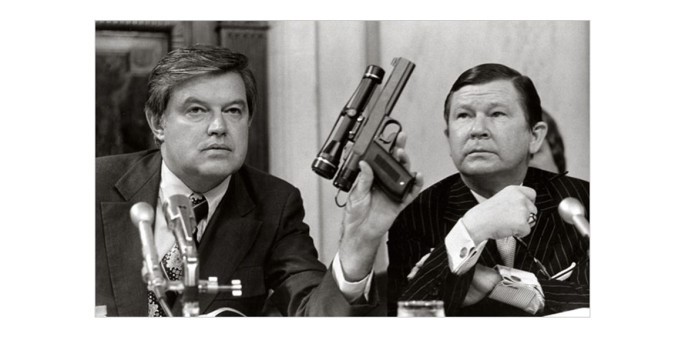
Senators Frank Church (D-ID) and John Tower (R-TX) examining the “heart attack gun” which could shoot a frozen projectile filled with a deadly toxin that would induce a heart attack in the victim, leaving only a small red dot on their skin, and no other substance that could be detected at autopsy.
Source: Youtube “The CIA’s Heart Attack Gun”.
The “heart attack gun” shown in the photograph above—given that this particular weapon was obviously developed for that specific purpose at least five decades ago—demonstrates the certain reality of how that tool would have been put to use. Obviously, certain protocols would have been created to define who would qualify for nominating candidates for potential victims and the decision procedures—or simply conferring that authority to specific high-level officers—to control its use. Considering everything we know about Lyndon B. Johnson’s capacity for executing such orders during his reign of power, it is axiomatic that his name would be the first on that list.
That weapon has probably now become the most primitive of the CIA’s inventory of such fatality-inducing tools, given the continually-expansive nature of that organization into every facet of American life, and death—not to mention every other country on the planet where its presence is felt.
Be seeing you
 MCViewPoint
Leave a comment