


Have You Seen the Safety Warning – LewRockwell
Posted by M. C. on July 20, 2019
Mitochondrial Dysfunction, Not Brain Tumors, Is the Primary Hazard of Cellphone Radiation
In this special edition of CBC Marketplace, originally aired March 2017, journalist Wendy Mesley investigates the safety of cellphones, focusing on a little-known warning from the manufacturer hidden within your cellphone manual that advises you to keep the device at a certain distance from your body to ensure you don’t exceed the federal safety limit for radiofrequency (RF) exposure.
In the real-world, however, most people carry their phones close to their body, usually in a pocket. Many women even tuck their phone right into their bra which, by the way, is the absolute worst area for a woman to put it, as it could raise their risk of both heart problems and breast tumors, their two leading risks of death.
What’s more, while the safe use information is provided by all cellphone manufacturers, you’d be hard-pressed to find anyone who has actually been able to find the message on their phone, without detailed instructions on where to locate it.
What the Manufacturer’s Warning Says
While the safe use warning may differ slightly from one phone to the next, the basics remain the same. Mesley reads the information from her iPhone:
“To reduce exposure to RF energy, use a hands-free option, such as speakerphone … Carry iPhone at least 5 millimeters [mm] away from your body to ensure exposure levels remain at or below the as tested levels.”
According to the report, “81 percent of Canadians have never seen the message in their phone or manual about carrying their phone 5 to 15 mm away from their body.” What’s more, few really understand what it all means. Is it dangerous to have the phone touching your body? Mesley sets out to discover what the warning means for consumers.
The Berkeley Controversy
Mesley visits Berkeley, California, where the city council passed a cellphone “Right to Know” ordinance,1 requiring cellphone retailers to put up signage informing customers that carrying their cellphone in their pocket or bra when the phone is on may result in RF exposure that exceeds federal safety guidelines. The ordinance was initially proposed in 2010 and passed in 2015.
In response, the wireless industry (CTIA) sued Berkeley, claiming the ordinance violates free speech rights by forcing retailers to share this information. Considering the information in question is hidden in the manual of every cellphone sold, and is required by federal law, this legal wrangling sure makes it appear as though the manufacturers have hidden the warning on purpose, and really do not want consumers to find or know about it.
Berkeley mayor Jesse Arreguin believes the lawsuit was launched to prevent other areas from following suit. If Berkeley can require cellphone retailers to post warnings, before you know it, the safety message might be required to be posted in every store across the nation.
What You Need to Know About Your Phone’s SAR Value
As noted by Mesley, whether your phone should be kept 5, 10 or 15 mm away from your body in order to prevent RF exposure exceeding federal safety limits has to do with how the phone was tested. In the film she brings three newly purchased cellphones to RF Exposure Lab in San Marcos, California, one of several labs across the U.S. that conducts specific absorption rate (SAR) testing for cellphones.
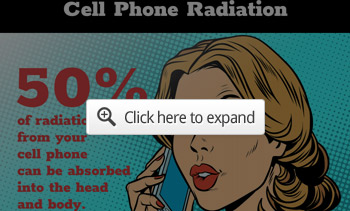
SAR is a measure of how much RF energy your body will absorb from the device when held at a specific distance from your body (ranging from 5 to 15 mm, depending on the manufacturer). It’s important to realize that the SAR value is not an indication of overall safety. As explained by the Federal Communications Commission (FCC):2
“Many people mistakenly assume that using a cellphone with a lower reported SAR value necessarily decreases a user’s exposure to RF emissions, or is somehow ‘safer’ than using a cellphone with a high SAR value.
While SAR values are an important tool in judging the maximum possible exposure to RF energy from a particular model of cellphone, a single SAR value does not provide sufficient information about the amount of RF exposure under typical usage conditions to reliably compare individual cellphone models.
Rather, the SAR values collected by the FCC are intended only to ensure that the cellphone does not exceed the FCC’s maximum permissible exposure levels even when operating in conditions which result in the device’s highest possible — but not its typical — RF energy absorption for a user.”
Why SAR Ratings Are Terribly Flawed…
How to Limit Your RF Exposure
While saying there’s no cause for concern, Health Canada still recommends replacing calls with texts, using hands-free devices and limiting use for children if you’re concerned about potential effects.
The U.S. has taken an identical approach. The U.S. Food and Drug Administration says that while any potential risk is “probably very small,” you can reduce your RF exposure by limiting the amount of time you spend on your cellphone and using the speaker or a headset to create more distance between the phone and your head.38
There’s no doubt in my mind that RF exposure from cellphones and other wireless devices is a significant hazard to your health that will damage your DNA and contribute to chronic disease and premature aging. It needs to be addressed if you’re concerned about your health, and that of your family.
To protect yourself and your family from cellphone radiation and other sources of harmful electromagnetic fields, consider taking the following precautions:
Avoid carrying your cellphone on your body unless in airplane mode and never sleep with it in your bedroom unless it is in airplane mode. Even in airplane mode it can emit signals, which is why I put my phone in a Faraday bag.39
When using your cellphone, use the speaker phone and hold the phone at least 3 feet away from you.
Seek to radically decrease your time on the cellphone. Instead, use VoIP software phones that you can use while connected to the internet via a wired connection.
Connect your desktop computer to the internet via a wired Ethernet connection and be sure to put your desktop in airplane mode. Also avoid wireless keyboards, trackballs, mice, game systems, printers and portable house phones. Opt for the wired versions.
If you must use Wi-Fi, shut it off when not in use, especially at night when you are sleeping. Ideally, work toward hardwiring your house so you can eliminate Wi-Fi altogether. If you have a notebook without any Ethernet ports, a USB Ethernet adapter will allow you to connect to the internet with a wired connection.
Shut off the electricity to your bedroom at night. This typically works to reduce electrical fields from the wires in your wall unless there is an adjoining room next to your bedroom. If that is the case you will need to use a meter to determine if you also need to turn off power in the adjacent room.
Use a battery-powered alarm clock, ideally one without any light. I use a talking clock for the visually impaired.40
If you still use a microwave oven, consider replacing it with a steam convection oven, which will heat your food as quickly and far more safely.
Avoid using “smart” appliances and thermostats that depend on wireless signaling. This would include all new “smart” TVs. They are called smart because they emit a Wi-Fi signal and, unlike your computer, you cannot shut the Wi-Fi signal off. Consider using a large computer monitor as your TV instead, as they don’t emit Wi-Fi.
Refuse smart meters as long as you can, or add a shield to an existing smart meter, some of which have been shown to reduce radiation by 98 to 99 percent.41
Consider moving your baby’s bed into your room instead of using a wireless baby monitor. Alternatively, use a hard-wired monitor.
Replace CFL bulbs with incandescent bulbs. Ideally remove all fluorescent lights from your house. Not only do they emit unhealthy light, but more importantly, they will actually transfer current to your body just being close to the bulbs.
Be seeing you
 MCViewPoint
Leave a comment