Israel is refusing to allow aid in through one of its border crossings with Gaza, making it unlikely 200 aid trucks per day will be able to enter the Strip
Biden administration officials told The Times of Israelthat they don’t believe Israel can live up to its commitment to allow 200 aid trucks to enter Gaza per day during the pause that’s part of the hostage deal with Hamas.
The officials said Israel is refusing to open its Kerem Shalom crossing with Gaza during the four-day pause or at any time after. With only Egypt’s Rafah crossing available, 200 aid trucks will unlikely be able to enter per day.
When Israel unleashed its bombing campaign after the October 7 Hamas attack, it initially refused to allow any aid to enter Gaza. After agreeing to let some in, Israel required aid trucks first to be inspected in Egypt, then inspected at an Israeli crossing before being sent to Rafah to enter Gaza.
The extra steps have slowed down the limited aid that’s entering Gaza, and only a few times since deliveries resumed have aid groups reached their goal of getting 100 trucks into the enclave in a day. US officials have said there’s no indication Israel will open its Kerem Shalom crossing during the truce, putting the hostage deal in peril.
And now comes young St. Greta. She’s proof of the ignorance of children. But, more importantly, she illustrates the stupidity of the public, who are apparently willing to believe a kid devoid of experience, expertise, or even a reasonable education. It’s actually a laugh riot when she gives a lecture to adults for having ruined her childhood.
International Man: Throughout history, governments have always used propaganda to drum up support for war. Often, their atrocity propaganda features children to get the maximum emotional response.
For example, during World War 1, the US media whipped up a frenzy by claiming that the Germans were bayoneting Belgian babies. The atrocities never happened.
In the run-up to the Gulf War in 1991, Americans were told that Iraqi soldiers were ripping babies from incubators in Kuwaiti hospitals. President George H.W. Bush later repeated the story. It was a pivotal event that increased support for the war. Later, the incident was revealed to be fake, and the woman making the claims was the daughter of the Kuwaiti ambassador to Washington, someone who had a motive to get the US involved in the war.
More recently, the media told us about the Palestinian Hamas beheading 40 Israeli babies. President Joe Biden repeated the incident. It was later revealed not to have occurred.
These are just a few examples of this propaganda tactic.
What is your take on all of this?
Doug Casey: It’s long been said, quite correctly, that “The first casualty in war is truth.” Especially when it comes to war reporting, you never know what to believe. It’s impossible to separate truth from propaganda most of the time. Emotion almost always triumphs over reason.
Americans are particularly vulnerable to emotional arguments because they always see themselves as the “good guys.” Although their interventions almost always made things worse—starting with the US fomenting the Spanish-American War, then prolonging World War I and setting up the conditions for World War II. Foreign disasters have gotten worse since—in Korea, Vietnam, Afghanistan, and Iraq.
Now, in the Ukraine and Gaza. And lots of others on the runway. Americans are particularly vulnerable to seeing themselves as saviors when they should just mind their own business.
Nevertheless, it is reform and replace that is their cry, not repeal. But what is really unfortunate is that some libertarians have adopted the same approach. They confuse making the welfare state more effective and efficient with advancing liberty and libertarianism.
The federal government contains a myriad of agencies, bureaus, corporations, offices, commissions, administrations, authorities, and boards, most of which are organized under 15 cabinet-level, executive-branch departments headed by a secretary: for example, Health and Human Services, Housing and Urban Development, Homeland Security, Agriculture, and Education. The Executive Office of the President (EOP) contains agencies that support the work of the president: for example, the National Security Council (NSC), the Council of Economic Advisors (CEA), the Office of Management and Budget (OMB), the Office of National Drug Control Policy (ONDCP), and the Office of the United States Trade Representative (USTR).
And then there are the many independent executive and regulatory agencies of the federal government: for example, the Social Security Administration (SSA), the Environmental Protection Agency (EPA), the Equal Employment Opportunity Commission (EEOC), the National Aeronautics and Space Administration (NASA), the National Endowment for the Arts (NEA), the Federal Communications Commission (FCC), the Small Business Administration (SBA), the National Security Agency (NSA), and the Central Intelligence Agency (CIA).
The number of federal programs and regulations are incalculable.
One result of all of this is a vast welfare state, as pointed out by the late Walter Williams, professor of economics for many years at George Mason University:
Tragically, two-thirds to three-quarters of the federal budget can be described as Congress taking the rightful earnings of one American to give to another American — using one American to serve another. Such acts include farm subsidies, business bailouts, Social Security, Medicare, Medicaid, food stamps, welfare, and many other programs.
But with the Constitution in focus, things are even worse than that. Writing recently at the American Thinker, J. B. Shurk pulls no punches:
The plain meaning of the U.S. Constitution and the Founding Fathers’ copious essays and personal correspondence all attest to their intention to keep the federal government small, limited in authority, and deferential to the states. Instead, we have today the largest, most expensive, most powerful central government that has ever existed on Planet Earth. No detail of an American’s life is too small for the federal government not to regulate;… If we were still abiding by the Constitution, then 99 percent of today’s federal government would be chucked to the bottom of the Potomac.
What, then, can be done about this?
Conservatives think they have the answer. And they think that if they recite their mantra of the Constitution, limited government, individual freedom, private property, and free enterprise enough times, people will take their proposals seriously. Nevertheless, it is reform and replace that is their cry, not repeal. But what is really unfortunate is that some libertarians have adopted the same approach. They confuse making the welfare state more effective and efficient with advancing liberty and libertarianism.
So when it is all said and done, anyone expecting electricity prices to come down due to the wonders of “free wind” is in for a nasty surprise. This ultimately is going to lead to higher electricity prices and that is higher inflation, higher interest rates, and everything thereafter.
It seems that each week that goes by we come up with variations of the same themes, one of which is supply destruction and restriction of fossil fuels. For want of doubt check out the latest garbage from Deutsche Bank. It seems that the energy crisis of last year taught them nothing. Without coal, where would Germany be?
Deutsche Bank’s actions are nothing short of malthusian (depopulation):
Deutsche Bank AG is expanding restrictions on its financing of coal, one of the main sources of energy in its home market of Germany, as part of a wider crackdown on high-emitting sectors.
Companies that have “no credible plans” to reduce thermal coal’s contribution to their revenue below half by 2025 will see their financing cut off, the Frankfurt-based bank said in its initial transition plan, published on Thursday. For companies operating outside the OECD, the revenue threshold is 30% by 2030.
For coal, Deutsche’s target covers both thermal and metallurgical coal and builds on an existing thermal coal policy. The bank is aiming for a 49% cut in absolute terms in the broadest measure of financed emissions — known as Scope 3 — by 2030. By 2050, its goal is a 97% reduction. In cement the bank is targeting a 29% reduction in Scope 1 and 2 physical emissions intensity by 2030, and a 98% reduction by 2050.
We say contradiction because without met coal you don’t have any steel, and without coal you don’t have any cement (thermal coal is mainly used in the cement manufacturing process). And without thermal coal you don’t have any electricity… and without electricity you don’t have any aluminium (amongst other base metals) or polysilicon.
Cutting a long story short: without coal you cannot produce renewable energy producing equipment.
But wait, this story becomes even more logic defying. From a bloomberg article:
Here is an excerpt from the EU Commission press release:
Achieving the recently agreed EU target of at least 42.5% renewable energy by 2030, with an ambition to reach 45% renewables, will require a massive increase in wind installed capacity with an expected growth from 204 GW in 2022 to more than 500 GW in 2030.
Can this be achieved?
Well, miracles have been known to happen from time to time:
Eugene Bertram Krupa (January 15, 1909 – October 16, 1973),[1] was an American jazzdrummer, bandleader and composer.[2][3] Krupa is widely regarded as one of the most influential drummers in the history of popular music. His drum solo on Benny Goodman‘s 1937 recording of “Sing, Sing, Sing” elevated the role of the drummer from an accompanist to an important solo voice in the band.
In collaboration with the Slingerland drum and Zildjian cymbal manufacturers, he was a major force in defining the standard band drummer’s kit. Krupa is considered “the founding father of the modern drumset” by Modern Drummer magazine.[4]
Upon his death, The New York Times labeled Krupa a “revolutionary” known for “frenzied, flashy” drumming, with his work having generated a significant musical legacy that started “in jazz and has continued on through the rock era.”[5] – Wikipedia
When Benny Goodman first hired Krupa he was put at the back of the bandstand. The standard place for the drummer. That didn’t last long.
This morning, my dog Loki — who has a puppy heart still at 14 months, and will no doubt always have a puppy temperament, whatever his age —stepped out into Thanksgiving morning; into the upstate New York, rural, outside world.
He walked onto the porch of the house where we are staying, as if he was witnessing the most extraordinary miracle. He paused and gazed in evident wonderment. Blue sky, arcing overhead! The slope of the earth down to a little valley! Slow silvery river meandering at the bottom of it; foothills in the distance, covered in trees now bare of leaves! Astonishing.
There is a cemetery to our left, with headstones going back to the early 19th century. It is still active; week by week earth-moving machines still prepare to lay to rest the fathers and mothers of this long-established small-town community, who have passed. There are Mardi Gras beads draped onto some of the headstones, a touch I find hopeful and comforting. Some gravestones are decorated with American flags; perhaps these were veterans. Some now have small pumpkins nestled against them, and some have artificial poinsettias, adorning them early, preparatory to Christmas. Love, clearly, carries on; among us, as in every culture, we long to include the beloved dead in the celebrations that mark our lives.
There is the white 19th century wooden church in the midst of the cemetery, with its spire lifting to heaven; it is now a sculptors’ studio, which is also oddly comforting; rather than God’s house having fallen into emptiness and disrepair, God’s house now shelters people creating beauty for His human family.
The bushes outside are rust-brown now, but studded throughout with enamel-like scarlet pods, like jewelry. The formerly crimson Japanese Maple has shed its leaves, and reaches bare black arms to the clear blue sky.
I can’t imagine the scene entirely through puppy eyes, but I understand Loki’s incredulity: through human eyes, too, yes, it is all a wonder.
I turned with Loki and headed into the grassy slope to the left of the house, now planted with mature trees. The hillside had been bare, we were told, when the people who built this house and planted these trees forty years ago, made their start. The couple who made the decisions to plant — especially the wife, whose vision had directed the placement of the trees, and who had nurtured the cozy but elegant garden; who had put a small sculpture of an angel in the center of a walkway between beds of now-dormant lavender — have both passed away. There is a stone bench that reads “Gone But Not Forgotten”, and a grieving stone angel near it, both devoted to their memory, under the sheltering trees.
When I walk under these trees, I think with gratitude of them both, though I have never met them. They are not here to see how much beauty they have left behind them for others to enjoy, but their legacy is extraordinary. I believe the husband was a New York City police officer, who then retired; I believe the wife was a homemaker. They were not handed privilege, but they nonetheless accomplished remarkable things. By planting trees on this bare hillside, by believing in growth, by believing in their own powers to shape their world; by having a vision and pursuing it; by building a house and planting a garden, by placing a stone angel among lavender beds, they created a magical world that lives on, that affects the living, that will inspire people who visit this place, into the future.
Loki dove into the grassy stretch under the trees, delirious with happiness. He leapt and leapt into the light and shadow as if into the spray of an an ocean. He looked back at me: that was my signal to run. When I run (and yes, I am running again with Loki, more carefully, now that I have recovered from my fall), he is all joy, all speed, all pure instinct of movement. He darted; he couldn’t believe it. Piles of fallen orange leaves to smell! Animal scents! Squirrels! He dashed this way and that, and I did my best to keep up the race behind him.
At one point he paused and looked back at me again. Behind him, about thirty feet away, I saw a stag emerge from just past an ancient low stone wall. The stag rose up like an apparition. He had a flare of white on his chest, powerful buff-colored shoulders, and a noble neck; he lifted his elegant head to gaze directly at me. His antlers, not yet large – he must have been young – were like a crown. I was not afraid, and he seemed not to be afraid. We beheld one another in perfect calm.
Now well-ensconced in my eighth decade, I can recall many memorable Thanksgiving dinners, more than a few cooked up lovingly by yours truly. The best and most memorable, however, were rooted in the 1960s.
My father had moved the family out to Mill Valley, California, just north of the Golden Gate, in the gentle shadow of Mt. Tamalpais, so he could pursue his career as a baseball writer in the luminous shadow of the great Willie Mays. He covered the Giants for the Examiner, first at Seals Stadium in the Mission District, then — a couple of years later — at Candlestick Park in South San Francisco, perhaps history’s worst place to watch history’s greatest ballplayer.
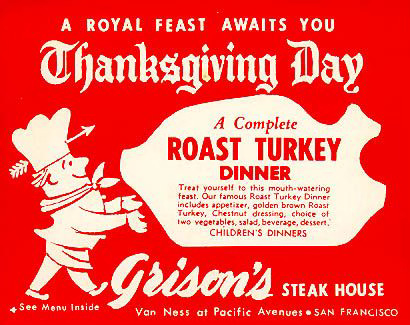
In the offseason Dad worked as the Examiner’s Entertainment Editor, and it was in this capacity that he encountered Bob Grison, a great San Francisco restauranteur, proprietor and founder of Grison’s Steak and Chop House, all mahogany, white linen, and brass upholstery tacks, with an easy elegance that fit my father’s pedestrian ballpark sensibilities like an old brown shoe.
Everything about Grison’s — including the standard menu…
…was timeless, and it was here my family dined each Thanksgiving for several years in the early 1960s…
The long‐awaited text of Senator Bill Cassidy’s (R‑LA) legislation to impose a tax on imports based on “pollution intensity” was released on November 3. Fisher’s previous piece highlighted how Senator Cassidy’s concept of a “foreign pollution fee” is 1) a carbon tax on imports, 2) will hurt American consumers, and 3) lays the groundwork for a domestic carbon tax. Unfortunately, those facts remain upon inspection of the bill.
Senator Lindsey Graham (R‑SC) is a sponsor of the bill but Senator Roger Wicker (R‑MS), the other original co‐sponsor of the legislation, withdrew his endorsement.
We’ve read the 92 pages of the Foreign Pollution Fee Act of 2023 (hereinafter referred to as the Cassidy Carbon Tax) so our audience doesn’t have to. There are several areas of grave concern, much of which relate to provisions in the bill that were not apparent in Senator Cassidy’s Foreign Affairsarticle, which explained the concept in broad strokes.
Israel’s best move is an immediate ceasefire. But it can’t see this through the hateful haze of its tilt. The IUSG could stop the madness with a phone call, but it prefers to keep the casino of death running full tilt.
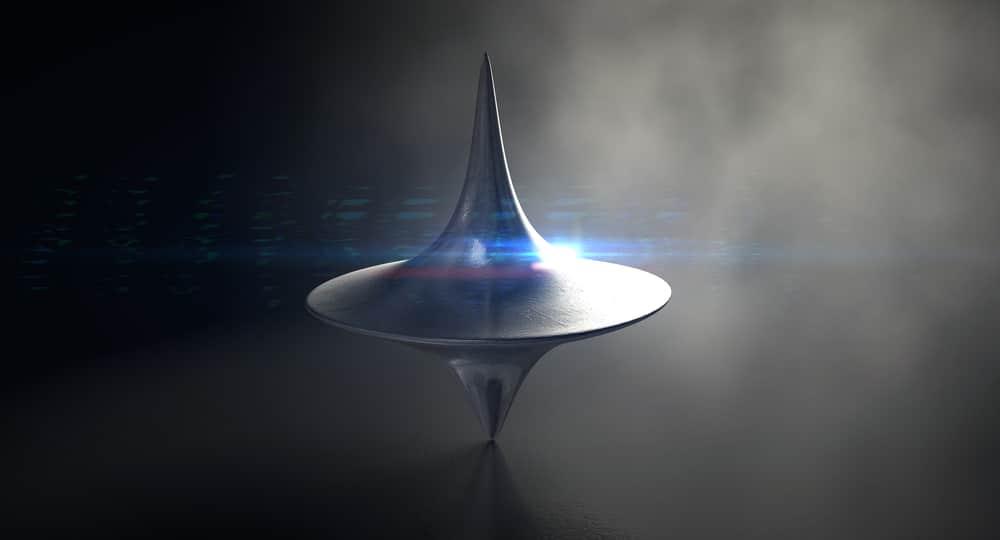
A slightly scratched die-cast lead spinning top in an upright position on a dark background with an eerie backlight.
The Imperial U.S. Government (IUSG) and its “greatest ally,” the state of Israel, are in full psychotic & psychopathic Tilt. Together, these governments are confronting the entire planet as they reinforce each other’s fundamental and inverse mythologies.
Tilt is a phenomenon in which agents lose control of their emotions and begin making bad decision after bad decision. It is commonly associated with poker, which is fitting since our imperial elites are gambling with our civilization and the very existence of the human species.
The U.S. government began tilting hard during the Aerican Civil War and throughout the nineteenth and early twentieth centuries. But it went into perpetual tilt following World War II when it embraced global empire.
Bad decisions were made, including the Korean War, the 1953 Iranian coup, the Vietnam War, mass surveillance of Americans, and reckless and irresponsible nuclear brinksmanship with the Soviet Union.
Upon the collapse of the Soviet Union, the IUSG went into entitlement tilt. It was time to do whatever it wanted because no one could stop it! All grounding in Realpolitick was thrown aside in favor of liberal interventionist and neoconservative psychoses.
More bad decisions were made, such as Desert Storm, dual containment, Waco, backing Islamist terrorists in Bosnia, Kosovo, and Chechnya, escalated Iran demonization, and NATO expansion.
When blowback came with the Al Qaeda terrorist attacks of September 11, 2001, the IUSG descended into revenge tilt.
The IUSG, embarrassed by the massive security failure of 9/11 and emboldened by the resulting popular support, pursued its own geopolitical fantasies. It made more bad decisions.
When the great majority of the people do this, the country thrives economically. The greater the economic freedom (i.e., the less governmental oversight and regulation), the more the country thrives.
But this never lasts forever. The eternal fly in the ointment is that governments seek continually to increase their control over others.
Like waves on the ocean, countries tend to go through economic cycles.
First, we have the micro cycles, which tend to rise and fall every few years, but may last a decade or more. Then we have the macro cycles, which tend to take hundreds of years.
In a macro cycle, a nation begins to thrive economically, when the people of that country adhere to a strong work ethic. They invest their money and toil into the economy, make a profit, then either save, purchase goods, reinvest, or a combination of the three.
When the great majority of the people do this, the country thrives economically. The greater the economic freedom (i.e., the less governmental oversight and regulation), the more the country thrives.
But this never lasts forever. The eternal fly in the ointment is that governments seek continually to increase their control over others.
First, they focus on the increased control of their own people through regulations, but invariably, they see the opportunity for broader control, through the domination of other nations. They then invade those nations.
Warfare is the costliest venture that nations enter into, and as such, it’s almost always a mistake. But the zeal to have greater power often brushes that fact aside, and leaders choose to invade other nations.
In almost every instance, they fail to underestimate the resistance from the invaded nation, and very quickly, the cost of the warfare doubles and redoubles, over and over again.
Invariably, the leaders then borrow money to keep the war going. Sometimes, they achieve victory in this manner, but more often than not, they fail. They find that the day comes when they must either sell off major assets to pay their debt, or face economic collapse.







 MCViewPoint