On the contrary, the events in Germany between 1933 and 1943 had shown him that perfectly intelligent people were, under the pressure of political power and propaganda, rendered stupid—that is, incapable of critical reasoning.
In 1943, the Lutheran pastor and member of the German resistance, Dietrich Bonhoeffer, was arrested and incarcerated in Tegel Prison. There he meditated on the question of why the German people—in spite of their vast education, culture, and intellectual achievements—had fallen so far from reason and morality. He concluded that they, as a people, had been afflicted with collective stupidity (German: Dummheit).
He was not being flippant or sarcastic, and he made it clear that stupidity is not the opposite of native intellect. On the contrary, the events in Germany between 1933 and 1943 had shown him that perfectly intelligent people were, under the pressure of political power and propaganda, rendered stupid—that is, incapable of critical reasoning. As he put it:
Stupidity is a more dangerous enemy of the good than wickedness. Evil can be protested against, exposed, and, if necessary, it can be prevented by force. Evil always harbors the germ of self-destruction by inducing at least some uneasiness in people. We are defenseless against stupidity. Nothing can be done to oppose it, neither with protests nor with violence. Reasons cannot prevail. Facts that contradict one’s prejudice simply don’t need to be believed, and when they are inescapable, they can simply be brushed aside as meaningless, isolated cases.
In contrast to evil, the stupid person is completely satisfied with himself. When irritated, he becomes dangerous and may even go on the attack. More caution is therefore required when dealing with the stupid than with the wicked. Never try to convince the stupid with reasons; it’s pointless and dangerous.
middle ground fallacy (the correct position between “Drink a gallon of bleach daily for good health” and “Drink zero bleach daily for good health” is not “Drink half a gallon of bleach daily for good health”)
In truth the so-called “centrists” or “moderates” of our world are really violent extremists, because they support the most murderous and tyrannical power structure on our planet, and are only regarded as moderate because they sit in the mid-range of a completely artificially created spectrum.
In reality the assumption that the truth exists anywhere in either of the two mainstream political viewpoints promoted by the managers of the western empire is an example of the bandwagon effect, which describes the cognitive bias in which humans tend to take on beliefs, behaviors, styles and attitudes solely because that’s what the people…
One of the worst mistakes you can make when formulating your understanding of the world is to begin with the assumption that the truest and most accurate position must lie somewhere near the center of the two major political perspectives you see laid out all around you.
It’s a mistake not only because assuming that the center position must be the best one is a type of fallacious reasoning known as the middle ground fallacy (the correct position between “Drink a gallon of bleach daily for good health” and “Drink zero bleach daily for good health” is not “Drink half a gallon of bleach daily for good health”); it’s also a mistake because the entire framing arises from a situation that has been artificially engineered by the powerful.
It’s a well-documented fact that the rich and powerful pour vast fortunes into manipulating the political and media landscape in ways that serve their interests. Their control over the news media and Silicon Valley tech platforms is used to set the agenda and influence public perception by determining what issues will receive attention and which won’t in ways that preserve the political status quo they’ve built their empire upon, thereby shrinking the Overton window of acceptable debate down to a very narrow spectrum whose outcomes can’t threaten their interests in any way.
“Normal human beings – whose brains haven’t been turned to clam chowder by propaganda from either mainstream faction – would much prefer to avoid giant world-threatening confrontations between any nuclear-armed nations.” https://t.co/mUIQO8eLzc
We just discussed this dynamic with regard to US aggressions against Russia and China; the Overton window is being narrowed to a debate between which US enemy should be the target of the most imperial aggressions, with voices who advocate detente with both countries finding no platform in mainstream politics or media. This is what Noam Chomsky was talking about when he said “the smart way to keep people passive and obedient is to strictly limit the spectrum of acceptable opinion, but allow very lively debate within that spectrum.”
People assume there must be truth in the mainstream worldview because so many others are invested in the mainstream worldview, when really the only reason that worldview is mainstream in the first place is because so much wealth and influence has gone into making it mainstream. In reality the assumption that the truth exists anywhere in either of the two mainstream political viewpoints promoted by the managers of the western empire is an example of the bandwagon effect, which describes the cognitive bias in which humans tend to take on beliefs, behaviors, styles and attitudes solely because that’s what the people around them are doing.
This bias would have had evolutionary advantages early on in our development as a species.
But while Ukraine can receive over $100 billion to fight a war they can’t win and let their oligarchs line their pockets with our money so they can go on vacations like Biden, FEMA has promised the wildfire victims a one-time $700 check.
$700 to rebuild your life from scratch, and Joe Biden is holding every extra penny hostage until Kiev gets its cut of the federal budget.
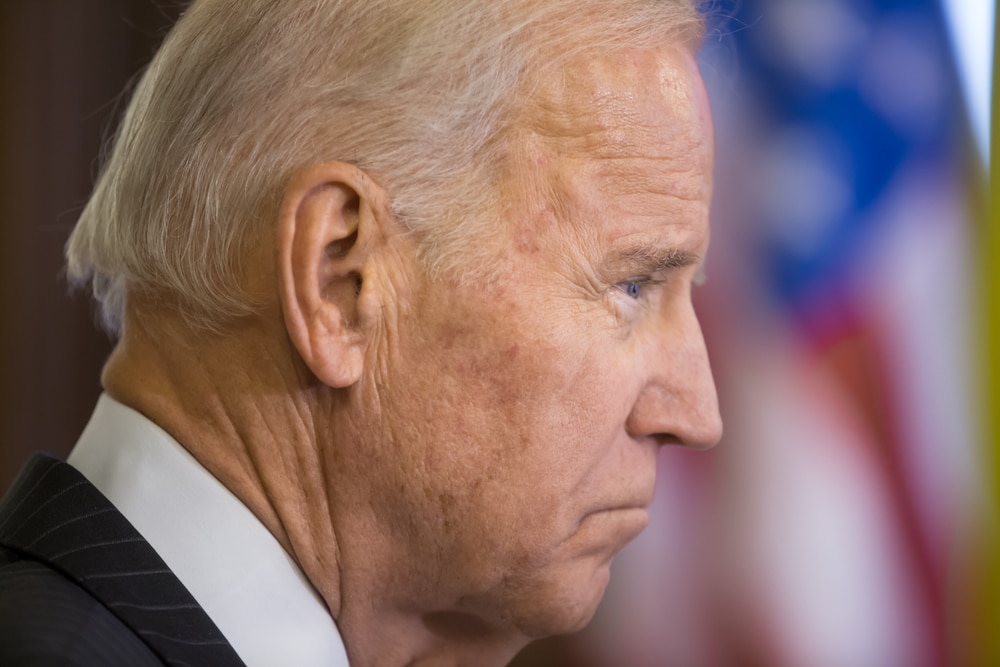
KIEV, UKRAINE – Jan 16, 2017: Vice president of USA Joe Biden during his visit to Kiev and meeting with President of Ukraine Petro Poroshenko
Less than two weeks ago a devastating wildfire engulfed the Hawaiian island of Maui, particularly the historic city of Lahaina.
Over one hundred people are confirmed dead, and more than a thousand are still missing. Blackened earth and soot scar what was once a beautiful and tropical paradise.
Error has compounded error in disaster response, with people on the ground still unable to return and discover what remains of their homes.
A lack of transparency, and the stonewalling of outside observers has led to appropriate suspicion about how high the blame goes.
I’ll let former Hawaii Rep. Tulsi Gabbard, who is currently activated on reserve duty, explain more. She told Glenn Beck on The Blaze:
“It’s unfortunate there has been so little communication going through official channels…there’s been a vacuum of communication and as you know in that vacuum a lot of questions and a lot of fears and concerns arise.”
Furthermore, she told Laura Ingraham on Fox News:
“I’m in constant touch with these community members and leaders, they are still not seeing response from the county, the state, the federal government to be able to go out and help them. The community support hubs that they have are 100% community led, volunteer supply collections, conducting all of these coordinations on their own. They feel like the government doesn’t care about them.”
My entire team at Bring Our Troops Home is praying for recovery in Maui and for the wonderful people of Hawaii.
The Biden administration slammed Turkey’s collaborators for anti-Kurdish crimes in Syria — including raping and torturing civilians.
The U.S. State Department publicly rebuked Turkey in 2021 for the child soldier recruitment. A few weeks later, the U.S. Treasury announced sanctions against Ahrar al-Sharqiya for abuses against Kurdish civilians.
This time around, the Biden administration is not pointing the finger at the Turkish government. U.S.-Turkish relations have warmed in recent months, as the West courts Turkey’s support against Russia. The White House is also looking to sell F-16 fighter jets to the Turkish military.
Apparently we haven’t won their hearts and minds so we must burn their village. Just a glitch in the continuing oil and pipeline control …err…foreign policy success story.
The Biden administration has imposed human rights sanctions on the Hamza Division, a formerly U.S.-backed rebel group in Syria that now fights against Kurds alongside the Turkish army. The sanctions, announced last week, also apply to the Suleiman Shah Brigade, a Turkish-backed militia whose leader has ties to CIA-backed rebels.
The two militias are accused of crimes including pillage, rape, kidnapping, and torture in Afrin, a Kurdish-majority district of Syria.
The Syrian Interim Government, which represents the two militias, said in a statement that the sanctions were “a result of deliberate defamation campaigns…based on reports issued by non-neutral organizations.” It claimed to be investigating any allegations of abuse internally. Militia members reportedly held a rally in Afrin and shouted, “may America fall and may Biden fall!”
In the space of a decade, Washington has gone from training the Hamza Division to blacklisting it. The sanctions are also part of a mixed message to U.S. ally Turkey. Less than a month ago, the U.S. State Department had denied that Turkey was committing ethnic cleansing against Syrian Kurds. Now the Biden administration is targeting the Hamza Division and the Suleiman Shah Brigade, both of which have a close relationship to the Turkish intelligence services.
The United States first levied sanctions against one Turkish backed militia in 2021. However, those sanctions targeted Ahrar al-Sharqiya, a group that had never received U.S. support and had a notoriously bad relationship with American troops. The Hamza Division and Suleiman Shah Brigade, on the other hand, have a long history of cooperation with Washington.
The U.S. military had once provided training and $8.8 million in cash to the Hamza Division, as part of an effort to enlist Syrian rebels in the fight against the Islamic State. Hamza Division leader Sayf Abu Bakr and Suleiman Shah Brigade founder Mohammad Abu Amsha had both moved through the ranks of rebel groups that received American weapons through a parallel CIA program to undermine the Syrian government.
U.S. support for the Syrian uprising dried up during the Trump administration. In the years since, some rebels have gone from trusted U.S. partners to “thugs, bandits and pirates” in the eyes of U.S. officials.
In early 2018, the Turkish military recruited several Syrian rebel groups to participate in the invasion of Afrin, a Kurdish-majority district of Syria. Turkey launched a second invasion of Syria in October 2019, using the same Syrian militias to once again take territory from Kurdish-led rebels.
The Trump administration had publicly shrugged its shoulders at Turkey’s 2018 invasion, and initially gave a green light to the 2019 invasion. After members of Congress accused the Trump administration of “betraying” the Kurds — who had also received U.S. military support — the White House helped negotiate a ceasefire.
The Turkish military stayed in the areas it had conquered. So did the Hamza Division, the Suleiman Shah Brigade, and Ahrar al-Sharqiya, who have all earned a reputation for brutality against Kurdish civilians. These militias reportedly extort civilians, pillage property, kidnap women, and commit sexual abuses. Abu Amsha, leader of the Suleiman Shah Brigade, is accused of raping one of his subordinates’ wives.
Turkish president Recep Tayyip Erdoğan has made the purpose of the occupation clear. At the outset of the 2018 invasion, he declared that Kurds are an alien presence in Afrin, which must be given back to its “rightful owners.” Speaking to the UN General Assembly in September 2019, he held up a map of Syria and laid out a plan to resettle 1 to 2 million refugees — mostly non-Kurds — in Kurdish-majority areas.
Finally, Kates makes another intriguing point: that a society where peaceful citizens are armed is far more likely to be one where Good Samaritans who voluntarily go to the aid of victims of crime will flourish. But take away people’s guns, and the public — disastrously for the victims — will tend to leave the matter to the police. Before New York State outlawed handguns, Good Samaritan instances were far more widespread than now.
Gun prohibition is the brainchild of white middle-class liberals who are oblivious to the situation of poor and minority people living in areas where the police have given up on crime control. Such liberals weren’t upset about marijuana laws, either, in the fifties when the busts were confined to the ghettos.
If, as libertarians believe, every individual has the right to own his person and property, it then follows that he has the right to employ violence to defend himself against the violence of criminal aggressors. But for some odd reason, liberals have systematically tried to deprive innocent persons of the means for defending themselves against aggression. Despite the fact that the Second Amendment to the Constitution guarantees that “the right of the people to keep and bear arms shall not be infringed,” the government has systematically eroded much of this right. Thus, in New York State, as in most other states, the Sullivan Law prohibits the carrying of “concealed weapons” without a license issued by the authorities. Not only has the carrying of guns been grievously restricted by this unconstitutional edict, but the government has extended this prohibition to almost any object that could possibly serve as a weapon — even those that could only be used for self-defense. As a result, potential victims of crime have been barred from carrying knives, tear-gas pens, or even hat pins, and people who have used such weapons in defending themselves against assault have themselves been prosecuted by the authorities. In the cities, this invasive prohibition against concealed [p. 115] weapons has in effect stripped victims of any possible self-defense against crime. (It is true that there is no official prohibition against carrying an unconcealed weapon, but a man in New York City who, several years ago, tested the law by walking the streets carrying a rifle was promptly arrested for “disturbing the peace.”) Furthermore, victims are so hamstrung by provisions against “undue” force in self-defense that the criminal is automatically handed an enormous built-in advantage by the existing legal system.
It should be clear that no physical object is in itself aggressive; any object, whether it be a gun, a knife, or a stick, can be used for aggression, for defense, or for numerous other purposes unconnected with crime. It makes no more sense to outlaw or restrict the purchase and ownership of guns than it does to outlaw the possession of knives, clubs, hatpins, or stones. And how are all of these objects to be outlawed, and if outlawed, how is the prohibition to be enforced? Instead of pursuing innocent people carrying or possessing various objects, then, the law should be concerned with combatting and apprehending real criminals.
There is, moreover, another consideration which reinforces our conclusion. If guns are restricted or outlawed, there is no reason to expect that determined criminals are going to pay much attention to the law. The criminals, then, will always be able to purchase and carry guns; it will only be their innocent victims who will suffer from the solicitous liberalism that imposes laws against guns and other weapons. Just as drugs, gambling, and pornography should be made legal, so too should guns and any other objects that might serve as weapons of self-defense.
One of the most brilliant propaganda maneuvers the managers of the US empire have pulled off lately is splitting the debate over US military policy along partisan lines, with one side supporting aggressions against Russia and the other preferring to focus aggressions on China. In this way they’ve ensured that mainstream discourse remains an argument over how US warmongering should occur, rather than if it should.
Senator Bernie Sanders has a new article out in The Guardian titled “The US and China must unite to fight the climate crisis, not each other,” in which he argues in favor of de-escalation measures comparable to those reached between Washington and Moscow after the Cuban Missile Crisis.
“Instead of spending enormous amounts of money planning for a war against each other, the US and China should come to an agreement to mutually cut their military budgets and use the savings to move aggressively to improve energy efficiency, move toward sustainable energy and end our reliance on fossil fuels,” Sanders argues.
Which is a fine sentiment as far as it goes, and it’s not the first time Sanders has expressed this view; last month in The Guardian he argued that the US government should be focused on resolving the climate crisis “instead of fomenting a new cold war with China.” But it’s worth noting that while acting as a dovish detente proponent with regard to China, Sanders has for years been acting as a hawkish cold warrior with regard to Russia.
Naturally, law enforcement officers rarely face any sanctions for their failures to bother themselves with private property, life, or limb. The federal courts have made it clear that law enforcement officers are not obligated to actually protect the public. In other words, the taxpayers must always pay taxes to hold up their end of the imagined “social contract” or face fines and imprisonment. But the other side of that “contract,” the state, has no legal obligation to make good on its end. This, of course, is not how real contracts work.
In all the media and regime frenzy over the Janaury 6 riots and the Pentagon Leaker in recent months, it is interesting to examine the contrast between how the regime treats “crimes” against its own interests, and real crime committed against ordinary private citizens.
Witness, for example, how the Biden administration and corporate media have treated the January 6 riot as if it were some kind of military coup, demanding that draconian sentences be handed down even to small-time vandals and trespassers. Regime paranoia has led the Justice Department to ask for a 30-year sentence for Enrique Tarrio, a man who was convicted of the non-crime of “seditious conspiracy” even though he wasn’t even in Washington on January 6. In recent months, Jacob Chansley, the “QAnon Shaman,” received a sentence of three-and-a-half years, even though prosecutors admit he did nothing violent. Riley Williams was given three years for simply trespassing in Nancy Pelosi’s office. Members of the Capitol Police force have been lionized in the media as great protectors of “sacred” government buildings, and any threat to the property or persons of Washington politicians has been equated with an assault on “democracy.”
Profit’s bad reputation is unearned, But it’s not true that only sellers can make a profit. Buyers do also, though in a non-financial sense, because they prefer the thing they obtain to the money’s alternative use. Moreover, to the extent that they pay less for an item than they were willing to pay, buyers make an additional profit.
P&G, the maker of popular household brands like Tide and Downy laundry products, is giving away $10,000 in college scholarships. That’s $1.5 million and 150 scholarships in all. My problem, aside from its encouraging college attendance, is with how the company is promoting the program. The television ads proclaim that the company sees the scholarships as a way of “giving back.” I’ve written about this before, but some further thoughts might be useful.
So, to whom does P&G wish to give back? Not to existing customers exclusively. The only eligibility requirements are U.S. residency, a minimum age of 16, enrollment in or acceptance by an undergraduate program, and free registration at P&G’s website. The online application does ask applicants if they are first-generation college students and where they do their laundry, which sounds creepy. The program is called a “sweepstakes”, and multiple entries are apparently allowed, so the winners are apparently picked randomly. The winners’ checks will be sent to the schools.
The “payback” angle that P&G touts will sound good to many people. (“Aw, that’s so nice.”) I suppose P&G never even considered entries by saying:
Because we at P&G are always looking for ways to increase our profits by creating goodwill, keeping our current customers from looking at rival products, and luring new customers from our competitors, we are giving away 150 scholarships worth $10,000 each. We’d prefer you to just buy our great products, but if that’s what it takes to get good publicity, so be it. Enter today!
That would offend too many people, though pro-market and pro-free-enterprise people like me would be approvingly amused. Why call it “giving back”? Unearned guilt, what’s why.
Adam Smith famously wrote that we do not believe the grocer puts food on the shelves because they are nice people (which of course they may well be). They do it because that’s how they earn a living. Smith wasn’t being pedantic. He was acknowledging that shoppers already know this. He writes, “We address ourselves, not to their humanity but to their self-love, and never talk to them of our own necessities but of their advantages.” (Sometimes we talk of our own necessities, for instance, when we can’t find what we want. But we know the grocer doesn’t help us out because he loves us.)
The “logic” of payback addresses the matter from the seller’s, not the buyer’s, side. Smith could have addressed grocers by writing:
It is not from the benevolence of the customers that you expect your income but from their regard to their own interest. You address yourselves, not to their humanity but to their self-love, and never talk to them of our own necessities but of their advantages.
Telling this to merchants would hardly be necessary. No merchant thinks his customers are doing him a favor by shopping in his store.