
https://rumble.com/v2is9gs-freedom-power-and-the-choice-that-we-each-need-to-make.html
Be seeing you

Enemy of the State-Read the Book-Know the Man
This is not a Safe Space but Baby, I don't care.

"I am not a number, I am a Free Man" - No. 6
 Information Liberation Alex Jones’ Prison Planet Gary North Specific Answers Antiwar The Daily Bell Tenth Amendment Center Economics Policy Journal The American Thinker The New American Lew Rockwell
Posted by M. C. on April 19, 2023
https://rumble.com/v2is9gs-freedom-power-and-the-choice-that-we-each-need-to-make.html
Be seeing you
Posted in Uncategorized | Tagged: Freedom, Power | Leave a Comment »
Posted by M. C. on April 19, 2023
When civilians or whistleblowers like Edward Snowden, Julian Assange (in jail for an incredible four years now), Reality Winner and now the “Discord Leaker” bring leaked information to the public, the immediate threat is Espionage Act charges and decades of jail time. When a CIA head or a top FBI official does it, it’s just news. In fact, officials talk openly about using “strategic leaks” as a P.R. staple.
Most readers might not remember Daniel Ellsburg, but for those of us who came of age during the Vietnam War, the maelstrom that formed around him and his actions helped to define that era. Ellsburg, of course, is famous because he leaked a number of internal government documents called the Pentagon Papers in which the writers expressed skepticism about the chances for U.S. success in the Vietnam War.
Ellsburg chose to leak to the New York Times and the Washington Post, which at that time (as well as today) were the print voices of the political and academic elites. By 1971, when the papers printed some of the documents (after the U.S. Supreme Court voted 6-3 to allow publication), the war was well out of favor with the Democratic Party – whose politicians had started the war in the first place – and it had been three years since Walter Cronkite denounced it on his evening broadcast.
The Richard Nixon administration, which had inherited the war and expanded it into neighboring Cambodia, charged Ellsburg with violating the Espionage Act of 1917, but the courts dismissed the charges in 1973 because of government misconduct. Ellsburg has been a free man since then and has been a celebrity in elite circles. (I saw him at a 2007 conference sponsored by the Future of Freedom Foundation. We gave him a standing ovation.)
Jack Texiera, the Massachusetts Air National guardsman who is accused of leaking U.S. Government documents relating to the Ukraine war and other U.S. interventions elsewhere, is unlikely to enjoy Ellsburg’s celebrity status with the progressive elites. Like Ellsburg, he is charged with violating the Espionage Act of 1917; unlike Ellsburg, the recipient of the allegedly leaked documents was a website that clearly does not have favor of the NYT or the Post.
Independent journalist Matt Taibbi writes:
On a flight, reading about the FBI’s arrest of Jack Texiera, already dubbed the “Pentagon Leaker.” A quick review reveals multiple media portraits already out depicting him as a dangerous incel who shared his wares on Discord, a social media app where “racist memes” and “offensive jokes” flourish.
Taibbi adds that the Post labeled him as a “gun enthusiast” as a means to further discredit him. Unlike Ellsburg, Texiera will not have Ivy League law professors representing him, nor will the editorial pages of the nation’s elite newspapers defend him. Indeed, the NYT has boasted about how it found the identity of the alleged leaker before government authorities did. David French, who recently became a columnist for the NYT and since has used his new journalistic perch to shill for unlimited American involvement in the Ukraine war, has condemned both Texiera and his defenders on Twitter, calling them “repulsive.” The alleged leaks, declares French, “can do immense damage.” Tom Nichols in The Atlantic has declared him to be a “narcissist” endangering America.
In the past, elite media has defended leaks of government documents, especially when it is clear that government officials have been lying. Unfortunately, in this new age of progressive media, the press now plays detective for the government if the leaks come from the “wrong” people. Taibbi writes:
The New York Times and Washington Post trumpeted roles in helping identify Air National Guardsman Teixiera for the FBI. “We’re delivering him to you with his head on a platter,” is how Glenn (Greenwald) put it.
Of course, one must ask what it means to be “endangering America.”
Be seeing you
Posted in Uncategorized | Tagged: Daniel Ellsburg, Government Secrets, Jack Texiera, Whistleblowers | Leave a Comment »
Posted by M. C. on April 18, 2023
“What’s happening is they’re training the AI to lie,” Musk said. “It’s bad.”
Musk said that AI is either being programmed to lie or to “either comment on some things, not comment on other things, but not to say what the data actually demands that it say.”
https://www.dailywire.com/news/elon-musk-warns-of-grave-danger-that-ai-could-pose-to-humanity
Twitter CEO Elon Musk warned during an interview with Fox News host Tucker Carlson on Tuesday that artificial intelligence needs to be regulated or else it could destroy humanity.
Musk said that AI had the potential to be more dangerous than almost anything because “it has the potential of civilizational destruction” and that it could be catastrophic to wait until after something bad has happened before deciding to implement regulations.
Musk said that he helped create ChatGPT because he saw Google racing to control the AI industry without seeming to understand the need for safety and controls.
When asked to give specifics of the danger that AI could pose to humanity, Musk said, “If you have a super-intelligent AI that is capable of writing incredibly well and in a way that is very influential, you know, convincing and then is constantly figuring out what is more convincing to people over time, and then enter social media, for example, Twitter, but also Facebook and others, you know, and potentially manipulates public opinion in a way that is very bad, how would we even know?”
“What’s happening is they’re training the AI to lie,” Musk said. “It’s bad.”
Musk said that AI is either being programmed to lie or to “either comment on some things, not comment on other things, but not to say what the data actually demands that it say.”
WATCH:
Be seeing you
Posted in Uncategorized | Tagged: AI, Elon Musk | Leave a Comment »
Posted by M. C. on April 18, 2023
https://www.racket.news/p/the-press-is-now-also-the-police?utm_source=substack&utm_medium=email

Back from vacation I made the mistake of scanning the news and was shocked by the media’s ongoing orgy of self-congratulation and Two-Minutes-Hating, in response to the capture of “Pentagon Leaker” Jack Teixeira. Glenn Greenwald has already covered a lot of this on System Update, but this represents a major new progression in the ongoing mutation of news media, from public advocate to cop.
The New York Times and Washington Post trumpeted roles in helping identify Air National Guardsman Teixiera for the FBI. “We’re delivering him to you with his head on a platter,” is how Glenn put it.
It’s an awful look for the press. This isn’t tracking down a serial killer or exposing Enron’s fraud. The alleged “crime” here is releasing true information, information that belongs to the American public and is secret only by official designation. At most, a newspaper might decide not to publish such information, but to help jail the leaker? It’s nuts. Reporters are supposed to be interested in everything and listen to information without judgment, like doctors, yet the whole industry is working itself into a moral frenzy because a bunch of overgrown Minecraft enthusiasts were privately passing around a few truths like a joint.
Subscribe to Racket News to keep reading this post and get 7 days of free access to the full post archives.
Already a paid subscriber? Sign in
© 2023 Matt Taibbi
Be seeing you
Posted in Uncategorized | Tagged: 1921 depression, Discord leak, police | Leave a Comment »
Posted by M. C. on April 18, 2023
Posted in Uncategorized | Tagged: Suffer No Fools, Walter Williams | Leave a Comment »
Posted by M. C. on April 18, 2023
But many incorrectly imagine that a future technocratic dystopia created by those measures would look a lot different from the dystopia we’re in right now, and it simply would not. Those measures would be used to help keep this current system locked in place, not to create a new one.


I had a nightmare that I leaked some classified information and got arrested and waterboarded by New York Times reporters.
❖
The goal is to keep us fighting with as much hostility as possible over issues which inconvenience our rulers as little as possible. It’s really amazing how successful they are at this.
The other day I saw a video of a guy angrily running over a case of Budweiser with a monster truck for reasons that made no sense to me, and everyone was excitedly yelling their opinions about it, and I was just like, oh my god we are so fucked. They’ve got us totally wrapped up.
❖
You couldn’t design a more effective totalitarian dystopia than the one we’re in right now. One where everyone’s brainwashed by propaganda without even knowing it, where everyone thinks, acts, votes and shops exactly as their rulers want them to, all while thinking they are free.
People worry about technocratic escalations like increasing surveillance, digital IDs, central bank digital currencies etc, and rightly so; those measures do give the powerful a greater degree of power over the populace. But many incorrectly imagine that a future technocratic dystopia created by those measures would look a lot different from the dystopia we’re in right now, and it simply would not. Those measures would be used to help keep this current system locked in place, not to create a new one.
People imagine totalitarian dystopia as some dark threat looming in the future because they don’t understand how profoundly unfree we already are right now. They think we’re free because we can choose what to buy at the supermarket and call the president “Brandon”, but we’re not. They imagine that our rulers have some grand conspiracy to create a dystopia where they can force us all to do as they wish, not realizing that we’re already in a dystopia where we are doing exactly as they wish. It really can’t be improved upon. They’re just locking it in.
Seriously, think about it: what could the rulers of western society possibly extract from us that they’re not already getting? There’s no meaningful political opposition, no antiwar movement, no anti-capitalist movement, very little critical thought — they’ve got total control. Everything we do in this dystopia is designed to funnel profit into the coffers of the oligarchs and power into the hands of the imperialists, and all efforts to resist and change these funneling systems have been successfully quashed by mass-scale psychological manipulation.
This totalitarian dystopia looks like freedom because they let us more or less do what we want, while controlling what it is that we want to do using mass-scale manipulation. They further bolster this by creating systems where what we do has little or no meaningful effect. Even if we had actual software in our brains that gave our rulers total and complete control over our minds, they’d have the masses think and behave in more or less the same way they do right now.
The primary weapon of our totalitarian rulers is not surveillance, police robots, digital IDs or CBDCs — their primary weapon is propaganda.
Be seeing you
Posted in Uncategorized | Tagged: central bank digital currencies, digital IDs, New York Times, Surveillance, Totalitarian Dystopia | 1 Comment »
Posted by M. C. on April 17, 2023
“Were the Soviet Union to sink tomorrow under the waters of the ocean, the American military-industrial complex would have to remain, substantially unchanged, until some other adversary could be invented. Anything else would be an unacceptable shock to the American economy.”
Was it the crux of the problem? The U.S. economy required a threat, real or imagined, to keep its economy humming. Simple as that? Perhaps it was intuitively understood by high Pentagon officials, acting as insiders and front-men for the military-industrial complex.
Ergo, the well-deserved “peace dividend” was not an option.
Dear Friends + Interlocutors,
What are they trying to do, what do they want to accomplish, and why? With reference to the entrenched cabal that has been running Washington for decades, in particular since the end of the Cold War (1990), these basic questions have been racking my brain in recent weeks.
We’ve got to step back and look at the big picture, a larger context. Does the world’s current predicament basically derive from the so-called Wolfowitz Doctrine of 1992, prepared under the stewardship of Dick Cheney at the Pentagon?
In the aftermath of the Soviet Union collapse (1989) and the U.S.-led successful ejection of Saddam Hussein from Kuwait (1991), Washington lost its bearings. Its collective mindset went fantee.
To quote from the Pentagon document, known as the Defense Planning Guidance:
“…The U.S. must show the leadership necessary to establish and protect a new order that holds the promise of convincing potential competitors that they need not aspire to a greater role or pursue a more aggressive posture to protect their legitimate interests.
“In non-defense areas, we must account sufficiently for the interests of the advanced industrial nations to discourage them from challenging our leadership or seeking to overturn the established political and economic order. We must maintain the mechanism for deterring potential competitors from even aspiring to a larger regional or global role.”
Granted, such grandiosity and hubris may have been understandable under the circumstances. However, in retrospect it was not just outlandish, but most unwise. Instead of cashing the “peace dividend” on behalf of the American people thanks to the end of the Cold War, Washington ginned up another, open-ended mission almost immediately.
This unipolar-world crusade was advocated by private-agenda actors, neocons and neoliberals, who were themselves in the saddle in Washington carrying out policy.
A saner course of action would have been to call out of retirement the wise man of U.S. foreign policy, George Kennan, along with ace Pentagon analyst Chuck Spinney. The latter must be a Kennan enthusiast, because not too long ago he brought to my attention a mind-boggling 1987 statement, contained in Kennan’s book, At A Century’s Ending, Reflections 1982-1995:
Be seeing you
Posted in Uncategorized | Tagged: Chuck Spinney, George Kennan, military-industrial complex, peace dividend, U.S. economy, Wolfowitz | Leave a Comment »
Posted by M. C. on April 17, 2023
In a 2017 article with Columbia Journalism Review titled “Spare the indignation: Voice of America has never been independent,” VOA veteran Dan Robinson says such outlets are entirely different from normal news companies and are expected to facilitate US information interests to receive government funding:
https://caitlinjohnstone.com/2023/04/14/the-us-could-use-some-separation-of-media-and-state/
Listen to a reading of this article (reading by Tim Foley):
❖
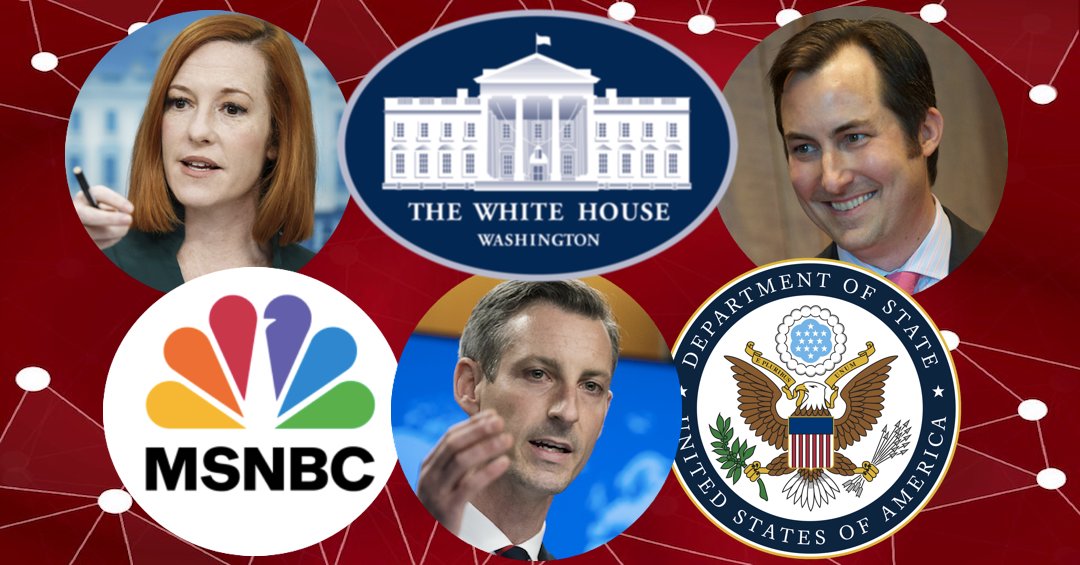
The US State Department’s spokesperson Ned Price is being replaced by a man named Matthew Miller. Like Price, Miller has had extensive prior involvement in both the US government and the mass media; Price is a former CIA officer and Obama administration National Security Council staffer who for years worked as an NBC News analyst, while Miller has previously had roles in both the Obama and Biden administrations and spent years as an analyst for MSNBC.
Like every high-level government spokesperson, Miller’s job will be to spin the nefarious things the US empire does in a positive light and deflect inconvenient questions with weasel-worded non-answers. Which also happens to be essentially the same job as the propagandists in the mainstream media.
In journalism school you are taught that there’s supposed to be a sharp line between government and the press; journalists are meant to hold the government to account, and there’s an obvious conflict of interest there if they’re also friends with government officials or are looking to the government as a potential future employer. But at the highest levels of the world’s most powerful government and the world’s most influential media platforms the line between media and state is effectively nonexistent; people flow seamlessly between roles in the media and roles in the government depending on who’s in office.
We see this indistinctness between government and media with White House press secretaries even more clearly. The current press secretary Karine Jean-Pierre is a former analyst for NBC News and MSNBC, and the last press secretary Jen Psaki now has her own show on MSNBC. Prior to her stint as White House press secretary Psaki worked as a CNN analyst, and before that she was a spokesperson for the State Department like Price and Miller.
At a recent event for the news startup Semafor, Psaki was asked if she considers herself a journalist and she said she does, adding that “to me, journalism is providing information to the public, helping make things clearer, explaining things.” Which is a bit funny considering that Psaki’s political faction has spent the last seven years furiously insisting that WikiLeaks founder Julian Assange is not a journalist. In liberal brainworms land the world’s greatest journalist is not a journalist at all, but Joe Biden’s spin doctor is because she’s got a knack for “explaining things”.
Lest you get the mistaken impression that this phenomenon is unique to Democrats and their aligned media outlets, it should here be noted that Trump’s press secretary Sarah Huckabee Sanders got a job as a Fox News contributor immediately after resigning from that position, and now she’s the governor of Arkansas. Another Trump administration press secretary, Kayleigh McEnany, is now an on-air contributor to Fox News, and previously worked for CNN. Trump’s first press secretary Sean Spicer reportedly tried to get jobs with CBS News, CNN, Fox News, ABC News and NBC News after his stint in the White House, but was turned down by all of them because nobody likes him.
Be seeing you
Posted in Uncategorized | Tagged: Media, separation, State | Leave a Comment »
Posted by M. C. on April 17, 2023
In theory, journalism’s job is to inform the public. In practice, “mainstream” journalism has, for at least the last few decades, largely become the government’s stenography pool, reliably reporting every official assertion as fact and seldom asking pointed questions about any subject more important than which politician has been having sex with which porn star.
by Thomas Knapp
On April 14, the US Department of Justice charged Airman First Class Jack Teixeira with copying and sharing information “connected with” or “relating to” the “national defense.” The government alleges that Teixeira is the man behind “leaks” of classified information which worked their way from the Massachusetts Air National Guard to a Discord chat server for gamers and thence to social media and, finally and unfortunately only very partially, to the US “mainstream” media.
At this point, due to mainstream media’s refusal to do its job, the public doesn’t know very much about the content of the leaked information, but from what we do know, that information had little or nothing to do with any plausible conception of “national defense,” at least where the United States is concerned.
Last time I checked, Ukraine was neither a US state, nor a US territory, nor for that matter located anywhere near the US. US involvement there has nothing to do with “national defense” and everything to do with declining empires raging against the dying of their respective lights at the expense of their subjects. The information not only shouldn’t have been “classified,” it shouldn’t have been compiled or generated. If there’s a crime involved, it was committed at that end, not Teixeira’s.
But that, really, is business as usual. While Julian Assange and Edward Snowden may have been more mindful and purposeful in their disclosures of US government crimes and peccadilloes, Teixeira (if he’s even “guilty”) did America similar service incidental to what sounds like a youthful ego trip.
If the whole incident exposes any new or novel issue, that issue involves the question Nikita Mazurov asks at The Intercept: “Why Did Journalists Help the Justice Department Identify a Leaker?”
Be seeing you
Posted in Uncategorized | Tagged: Jack Teixeira, mainstream media, National Security Leaks | Leave a Comment »
Posted by M. C. on April 16, 2023
Posted in Uncategorized | Tagged: Kind Interpretation, stoicism | Leave a Comment »

