Be seeing you
Archive for the ‘Uncategorized’ Category
The Guy that Believed Biden’s Speech
Posted by M. C. on September 7, 2022
Posted in Uncategorized | Tagged: Biden’s Speech | Leave a Comment »
Sweden and Finland May Be Making a Fatal Blunder
Posted by M. C. on September 7, 2022
The republic’s public finances were dire, Mexico continued to pose a looming military threat, and major European countries all eyed the infant country as a possible geopolitical pawn. Nevertheless, the decision to join the Union soon proved to be disastrous, since Texas did so just in time to become part of America’s slide into civil war. The Swedes and Finns must now hope that opting for NATO membership does not lead to a similar calamitous outcome.
US and other Western leaders are beaming at the impending addition of Sweden and Finland to NATO, although there still is an outside chance that Turkey might block their admission to the Alliance. Prime Minister Recep Tayyip Erdogan has hinted darkly that he may do so, unless the two candidate countries make certain concessions. He professes to be especially concerned about Sweden’s reluctance to extradite Kurdish “terrorists.” Given Erdogan’s long record of cynical opportunism on other issues, it is more likely that his threat is merely a bargaining tactic to show Ankara’s clout.
In addition to wanting policy concessions from Stockholm and Helsinki, he has sought concessions from the United States as NATO’s leader. His diplomatic hardball has already produced one benefit: Biden’s decision to approve a major sale of F-16 fighters to Turkey, a sale that had been on extended hold. Biden denied that there was any connection to Ankara’s position on NATO’s Nordic expansion, saying that “there was no quid pro quo with that; it was just that we should sell.” The timing of the White House approval, however, suggested otherwise. In any case, once Erdogan finishes with his diplomatic drama, NATO will have two new members.
Both countries bring significant military assets to the Alliance. Sweden, in particular, has a very capable, modern military, including a first-class air force. Finland possesses a smaller, less significant military force, but it has an 830-mile border with Russia. For NATO hawks, that situation is considered a major benefit, rather than another dangerous provocation toward Moscow. One might think that seeing the disastrous results of the West’s policy of making Ukraine a NATO military pawn would inhibit such recklessness with regard to Finland. Clearly, that is not the case, however.
The Kremlin’s reaction to the latest phase of NATO’s expansion has thus far been surprisingly mild. Moscow did inform both countries that if they joined the Alliance, Russia would be compelled to reposition its nuclear forces to focus more on Scandinavia, but there have not yet been any warnings that adding Sweden or even Finland crosses a “red line”—a warning that Vladimir Putin and other officials issued on several occasions with respect to Ukraine. One can hope that such restraint continues.
Be seeing you
Posted in Uncategorized | Tagged: Finland, NATO membership, Recep Tayyip Erdogan, Sweden | Leave a Comment »
The Republic has Flatlined
Posted by M. C. on September 7, 2022
The weaponization of the federal government has become complete with the creation of 87,000 armed IRS agents trained to kill, and with the Biden Administration’s open policy of criminalizing political opposition for the crime of wanting to Make America Great Again.

https://josephsansone.substack.com/p/the-republic-has-flatlined
The comparison of America to ancient Rome is routine for a few reasons. Western civilization and culture are largely an extension of ancient Roman civilization. Even our Judeo-Christian heritage was shaped by Rome with Emperor Constantine and the Council of Nicaea. Specifically, the American republic is a reincarnation of the ancient Roman republic. Although, the ancient Roman influence was present throughout the Dark Ages and Middle Ages, the Italian Renaissance created a cultural identification with the ancient Roman republic and inspired classical education for centuries in Western Europe.
The Italian Renaissance was the epitome of Charles Dicken’s immortal words “it was the best of times; it was the worst of times”. An age of enlightenment that produced Michele Angelo and Leonardo Davinci, and city state republics creating a short lived new golden age (i.e. Renaissance) in Italy that riveled that of ancient Greece. It also produced Machiavelli’s The Prince and was marked by constant violence and assassinations.
This rebirth of civilization tapped into an energy that laid dormant for a thousand years. The Romans had three distinct political periods. The kings, the republic, and then of course, the empire. The American founding fathers modeled the American republic after the Roman republic and started an experiment that changed the world. The Roman republic lasted approximately 450 years. That is uncommon. The truth is that most republics don’t last that long. The elected representatives’ degree of corruption usually reaches a boiling point, which leads to a dictatorship.
When Julius Caesar crossed the Rubicon, he was cheered as he was actually rescuing the citizens from the tyranny of the senators, as their level of corruption and oppression reached a pain threshold that could no longer be endured. The Roman senators were the technocrats of the age. The senate’s brutal assassination of Julius Caesar was arguably not to save the republic, it was to save the gravy train. Civil war followed and then Rome had an emperor Augustus and pax Romana began a new golden age for Rome.
This pattern of republics becoming corrupt and failing is maybe best exemplified by Poland. In the late 1700s Poland’s republic, weakened after civil conflict, had became so corrupt that its legislators gradually sold off partitions of the country to Russia, Prussia, and Austria, and eventually, the country ceased to exist. This was partly due to corruption and partly due to intimidation. Napoleon attempted to create a Polish area of self government, and there was another brief attempt, but essentially, Poland was not a sovereign state again until it was reinstated after World War I in the early 20th century.
America’s republican roots run deeper than Rome. They actually trace back to the Etruscans. The Etruscans were considered the holy people of the ancient world. Unique from all other cultures, the Etruscans prophesized and knew their distinct culture would only last a thousand years. Although, it did not actually die, as much of it was absorbed by Roman culture. The original twelve cities were on hilltops spreading across northern central Italy from coast to coast. The cities were originally ruled by the Lucumo, the god king. The Lucumoni eventually waned in power and were replaced by kings and then republics sprung up among the city states.
Etruscan culture was decentralized, however, and the cities were a confederacy. The fasces, made up of twelve rods and a double headed ax, represented the twelve original cities. This symbol was later bastardized by 20th century fascists. Arguably Etruria was the most advanced civilization at the time. The Etruscans were so wealthy that their slaves owned property and operated businesses and woman had equal rights. The next time you go out to dinner with another couple, recognize that this tradition started with the Etruscans. As a navel power the Etruscans riveled ancient Greece and the Phoenicians.
The wealth and power that accumulated in Etruria may be partly credited to its decentralized confederacy and open society. In fact, this distribution of power was evident in Etruscan cosmology, Tinia, the Etruscan equivalent to Jupiter Optimus Maximus and Zeus, had to consult with his committee of gods before striking you dead with a thunderbolt. Due process. An interesting concept. Although fierce in combat, it has also been argued that the Etruscans were too decentralized, and this hampered military coordination. The original American articles of confederacy may have resembled the Etruscan system more so than the Romans. This thinking that too much decentralization leads to weakness from external threats led to the U.S. Constitution and the creation of a more centralized system.
Caveat. The more centralized system of government envisioned by the American founding fathers is nothing like we see today. It is safe to say that if General Washington were alive today, he would have formed a continental army and replaced our current government in the past two and a half years.
Be seeing you
Posted in Uncategorized | Tagged: American Republic, Empire, Flatlined, Republic, Roman civilization | Leave a Comment »
“It’s a private company,” they say. Oh, really?
Posted by M. C. on September 7, 2022
But as these free speech platforms grow and become a threat, the efforts to crush them also grow – exactly as AOC, other Dems and their corporate media allies successfully demanded Google, Apple and Amazon destroy Parler when it became the single most-popular app in the country.
https://mailchi.mp/tomwoods/suppression?e=fa1aba8cd8
During the George W. Bush years, Glenn Greenwald rose to prominence for his opposition to the White House’s record on civil liberties.
Oh, the left-liberal establishment loved him.
Then he decided he would apply his principles equally to both sides.
Then they didn’t like him so much.
Today he published an important thread on Twitter, a portion of which I wanted to share with you. Here he describes exactly what’s going on with the suppression of dissident voices. And unlike all too many libertarians, whose entire analysis was “they’re private companies; they can do what they want,” Greenwald gets to the heart of what’s happening:
The regime of censorship being imposed on the internet – by a consortium of DC Dems, billionaire-funded “disinformation experts,” the US Security State, and liberal employees of media corporations – is dangerously intensifying in ways I believe are not adequately understood.
A series of “crises” have been cynically and aggressively exploited to inexorably restrict the range of permitted views, and expand pretexts for online silencing and deplatforming. Trump’s election, Russiagate, 1/6, COVID and war in Ukraine all fostered new methods of repression.
During the failed attempt in January to force Spotify to remove Joe Rogan, the country’s most popular podcaster – remember that? – I wrote that the current religion of Western liberals in politics and media is censorship: their prime weapon of activism.
But that Rogan failure only strengthened their repressive campaigns. Dems routinely abuse their majoritarian power in DC to explicitly coerce Big Tech silencing of their opponents and dissent. This is *Govt censorship* disguised as corporate autonomy.
There’s now an entire new industry, aligned with Dems, to pressure Big Tech to censor. Think tanks and self-proclaimed “disinformation experts” funded by Omidyar, Soros and the US/UK Security State use benign-sounding names to glorify ideological censorship as neutral expertise.
The worst, most vile arm of this regime are the censorship-mad liberal employees of big media corporations. Masquerading as “journalists,” they align with the scummiest Dem groups to silence and deplatform.
It is astonishing to watch Dems and their allies in media corporations posture as opponents of “fascism” – while their main goal is to *unite state and corporate power* to censor their critics and degrade the internet into an increasingly repressive weapon of information control.
A major myth that must be quickly dismantled: political censorship is not the byproduct of autonomous choices of Big Tech companies.
This is happening because DC Dems and the US Security State are threatening reprisals if they refuse. They’re explicit.
But the worst is watching people whose job title in corporate HR Departments is “journalist” take the lead in agitating for censorship. They exploit the platforms of corporate giants to pioneer increasingly dangerous means of banning dissenters. *These* are the authoritarians.
This is the frog-in-boiling-water problem: the increase in censorship is gradual but continuous, preventing recognition of how severe it’s become. The EU now legally mandates censorship of Russian news. They’ve made it *illegal* for companies to air it.
So many new tactics of censorship repression have emerged in the West: Trudeau freezing bank accounts of tucker-protesters; PayPal partnering with ADL to ban dissidents from the financial system; Big Tech platforms openly colluding in unison to de-person people from the internet.
All of this stems from the classic mentality of all would-be tyrants: our enemies are so dangerous, their views so threatening, that everything we do – lying, repression, censorship – is noble. That’s what made the Sam Harris confession so vital: that’s how liberal elites think.
This is why I regard the Hunter Biden scandal as uniquely alarming. The media didn’t just “bury” the archive. CIA concocted a lie about it (it’s “Russian disinformation”); media outlets spread that lie; Big Tech [censored] it — because lying and repression to them is justified!
The authoritarian mentality that led CIA, corporate media and Big Tech to lie about the Biden archive before the election is the same driving this new censorship craze. It’s the hallmark of all tyranny: “our enemies are so evil and dangerous, anything is justified to stop them.”
How come **not one media outlet** that spread this CIA lie – the Hunter Biden archive was “Russian disinformation” – retracted or apologized? This is why: they believe they are so benevolent, their cause so just, that lying and censorship are benevolent.
The one encouraging aspect: as so often happens with despotic factions, they are triggering and fueling the backlash to their excesses. Sites devoted to free speech – led by Rumble, along with Substack, Callin, and others – are exploding in growth.
But as these free speech platforms grow and become a threat, the efforts to crush them also grow – exactly as AOC, other Dems and their corporate media allies successfully demanded Google, Apple and Amazon destroy Parler when it became the single most-popular app in the country.
It is hard to overstate how much pressure is now brought to bear by liberal censors on these free speech platforms, especially Rumble. Their vendors are threatened. Their hosting companies targeted. They have accounts cancelled and firms refusing to deal with them. It’s a regime.
Be seeing you
Posted in Uncategorized | Tagged: Big Tech, censorship, disinformation, Joe Rogan, private company, Spotify | Leave a Comment »
What Has Government Done to Our Universities?
Posted by M. C. on September 7, 2022
by David Brady
The real spike in prices was primarily due to government guaranteed student loans. The government’s Federal Family Education Loan program guaranteed that if a loan from a private lender or Sallie Mae defaulted the government would take over the loan and pay the loss. This guarantee ended in 2010, but the consequences were in these lenders giving out more student loans than they ordinarily would.
The natural incentive is for the government to send money to those most likely to justify the actions of the government. Harvard University is the recipient of over $1.9 billion in grants from the National Institute of Health and one is for pushing ideas of “Transforming Transgender Care.”
https://libertarianinstitute.org/articles/what-has-government-done-to-our-universities/
Joe Biden has stoked more fire into the debate over higher education. The president unveiled a plan to forgive $10,000 of student debt for those making $125,000 a year or less, or $20,000 if that borrower was a recipient of a Pell Grant. While one can argue about the economic or moral implications of the decision, the question that many seem to have missed is: why is a college education so expensive? Is it even worth it? What has the government done to our higher education system?
In the United States, there is over $1.75 trillion in student loan debt with an average of $28,950 plus interest for each borrower. What made college so expensive? That is a gross combination of issues, including how students pay for their college education.
- Buffer
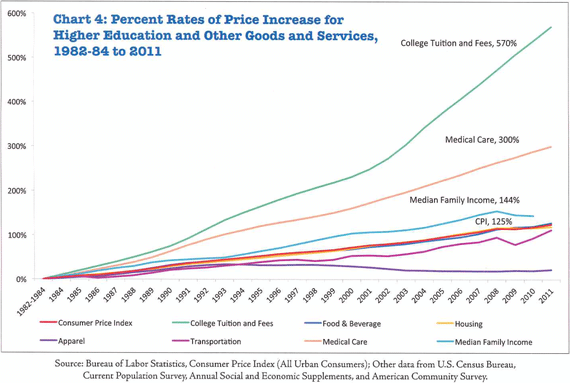
Traditionally a college education was paid for either by a family saving up for a child to seek a higher education, or the young adult working almost full time alongside their education to pay it off. That is no longer the case amongst Americans. Rather than alternatives such as entrepreneurship, apprenticeship, or simply requiring a GED or high school diploma, almost half the jobs in the United States now demand some form of college education according to the Bureau of Labor Statistics. The cultural demand for a college education certainly could have driven up costs, but almost 570% almost seems impossible.
The real spike in prices was primarily due to government guaranteed student loans. The government’s Federal Family Education Loan program guaranteed that if a loan from a private lender or Sallie Mae defaulted the government would take over the loan and pay the loss. This guarantee ended in 2010, but the consequences were in these lenders giving out more student loans than they ordinarily would. Borrowers who would be unable to get a loan for the career they seek out were less of a risk to these lenders, and those banks were willing to give out more loans to students. The subsequent result was rising prices. If loans are being given out so easily, then colleges can afford to raise prices as students will simply take out more loans.
Title II of the Student Aid and Fiscal Responsibility Act of 2009 (Subtitles A & B) demolished the Federal Family Education Loan Program and directed the Department of Education to issue loans directly to students. This misuse of loans has resulted in much the same issues and costs described above. Students choose majors that provide no real skills for actual jobs and waste years of their young lives while progressive ideology spreads.
Progressive ideology runs rampant in universities for to two reasons: heavy government investment and the embrace of ESG in their financiers. Between student aid, grants, and contracts the United States government has sent $149 billion to colleges and universities. The natural incentive is for the government to send money to those most likely to justify the actions of the government. Harvard University is the recipient of over $1.9 billion in grants from the National Institute of Health and one is for pushing ideas of “Transforming Transgender Care.” Harvard benefits from:
“…Tax privileges conferred by the federal government have helped institutions like Harvard build extraordinarily large endowments. So-called private colleges have willingly forfeited some of their independence to federal bureaucrats in order to keep the federal bounty coming.”
All the while, Harvard continues to promote progressive philosophy like Critical Race Theory that can be found explicitly in their law program and their website.
Universities and their endowment funds have even gone so far as to embrace ESG as part of their priorities. ESG—short for environmental, social, and governance—is a credit rating by large investment firms for businesses and companies based upon those three factors. ESG has become weaponized by progressives against companies that appear disfavorable to them. For example, Tesla, an electric car company, remains in the 58th Percentile, while Exxon, an oil company, is in the 38th. Clearly these have little to do with actual environmentalism and far more with what upsets the progressive dogma and ideology. Such schools as the University of California, Georgetown, Harvard, and Oxford have embraced ESG, and along with it the “social” governance scores that push a progressive agenda. ESG is used by the largest corporate firms in the world such as BlackRock, which manages around $10 trillion. Their CEO Larry Funk has intimate connections with the Federal Reserve Chairman.
A combination of government investment in loans as well as grants by progressive dogma has resulted in not only a more expensive higher education but also a progressive indoctrination camp. Students leave college with largely useless degrees, a thorough brainwashing, and tens of thousands in debt.
Government and ESG has our universities.

About David Brady
David Brady is an At-Large and Social Media Contributor for the Libertarian Party of Minnesota and host of The Road to Providence Podcast on YouTube & Odysee. Follow him on Twitter @realDavidBJr.
Be seeing you
Posted in Uncategorized | Tagged: Government, student loans, student loans. The government’s Federal Family Education, Transgender Care, Universities | Leave a Comment »
Watch “Governments Will Turn The Recession Into A Depression” on YouTube
Posted by M. C. on September 7, 2022
When the Fed counterfeits dollars, creating an artificial economic boom, a recession is inevitable and unavoidable. Recessions are a return to economic reality; the antidote for The Fed’s poison. While recessions are unavoidable, depressions can be avoided. Depressions occur when the government interferes and tries to prevent a return to economic reality. Government implements “policies” that are meant to “help,” but only end up extending the economic misery into a depression.
Be seeing you
Posted in Uncategorized | Tagged: Depression, economic boom, Fed, recession | Leave a Comment »
Africa’s Path to Energy Prosperity Is with Free Markets, Not Eco-Colonialism
Posted by M. C. on September 6, 2022
If California and Germany did not succeed at their solar and wind experiments, no rational person would expect underdeveloped countries to succeed at it. So, it is malicious to coerce African countries into an energy “transition” that the developed world is failing to achieve.
https://mises.org/wire/africas-path-energy-prosperity-free-markets-not-eco-colonialism
The ongoing energy crunch has revealed the hypocritical, if not duplicitous, nature of the Western imposition of climate and energy transition goals on other nations. Of course, we care about environmental protection, but the current arrangement amounts to eco-colonialism, is wildly detached from local realities, and severely hurts African economies and lives. For these and other reasons, African leaders should assert energy policy independence if they intend to serve and protect Africa’s socioeconomic well-being.
Africa must finally and truly develop. Access to dense, dispatchable, reliable, abundant, and cheap energy goods and services is crucial. Fossil fuels, which Africa has enormous quantities of, are best positioned to meet present and future demand. Today’s energy crisis conclusively shows that solar panels and wind turbines are not economically, materially, and ecologically viable alternatives.
If California and Germany did not succeed at their solar and wind experiments, no rational person would expect underdeveloped countries to succeed at it. So, it is malicious to coerce African countries into an energy “transition” that the developed world is failing to achieve.
Severe Energy Poverty
There is energy poverty everywhere, even in Western countries. But countries and regions are not equally energy poor. Africa, the least developed region, is, of course, the most energy poor. No need to turn this part of the article into a poverty porn session by presenting numerous statistics about the severity of energy poverty that plagues and cripples Africa. Still, some facts are worth pointing out.
N.J. Ayuk, chairman of the African Energy Chamber, notes that:
It is not an exaggeration to say energy poverty is one of our continent’s most pressing problems: Only 56% of Africa’s population has access to electricity today, and in many places, that power is still inadequate and unreliable at best. We address this topic in our recently released report, The State of African Energy 2022.
“Comprehensive energy access across the continent remains a central target, with some 600 million people without access to electricity today,” says the report. “Moreover, households themselves, facing low and inadequate supply of electricity, often rely on highly polluting traditional energy sources such as hard biomass, which constitutes 45% of total primary energy demand in Africa.”
Be seeing you
Posted in Uncategorized | Tagged: Africa, Eco-Colonialism, Energy Prosperity, free markets | Leave a Comment »
Quagmires in the Fed’s War on Inflation
Posted by M. C. on September 6, 2022
The answer to a question posed above is: The Fed can’t sell off its assets as quickly as it bought them in 2020 without risking havoc. The Fed simply can’t suck money out of the economy as easily as it can flood the economy with money. Given that, the Fed should allow all of its maturing assets to undergo portfolio runoff, not put a cap on runoffs of $95B a month.
By Jon N. Hall
American Thinker
https://www.americanthinker.com/articles/2022/09/quagmires_in_the_feds_war_on_inflation.html
After the financial crisis of 2008, the Federal Reserve used two policies to prop up the economy: zero percent interest rates and pumping newly-created money into the economy through quantitative easing (QE). Because of 40-year-high inflation, the Fed has recently reversed policy and is raising its key interest rate target on overnight loans between banks. The Fed is also doing quantitative tightening (QT, the opposite of QE), and is withdrawing money from the economy.
There are two ways to do QT: “portfolio runoff” and selling assets. The Fed is doing only the former, runoff, which entails allowing its assets to mature and not reinvesting the proceeds. Beginning in September, the Fed will do portfolio runoff at a pace of $95B a month, $60B of which will be U.S. treasuries and $35B will be mortgage-backed securities. That pace works out to $1.14 trillion in a year. Nothing to sneeze at, but to really fight inflation could the Fed go faster and take even more money out of the economy each month?
Rather than relying solely on portfolio runoff of maturing assets, this writer recently suggested that the Fed also sell its assets prior to maturity in order to speed up the deflating of the money supply, and perhaps obviate continued interest rate hikes. Just as with portfolio runoff, the Fed wouldn’t reinvest the proceeds of its sales. Selling assets presents serious implications concerning prices and yields.
Reducing the Fed’s portfolio (balance sheet) through sales is a problem. Back in the Spring of 2020, during the height of the pandemic, the Fed bought assets for a time at the furious pace of a trillion dollars a month. Selling those assets will be more of a problem than was buying them. What if the Fed tried to sell off its assets as quickly as it bought them in 2020?
When it sells its assets, the Fed does so in secondary markets where prices and yields are subject to change. When too much of something is put on any market at one time, prices tend to fall. In bond markets, when prices fall yields rise.
The trick for the Fed in selling its assets is to sell them at high prices. The higher the price, the more money the Fed is sucking out of the money supply, thereby attacking inflation directly. But there’s another consideration: the relationship between the secondary market and the primary market.
In the case of the primary market for U.S. treasuries, they’re sold at par, or face value; what’s paid at maturity. So the way that that primary market could compete with its secondary market during times when the secondary market has better yields than its primary market is to raise its coupon rates, i.e. the interest rates on its treasuries.
Since interest on treasuries is an item in the federal budget, low prices for treasuries in the secondary market is a problem if they result in higher interest rates for new treasuries. The amount of interest on the federal debt that the taxpayer is to pay in ten years is already predicted to go up by a factor of three.
Be seeing you
Posted in Uncategorized | Leave a Comment »
Ultra-Hawk Liz Truss to Be Next British Prime Minister
Posted by M. C. on September 6, 2022
Truss said at a recent town hall that she would be ‘ready’ to launch nuclear weapons as prime minister
British Foreign Secretary Liz Truss will replace Boris Johnson as the British prime minister after the UK’s Conservative Party voted to make her the leader of the government. She beat out former Finance Minister Rishi Sunak and is expected to be formally named prime minister by the Queen on Tuesday.
As the British foreign secretary, Truss has delivered some of the most hawkish rhetoric against Russia in NATO’s response to the invasion of Ukraine. When the war first broke out, Truss said that she supported individuals from the UK who wanted to fight in Ukraine.
While campaigning to become the prime minister, Truss said if she took the position, she would follow in Johnson’s footsteps and be Ukraine’s “greatest friend” to ensure that Russian President Vladimir Putin “fails in Ukraine and suffers a strategic defeat.”
According to a report from The Financial Times, Truss and her team have been frustrated that the US hasn’t taken a “harder line” on Russia even as Washington has pledged over $13 billion in weapons for Ukraine, dwarfing the $2.8 billion in military aid London has committed.
While the UK isn’t contributing nearly as much money as the US, Britain is one of the leading NATO supporters of Ukraine. The British are currently training thousands of Ukrainian soldiers inside the UK, with the goal of training 10,000 within 120 days. According to reports from The Times and The New York Times, British special operations forces are on the ground in Ukraine.
Truss has also voiced her opposition to negotiations with Russa, saying talks could only happen after Moscow is “defeated.” Johnson frequently discouraged negotiations and reportedly played an integral role in the failure of earlier peace talks between Russia and Ukraine, a pattern that will likely continue under a Truss premiership.
Truss has also been hawkish in her rhetoric against China and has called for a “global NATO” that’s capable of defending Taiwan and the broader Asia Pacific region. She is expected to be confrontational with Beijing and will reportedly classify China as a “threat” to British national security for the first time.
During a recent town hall, Truss was asked by host John Pienaar how she would “feel” if she had to order a nuclear strike, which Pienaar recognized would likely mean global annihilation. Truss said, “I think it’s an important duty of the prime minister and I’m ready to do that.”
When asked again how ordering a nuclear strike would make her feel, Truss simply responded, “I’m ready to do that.”
Be seeing you
Posted in Uncategorized | Tagged: Liz Truss, Prime Minister | Leave a Comment »
Leaked Paper Shows UK Cops Preparing For “Greater Civil Unrest” This Winter
Posted by M. C. on September 6, 2022

BY TYLER DURDEN
Europeans are finally waking up to how bad Western sanctions on Russia have backfired, as their governments sacrificed ordinary people over NATO’s proxy fight against Russia in Ukraine.
https://www.zerohedge.com/geopolitical/uk-cops-prepare-greater-civil-unrest-winter
New Prime Minister Liz Truss may have only weeks to deliver a confidence turnaround in the UK economy or face a surge in violent crime and breakdown in public order caused by a cost-of-living crisis.
The Times revealed police chiefs fear “economic turmoil and financial instability” has the “potential to drive increases in particular crime types,” such as shoplifting, burglary, vehicle theft, and online fraud and blackmail, as Brits face one of the worst collapses in living standards in a century amid energy hyperinflation.
“Prolonged and painful economic pressure” could spark “greater civil unrest,” similar to the 2011 London riots, the leaked national strategy paper read.
“Greater financial vulnerability may expose some staff to a higher risk of corruption, especially among those who fall into significant debt or financial difficulties,” it continued.
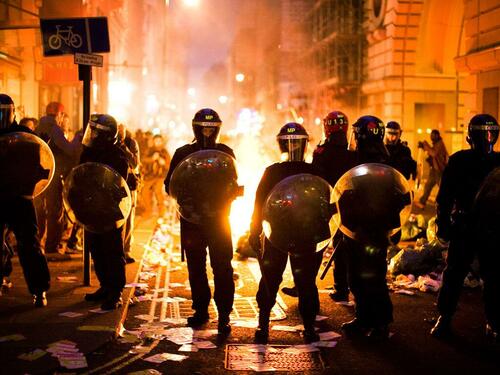
One police chief noticed increased violent crime as inflation is stuck at multi-decade highs. This comes as energy regulator Ofgem increased the cap on power bills to a record £3,549 ($4,189) beginning Oct. 1 from £1,971 ($2,330). That cap is expected to rise to £5,439 ($6,427) by January and £7,272 ($8,594) by spring.
Besides police, energy executives warned that mass civil unrest looms as people cannot afford their heating and electricity bills this winter.
About 160,000 Brits have joined a movement against skyrocketing electricity bills, vowing not to pay come Oct. 1.
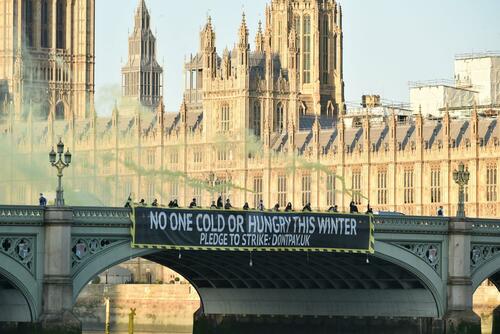
Last Friday, Russia’s energy giant Gazprom PJSC halted flows via Nord Stream 1 to Europe, sending EU natural gas and electricity prices soaring on Monday. This means Truss hardly has any time to deliver a coherent strategy to save households from energy poverty and businesses from failing.
The massive protest in Prague this past weekend, where tens of thousands of Czechs flooded the streets, offers a glimpse of the impending social unrest that could hit the street of the UK if power bills continue rising without government intervention.
Published last week was a new report via Verisk Maplecroft, a UK-based risk consulting and intelligence firm, warning there’s a high risk of social unrest in Europe later this year due to rising inflation.
Europeans are finally waking up to how bad Western sanctions on Russia have backfired, as their governments sacrificed ordinary people over NATO’s proxy fight against Russia in Ukraine. These protests could spread like wildfire across Europe, and it appears the UK is preparing for the worst-case scenario.
Be seeing you
Posted in Uncategorized | Tagged: civil unrest, Liz Truss, NATO, UK Cops, Western sanctions | Leave a Comment »