The French abbot and mystic, Bernard of Clairvaux, famously remarked that “A wise man is one who savors all things as they really are.”
I was reminded of this remark a few days ago in a conversation with my younger brother, who lamented how hard it is to find young skilled labor for his general contracting business on Maui.
“All of my skilled guys are now old,” he said. “My electrician is a Vietnam veteran. He loves his job and is very good at at it, but I can’t find anyone to replace him.”
“What do the youngsters on Maui do for a living?” I asked.
“I don’t know,” he replied.
“How do cover their cost of living?”
“I think a lot parents of our generation still support their grown children.”
“What does the younger set do with their time?” I asked.
“Look at their phones.”
To be sure, my brother’s sample size on Maui is very small. However, his personal perception seems to find confirmation in the remarkable fact that, out of a total U.S. population of 340 million, only 161 million are employed, or less than half.
Of the 179 million who are not employed, 50 million are retired and receiving Social Security benefits, 11 million are stay-at-home moms, 74 million are minors, and 44 million are apparently none of the above.
I wonder about the social and political outcome for a society when less that half of it does remunerative work and pays taxes. Could this be a major factor in the rapid and steady proliferation of debt to finance America’s high standard of living?
As the US-backed atrocities in the middle east get uglier and uglier, I keep thinking about something that was said by an Iranian cleric named Shahab Moradi after the US assassinated Iran’s immensely popular general Qassem Soleimani in 2020.
Moradi complained that Iran can’t even really retaliate for the assassination because the US doesn’t have any real heroes of its own like Soleimani, saying, “Think about it. Are we supposed to take out Spider-Man and SpongeBob?”
I’ve never seen a more incisive and withering critique of western culture, and I probably never will. It’s such an accurate statement and paints such a clear picture of what this civilization is really like that it’s hard to imagine how anyone could possibly top it.
There are no real heroes with popular support in the western empire, because everything that’s truly heroic gets stomped down here, and everything that gets amplified to popularity is either vapid distraction or directly facilitates the interests of the evil empire.
Our own generals are busy butchering civilians for oil and geostrategic control.
Our military personnel are imperial stormtroopers.
Our police are the security guards of capitalism.
Our most prominent journalists are all propagandists.
Our most prominent celebrities are famous because of their ability to pretend to be fictional characters doing fake things in Hollywood movies.
Our most prominent artists are famous because of their ability to churn out formulaic pop songs about empty-headed bullshit.
Our most widely recognized symbols are corporate logos.
Our most highly regarded professionals are those who can sell westerners the most future landfill manufactured by wage slaves in the global south.
Our most well-known government leaders are those who’ve sold their souls to oligarchs and imperialists and can lie to the public most convincingly.
The only westerners doing truly heroic things here get thrown in prison, or murdered, or pushed into obscurity, because the only truly heroic thing anyone can do in today’s world is to take a stand against the western empire.
The FTC’s successful efforts to lower prescription drug prices is an example of the agency “fixing” a problem caused by government intervention. The FTC lowered prices of prescription drugs by challenging patents filed by companies whose sole purpose was to keep generic alternatives off the market—thus enabling the big pharmaceutical companies to keep prices high. So, the pharmaceutical companies were not abusing market power to keep prices high. they were manipulating the legal and regulatory process.
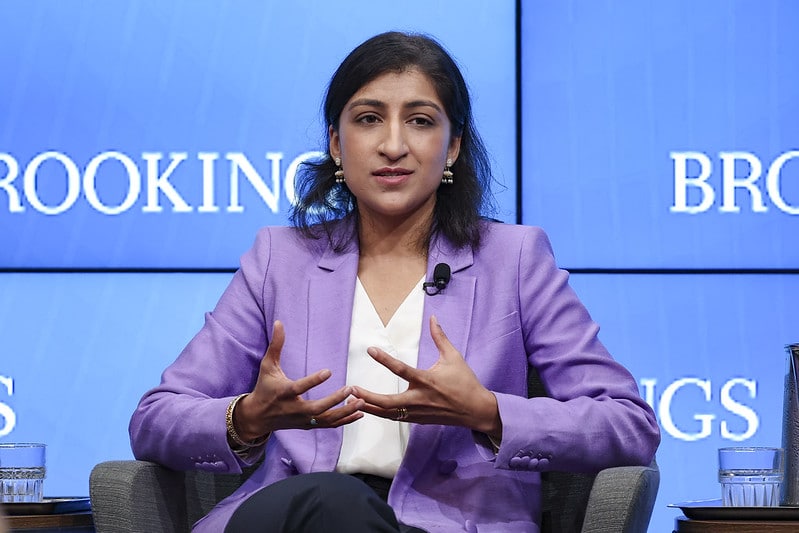
60 Minutes recently aired an interview with Federal Trade Commission (FTC) Chair Lina Khan conducted by veteran reporter Lesley Stahl. This may have been the first time in their 58-year history that 60 Minutes has profiled an FTC chair, but Lina Khan is not the “typical” FTC chair.
President Joe Biden picked Lina Khan to head the FTC because she is a (maybe the) leading advocate for “neo-Brandeisians.” Named for former Supreme Court Justice (and progressive icon) Louis Brandeis, this movement seeks to restore the “big is de facto bad” approach that dominated antitrust from the passage of the first antitrust laws in the 1890s until the Ronald Reagan administration. The “big is de facto bad” approach was displaced by the consumer welfare standard, which focuses on how businesses’ actions affect consumers.
Stahl questioned Khan about concerns that when government prevents companies from merging, they deprive them of the ability to use economies of scale to lower prices. Khan said, “Even if those efficiencies arise, if the companies are not checked by competition, it won’t have an incentive to pass those benefits on to the consumer because those consumers may not have anywhere else to go.” Khan and her progressive allies fail to consider the history of businesses that believed their position as leader of the market was so untouchable that they could abuse their customers with high prices, poor customer service, and a refusal to adapt to compete with new and innovative competitors.
An example of a seemingly untouchable market leader that failed to “keep up with the times” is Borders Books. Borders’ failure to see the potential in online retail caused the company to lose many customers (and eventually go bankrupt) to an online book retailer that started as one man selling books in a rented warehouse. That company was Amazon.
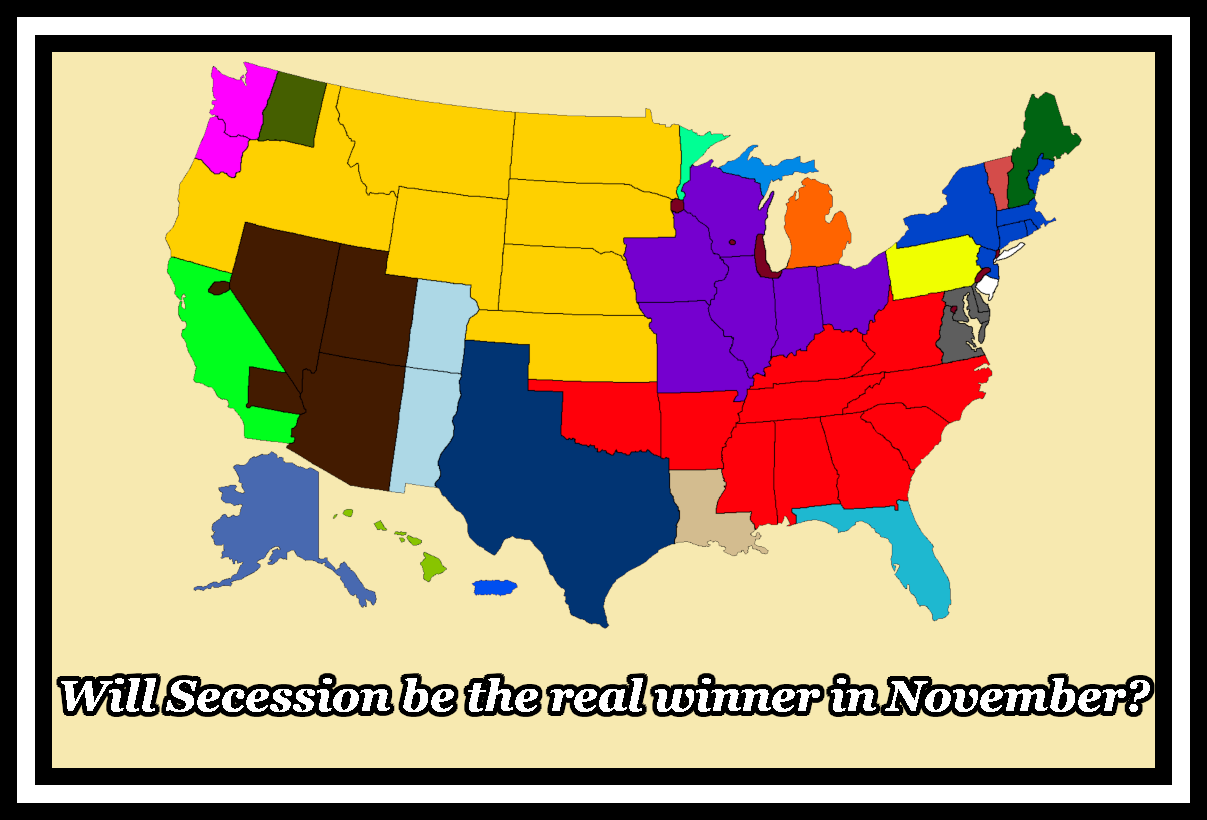
People of good faith have reason to believe that the country is about to be blown apart. By another odd coincidence, an outfit called the Armed Forces Communications and Electronics Association International (AFCEA) has scheduled an “exercise simulating a cyber-attack on critical infrastructure” for November 5 in Atlanta, Georgia. That’s election day. In a big swing state. Whose idea was that? Is there already not enough that might go wrong that some treasonous moron had to kick the risk of fiasco up another notch?
It is no secret that America faces a very uncertain future heading into the November 5th elections. On one side are a desperate cadre of elites, criminals, and rabid cultists cowering at the fear of what a Trump electoral victory could mean for their exclusive clique which has run the American political system for at least the last century. On the other side are many ordinary Americans who have been driven to the edge domestically in all aspects of their lives by failed elitist policies and criminal enterprises sanctioned by the increasingly imperial government in Washington DC. It is a mercurial period which is bearing much resemblance to the lead-up of several flashpoints in American history, such as the conflicts in the 1770s, 1860s, and 1940s.
The general assumption among many is that the planned electoral fraud in this election cycle is meant to help ensure Donald Trump is defeated on election night, just as the 2020 effort did. Though a closer look at certain other details shows that there may be more to it than just stopping Trump this time. Trump’s support in the polls is far higher than it was in either 2016 or 2020. This has led to speculation that the sheer volume of votes for him could be enough to overwhelm the efforts to rig the votes against him in certain states. However, the Elites may be ready for that this time with backup plans ready for implementation.
The US PATRIOT Act wasn’t just a mistake; it was a turning point in the relentless erosion of privacy. It institutionalized mass surveillance, shredding the Fourth Amendment in the US and fundamentally altering our lives.
It was sold to us as a temporary measure. But it became a permanent feature of our world, that had global implications.
Today marks the anniversary of the Patriot Act’s passage, and all week NBTV has been leading a major push for surveillance awareness. We released seven new videos: interviews with privacy advocates from all walks of life, and sketches exposing the intrusive surveillance that has become disturbingly normal. This week, I also spoke at Saintcon in Utah to inspire others to join us in this fight for privacy.
Because we can’t afford to stay silent.
The truth is, privacy is disappearing fast. Corporations, malicious actors, and governments are all working to undermine it. – Surveillance capabilities double every two years, keeping pace with Moore’s law. – AI makes data collection easier than ever by aggregating disparate data sets and drawing ever more inferences from the patterns that are revealed. – Year after year, new legislation is introduced to try to ban end-to-end encryption and force backdoors into every app we use.
But privacy tools aren’t keeping up.
We also face a troubling cultural shift: people insisting they “have nothing to hide” and dismissing the value of privacy entirely. This dangerous mindset is hurting us all. Developers don’t feel a sense of urgency to build privacy tools because the public isn’t demanding them. Some developers even fear working on privacy tools—being told “only criminals need privacy.” And too few people are showing up to fight against bad legislation, because we’re not treating this threat with the seriousness it demands.
We have to change that.
When people tell us they have nothing to hide, we must show them why privacy matters. This fight isn’t about secrecy—it’s about choice. Even if you don’t think you need privacy today, many people do. For activists, journalists, dissidents, protestors, whistleblowers, and anyone who doesn’t fit mainstream norms, privacy can mean life or death.
We fight for privacy so that the most vulnerable people in our society still have that choice, in a world where this option is rapidly vanishing. We fight to protect this right for our children and grandchildren so they, too, can choose privacy—whether they need it today or not.
Right now, we are dangerously close to losing this choice forever. The tools needed to protect privacy aren’t advancing fast enough to keep up with the forces working to dismantle it.
I need your help.
We are at a tipping point. This erosion of privacy is not a distant threat—it’s happening now. Together, we can create a future where privacy is not a luxury for the few but a right for all. A future where you don’t need to conform to society’s expectations just to feel safe.
Let’s make sure tech and privacy can coexist freely—for everyone.
Please join me in Accelerating Privacy.
Being a privacy accelerationist means taking action now to ensure privacy tools don’t just survive—they thrive. It means getting these tools into as many hands as possible, so everyone—no matter their income or technical skill—has access to privacy. It means fighting back against bad laws designed to strip us of privacy, and ensuring the choice to protect yourself remains available to all.
It also means pushing back against the cultural shift that paints privacy as suspicious. We need to reverse the normalization of surveillance and remind people that privacy isn’t just good—it’s essential for a free society.
Privacy accelerationists know that we can no longer afford to wait for people to wake up to what’s at stake. We must act now to protect the tools and rights we’ll need tomorrow.
The fevered competition for eyeballs / visibility has generated a self-reinforcing feedback of faking authenticity better than other spectacles. The goal isn’t to present “real life,” what would be the point of such absurdly uncompelling, boring anti-spectacle?
As every dealer knows, there’s no more reliable source of revenue than a junkie with a monkey on his back, and encouraging addiction to screens is astoundingly profitable.
No wonder we’re restless, teetering on the edge, frustrated by our addictions to fakery and excess, starved for what cannot be marketed or made profitable, so it no longer exists except in the shadows.
Everything is staged, and therefore fake. Given the near-zero cost of posting content in the digital world, everyone discovered that staging wasn’t limited to high-end political events, parades and Hollywood sets; since all the world’s a stage, everything could be staged, from every selfie on social media to every video on YouTube to every public display.
With staging comes spectacle, with spectacle comes self-serving artifice, and with artifice comes excess. The captivating idea of staging is by mimicking authenticity, we manifest an implicitly self-serving purpose: we stage the film to mimic “real life” to entertain the audience, and by this means reap a fortune.
By staging a political event, we rouse blood lust to serve our ascension to power. By staging a selfie in a swank bar sipping a costly cocktail, while home is a shared room in a squalid, overpriced flat, we serve our desire for a digitally distributed simulacrum of a status we cannot possibly achieve in our real lives.
Now that everything is staged, the competition to get noticed in a sea frothing with endless scrolls of “content” demands excess. Everything is now so sensationalized that we are desensitized to it all. As a result, everything distills down to self-parody, rendering parody impossible, for everything is already a parody of itself.
Mimicking authenticity to make the sale is now so embedded, so ubiquitous, that irony is also lost: we are living in a Philip K. Dick story come to life in which young women fabricating fake lives of glamor and luxury to boost their visibility are now competing with digitized imaginary young women that are idealized versions of the sexually compelling female.
Now that engagement is the coin of the Attention Economy realm, traditional media and social media have merged: everybody’s competing for engagement because that’s everyone’s source of income. Never mind that the Big Tech platforms skim the bulk of the engagement revenues and a handful of influencers reap the majority of what’s left; the mob is furiously dedicated to the task of picking up the pennies scattered in the sand-covered floor of the Coliseum.
In my view, engagement is the polite term for addiction, the core value proposition in Addiction Capitalism. As every dealer knows, there’s no more reliable source of revenue than a junkie with a monkey on his back, and encouraging addiction to screens is astoundingly profitable.
“Immediately before the 2004 presidential election, almost 70 percent of U.S. citizens were unaware that Congress had added a prescription drug benefit to Medicare, though this was a giant increase to the federal budget and the largest new entitlement program since President Lyndon Johnson began the War on Poverty.”
“In 1964, only a minority of citizens knew that the Soviet Union was not a member of NATO…the organization created to oppose the Soviet Union.”
A couple weeks back, the managing editor here at the Libertarian Institute, Keith Knight, posted on Twitter/X about voter ignorance. The post, which featured the headline “Monetary Policy by the Taylor Rule,” along with the associated equation, concluded with the comment: “What % of voters know this and can comprehend this? How long would it take to teach everyone? Democracy is a joke, privitize [sic] everything.”
While voters might be forgiven for not being able to parse the arcane occult of highly mathematized macroeconomic policy—no matter their other scholastic qualifications, those lacking graduate training in economics are unlikely to be able to do so—a survey of voter competency across a broader range of metrics provides no great comfort.
Indeed, Knight’s criticism and prescription stand.
Consider the following recent examples a quick search revealed:
2017 Annenberg Public Policy Center Study: This found that only 26% of Americans could name all three branches of government, while 33% couldn’t name any branches at all, underscoring a lack of basic civic knowledge.
2010 Pew Research Center Knowledge Survey: Around 45% of respondents did not know that the Republican Party was generally considered more conservative than the Democratic Party, indicating a basic lack of understanding about the ideological differences between the major parties.
2018 National Election Studies: A significant number of voters misidentified which party controlled Congress. Despite widespread media coverage, many voters were confused about which party had the majority in the U.S. House and Senate, demonstrating low political awareness.
2010 Survey by Xavier University: This survey found that one-third of voters did not know that the Bill of Rights is part of the U.S. Constitution, revealing a gap in basic constitutional knowledge.
2019 Quinnipiac University Poll: This found that a significant percentage of Americans, over 50%, believed that Social Security was funded by a government trust fund rather than through a pay-as-you-go system where current workers’ payroll taxes fund current retirees’ benefits.
These instances illustrate a wide range of voter ignorance, from misinformation to a lack of knowledge about key political processes, policies, and historical facts. They highlight the challenges voters face in making informed decisions in elections—and this is hardly new!
Consider these earlier instances of voter ignorance, provided by the political scientist Jason Brennan in his Against Democracy:




 MCViewPoint