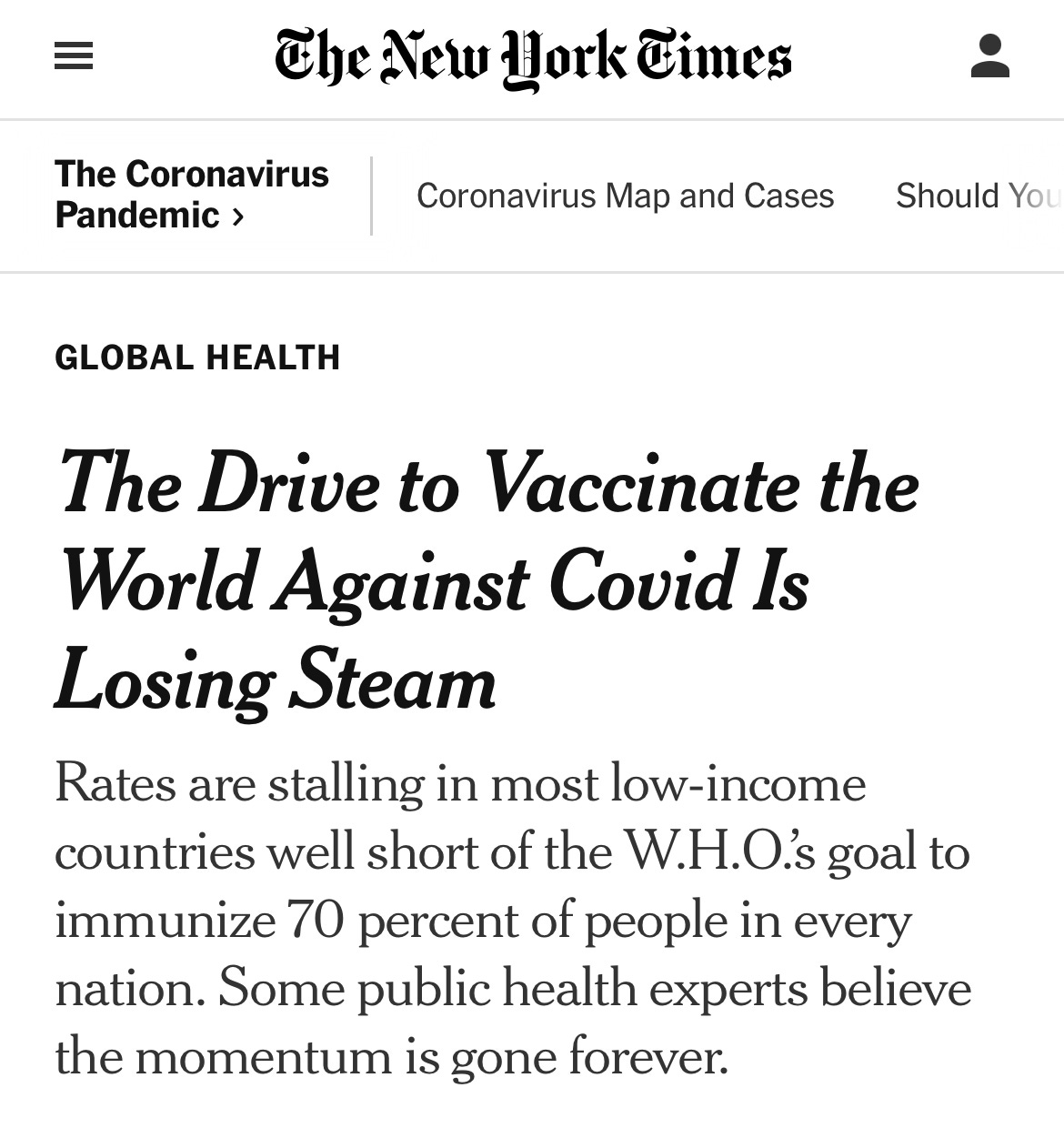
Seems African countries couldn’t care less about Covid vaccines:
Gee, I wonder why?
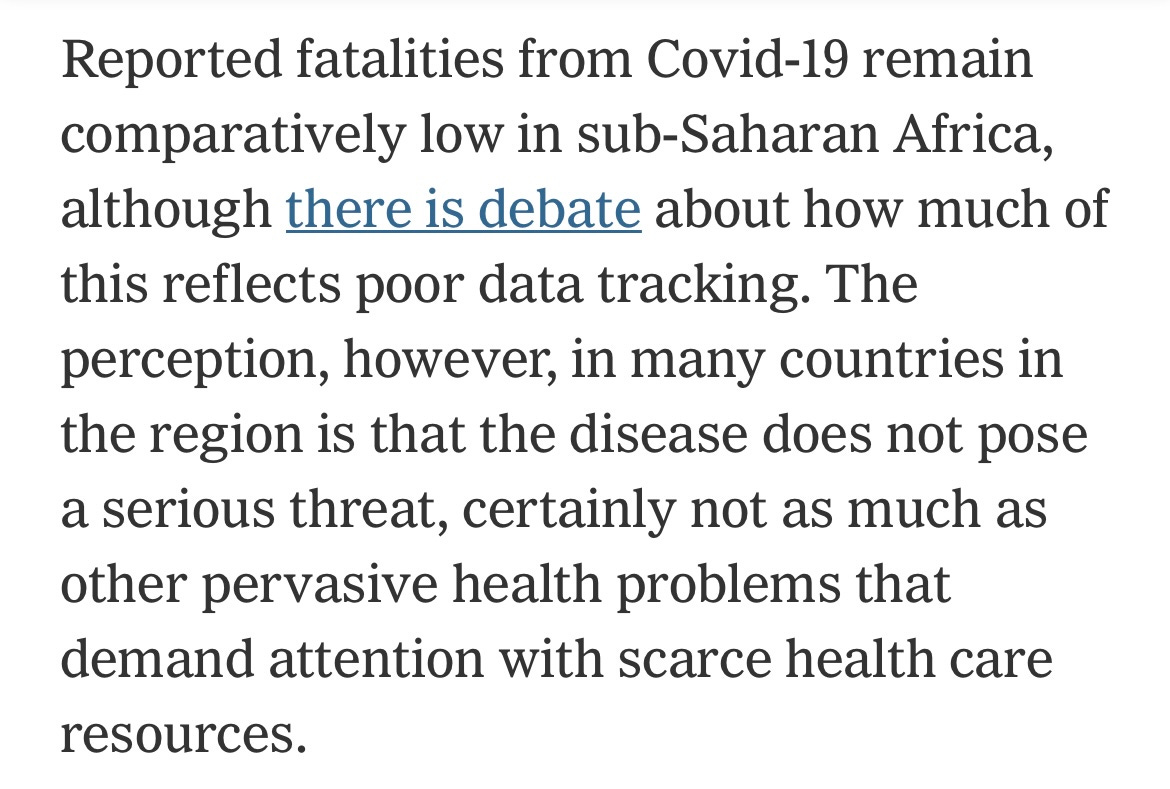
Covid “does not pose a serious threat”? Did those words just appear in the New York Times?
Diana Zicklin Berrent’s newly-single-lady apartment has just frozen over.
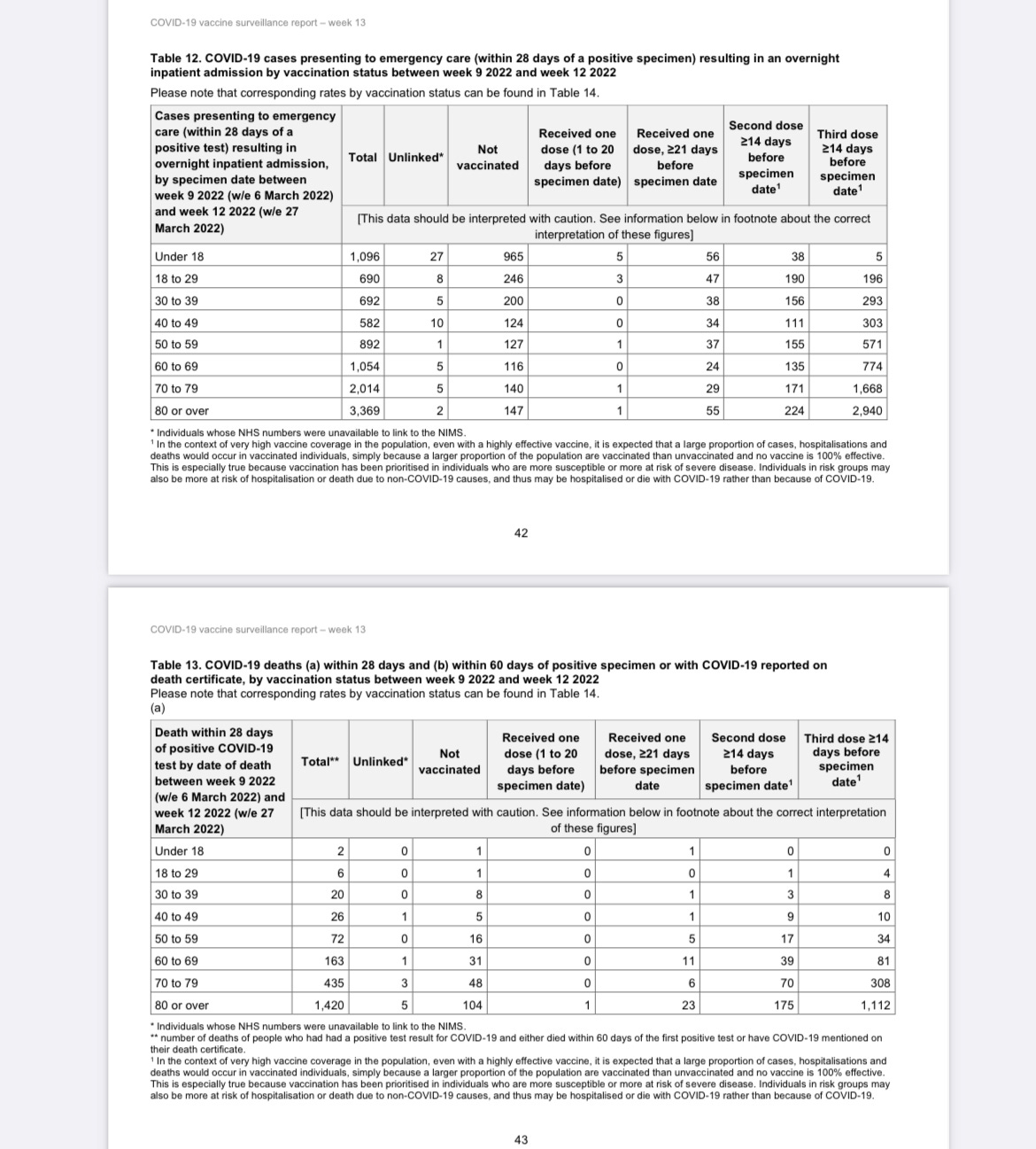
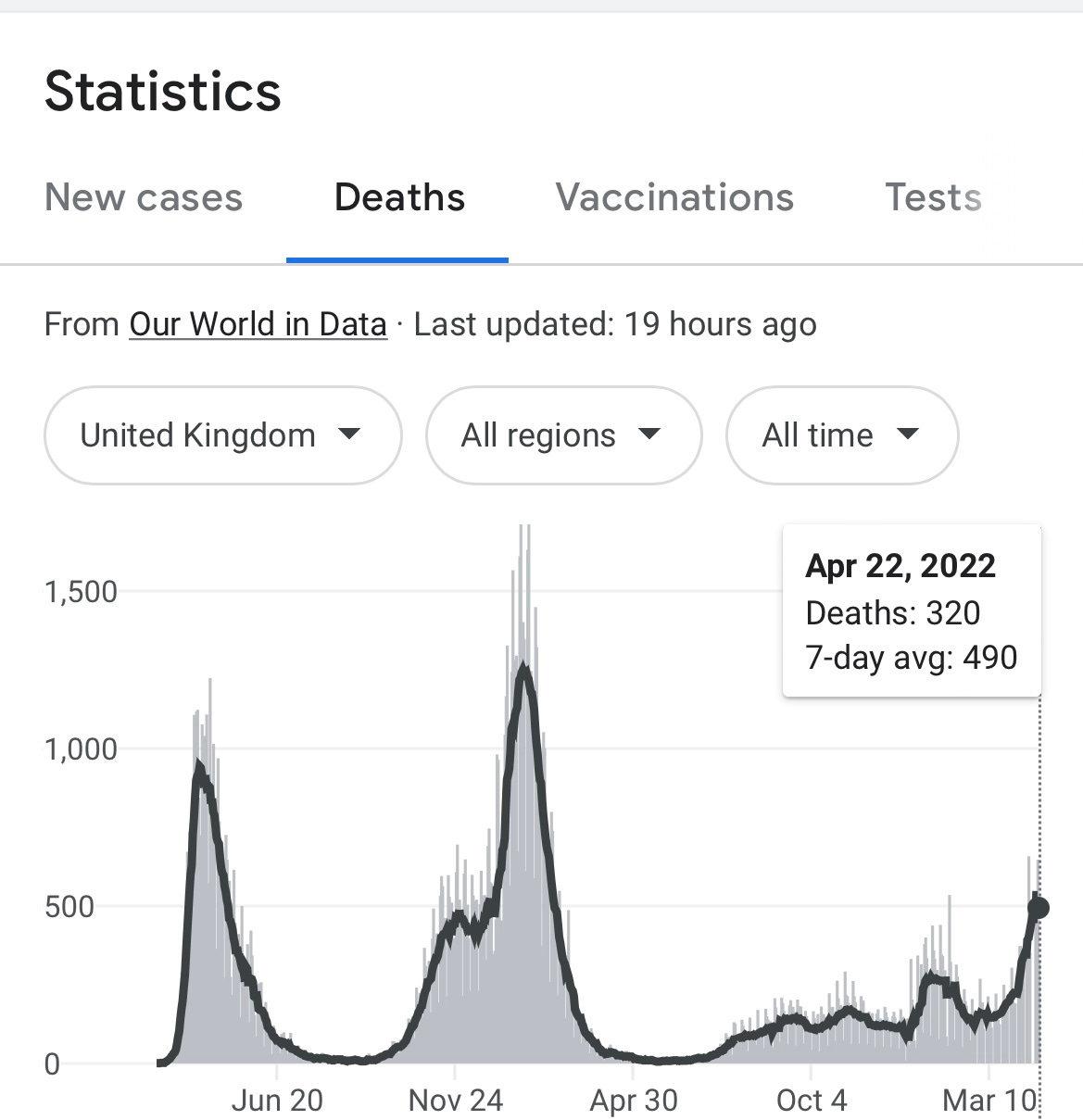
But wait! Doesn’t Africa want to replicate the success that Britain – 90% adult vaccinated, 70% boosted Britain – has had in eradicating Covid?
Yeah, about that:
It’s looking more and more like the African decision to let the wazungu try the magic new medicine first will go down as the continent’s first great win of the 21st century.
Collective security, the official goal of NATO, the North Atlantic Treaty Organization, seems plausible on its face. A group of nations ostensibly concerned about a common threat agree to defend one another in the event of an attack. “All for one and one for all,” as the Three Musketeers said.
But like many things, the principle, even if sincerely invoked, is more problematic than the first glance indicates. This is particularly true with governments, and in no area more so than foreign policy and armed forces. Schoolyard analogies involving bullies do not hold.
NATO was established soon after World War II ostensibly to keep the Soviet Union from overrunning Western Europe. The Red Army was present in Eastern and Central Europe, including eastern Germany, having driven back the Wehrmacht in the Allied defeat of Nazi Germany. It is by no means clear that Soviet dictator Josef Stalin aspired to have his armed forces conquer Western Europe, and his doctrine of “socialism in one country,” which suggests a conservative foreign policy, hardly supports a militarily aggressive posture toward the West. For one thing, the Soviet Union was exhausted from the savage war – it lost well over 20 million military personnel and civilians – and was hardly in a position to begin a new one against the Americans.
While many American politicians, fearing a return of the prewar public sentiment against foreign intervention, spoke of a Soviet threat, not all agreed. The influential Republican senator Robert A. Taft of Ohio, whom I will discuss below, questioned the consensus and thus the official premise of the Cold War.
On April 4, 1949, 12 countries – the United States, Canada, Great Britain, France, Belgium, the Netherlands, Luxembourg, Portugal, Italy, Norway, Denmark, and Iceland – signed the treaty that created NATO. (The Warsaw Pact, the Soviet Union’s counter-alliance with the Eastern European countries it occupied, would not be founded for another six years.) Since 1998, 18 more countries have joined NATO, for a total of 30, including former Warsaw Pact members and the former Soviet Baltic republics that border Russia – with the predicted disastrous consequences. (Austria is not a member, having agreed to neutrality in 1955, in return for the Soviet withdrawal. West Germany became a member in 1955, and then a reunified Germany became a member in 1990 as the Soviet Union and Warsaw Pact were being dismantled.)
The heart of the treaty, the “all for one and one for all” provision, is Article 5:
Among economists who study the effects of education, there is a great divide between those who believe that education augments your skills and thereby enables you to do a better job (the “human capital” crowd) and those who think that education mostly reveals your pre-existing abilities and thereby enables you to get a better job (the signaling crowd). Caplan is firmly in the latter camp.
Almost every book on education policy (and I have read a great many of them) springs from the set of assumptions that education “experts” embrace: that schooling builds our stock of knowledge and skill, that it needs to be done mainly by government, that it makes us better human beings, and that we owe our prosperity to our great “investment” in education, kindergarten through college.
Among the tiny number of books that challenge the conventional wisdom about education, the latest and perhaps the most daring is Bryan Caplan’s Case against Education. Caplan, a professor of economics at George Mason University, is not, of course, against people’s acquiring skills and knowledge, but contends that our current system of education does a poor job of that, and at inordinate cost to taxpayers. He would like to see government subsidies for education stopped and believes that in an ideal world, education would be kept separate from the government.
Caplan puts his case starkly: “Most critics of our education system … miss what I see as its supreme defect: there’s way too much education. Typical students burn thousands of hours studying material that neither raises their productivity nor enriches their lives. And of course, students can’t waste time without experts to show them how.”
At this point, nearly all readers will be thinking, “Well, that is obviously wrong, since we know that college brings a handsome payoff to graduates. That college premium certainly shows that more years of education are valuable.”
Here is Caplan’s reply: “How could such a lucrative investment be wasteful? The answer is a single word I want to burn into your mind: signaling. Even if what a student learned in school is utterly useless, employers will happily pay extra if their scholastic achievement provides information about their productivity.”
How signalling works
Among economists who study the effects of education, there is a great divide between those who believe that education augments your skills and thereby enables you to do a better job (the “human capital” crowd) and those who think that education mostly reveals your pre-existing abilities and thereby enables you to get a better job (the signaling crowd). Caplan is firmly in the latter camp. He argues that the education premium that people enjoy for having crossed various educational thresholds is about 80 percent due to signaling and only 20 percent due to human capital improvement.
Education signals three broad traits: intelligence, conscientiousness, and conformity. Employers of all kinds want workers with those traits. While it is possible for a person to acquire them in the absence of formal education, it’s almost impossible to let the rest of the world know that — and without such knowledge, few employers will take a chance on you.
Suppose you try to signal your employability in some way other than by getting educational credentials, say by dropping out of high school to prove the Riemann Hypothesis or something equally brainy. Unfortunately, even if you are able to convince some people that you’re a math genius with your proof, to most employers that actually sends a bad signal — your lack of conformity. Trying to get noticed without educational credentials rarely works. Consequently, Americans have become so fixated on those credentials that nearly everyone feels compelled to play the expensive “sheepskin” game.
A fraudulent profession has been exposed to the world.
What is left of the Public Health expert class is a variety of ridiculous people who, like the last members of a dying cult, are lashing out to justify what is left of their relevance. The entire Public Health schtick has been exposed as fraudulent. COVID Mania showed us that this outfit is largely nothing more than ideological authoritarians, failed statisticians, midwit academics, and the occasional academic MD who advocates via virtue signal for their non existent patient roster.
The very concept of Public Health, once a rather innocuous term, is facing an extinction level event, and Americans should be incredibly thankful for this development.
Sometimes, when a people are faced with a grand crisis, a bold new idea or group of individuals moves humanity forward in ways once thought of as improbable, if not impossible.
But the elevation of the supposed masters of Public Health has achieved the opposite effect. It is now a term that half of America reacts to with some combination of revulsion and mockery, and rightfully so.
Prior to the pandemic, America’s Public Health “experts” were rarely heard or seen. In the past, these forces would arise from obscurity to tell us the world is coming to an end, only to be routinely dismissed, forcing them to crawl back underneath the surface. With COVID Mania, that all changed. And now that we’ve seen what this profession is truly about, many long for the days when the insignificance of the Public Health man is restored to his proper place in society.
Pre-2019, the individuals that are relentlessly populating our corporate press and policy circles were just run of the mill collectivists, a collection of over credentialed and underachieving individuals doing niche “research” to justify their existence in a variety of academic circles, or pushing paper in a government or pharmaceutical bureaucracy. The savior complex they seem to collectively embody had not yet shown its face.
Prior to COVID Mania, panic profiteer Eric Feigl Ding was co-authoring research papers about diarrhea. Deborah Birx was a no name bureaucrat giving lectures sponsored by the Gates Foundation about Aids in Africa. Anthony Fauci was peddling a variety of Ebola-related pharmaceuticals (some things never change). Pfizer’s Scott Gottlieb was… doing the same thing, but without a Wall Street Journal column and a weekly national television appearance. And the Public Health chairs of the various China-funded Ivy League academic departments were lecturing their students about equity and racism, and promoting their favorite socialist heroes.
A Polish friend of mine in Vegas, Paul P., was hosting his sister-in-law from back home. Mariola is quite cultured, beautiful, speaks nearly perfect English, and is very politically savvy – – – she was the protoge’ of economics professor Leszek Balcerowicz who became Poland’s first post-communist finance minister.
On the way back from Los Angeles, they passed a highwayman, ah, that is, a Highway Patrol officer, along the side of the road rummaging through a motorist’s open trunk.
Since I was regarded as the resident expert on American ethnology at the time — at least among my Polish friends — Mariola later asked me what had been going on. I explained that despite previous challenges, according to an at-that-time-recent Supreme Court ruling, American cops had the de-facto right to search in the trunk of your vehicle, and that if you didn’t open up “voluntarily,” they could and would force it open. It’s true. She didn’t believe me at first. “Surely you are joking,” she said. “This is America. They cannot do that – – – even in Poland!” This was before the 1989 Revolution — before the Berlin Wall came down. At the time, Poland was still “communist.”
I in turn didn’t quite believe her. “That’s completely at odds with what we were taught about communist countries. Polish cops can’t even make you open the trunk to your car?” I asked.
“Not without special paper,” she stated. “Not even secret police.”
Mariola was clearly incensed that American cops could do what Polish cops couldn’t, not even during communism.
Chrissy and I were visiting Poland shortly after the wall came down, and got a little first hand experience. Our rented car was parked at an open-air market, when an officer approached us.
After cracking the language barrier, we discovered he wanted to look in the trunk. We asked why. He told us that he thought the car might be stolen and he’d be able to tell by checking the spare tire – – – or something. (We’d only cracked the language barrier apparently, not broken it entirely.)
At the time, because of certain legal anomalies, Poland was a hotbed of cars stolen elsewhere in Europe, so the request wasn’t really out of line. We were reasonably sure our rented car wasn’t stolen — it was a Polish Lada (Fiat) — so we decided to see what would happen if we told the guy “No.”
When we did, he thanked us politely and went on his way. Now there’s a polite policeman! We asked our hosts how they ever caught any crooks. They told us that if he’d had anything much to go on, he’d have been more persistent, but he still wouldn’t be able to check the trunk without permission — or that special paper.
Mariola spent quite a bit of time in the U.S. and even got a Nevada driver’s license. Just before she left America for the last time, she told me why she would never come back.
“You have to worry about how much money you bring into the country, how much you take out. You have to keep financial records, not for yourself, but for your IRS. Is this the sign of a free country? You have more police and more laws making more things illegal than any other country in the world. Is this the sign of a free country?
“They told us we lived in free country too.
“I never believed all those propaganda stories they told us about America when I was a child, but I do now.”
“America isn’t free,” she said. “It starts with your driver’s license. When the police stop me in Poland, the only thing they know about me is my name and where I live. Here they go to those computers they have in their cars. They know if I’m married or single, who my husband is, how many children I have. They can find out if I have had any other contact with the police, what my income is or if I’m unemployed. If I were an American, they would know my national identification number — you call it ‘Social Security.’ With that, they could even look at my credit card and spending habits, military record, school grades and even find out my blood type.”
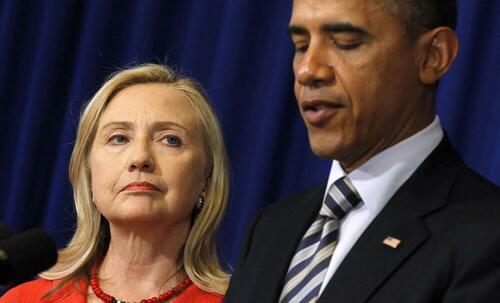
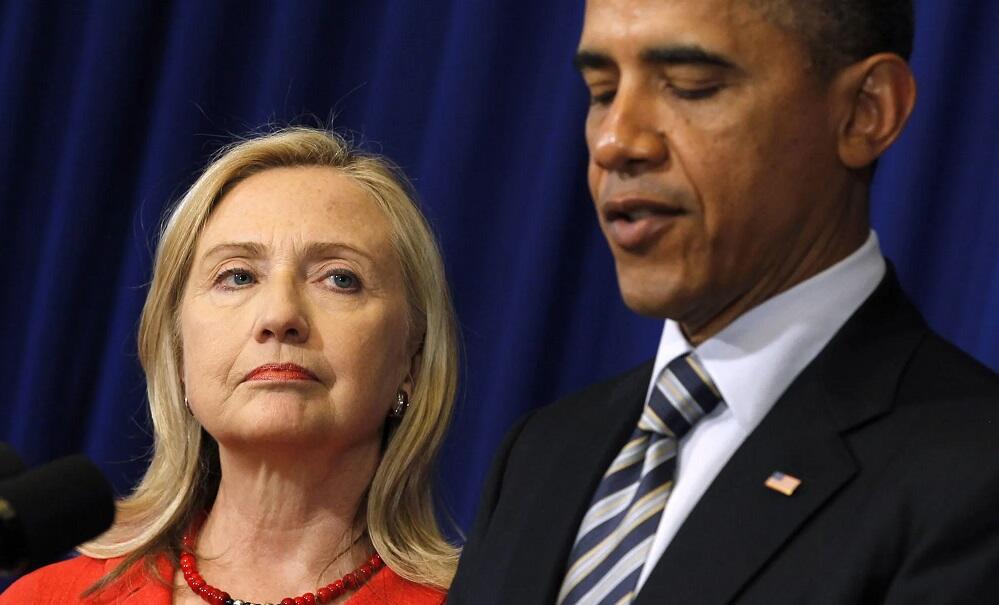
Over the last 24 hours, former President Barack Obama and twice-failed presidential hopeful Hillary Clinton have come out against free speech – calling for big tech to go further to censor views they disagree with.
On Thursday, Obama told an audience at Stanford University that tech companies are “turbo-charging some of humanity’s worst impulses,” adding “One of the biggest reasons for the weakening of democracy is the profound change that’s taken place in how we communicate and consume information.”
He then said that people are ‘dying because of disinformation.’
Obama goes on psychotic rant, claims people are dying because of “misinformation”. pic.twitter.com/uHBeKpT7rI
Obama’s ‘misinformation’ shtick was largely a repeat of a speech he gave two weeks ago in Chicago, when he claimed “You have to fight to provide people [with] the information they need to be free and self-governing.” In other words, government-approved narratives.
As The Federalist noted, however, Obama “Spied on the Donald Trump campaign with a secret court warrant backed by the Hillary Clinton campaign-funded Christopher Steele dossier which, in an ironic twist, was the product of Russian disinformation. Democrats used this disinformation to repeatedly smear President Trump and undermine the integrity of the 2016 election.”
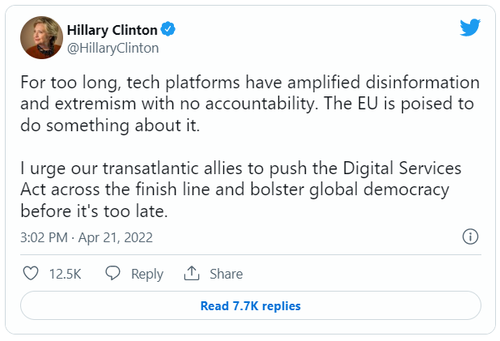
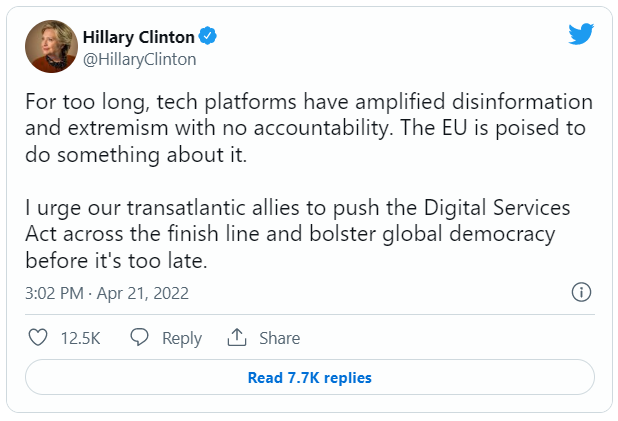
Hillary Clinton joined the fray on Thursday, tweeting “For too long, tech platforms have amplified disinformation and extremism with no accountability,” and called on “our transatlantic allies to push the Digital Services Act,” aimed at regulating online platforms.
Of course, Hillary Clinton funded the Russian disinfo dossier that Obama’s administration used against Trump, and the former British spy that was paid to fabricate it pushed it to major news outlets which peddled the misinformation as long as they could squeeze blood from that stone.
Dispensing with the many sacred cows of the managerial state is key to changing society’s views of the state and moving toward a society based on subsidiarity and voluntary association. Once the luster of government agencies like the FBI is gone, ushering in substantive reforms such as defunding the FBI and outright abolishing it becomes much more feasible.
Will the mainstream Right rethink federal law enforcement?
The past six years have witnessed America enter a bizarro world state where Democrats are the prowar, prosurveillance state party, while Republicans have looked rather restrained in comparison.
For example, Dinesh D’Souza floored onlookers in 2021 by calling for the abolition of the Federal Bureau of Investigation in one of his op-eds. In an article titled “Abolish the FBI,” D’Souza argued that the federal law enforcement agency has been “corrupted from the top,” its deterioration starting in the Obama administration and continuing apace during the Trump administration. D’Souza also contrasted the FBI’s treatment of Antifa and Black Lives Matter with that of the January 6 demonstrators. The FBI vigorously hunted the latter group while treating the aforementioned leftist groups with kid gloves.
In fairness, D’Souza’s belief that the FBI has been recently politicized is an inaccurate depiction of the institution’s controversial history. The FBI’s involvement in arresting and snooping on antiwar protesters during World War I and the Vietnam War, coupled with the controversial sieges it carried out at Ruby Ridge and Waco, showcases a longstanding track record of malfeasances that conservatives have largely overlooked. Pace D’Souza and fellow conservative commentators like Sean Hannity, the FBI’s politicization is not a recent development; it’s been a feature since its very foundation.
Nonetheless, it’s still a significant improvement to see D’Souza—a major booster of neoconservative programs—push a proposal (FBI abolition) that has never been on the conservative menu.
But there is still significant institutional inertia in DC and the conservative movement is ideologically committed to playing the role of progressivism driving the speed limit. All told, these factors make one justifiably skeptical of sentiments coming from the likes of D’Souza.
The aftermath of the January 6, 2021, storming of the Capitol provided a sneak preview of what’s in store for anyone on the ostensive Right who dares to deviate from acceptable norms. In likening January 6 to Pearl Harbor and 9/11, the ruling class has laid the groundwork for a campaign to categorize broad swathes of the Right as “domestic extremists,” “terrorists,” and enemies of the state.
There is something to be said for how an incident like January 6, especially the way the ruling class responded to it, has likely pushed significant numbers of conservatives over the edge. The allegations of abusive treatment of January 6 demonstrators who are currently imprisoned has undoubtedly tarnished the US’s image as a bastion of freedom. When countries like Belarus are offering asylum to January 6 attendees in the crosshairs of the Potomac regime, the US’s “exceptionalist” brand has to be called into question.
Republicans are poised to retake the House and Senate in the 2022 midterms. On paper, Republicans could put forward spending proposals that downsize the FBI’s budget. These questions will soon be answered. And if history is any guide, one cannot expect much from conservatives in elected office. More often than not, grassroots voter bases are more sensible than party leadership; a dynamic that often creates a major fissure between party elites and their voters.
Many of these people who are questioning the deep state are not by any stretch of the term right-wing extremists. They’re likely normal Republican or “realignment” voters who have grown disillusioned with the current political system. So much so that they’re beginning to rethink the very legitimacy of institutions that enjoy quasi-religious devotion from America’s bien pensants.
In previous eras, the average American treated alphabet soup agencies as normal features of national politics. Most couldn’t even fathom the prospect of abolishing an agency like the FBI. It would almost seem like a doomsday scenario. The amusing part of such fears is that the US did not have any law enforcement body resembling the FBI for well over a century, and the sky never fell in that epoch of American history.
Thanks to the relentless propaganda from educational institutions and the corporate press, people have been conditioned to treat the FBI as a sacred institution. Upon reviewing the FBI’s history, it functions as a blunt instrument for a ruling class that is always looking for a nail to hammer down. For anyone who believes in a society predicated on voluntary association, property rights, and the respect for privacy, the FBI is not only nonessential but also represents an existential threat to the traditional liberties that Americans champion.
The modern conservative movement has made a litany of mistakes from cosigning on the welfare state to being enthusiastic boosters of the intelligence community and national security state. Their devotion to the status quo has blinded them to how the very monster state they support or at least tacitly accept is now being used against them. With state actors wanting to treat various factions of right-leaning Americans like Islamist insurgents in Iraq and genuine domestic terrorists, conservatives are getting a rude wake-up call about the dangers of trusting the federal behemoth.
As they say, it’s better late than never. The more conservatives and other mainline constituencies grasp the depraved nature of the state, the more likely significant changes can be made in American politics. There exists considerable distrust toward America’s otherwise vaunted electoral institutions, as demonstrated by a 2021 Yahoo News/YouGov poll that showed two-thirds of Republicans believe the 2020 election was rigged.
Dispensing with the many sacred cows of the managerial state is key to changing society’s views of the state and moving toward a society based on subsidiarity and voluntary association. Once the luster of government agencies like the FBI is gone, ushering in substantive reforms such as defunding the FBI and outright abolishing it becomes much more feasible.
José Niño is a freelance writer based in Austin, Texas. Sign up for his mailing list here. Contact him via Facebook or Twitter. Get his premium newsletter here. Subscribe to his Substack here.
Not everyone is happy that we’re not wearing masks on airplanes anymore.
Some people are saying it’s too risky to take the masks off. But that means they’re assuming the masks do anything in the first place, and they clearly don’t. We’ve observed the uselessness of masks for a very long time now. That anyone at all is still clinging to them is astonishing.
In case you’d like to buttress your own case against them, here is the definitive masks-don’t-work episode of the Tom Woods Show: https://tomwoods.com/ep-2051-the-definitive-masks-dont-work-episode/ The Fauci response to the decision is worth hearing, because it says so much:
“[I’m] both surprised and disappointed, because those types of things really are the purview of the CDC. This is a public-health issue. And for a court to come in — and if you look at the rationale for that it really is not particularly firm. And we are concerned about that, about courts getting involved in things that are unequivocally public-health decisions. This is a CDC issue. It should not have been a court issue.”
We already knew that’s how Fauci felt about restraints on him or on “public health” at large, but it’s refreshing to hear him state it so clearly.
We can’t have legal recourse against these people because they’re looking out for what’s best for us.
This is how every dictator speaks. Dictators rarely say: “I’m ruling over you because I’m an evil bastard.”
Not to mention: so-called public-health experts have been embarrassingly wrong about masks again and again. Their so-called studies amount to isolating a narrow period of time in which a masked area had better results than an unmasked area. But when you zoom out and look at the entire Covid period we’ve lived through, that pattern no longer holds. They are trying to snow the public. There is no other explanation for behavior like that.
Even someone like CNN medical commentator Leana Wen, who went so far as to favor mandatory vaccination for interstate travel, has said that cloth masks — which Dr. Fauci still defends — are nothing more than facial decoration. But we’re supposed to believe that enough unanimity exists on masks that challenging them is unthinkable?
Fauci’s star keeps fading, as fewer and fewer people care about his recommendations.
It’s about blankety-blank time.
If you took my advice, on the other hand, then (1) you’ve avoided masks because you know they’re useless, and (2) you spent a little time yesterday away from the crazies who hate you and think nothing of ruining your life, and instead did something enriching: you learned about how to create the kind of membership business I myself have three of, and which are an excellent way to create a comfortable side hustle for yourself for when the SOBs come after you again.
For those of you who may not have time for a three-day workshop on the subject, my old podcast guest Stu McLaren is offering a one-session summary version this weekend.