
FCC – Another gaggle of non-elected bureaucrats that needs reined in.
Sen. Ted Cruz (R-TX) questions Gigi Sohn, the nominee to be Commissioner of the Federal Communications Commission during a Senate Commerce Committee hearing.
Be seeing you

Enemy of the State-Read the Book-Know the Man
This is not a Safe Space but Baby, I don't care.

"I am not a number, I am a Free Man" - No. 6
 Information Liberation Alex Jones’ Prison Planet Gary North Specific Answers Antiwar The Daily Bell Tenth Amendment Center Economics Policy Journal The American Thinker The New American Lew Rockwell
Posted by M. C. on February 10, 2022
FCC – Another gaggle of non-elected bureaucrats that needs reined in.
Sen. Ted Cruz (R-TX) questions Gigi Sohn, the nominee to be Commissioner of the Federal Communications Commission during a Senate Commerce Committee hearing.
Be seeing you
Posted in Uncategorized | Tagged: Federal Communications Commission during a Senate Commerce C, Gigi Sohn, Secret Settlement, Ted Cruz | Leave a Comment »
Posted by M. C. on February 10, 2022
It’s probably worth mentioning that after Kansi was executed, four American citizens were assassinated in Pakistan in retaliation.
What we need in America is a great awakening, one that involves a revival of individual conscience. When that day comes, Americans will put a stop to the evil within our midst by converting America back to a limited-government republic and putting an end to state-sponsored murder. It will also make Americans traveling overseas a lot safer.
Four years later, FBI agents arrested Kansi in Pakistan – Another problem, a US domestic enforcement organization on the other side of the planet.
On the morning of January 25, 1993, a man named Mir Amal Kansi appeared outside CIA headquarters in Langley, Virginia, where he began assassinating people who were driving their cars into the facility. He ended up killing two CIA employees and wounding three others.
Four years later, FBI agents arrested Kansi in Pakistan and brought him back to the United States.
Kansi was prosecuted in a Virginia state court for murder, where he was convicted and sentenced to die. On November 14, 2002, the state of Virginia executed him.
What I find fascinating in this episode is that under U.S national-security law, when the CIA assassinates people, it isn’t considered murder. But as Kansi’s case shows, when people assassinate CIA officials, it is considered murder.
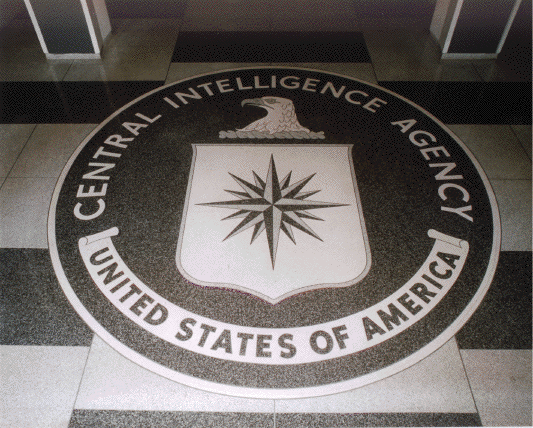
Kansi gave the reason for his assassinations. No, he didn’t say that he hated America for its “freedom and values.” He said that the reason he was assassinating CIA officials was to retaliate for the fact that the U.S. government was killing people in Iraq and for its role in helping Israel kill Palestinians.
Under U.S. national-security law, U.S. officials can assassinate anyone they want — “communists,” “terrorists,” “bad guys,” “adversaries,” “opponents,” “rivals,” or “enemies.” When they do that, it’s to be called an “assassination” or a “targeted killing.”
Moreover, under the law, U.S. officials can kill whoever they want with economic sanctions, as they were doing with the Iraqi people at the time that Kansi was retaliating. I am reminded of U.S. Ambassador Madeleine Albright’s infamous statement that the deaths of half-a-million Iraqi children from the sanctions were “worth it.” Those killings weren’t called “murder” of course. They were called unfortunate deaths arising from the sanctions.
U.S. officials also wield the authority to kill whoever they want with invasions of Third-World countries. The people of Afghanistan and Iraq can attest to that. Again, those killings are not considered to be murder. They are considered to be casualties of war.
If, however, anyone retaliates against the national-security establishment by assassinating officials within the national-security establishment, it’s called “murder,” in which case the assassin will be put to death after being accorded a trial.
Of course, this was the law prior to the 9/11 attacks. After those attacks, the law was implicitly amended to provide that the national-security establishment had the option of taking “bad guys” like Kansi to Gitmo, where they could be tortured, held indefinitely without trial, or executed after a kangaroo trial before a military tribunal.
All this hypocrisy goes to show what the conversion from a limited-government republic to a national-security state has done to the consciences of the American people. Most everyone has come to accept the state-sponsored assassinations and deaths arising from sanctions, embargoes, invasions, occupations, and wars of aggression as just part and parcel of the U.S. government’s “foreign policy tools.”
As I pointed out in a recent blog post, however, the Pentagon’s and the CIA’s assassinations do constitute murder, just as Kansi’s assassinations do. Why, even Lyndon Johnson referred to the CIA’s assassination program as a “Murder, Inc.,” which is precisely what it is. The same goes for deaths arising from sanctions, embargoes, wars of aggression, invasions, and occupations. It’s just plain murder.
Referring to Kansi, Virginia prosecutor Robert F. Horne stated, “I’ve tried an awful lot of killers in my life, and I think he’s the only one I’ve run into that is absolutely proud of what he did. You get a lot of killers who don’t feel all that bad about what they did, but he’s proud of it.”
Apparently Horne has never met any CIA assassins or other federal officials who kill people. Like Kansi, they feel really good about their killings and are absolutely proud of what they do, especially when they’re killing people through assassination, sanctions, embargoes, invasions, occupations, and illegal wars of aggression.. What Horne fails to realize is that even though Kansi is a “bad guy” for assassinating people, that doesn’t convert CIA assassins and other U.S. officials who kill people into “good guys.”
It’s probably worth mentioning that after Kansi was executed, four American citizens were assassinated in Pakistan in retaliation.
What we need in America is a great awakening, one that involves a revival of individual conscience. When that day comes, Americans will put a stop to the evil within our midst by converting America back to a limited-government republic and putting an end to state-sponsored murder. It will also make Americans traveling overseas a lot safer.
This post was written by: Jacob G. Hornberger
Be seeing you
Posted in Uncategorized | Tagged: assassination, CIA, FBI, Hypocrisy, Mir Amal Kansi | Leave a Comment »
Posted by M. C. on February 10, 2022
This year Congressman Emmer proposed a bill to limit the Fed’s ability to issue its own digital currency. He says that a CBDC is an Orwellian surveillance tool, and that we should not be trying to emulate China. He has been an outspoken advocate for financial privacy, and so we chatted to him about cryptocurrencies, and whether the SEC and Fed are taking us down a dangerous path.
https://emmer.house.gov/2022/1/emmer-…
Be seeing you
Posted in Uncategorized | Tagged: CBDC, cryptocurrencies, digital currency, Fed, financial privacy, Rep. Emmer | 1 Comment »
Posted by M. C. on February 10, 2022
That is the problem with closed regimes like we have in Washington. No one can see inside to figure out what is happening. Everyone inside sees everyone outside as a possible enemy, so no one talks candidly about what is happening. Everything operates inside of a black box. No one sees in and no one sees out. To the outside the world, the regime looks increasingly paranoid and dangerous. Eventually, it burns through its legitimacy and we arrive at a Ceausescu moment.
by thezman
Note: For those in need of some audio stimulation, my appearance on Cotto & Gottfried is now up on iTunes. It is mostly about the state of conservatism.
It has been noted many times now that people in the West have to read American media the same way they used to read the Soviet media. Most of what we get from mainstream sources is the natural propaganda one expects from the toadies and bootlickers that follow every authoritarian regime. Other pieces are planted by regime elements for reasons that are not always obvious. As with Kremlinology a generation ago, regime-ology is something of sport now.
For example, the regime keeps planting these stories about an imminent Russian invasion of Ukraine in their favorites outlets. A few days ago this entirely made up report was sprinkled all over regime media. It painted a grim picture of the attack that we are told was happening any minute. Of course, the White House comes out every day and tells the stenographers in the press pool that the Russians will invade Ukraine as soon as tomorrow, but tomorrow never comes.
Today we have the latest regime scare story written by one of the zombies at their favorite outlet. The point of this story is to embarrass French President Emmanuel Macron who is trying to work out a deal with the Russians. He has been meeting with the parties the last two weeks to put an end to the situation. Unlike the Washington regime, Europe has no interest in war over Ukraine. The Europeans can read a map and they are not insane.
For a long time, it was assumed that the reason for the war drums from Washington was due to so many pols being on the Ukrainian payroll. We know the Biden family has been taking bribes from Ukraine for over a decade. That was one of those interesting stories that arose from the second impeachment of Trump. This tiny little corrupt country in Eurasia had a lot of friends in both political parties. The best sort of friends, the kind that can be bought and will stay bought.
That may be part of it, but it is clear that the Ukrainians have no desire to be the battleground in a new Cold War. For their part, the Russians have made clear they will never tolerate Ukraine in NATO. This should be an easy demand to meet, as no one in NATO, other than the Washington regime, wants Ukraine in NATO. Everyone in Europe understands the reality of Ukraine. It is a hyper corrupt kleptocracy that would be better off turned into a federalized neutral zone.
The other aspect of this is that the stories about the Russian military buildup appear to be mostly fake. The Russians are free to conduct exercises in their own land, which is what they have been doing thus far. They have not been sending weapons or “advisers” to the friendly militias operating in Ukraine. The CIA has been conducting covert operations with friendly militias for a decade now. In other words, this whole thing is one long running color revolution.
That raises the obvious question. If no one in Europe wants a war over Ukraine and the Ukrainians are not interested in a war, what is really going on here? One option is the permanent foreign policy establishment is infested with paranoids who wake in the middle of the night to the sound of hoofbeats. That has been an amusing line for years, but it would be a terrifying reality. Is the Ukraine mess really the result of deranged fanatics operating in the Washington foreign policy establishment?
Another less terrifying option is energy. The one thread that ties the foreign policy misadventures of the last thirty years together is energy. Russia has partnered with Iran and Syria because of energy. If they can control of natural gas out of the Middle East into Europe, that gives them leverage. Nord Stream 2 is a regular topic for the regime media, so it is fair to assume that the regime is worried about it. In this context, Ukraine is just a convenient cat’s paw in a larger geopolitical game.
What the regime is hoping for is an invasion of Ukraine that would then force the Europeans, especially the Germans, to kill Nord Stream 2. The Russians would remain the primary supplier of natural gas to Europe, but they would not become the exclusive supplier of energy. If Nord Stream 2 comes online Washington loses most of its leverage over Europe with regards to Russia. This is why they are so committed to this narrative about a Russian invasion. It has to happen.
The problem with this scenario is that it is too late to kill Nord Stream 2. The pipeline is complete and filled with gas. The last step in the project is for Germany to start using the gas and pay the Russians for it. No sane person can imagine a scenario in which this project is shut down. Even an invasion of Ukraine by Russia would only delay the opening of the pipeline. The Germans want the gas, the Russians want to sell it to them, so that deal will be consummated no matter what.
One interesting side bar to this is that the regime is certain they can jawbone the Russians into invading Ukraine. They also seem to think they can convince the world that a war is imminent. It is one of those examples where the regime reveals how disconnected they are from reality. Exactly no one seems to be falling for this disinformation campaign, especially the Russians. Yet the regime keeps running these stories in their media as if they are working.
As was the case with Kremlinology, we are left with our best guesses as to why the Washington regime is hyper-aggressive toward Russia. It could simply be cultural momentum within the foreign policy establishment. No one inside the regime knows why they have to talk about Russia as the great villain. It has just been the way it has always been. No one questions it, so the cultural inertia inside the system just keeps pushing the political class into confrontation with Russia.
That is the problem with closed regimes like we have in Washington. No one can see inside to figure out what is happening. Everyone inside sees everyone outside as a possible enemy, so no one talks candidly about what is happening. Everything operates inside of a black box. No one sees in and no one sees out. To the outside the world, the regime looks increasingly paranoid and dangerous. Eventually, it burns through its legitimacy and we arrive at a Ceausescu moment.
If you like my work and wish to kick in a few bucks, you can buy me a beer. You can sign up for a SubscribeStar subscription and get some extra content. You can donate via PayPal. My crypto addresses are here for those who prefer that option. You can send gold bars to: Z Media LLC P.O. Box 432 Cockeysville, MD 21030-0432. Thank you for your support!
Be seeing you
Posted in Uncategorized | Tagged: Ceausescu, Emmanuel Macron, NATO, Nord Stream 2, Russian invasion, Ukraine | Leave a Comment »
Posted by M. C. on February 10, 2022
Yet, while Boris Johnson of UK is abolishing the COVID-19 passes, mask mandates, and work-from-home requirements, Austria has gone full-bore nazi, requiring nearly all citizens over age 18 to get the genetic “vaccine.” Those who refuse will face heavy fines and could be placed in a concentration camp or “quarantine” until they comply.
A globalist cabal comprising less than One-Thousandth Of One Percent of humanity has succeeded in injecting over 10 billion doses of a lethal poison into at least 4.84 billion people. It’s a stunning feat, by any measure.
This genetic-modification treatment, falsely labeled a “vaccine,” has already killed millions of people around the the world and severely damaged hundreds of millions, according to the official data of the US, UK, and EU. In the months and years ahead, a lot more people will die from these so-called Covid “vaccines,” and many of those who don’t die will face lifelong medical problems and wrecked immune systems from the shots and the boosters. Meanwhile, the vaccine juggernaut rolls on.
The experimental mRNA technology used in the Pfizer and Moderna shots has never been used before on human beings. In all previous clinical trials, all or nearly all of the test animals died due to the mRNA “vaccine.” For the latest coronavirus “vaccines”, the animal trials were cut short after 58 days or less, because the vaccine companies suspected what would happen if the trials lasted six months or longer.
Johnson & Johnson, Oxford-AstraZeneca, Russia’s Sputnik V, and India’s Covishield “vaccines” use a different, adenovirus-vector delivery system—but all of the above-named clot-shots reprogram the human body to manufacture hundreds of millions of toxic, synthetic spike proteins.
No medical product in human history has ever before forced people to manufacture a protein. This grotesque, extremely dangerous genetic technology is being deployed in a wholly unnecessary global medical experiment. The unfortunate human guinea pigs in this experiment never gave informed consent because they were never informed of the real risks.
None of the COVID-19 “vaccines” were adequately tested, but their harmful, often devastating effects were well-known to the vaccine manufacturers, who kept this information hidden from the public with the news media’s complicity.
This is clearly a genocide and a democide (“the killing of members of a country’s civilian population as a result of its government’s policy, including by direct action, indifference, and neglect”).
How did the globalist cabal manage to get away with what is shaping up to be the biggest mass murder and the worst crime in human history? It wasn’t that difficult. Here’s how:
1) Propaganda — The Globalist Cabal owns and controls all the major news media and entertainment industry. Six corporations control 90% of what you read, watch, and listen to in the USA, and nine corporations control 90% of all news media worldwide.
This handful of media behemoths are essentially one big interlocking corporation because the One-Thousandth Of One Percent own all of them through Blackrock, Vanguard, and other investment houses.
By means of a massive, unprecedented round-the-clock propaganda campaign, the population was brainwashed and panicked into believing that an alleged respiratory virus (never proven to exist) would quickly kill millions of people unless they got the “vaccine.” Never mind that COVID-19 has an infection fatality rate less than the seasonal flu, and no vaccines, lockdowns, masks, or social distancing were ever necessary.
2) Frontmen — The globalist cabal used frontmen such as sociopathic vaccine-fanatic billionaire Bill Gates, serial killer Anthony Fauci, and former Ethiopian terrorist Ghebreyesus of the World Health Organization to sell its “vaccination” program to the public. Other frontmen owned and controlled by the globalist cabal include Biden, Trudeau, Macron, Merkel, Schellenberg of Austria, Ardern of New Zealand, and Morrison of Australia. Donald Trump, who unleashed the deadly “vaccines” on the public via Operation Warp Speed, and who still avidly promotes the kill-shots, also belongs on this list, although some fans claim he was misled by his advisors.
The One-Thousandth of One Percent own 90% or more of the world’s wealth. They own banks, industries, economies, Big Pharma/Big Medicine, TV and radio stations, newspapers, magazines, universities, Hollywood, social-media companies, the military/armaments complex, and politicians. Through Big Pharma “donations” (bribes) they own and control both houses of the U.S. Congress. That’s why not a single member of the Senate or House of Representatives will call for an end to the lethal “vaccines.” They are corrupt child-killers, complicit in mass murder through their silence and inaction. They are also committing treason by forcing members of the U.S. Armed Services to get the kill-shots, which are decimating the ranks with astronomical increases in cancers, myocardial infarction, autoimmune disease, heart and circulatory disorders, neurological disease, pulmonary embolism, infertility, and miscarriages. China must be positively exuberant! China’s top brass declared years ago that they would destroy the United States without firing a single shot, and they seem well on their way to accomplishing that goal.
3) Censorship — The globalist cabal found ready accomplices in social-media giants like Facebook, Twitter, and Google, along with all the Mainstream Media newspapers, TV and radio stations to censor, vilify, and smear anyone who dares to question the Official Narrative (“the vaccines are 100% safe and effective; the virus is a deadly threat; the unvaccinated are a danger to humanity”).
4) Data manipulation — The number of people who supposedly died from a never-isolated entity called SARS-CoV-2 has been vastly exaggerated. In unfree America anyone who dies from a heart attack, cancer, pneumonia, or in a car crash is counted as “death by COVID-19” if they got a positive PCR test. The fraudulent PCR test is incapable of diagnosing any disease; it generates false-positives up to 97% of the time and can’t differentiate between COVID-19 and seasonal flu, as the CDC and WHO have admitted.
Doctors and clinics are financially incentivized to record every death as a COVID-19 death. Fear-panicked people who rushed to hospital were killed off by Dr. Anthony Fauci via lung-damaging ventilators and the mandated drug Remdesivir, which he knew is a killer-drug causing acute kidney injury and multi-organ failure leading to death within 10 days, as the disastrous Ebola trials proved.
Meanwhile, the millions of vaccine-induced deaths and life-destroying adverse events have been censored by the Mainstream Media. Any such incident is called “a coincidence — no relation to the vaccine”—even though countless people drop dead within a few hours to a couple of days after getting the jab, and millions of other vaxxed individuals immediately start to deteriorate and never recover. “It’s all a coincidence. Nothing to see here. Move along,” says the New York Times, Washington Post, CNN, and the Pharma-paid “fact checkers”.
With a majority of the population jabbed and brainwashed in many countries, the globalist cabal intends to keep using the fake “pandemic” as a pretext to pursue its agenda of population reduction, destroying the middle class, and the creation of a New World Order ruled by a technocratic elite that will impose mandatory repeat “vaccination,” a digital ID vaccine passport, and a Chinese-style digital social-credit system to track and grade all your transactions, health decisions, tweets, and emails.
The Official Narrative is crumbling in many parts of the world, most notably in Canada where 50,000 trucks and countless citizens have converged on the capital, Ottawa, demanding an end to the vaccine mandates and other restrictions. The bought-and-paid-for Mainstream Media will continue to vilify this courageous grassroots protest, and it remains to be seen if it will succeed or be crushed by the globalist puppet Trudeau. Meanwhile, 11 European countries are rolling back COVID-19 restrictions, and Israel has scrapped its “Green Pass” Covid vaccine passport for restaurants, hotels, gyms, and theaters.
Yet, while Boris Johnson of UK is abolishing the COVID-19 passes, mask mandates, and work-from-home requirements, Austria has gone full-bore nazi, requiring nearly all citizens over age 18 to get the genetic “vaccine.” Those who refuse will face heavy fines and could be placed in a concentration camp or “quarantine” until they comply.
The battle against this tyranny is clearly not over, and will require a massive uprising by millions of informed, aware people who have learned the truth about the fake pandemic and the dangerous Genetic Cell-Disruptor Biologics (“vaccines”) which they were tricked or coerced into taking.
If Trucker Freedom Convoys converged on major cities in many countries around the globe, demanding an end to the lethal “vaccines,” the mandates, the vaccine passports, and the oxygen-inhibiting, disease-causing masks, then the plandemic/scamdemic would be over quickly.
But don’t wait for the truckers to save us. Everyone must do their part, at whatever level of society, by saying NO to the globalists’ criminal scheme.
Posted in Uncategorized | Tagged: genetic-modification, Globalists, lethal poison, mRNA | Leave a Comment »
Posted by M. C. on February 10, 2022
DHS is now going after COVID misinformation spreaders considering them terrorist threats. Here’s my list of people I think they should be investigating.
Perhaps in a future article, I can list those who should be acknowledged for not complying such as:
Steve Kirsch’s Newsletter
DHS is getting tough on COVID misinformation spreaders, i.e., people who spread information that “undermines public trust in government institutions.”
Since DHS has finite resources to pursue all these perpetrators, as a public service, I have created a list of what I believe are some of the country’s top misinformation spreaders.
I sincerely hope that the DHS will focus their efforts on these individuals since they have made statements and/or taken actions (or refused to take action) that result in the undermining of public trust in US government institutions.
It is extremely easy to tell who is telling the truth here: it’s the people who are not afraid of debate. The one thing everyone on our list has in common is that they will never agree to debate anyone with opposing views.
These people need to be stopped now and I’m grateful that DHS is finally taking this seriously as innocent lives are being lost.
Read this memo issued yesterday, Feb 7, entitled Summary of Terrorism Threat to the U.S. Homeland.
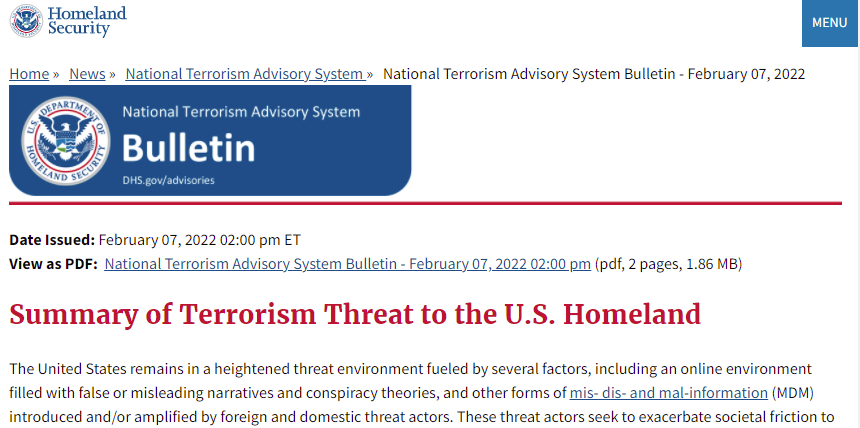
In particular, check this out this section:

Hmmm…I couldn’t come up with any “violent extremist attacks during 2021” that were inspired by this alleged COVID-19 misinformation. Can you?
To make their job easier to pursue these spreaders of COVID-19 misinformation, I’ve compiled a list of the Disinformation Dozen, the top spreaders of COVID disinformation that are literally killing people through spreading misinformation about COVID.
I believe that all of these people are involved in “The proliferation of false or misleading narratives, which sow discord or undermine public trust in U.S. government institutions” and have collectively led to the tragic death of over 1M Americans.
All of these people should be detained for questioning.
I’ve also provided a handy list of questions that none of them will be able to answer with satisfactory answers.
Note that the list is subjective. Different people will likely have different lists but most people would agree on the top five.
These companies refuse to censor doctors and scientists who claim that the vaccines are safe and effective and masks work. Instead they actually compound the problem censor people who are telling the truth. Net result: hundreds of thousands of deaths caused by censoring the wrong people.
Be seeing you
Posted in Uncategorized | Tagged: COVID misinformation, DHS, misinformation spreaders | 1 Comment »
Posted by M. C. on February 10, 2022
If you’re new here, you may want to subscribe to my RSS feed. Thanks for visiting!
(Psst: The FTC wants me to remind you that this website contains affiliate links. That means if you make a purchase from a link you click on, I might receive a small commission. This does not increase the price you’ll pay for that item nor does it decrease the awesomeness of the item. ~ Daisy)
Ottawa police recently engaged in a widespread string of thefts of privately purchased gasoline and propane throughout the city in an attempt to drive the Freedom Convoy out of the city.
Section 8 of the Charter of Rights reads “Everyone has the right to be secure against unreasonable search or seizure.” Without a search warrant, this is just theft. Governments are used to violating our privacy now, aren’t they? And the media love it. pic.twitter.com/UOYAK6OoF8
— Ezra Levant 🍁 (@ezralevant) February 7, 2022
This came about shortly after the Ottawa mayor, Jim Watson, declared a state of emergency on February 6. It was then that Watson said, “The situation at this point is completely out of control, because the individuals with the protest are calling the shots. They have far more people than we have police officers, and I’ve indicated to the chief that we have to be much more nimble and proactive when it comes to these activities.”
Watson would go on to say, “we are outnumbered and we are losing this battle right now,” as he went on to add, “We’re in the midst of a serious emergency, the most serious emergency our city has ever faced, and we need to cut the red tape to get these supplies available to our police officers and to our public works staff.”
“Declaring a state of emergency reflects the serious danger and threat to the safety and security of residents posed by the ongoing demonstrations and highlights the need for support from other jurisdictions and levels of government,” said a statement from the city.
It appears that Ottawa is potentially calling for federal troops to enter the scene. Other sources seem to confirm this notion.
(For information on how to starve the beast, be sure to check out our free QUICKSTART Guide.)
Shortly after the state of emergency was declared by the Ottawa mayor, the Ottawa Police Department sent out this tweet:
IMPORTANT: Anyone attempting to bring material supports (gas, etc.) to the demonstrators could be subject to arrest. Enforcement is underway. #ottawa #ottnews pic.twitter.com/tp4e5d2xe1
— Ottawa Police (@OttawaPolice) February 6, 2022
Around 9PM that night, the Ottawa Police Department reported that they’d made multiple arrests, having seized multiple vehicles as well as fuel. Members of the Freedom Convoy were frequently charged with “mischief” or “hate crimes.”
Transporting fuel into the Freedom Convoy was enough of a penalty to be slapped with a mischief charge. Other infractions members of the Convoy were charged with include not wearing a seat belt, having a defective muffler, and excessive honking.
At approximately, 7PM, the OPD had stolen 3200 L of fuel from the Freedom Convoy out of a parking lot. The OPD began the dismantling of the Freedom Convoy’s logistics camp as well:
There is a long row of tow trucks at the ready to remove transport trucks
I see 30 police officers dismantling the logistics camp pic.twitter.com/LXWPv7tFcg— Judy Trinh (@judyatrinh) February 7, 2022
While there are some reports surfacing that claim that an Ottawa judge has ordered the police to return the stolen goods, this has not been confirmed as of yet.
Yet another rumor that is currently being floated about is that there is soon to be a mass arrest planned for members of the Freedom Convoy. Federal officers have allegedly been scouring Ottawa, gathering as much information about the members of the Convoy as possible.
The OPD set out a statement Sunday afternoon, stating, “Overnight, demonstrators exhibited extremely disruptive and unlawful behavior, which presented risks to public safety and unacceptable distress for Ottawa residents.”
However, Canadians have stated that the allegations of disruptive and unlawful behavior are being fabricated. Allegations of dancing on The Tomb of the Unknown Soldier have been made by Ottawa officials. Canadians have responded that they were actually shoveling the snow off of it.
Supporters of the convoy for freedom in Ottawa, including a disabled veteran, tell why they’re shoveling snow off the National War Memorial, take note Trudeau.#FreedomConvoyCanada2022 https://t.co/otY2rxPR9d pic.twitter.com/t96671Gq3g
— WorldWideNews24 (XII) (@News24Wide) February 4, 2022
Look at all these extremists on the streets oppressing that snow!
Justin Trudeau made the right choice by hiding in his basement from these radicals shoveling snow and picking up garbage. #TruckersForFreedom2022 #TruckersForFreedom #FreedomConvoy pic.twitter.com/PTH3jz0AJQ
— The National Telegraph (@NatTelegraph) February 4, 2022
The Freedom Convoy had built a small wooden shed to serve food to Canadians out of. The Ottawa PD removed it in an effort to force the members of the Freedom Convoy to move on. Nobody was being charged for the food, as it was being freely given away to those in the area. Yet, it was removed.
There’s a homeless man parked at the corner of Wellington and Mackenzie Drive.Seen him many times over the years at the same spot.He told me he doesn’t understand why the truckers are here but they don’t bother him.They bring over food to him and he’s been invited to eat with him
— Rupa Subramanya (@rupasubramanya) February 4, 2022
The truckers have since expanded their Convoy to include the Ambassador Bridge in Michigan as well. As of this writing, the blockade of this bridge has been ongoing 50+ hours, and has the potential to cause severe supply chain issues.
Here is aerial footage of the bridge:
Candian Freedom Convoy causes Ambassador Bridge to be closed at the Detroit and Windsor border again today. Story: https://t.co/J9eOJEPnfG pic.twitter.com/kgZczI6d0b
— Dave Bondy (@DaveBondyTV) February 8, 2022
As discussed previously here at TOP, this Freedom Convoy idea has rapidly gained traction throughout the world of late as well. A New Zealand convoy is currently being organized, with plans to meet up in the capital city of Wellington. Scottish truckers are preparing to head to Edinburgh. English truckers are headed to London. Ireland and Wales have begun to organize. And even Austria, home of some of the most draconian levels of force against citizens, currently has truckers preparing to head out to Vienna.
It appears this movement is only going to continue to spread, particularly after the success it has seen in Alberta and Saskatchewan, where governments have promised that they will allegedly remove all restrictions in the upcoming weeks.
But as this movement does grow, we are liable to see increasing levels of political resistance.
We’ll keep you updated as events unfold.
What are your thoughts? Are there other on-the-ground stories that you’re hearing? Do you think that Trudeau will back down? Let us know in the comments below.
Aden Tate is a regular contributor to TheOrganicPrepper.com and TheFrugalite.com. Aden runs a micro-farm where he raises dairy goats, a pig, honeybees, meat chickens, laying chickens, tomatoes, mushrooms, and greens. Aden has two published books, The Faithful Prepper and Zombie Choices. You can find his podcast The Last American on Preppers’ Broadcasting Network.
Be seeing you
Posted in Uncategorized | Tagged: Charter of Rights, Freedom Convoy, Jim Watson, Ottawa Cops, Stole Gas | 1 Comment »
Posted by M. C. on February 10, 2022
Tom Woods News Letter
Some months ago on the Tom Woods Show I asked Stanford University’s Jay Bhattacharya what he thought the future had in store for vaccine passport systems in certain cities, whereby “proof of vaccination” is necessary to enter many indoor businesses.
He said he thought they would be relatively short lived. I hoped he was right.
Well, maybe he was.
Now it’s true: not all problems are solved.
But:
In Denver the requirement has been withdrawn.
In St. Paul, Minnesota, the mayor says he hopes to lift the policy this week. In Minneapolis, the mayor is planning to lift the policy sooner than expected, possibly within the coming days.
In Chicago the mayor is saying the policy could be lifted in a matter of weeks.
In Boston the mayor has finally indicated that the policy is temporary and will be lifted when three metrics are reached. One of them has already been reached, and the others are well on their way to being reached.
Now before you think Woods has gone all wimpy on you:
I’m not saying that the people in charge of these places are good or reasonable, or they wouldn’t have enacted these policies in the first place. They are hopeless. And some of them support other terrible policies, still in place.
Their crazy “metrics” are arbitrary and based on nothing.
They insist that they have the power to reimpose these measures at any time.
We cannot pretend any of this is normal or acceptable, even as we celebrate the lifting of the stupidest and most destructive policies.
But to see them back off from this insanity so quickly is a reminder that (1) measures like these crush businesses and economies, and (2) a determined minority can make things happen.
Of course, I have a certain prejudice in favor of my own determined minority, namely the folks inside the Tom Woods Show Elite.
Want to know what’s going to happen in six months? Read (and participate in) our discussions today.
It’s one of many perks Woods supporters get.
See you in there:
http://www.SupportingListeners.com
Tom Woods
Posted in Uncategorized | Leave a Comment »
Posted by M. C. on February 9, 2022
Be seeing you
Posted in Uncategorized | Tagged: Carl Vernon, Justin Trudeau | Leave a Comment »
 MCViewPoint