No doubt there will be defense guarantees. That means war with China when China wants to take back their teeny tiny, inconsequential to US freedom and liberty island.
Would China go to war against US in the name of Puerto Rico?
The embattled Trump administration has just nuked the decades long US recognition of the “One China” policy status quo in what surely constitutes the biggest shot across Beijing’s bow after months of anti-China escalation.
Despite the globe’s attention focused on the Capitol protest chaos and Democrats readying a charge to impeach under Pelosi, Secretary of State Mike Pompeo on Saturday announced this absolute bombshell, namely that he’s now lifting “self-imposed restrictions” on the relationship between the United States and Taiwan. He announced in an official statement:
Today I am announcing that I am lifting all of these self-imposed restrictions. Executive branch agencies should consider all “contact guidelines” regarding relations with Taiwan previously issued by the Department of State under authorities delegated to the Secretary of State to be null and void.
The US will no longer act in accord with viewing the island in context of a single sovereign China when it comes to relations with Taiwan as has kept the unsteady “peace” for decades.
His statement began by describing the complex impediments restraining US action which have been in effect since at least the 1980’s (since 1979, and outgrowth of Carter’s Taiwan Relations Act) regarding the official ‘One China’ doctrine which he’s just effectively declared null and void:
Taiwan is a vibrant democracy and reliable partner of the United States, and yet for several decades the State Department has created complex internal restrictions to regulate our diplomats, servicemembers, and other officials’ interactions with their Taiwanese counterparts. The United States government took these actions unilaterally, in an attempt to appease the Communist regime in Beijing. No more.
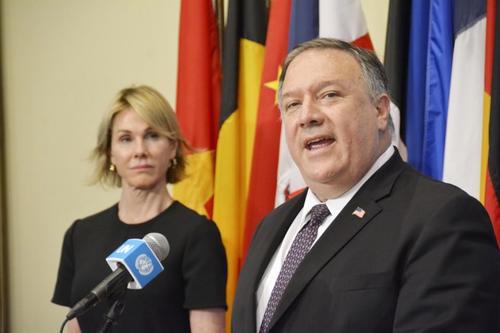
Crucially the shock announcement comes just ahead of U.S. Ambassador to the UN Kelly Craft’s controversial visit to Taipei, which Beijing has already slammed as a “crazy provocation”.
China had further already warned this week that Washington will pay a “heavy price” should it move forward with sending Kelly on the official visit.
To be sure, the Chinese govt will not be happy about this memo, but (from their perspective) at least @SecPompeo referred to Taiwan as an “unofficial partner.” — Julian Ku 古舉倫 (@julianku) January 9, 2021
Additionally, any and all sections of the Foreign Affairs Manual or Foreign Affairs Handbook that convey authorities or otherwise purport to regulate executive branch engagement with Taiwan via any entity other than the American Institute in Taiwan (AIT) are also hereby voided. The executive branch‘s relations with Taiwan are to be handled by the non-profit AIT, as stipulated in the Taiwan Relations Act.
The United States government maintains relationships with unofficial partners around the world, and Taiwan is no exception. Our two democracies share common values of individual freedom, the rule of law, and a respect for human dignity. Today’s statement recognizes that the U.S.-Taiwan relationship need not, and should not, be shackled by self-imposed restrictions of our permanent bureaucracy.
This is sure to create more transition chaos with a mere week-and-a-half left till Biden’s inauguration.
The timing of it will also be a huge factor in determining Beijing’s response, given it may look to Biden for assurances that he’ll roll back whatever “damage” Trump’s dumping of the longstanding ‘One China’ has done on the way out the door.
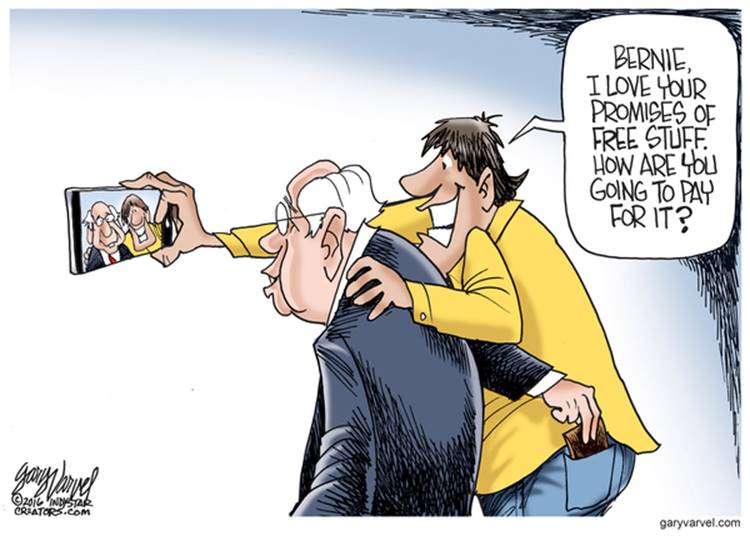
According to Axios, Biden wants to follow this up with a $3 trillion tax and infrastructure package.
Yes, give most Americans $1,400 (in addition to the $600 they are now receiving) and then tax the hell out of the “rich.” In addition to raising capital gains taxes for all.
This is what the Democratic control of both houses of Congress is going to bring.
Joe Biden is considering asking Congress to give Americans the balance of the $2,000 per person coronavirus payments that was promoted by Trump, Axios reports. In addition, Biden wants to send funds to state and local governments to fill gaps in revenue that were created by governors and mayors that locked down their jurisdictions because of COVID-19.
Then, get this.
According to Axios, Biden wants to follow this up with a $3 trillion tax and infrastructure package.
Yes, give most Americans $1,400 (in addition to the $600 they are now receiving) and then tax the hell out of the “rich.” In addition to raising capital gains taxes for all.
This is what the Democratic control of both houses of Congress is going to bring.
Mitch as majority leader, though a crony himself, would have stopped a lot of this.
Needless to say, the spending Biden is proposing here is going to be much higher than what will be generated by any new taxes, so Jay Powell at the Federal Reserve better start ordering a lot more barrels of green ink.
Many of these same small businesses teetering on the brink of collapse are about to get slapped in the face with surging labor costs. A total of 20 states had minimum wage hikes take effect this month as part of scheduled ramp-ups.
These might not sound like massive hikes in absolute terms, but you have to think of it like this. Payroll is often one of the largest expenses small businesses have—and it may have just arbitrarily spiked by 5 to 15 percent.
2020 was one of the worst years in modern American history for small businesses. And now, thanks to a wave of minimum wage legislation that kicked in on January 1, things are about to get even worse.
Make no mistake: small business owners are already seriously hurting.
When state and local governments responded to the outbreak of COVID-19 in the spring with harsh lockdowns and restrictions, businesses were forced to shutter. Many in the restaurant and hospitality industry remain shut down many months later, or were briefly allowed to reopen then shut down again this fall. Meanwhile, much of the taxpayer-financed aid meant to help these businesses was instead captured by big corporations or lost to fraud and waste.
To add insult to injury, thousands of small businesses were vandalized and looted during the summer unrest after the death of George Floyd. (No, insurance doesn’t eliminate the harm).
At least 100,000 small businesses that were forced to close in 2020 will not reopen, according to Yelp. In a recent survey, almost 60 percent of small business owners said that they don’t expect their enterprise to survive through June 2021.
Many of these same small businesses teetering on the brink of collapse are about to get slapped in the face with surging labor costs. A total of 20 states had minimum wage hikes take effect this month as part of scheduled ramp-ups.
“New Mexico will see the largest jump, adding $1.50 to its hourly minimum and bringing it up to $10.50,” the Hillreports. “Arkansas, California, Illinois and New Jersey will each increase their minimum wages by $1.”https://platform.twitter.com/embed/index.html?creatorScreenName=feeonline&dnt=false&embedId=twitter-widget-0&frame=false&hideCard=false&hideThread=false&id=1345953362878074881&lang=en&origin=https%3A%2F%2Ffee.org%2Farticles%2Fminimum-wage-hikes-kick-in-across-the-country-at-the-worst-possible-time-for-small-businesses%2F&siteScreenName=feeonline&theme=light&widgetsVersion=ed20a2b%3A1601588405575&width=550px
Additionally, many localities have enacted area-specific minimum wage hikes. For example, Flagstaff, Arizona just raised its minimum wage to $15 an hour while Belmont, California just upped its rate to $15.90 an hour.
These might not sound like massive hikes in absolute terms, but you have to think of it like this. Payroll is often one of the largest expenses small businesses have—and it may have just arbitrarily spiked by 5 to 15 percent.
The timing here could not be worse.
“A dramatic increase in the minimum wage even in good economic times has been shown to be harmful,” Employment Policy Institute Managing Director Michael Saltsman said. “In the current climate, for many employers it could be the final nail in the coffin.”
And employees will suffer perhaps just as much as employers. Even though they’re ostensibly meant to uplift workers, increases in the minimum wage always and inevitably hurt more than they help.
Why? A wage is important for the living standards of the worker, but that isn’t its only important aspect. A wage is a price. Prices are essential for order in an economy, so price controls throw markets into chaos.
“By the simplest and most basic economics, a price artificially raised tends to cause more to be supplied and less to be demanded than when prices are left to be determined by supply and demand in a free market,” famed free-market economist Thomas Sowell explained in his book Basic Economics. “The result is a surplus, whether the price that is set artificially high is that of farm produce or labor.”
“Making it illegal to pay less than a given amount does not make a worker’s productivity worth that amount— and, if it is not, that worker is unlikely to be employed,” Sowell writes. “Unfortunately, the real minimum wage is always zero, regardless of the laws, and that is the wage that many workers receive in the wake of the creation or escalation of a government-mandated minimum wage, because they either lose their jobs or fail to find jobs when they enter the labor force.”
Thus, as free-market economist Murray Rothbard put it, the minimum wage amounts to outlawing jobs:
“In truth, there is only one way to regard a minimum wage law: it is compulsory unemployment, period. The law says: it is illegal, and therefore criminal, for anyone to hire anyone else below the level of X dollars an hour. This means, plainly and simply, that a large number of free and voluntary wage contracts are now outlawed and hence that there will be a large amount of unemployment. Remember that the minimum wage law provides no jobs; it only outlaws them; and outlawed jobs are the inevitable result.”
So, it’s no surprise that the nonpartisan Congressional Budget Office projects that a national $15 minimum wage would destroy up to 3.7 million jobs. Of course, these hikes aren’t nationwide, and many aren’t quite up to $15 yet. Nonetheless, struggling small businesses already have so little wiggle room in their budgets and are on the brink of collapse. Thus the negative effect minimum wage hikes have on local economies will be severe.
Of course, there’s little doubt that the legislators who enacted these pre-planned minimum wage hikes hoped to help workers, not put them out of work amid an economic crisis. But the laws of basic economics are unmoved by compassionate hand-wringing—and good intentions never guarantee good results.
Brad Polumbo (@Brad_Polumbo) is a libertarian-conservative journalist and Opinion Editor at the Foundation for Economic Education. The above originally appeared at FEE.org.
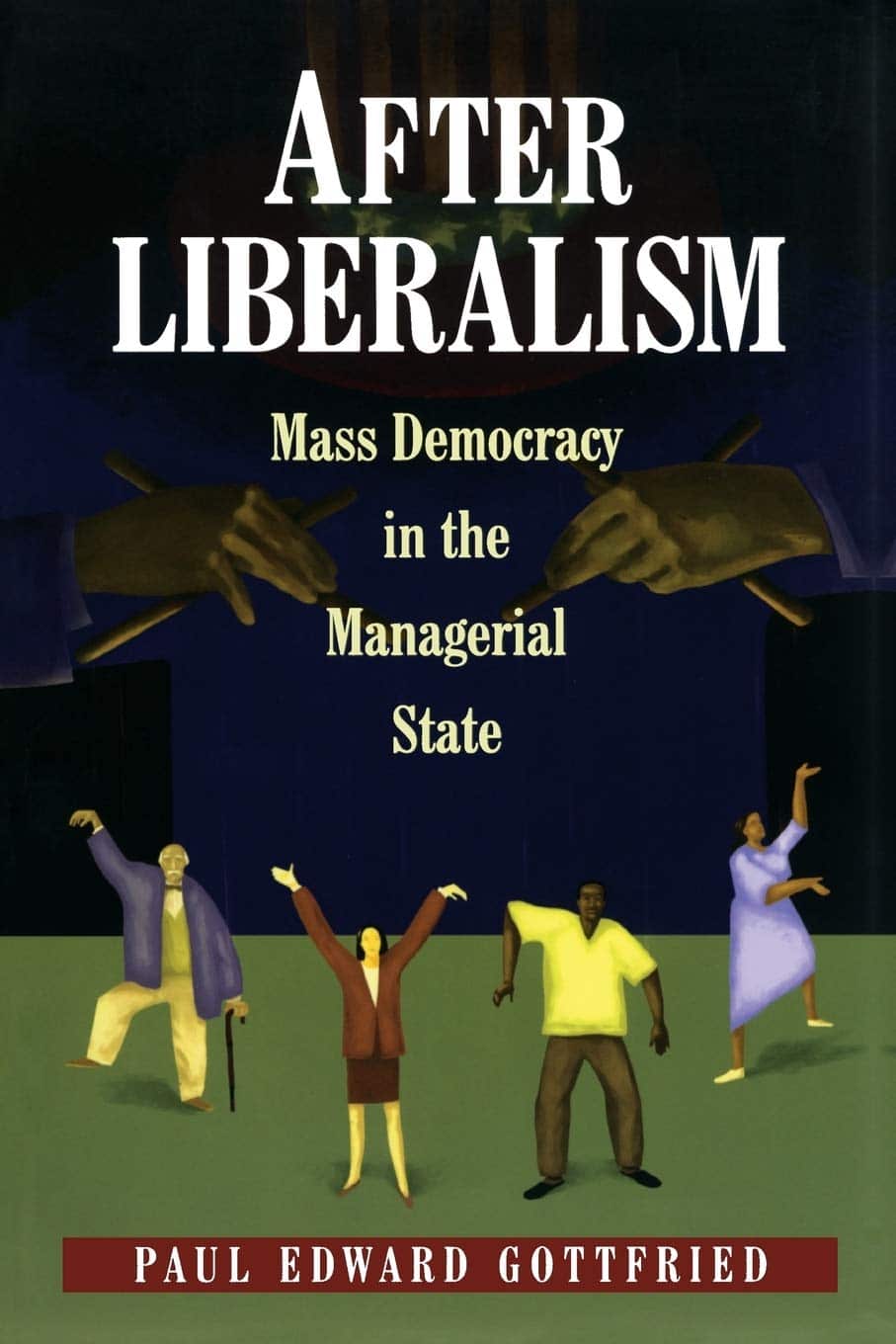
Some historians such as the paleoconservative scholar Paul Gottfried make the case that old school liberalism transitioned into a more progressive statism centered on social engineering and behavioral control starting in the 1900s. In his book, After Liberalism, Gottfried documents how the restrained liberalism of the 19th century gradually vanished, to be later replaced by its modern-day successor.
Has the definition of “liberal” changed over time?
One of the more compelling debates in American intellectual circles concerns classical liberalism vs modern liberalism.
In American parlance, the word liberal is used reflexively, often without much deep thought about its origin. It usually refers to individuals associated with the contemporary left and loosely connected to the Democratic Party. However, liberal did not always have that connotation in American politics.
To understand these changes, let’s take a stroll down memory lane to learn how its meaning has evolved over time.
Classical Liberalism vs. Modern Liberalism
Originally, liberalism was associated with a political philosophy of governance that protected individual rights, called for checks on government, encouraged economic freedom, and was centered around individualism.
In the present, we see liberalism generally associated with the modern-day political Left which is more focused on using the state to proactively promote egalitarianism and purge society of perceived blights such as racism, oppression, and patriarchal institutions.
The proactive role for the state to modify behavior would seem foreign to the liberals of yore, who generally believed in a restrained state. Crucial historical developments such as the Progressive Era, World War I, the Great Depression, and World War II forever changed American politics, and by extension, politics in the West.
One of the more profound changes was the way the word “liberal” would be used in political speech.
What Changed
Some historians such as the paleoconservative scholar Paul Gottfried make the case that old school liberalism transitioned into a more progressive statism centered on social engineering and behavioral control starting in the 1900s. In his book, After Liberalism, Gottfried documents how the restrained liberalism of the 19th century gradually vanished, to be later replaced by its modern-day successor.
Gottfried argued that “Liberalism is increasingly adrift. Having gone over to social planning earlier in the century, it had to jettison its nineteenth-century heritage in return for humanitarian and ‘scientific’ goals.” The rise of the Progressive Movement at the end of the 19th century, which came about in response to the perceived injustices of the Gilded Age, started to plant the seeds of 19th century liberalism’s destruction.
From Laissez-Faire Capitalism to Welfare Capitalism
Welfare capitalism was a reasonable compromise for those skeptical of both the market and totalitarian economic systems such as Communism. This contemporary political economy generally features a system of progressive taxation, national wage standards, state-run pension systems, and welfare programs for the poor.
On the behavioral front, liberal states in the past century frequently turned to anti-discrimination laws and administrative edicts to purge society of undesirable behavior such as racism, sexism, and homophobia. Top-down state activism was justified under the banner of promoting social justice.
How Progressivism Grew
Many progressive reformers started out locally, but this was only one step in their quest for power. Their vision was to make their way to the top and use the levers of state power to mold American society along scientific lines. Although Progressives had an elitist outlook, they saw mass democracy as one tool to overthrow the previous political order.
The Impact of War on Liberalism
World War I was a major catalyst for governments across the West to assume greater powers than previously imagined. It is often forgotten that a battery of commissions set up during this period inspired a number of New Deal era agencies. Progressives did not see war-time measures as temporary, but rather stepping stones for even larger interventions that would become permanent in times of peace.
Education as a Tool to Socialize the Masses
Progressives were busy on the education front as well. They recognized the power of public education as a tool to socialize the masses. So they did not waste any time to impose their beliefs on the malleable minds of America’s youth.
Educators such as Thomas Dewey were energetic about using public education to spread progressive liberal ideas and socialize the American public. Dewey originally championed progressivism, but grew tired of the term over time.
Gottfried observed that other ideological currents taking root in the early 1900s, compelled reformers like Dewey to describe their approach as “liberal” by default:
“When Dewey decided to characterize his proposed social reforms as ‘liberal,’ he had already tried out ‘progressive,’ ‘corporate,’ and ‘organic.’ The rise of fascism may have rendered rhetorically problematic the last two alternatives to “liberal.” And since there were competitors for ‘progressive’ associated with the reform wings of the two major national parties, Dewey and his confreres may have become ‘liberals’ faute de mieux.”
The Transformational Era of the New Deal
Once the New Deal rolled around, the word “liberal” took on a whole different meaning in American parlance. In Gottfried’s view, the rise of the managerial state — a technocratic state that occupies itself with modifying people’s behavior — during the Progressive Era and its subsequent consolidation during the interventionist period of the New Deal is what put an end to the liberal current of the 19th century.
The economist John Maynard Keynes played an integral role throughout the New Deal in normalizing government intervention in the economy. His public policy prescriptions of massive government spending and bureaucratic administration were a radical departure from the previous laissez-faire paradigm of divided powers, bourgeois morality, and a robust civil society to keep the state in check.
The Civil Rights Revolution’s Knockout Punch
The Great Society reforms of the 1960s further accelerated the ascent of modern-day liberalism after anti-discrimination laws and welfare became the norm. Once the 1960s ended, American liberalism became a force for social reconstruction that made the liberalism of the previous century look even quainter.
Gottfried contended that “Liberalism now survives as a series of social programs informed by a vague egalitarian spirit, and it maintains its power by pointing its finger accusingly at antiliberals.” The constant desire to reshape society is part and parcel of the modern-day liberal experiment.
What is Modern Liberalism
Modern-day liberalism mostly refers to the mass democratic philosophy that center-Left political parties across the West — from liberal internationalists to social democrats — have thoroughly embraced. The way one can define modern liberalism is by characterizing it as a system which features a mixed economy with an activist state that is involved in molding people’s behaviors.
Classical liberals believed in the protection of private property, free speech, and a robust civil society. Modern liberals were more in favor of using the state as a vehicle of promoting social change. They are by no means communists. Modern liberals still believe in private property and civil society outside of the state.
But for the modern-day liberal, these institutions could be exploited and co-opted to serve managerial elites’ ends. Modern liberals ultimately conceded that a functioning market was necessary for funding a welfare state.
What is Classical Liberalism
Figuring out the difference between classical liberalism and modern liberalism requires us to go back to the origins of liberalism itself. English philosopher John Locke is largely credited as the founder of classical liberalism and his example serves as a good starting point for any classical liberal vs modern liberal analysis.
His famous Two Treatises of Civil Government functioned as the definitive text for liberal governance in a time when Europe was largely marked by absolutist monarchies. Locke did not believe in the divine right of kings but was rather of the view that governments needed the consent of the governed in order to have legitimacy.
Locke’s emphasis on “pre-political” rights was revolutionary in that it placed the individual at the forefront of any political order. In addition, individuals could set up their own governments and disband them if they felt that they no longer protected their rights.
For Locke, the government’s only legitimate function was to protect life and property. His ideas would play integral roles during the Glorious Revolution and the American Revolution.
The American Revolution’s Liberal Origins
In the case of the American Revolution, a number of the signatories of the Declaration of Independence drew heavily from Locke. They used his ideology as a basis of rebelling against the British government, which they perceived as a government that usurped its legitimate functions and violated traditional English liberties.
America’s Liberal Experiment in Action
Subsequently, the founding generation drew from Lockean principles to codify a number of civil liberties and limited government functions in the U.S. constitution. These included a separation of powers between the Executive, Legislative, and Judicial branches and the protection of liberties such as the freedom of religion, free speech, freedom to peacefully assemble, freedom of religion, the right to bear arms, and due process.
The French’s Role in Influencing American Governance
The separation of powers was largely inspired by liberal thinkers such as the French political philosopher Baron de Montesquieu and his Enlightenment counterparts who championed a social contract of sorts between individuals and the state. Under this political order, the rule of law, equal rights among rulers and the ruled, and the ability for citizens to petition their government would be safeguarded.
How Classical Liberalism Provided the Intellectual Backbone for Capitalism
Classical liberalism wasn’t just confined to the political sphere. Economists such as Adam Smith took the logic of liberalism and applied it to economic policy. Smith became a firm believer in a capitalist economy that promoted free commerce between nations, as opposed to the prevailing mercantilist model that European preferred at the time.
Similar to Locke’s political works, Smith’s Wealth of Nations became one of the most influential pieces of economic literature in human history and put the field of economics on the map.
Classical Liberalism’s Peak in the 19th Century
By the mid-19th century, liberalism reached a turning point after the British Empire embraced global free trade through its repeal of the Corn Laws. From that point until World War I, Britain and most of the West enjoyed unprecedented economic prosperity, relative peace, and a gradual transition to constitutional democratic rule.
For many historians of liberalism, the Gilded Age or Belle Epoque (Beautiful Era) was the height of personal freedom in the West combined with a level of economic growth that was never seen before thanks to the Industrial Revolution.
Given these historical contrasts, it’s no surprise why many historians like to participate in the classical liberal vs modern liberal discussion. Upon deep inspection, there are clear differences in these ideological strands, which merit considerable analysis.
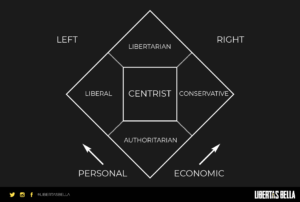
Classical Liberalism vs Modern Liberalism on the Nolan Chart
The Nolan chart was named after David Nolan, a respected activist who was heavily involved in the liberty movement. This chart has helped determine how Americans identify themselves on the political spectrum. It went beyond the typical liberalism vs. conservatism debates of the 1900s and added a twist by including criteria that was generally associated with libertarianism.
The chart is divided into four quadrants that list political viewpoints along two axes, which highlight economic and personal freedom.
The classical liberal respect for individual liberties and a restrained state has lived on in modern-day libertarianism. Most classical liberals would likely score in the lower part of the libertarian quadrant closer towards the centrist bloc.
Liberals in the present, on the other hand, would probably land more on the left hand progressive quadrant, with some sliding downwards towards statism. Their economic views put them well to the left of all free-market liberals.
That said, there are some progressives and contemporary liberals who share similar views with free-market liberals regarding civil liberties.
Liberalism’s Comeback
19th century liberal ideas have witnessed somewhat of a comeback but with a slightly more radical twist after World War II. Economists such as Friedrich A. Hayek and Milton Friedman helped supply the intellectual ammo that sparked a resurgence in liberal thought and the subsequent entrance of libertarianism in American politics.
The Differences Between Classical Liberals and Libertarians
Although there are considerable degrees of overlap between classical liberals and libertarians, the latter tend to be more radical in their views of the role the state plays in society and how much government intervention should be tolerated.
For many sects of libertarianism, the state should only be limited to the provision of defense, the court system, and law enforcement. The more anarchist wings of this movement tend to believe that the private sector and civil society can assume all competencies of the state.
Where Liberalism Stands Now
As much as some would like to deny it, the definition of words matter. They can have different meanings depending on the country, time, or place. In the rest of the Anglosphere, liberal is generally associated with the free-market Right.
The same is the case in Spanish-speaking countries. However, this has not been the case in the American context. Political movements tend to come and go throughout history.
The Percieved Triumph of Liberalism Against Communism
The 20th century largely saw the demise of 19th century liberalism and ushered in a completely different paradigm. The waning years of the Cold War witnessed the demise of Soviet-style totalitarianism and the perceived triumph of liberal democracy.
Political leaders such as Margaret Thatcher and Ronald Reagan provided the public policies and political leadership that allowed for market-based liberalism to thrive and set itself apart from central planning.
The New Liberal Consensus
By the 1990s, market-based economies were generally accepted by elites and became the order of the day. This became embodied in “neoliberalism”, a resurgence of economic liberalism in the form of lower tariffs, multilateral trade, less stringent migration, moves towards privatization of state enterprises, and slightly sleeker welfare states.
Neoliberal Dominance
In contrast to its distant 19th century ancestor, neoliberalism was not as pro-liberty and still maintained the managerial state and the concomitant social engineering measures that were established in the 1960s. Regardless, the ideological dominance of neoliberalism cannot be denied as most of the globe has embraced some form of market economy and has largely rejected Soviet-style central planning.
Although the New Deal saw a leftist shift on economics issues, “neoliberals” of the post-Cold War era started taking more market-based positions on multilateral free trade and immigration.
The Fragile Nature of the Post-Cold War Order
At a glance, post-Cold War liberals have appeared to engage in a form of “fusionism”, wherein they blend free-market positions on immigration and trade, with more left collectivist positions on education, healthcare, free speech, gender relations, and freedom of association.
The emergence of “wokism” has further perverted liberalism, as its collectivism has now become more racialized and has taken on an iconoclastic form now that basic gender relations, appreciation for a nation’s history, and free speech are all being called into question.
Many liberals have grudgingly moved along with this new trend of leftism. Indeed, a 90s neoliberal would likely shudder at the prospect of any member of the woke generation coming into power.
The Challenge of Resurrecting Liberal Ideas
Several public intellectuals such as American political commentator Dave Rubin and psychology professor Jordan Peterson have made attempts to resurrect old liberalism in a time when political discourse is threatened by cancel culture and anti-free speech forces on the Left.
Based on the new political challenges of the 21st century, classically liberal ideas have a tall task in front of them in trying to become relevant again in political movements on the Right. Nationalism and conservatism are the most influential movements on the Right at the moment and they have generally become less liberal over time.
Regardless of the changing political ecosystem, it would still benefit people to understand the classical liberalism vs. modern liberalism debate in order to make sense of our ever-changing political environment.
“Hence it is that such democracies have ever been spectacles of turbulence and contention; have ever been found incompatible with personal security or the rights of property; and have in general been as short in their lives as they have been violent in their deaths.” –James Madison, Federalist Paper 10
“All democracies turn into dictatorships — but not by coup. The people give their democracy to a dictator, whether it’s Julius Caesar or Napoleon or Adolf Hitler. Ultimately, the general population goes along with the idea … ” –filmmaker George Lucas, Dark Victory from time.com
People ask me if I feel “ashamed” about what Miranda Devine describes as “the clueless insurrection” in the Capitol on Wednesday. My response? I am about as ashamed as Joe Biden, Senator Chuck Schumer (D-N.Y.) and Juan Williams of Fox News were about the riots and shootings that the Democratic Party subsidized and even justified last summer.
Unlike those violent riots, which the Democrats and national media attributed to white racism, and which came from Democratic voters, the turmoil in the Capitol on Wednesday did not result in burning and looting. There were no white or black policemen shot and the only shooting victim (which the media don’t seem to care about since white Republican lives don’t matter) was a female protestor, Air Force veteran Ashli Babbitt, by a Capitol police officer.
I also heard our Democratic constitutional expert on Fox News, Jonathan Turley, telling us Wednesday evening that pro-Trump thugs had “lost their faith” in our constitutional system. It was for this reason that they “desecrated” our sacred space. I don’t recall similar talk about desecration when the “peaceful protesters” tried to burn down St. John’s Episcopal Church across from the White House last summer.
Of course, there was a storm of media abuse afterwards when President Trump spoke before the historical site that had been saved from “peaceful protestors.” Nor do I remember anything more than whispered protest, even on Fox News, when the Democratic Party got howling banshees to invade the Senate chamber to protest the confirmation of Brett Kavanaugh as a Supreme Court justice and to hassle his supporters. It seems that there are big-time desecrations, for example, when people with MAGA hats commit them, and then there are the entirely excusable ones that transpire when feminist Democrats invade the sacred precinct.
No, I am not giving a stamp of approval to what occurred in the Capitol. On balance, the actions by pro-Trump forces were not particularly useful for our side, and the death of the lady veteran was nothing short of disastrous. But let’s not pretend, like Rod Dreher, John Podhoretz, George Will, Erick Erickson, and most of the usual suspects that Wednesday’s occupation of the Capitol after a very impulsive speech by the president was a horrible black mark on the Right.
According to these media celebrities, we should be impeaching Trump right now, less than two weeks before the presidency falls to a corrupt, senile political hack, on its way to being turned over to Kamala Harris. We have a duty to punish our side because unlike the other side, we should be especially virtuous and shun any conflict, except of course with the American Right. Erickson went so far as to call on the police to “shoot the protestors.”
I must also take exception with Miranda Devine, who asserts that Trump’s supporters and Trump himself have now given the Left “a free pass to persecute their ideological enemies while enacting their pet cultural Marxist projects and changing this country irrevocably for the worst.” This is inevitably just what the one-party Left will do, but not because of what happened Wednesday.
Devine also provides the real reason—namely, that the Senate is now “in Democratic control, thanks to Tuesday’s runoff debacle.” Because of the vote counting in that race, which looked every bit as suspect as what occurred in the same state in November, our wacky cultural Marxist Left will soon be able to do what it wants with the federal government. The media will cover for any outrage this Left unleashes, and Conservatism, Inc. will predictably do its part as gatekeeper for the politically correct Right.
What happened Wednesday is comparable to the way other would-be totalitarians take over. They manufacture crises that justify their unchecked power. The Nazi regime used the attempted burning of the Reichstag in March 1933 to marginalize opposition. If a Reichstag fire had not come along, some other pretext would have been devised to justify the Third Reich’s tightening grip. The Left, once in charge of the federal government, will unroll with media cooperation multiple examples of “prejudice” and “discrimination” that it will then proceed to address—e.g., imposed gender roles at birth, distinctions between citizens and illegal aliens (read: future Democratic voters), and the unsettling effects of gender-specific pronouns. There will also be more lockdowns, probably long after the COVID-19 infection rate plummets because of the vaccine, and green deals in abundance.
None of this will happen because of what overly combative Trump demonstrators did Wednesday. It will take place because the Left is maniacal and power-driven and those on the other side are led by wusses and nonstop apologists. But let’s stop fixating on Wednesday’s events. We can deplore them once the Left repents of its far, far greater sins.
About Paul Gottfried
Paul Edward Gottfried is the editor of Chronicles. An American paleoconservative philosopher, historian, and columnist, Gottfried is a former Horace Raffensperger Professor of Humanities at Elizabethtown College in Elizabethtown, Pennsylvania, as well as a Guggenheim recipient.
Disturbing video available (for now) on Twitter shows Capitol Police allowing demonstrators to enter the Capitol grounds. . . Elsewhere at the Capitol, the police sent out to hold a perimeter were unable to hold off mobs.
Why was the United States Capitol left so vulnerable?
What can be done now? President Trump should not urge us all to “come together.” Instead, he should support secession. States and communities that support Trump are too far apart from supporters of the Biden-Harris BLM camorra to live in a united country. “Bear not the yoke with unbelievers. For what participation hath justice with injustice? Or what fellowship hath light with darkness?” (2 Corinthians 6:14 [Douay-Rheims Bible])
According to a left-wing propaganda narrative that you can read in the New York Times, Washington Post, CNN, and similar outlets, the violence in Congress that occurred in the afternoon of January 6 was the culmination of a long series of outrages by President Donald Trump. When he lost the November election to Joe Biden, he could not accept his loss. He kept making baseless claims that he had won the election and accused Biden supporters of using fake ballots and rigged voting machines to inflate the totals for Biden. He kept filing lawsuits to get parts of the verdict overturned, but the courts rejected all his claims. He thought he still had a chance on January 6, when the electoral votes are counted in Congress. He wanted Vice President Mike Pence to violate the Constitution. Although Pence has the purely ceremonial role of presiding over the joint session, he wanted Pence to toss out slates of electors who opposed him, or at least send them back to the states for recertification. Pence refused to violate the Constitution. When Trump found out about it, he was so angry that he incited part of a rally supporting him to storm Congress and shut down the session. Because of him, several people were killed. He is a sore loser who should be removed from office immediately and sent to prison for sedition as well.
Every word of this narrative is false. Let’s take one item out of chronological order, because it has gotten so much attention. It’s alleged that Trump became enraged at Pence because Pence wouldn’t violate the Constitution. In fact, there is a good case that what Trump was asking Pence to do was perfectly legitimate. As John Yoo and Robert Delahunty pointed out in an article in the American Mind last October 19,
We suggest that the Vice President’s role is not the merely ministerial one of opening the ballots and then handing them over (to whom?) to be counted. Though the 12th Amendment describes the counting in the passive voice, the language seems to envisage a single, continuous process in which the Vice President both opens and counts the votes.
The check on error or fraud in the count is that the Vice President’s activities are to be done publicly, “in the presence” of Congress. And if “counting” the electors’ votes is the Vice President’s responsibility, then the inextricably intertwined responsibility for judging the validity of those votes must also be his.
If that reading is correct, then the Electoral Count Act is unconstitutional. Congress cannot use legislation to dictate how any individual branch of government is to perform its unique duties: Congress could not prescribe how future Senates should conduct an impeachment trial, for example. Similarly, we think the better reading is that Vice President Pence would decide between competing slates of electors chosen by state legislators and governors, or decide whether to count votes that remain in litigation.
Yoo is a controversial person, but there’s no doubt he is a constitutional law scholar in good standing.
Well, you might say, what right did Trump have to blow up on Pence just because Pence disagreed with his understanding of the Constitution? The answer to that is simple. Pence had assured Trump that he accepted his claim that there were irregularities in the voting. He said at a rally in Georgia on January 4, just two days before the count,
that the case for widespread election fraud would be made to the American people when Congress meets this week to certify President-elect Joe Biden’s victory over President Trump.
“We’ve all got our doubts about the last election. I share the concerns of millions of Americans about voting irregularities,” Pence said at an indoor congregation at Rock Springs Church in Milner, Ga., in support of Republican Sens. Kelly Loeffler and David Perdue in runoff elections there.
Pence, who by law will be tasked with declaring a winner of the Electoral College vote, seemed to leave open the possibility that Trump could still remain in power for a second term.
“Come this Wednesday,” he said, referring to the impending certification of election results, “we’ll have our day in Congress. We’ll hear the evidence.”
The election was in fact stolen from him. It’s easy to hack voting machines, such as those made by Dominion, to change vote totals. When I say this, I’m not relying on a source the Left will dismiss as fantasies from conspiracy-theory nuts. According to a story published by NBC News last year,
It was an assurance designed to bolster public confidence in the way America votes: Voting machines “are not connected to the internet.”
Then Acting Undersecretary for Cybersecurity and Communications at the Department of Homeland Security Jeanette Manfra said those words in 2017, testifying before Congress while she was responsible for the security of the nation’s voting system.
So many government officials like Manfra have said the same thing over the last few years that it is commonly accepted as gospel by most Americans. Behind it is the notion that if voting systems are not online, hackers will have a harder time compromising them.
But that is an overstatement, according to a team of 10 independent cybersecurity experts who specialize in voting systems and elections. While the voting machines themselves are not designed to be online, the larger voting systems in many states end up there, putting the voting process at risk.
That team of election security experts say[s] that last summer, they discovered some systems are, in fact, online.
“We found over 35 [voting systems] had been left online and we’re still continuing to find more,” Kevin Skoglund, a senior technical advisor at the election security advocacy group National Election Defense Coalition, told NBC News.
“We kept hearing from election officials that voting machines were never on the internet,” he said. “And we knew that wasn’t true. And so we set out to try and find the voting machines to see if we could find them on the internet, and especially the back-end systems that voting machines in the precinct were connecting to to report their results.” …
The three largest voting manufacturing companies—Election Systems &Software, Dominion Voting Systems and Hart InterCivic—have acknowledged they all put modems in some of their tabulators and scanners. The reason? So that unofficial election results can more quickly be relayed to the public. Those modems connect to cell phone networks, which, in turn, are connected to the internet.
Trump has every right to be suspicious. Shouldn’t there be a full and impartial investigation by recognized experts of whether fraud occurred? If the Biden camp thinks the election was fair and honest, shouldn’t they have welcomed a full investigation? But of course they didn’t. And this type of fraud is just one of many others, such as truckloads of Biden ballots arriving after it looked like Trump was winning, in just the right numbers to give Biden the victory.
When we look at Trump’s complaints, we need to bear one vital fact in mind. As Mike Davis noted in New Left Review, November–December 2020, p. 5, “Biden eked out a slim victory, in some states only by microscopic margins, that won him 306 electoral votes, the same as Trump four years ago. A mere 256,000 vote in five key states purchased 73 of those votes.” This is why Trump is right: because just a few votes could change the outcome, and because there was a lot of apparent fraud, a full investigation was needed.
But, some people might say, this doesn’t excuse Trump. Didn’t he incite people at a rally to invade the sacred halls of Congress? Well, in the first place, the halls of Congress aren’t “sacred”. They belong to the people. And Trump didn’t incite violence. Not at all. He wanted a peaceful protest, and this is what he got, aside from a few antifa activists who crashed the protest. They had been bused into Washington earlier.
According to in the American Thinker published on January 7,
January 6th’s events are being seized on as a game-changer, leading to calls to invoke the 25th Amendment; calls to impeach and remove President Trump; and efforts to discredit Trump, his supporters, and conservatism. It has distracted attention from issues around the legitimacy of voting procedures in several key states and guaranteed the Electoral College vote just before 4 A.M. that ratified Joe Biden’s and Kamala Harris’s inauguration as president and vice president.
Applying the classic legal question ‘cui bono?’ (‘who benefits?’), it is clear that Democrats, anti-Trump establishment Republicans, the leftist media, and TDS-sufferers all are victorious.
Disturbing video available (for now) on Twitter shows Capitol Police allowing demonstrators to enter the Capitol grounds. . . Elsewhere at the Capitol, the police sent out to hold a perimeter were unable to hold off mobs.
Why was the United States Capitol left so vulnerable?
After the demonstrators were led in, a policeman killed a young woman at point-blank rage. The police and Secret Service ended the session of Congress, not the peaceful demonstrators. To give themselves cover, they imported a few Antifa agitators.
Why did they do this? I suggest they did this for a reason, which will become clear if we ask, What was going on just before the demonstration? The members of Congress were about to hear a debate on the objections raised against the votes in the swing states. The American people would have been able to hear the evidence for themselves. This had to be stopped. By stopping the session for about six hours, the debate was shifted to the very late evening hours of January 6 and early morning hours of January 7, when very few people were watching. Besides, all the attention was now on the protest rather than the fraudulent voting.
What can be done now? President Trump should not urge us all to “come together.” Instead, he should support secession. States and communities that support Trump are too far apart from supporters of the Biden-Harris BLM camorra to live in a united country. “Bear not the yoke with unbelievers. For what participation hath justice with injustice? Or what fellowship hath light with darkness?” (2 Corinthians 6:14 [Douay-Rheims Bible])
What is so harmful about using taxes to fund these services? Some families who would prefer to take care of their children and elderly parents themselves in their own homes are stripped of the resources they would have used to do so, as these resources are taxed away to pay for daycare and nursing home subsidies, government schools, etc.
In effect, those who want to take care of their families are forced to pay twice to do so, first for the subsidies they’re not using and second to take care of their families themselves. When families are taxed but outsourcing family obligations is subsidized, there will be more of the latter, and the family bond will dissolve.
Human life is given meaning and sustenance by various forms of community: the church, the nuclear family, the extended family, fraternal organizations, businesses, etc. But as the state has grown, civil society has shrunk.
The state over the centuries has absorbed an increasing share of the resources, functions, and moral authority of these other institutions. In countries where the state succeeds in finally absorbing competing institutions, the result is totalitarianism.
One striking example of how the state has encroached on the domain of civil society in general and the family in particular is the care of the young and the old. Through its financing of daycares, K-12 schools, and nursing homes (among other options) the state gradually encroaches on what were once integral functions of the family. It inserts itself as a wedge between children, the elderly, and the rest of the family.
By supplanting the family in caring for the young and the old, not only does the state increase the role it plays in society here and now, it also erodes the competency of the family in the long term. By performing these functions in place of the family, the ability of the family to perform its former responsibilities atrophies and withers.
An institution, through long neglect of once essential functions, loses the knowledge and ability to perform these functions, and even the belief that this function belongs to its sphere. Care of the young and elderly gradually become accepted not as the role of the extended family but as one shared between the family and the state. And where the state gains a foothold, it rarely ever voluntarily relinquishes influence, but rather continues to grow.
A Look at The Tentacles
When I think of government-provided daycare, I think of difficult-to-fire DMV employees entrusted with dozens of strangers’ six-month-old babies.
The Bolsheviks actively saw state-provided childcare as a way of destroying the traditional family. A 1974 New York Timesarticle tells the story of working mother Zoya Idenko:
Under the highly subsidized Soviet day care system, Mrs. Idenko pays a modest 10.50 rubles ($13.86) per month—about one‐tenth of her pay—for six days a week of child care. She drops h,er [sic] boy off at about 8 A.M. and picks him up at 7 P.M. He gets three meals and a snack daily. Child‐rearing, [sic] never had much attraction for Mrs. Idenko. “I went back to work three months after my son was born,” she said. “I could have waited a year legally and still kept my job, but it was difficult for me to bring up the baby and I wanted to get out of the house. My mother‐inlaw [sic] lives with us and she took care of him.
Whether Idenko was truly as cavalier toward her motherly duties as this quote suggests or needed to return to work out of material necessity is unclear. Thankfully, in this story there is a remnant of the extended family in Idenko’s mother-in-law, who stepped in and gave the child some filial attention.
The US follows in the footsteps of its defeated rival. For fiscal year 2020, $5.826 billion was devoted to funding the Child Care and Development Block Grant (CCDBG). The recent CARES Act allocated another $3.5 billion for the CCDBG, which “provides subsidies to assist low-income families in obtaining child care so that parents can work or participate in education or training activities.” Of course, the largest government daycare program is the public K-12 school system.
Naturally, the situation is even worse in France, where the state provides 80 percent of the funding for the childcare system, in which “From the age of 2½ months to 3 years a child can be placed in a crèche.” These “crèches” are various types of childcare facilities that are found in “All cities, towns and some villages” and operate eleven hours daily.
The Elderly
About 1.3 million Americans live in nursing homes rather than with their families. In fiscal year 2010, 66.6 percent of the $207.9 billion of spending on long-term care expenditures came from the government.
This includes government spending on nursing homes, as well as funding for other types of long-term care like home health services. However, even when the state uses taxes to hire a healthcare worker to provide assistance within the home, this still helps to replace the family in providing this assistance.
In other countries, the state does even more to force resources away from the family and into nursing homes and other forms of state provision for the elderly. In Norway, Sweden, Denmark, Finland, Germany, Japan, Korea, the Netherlands, and Luxembourg, the state uses taxes to fund universal long-term care.
The Vampirism of Double Taxation
What is so harmful about using taxes to fund these services? Some families who would prefer to take care of their children and elderly parents themselves in their own homes are stripped of the resources they would have used to do so, as these resources are taxed away to pay for daycare and nursing home subsidies, government schools, etc.
In effect, those who want to take care of their families are forced to pay twice to do so, first for the subsidies they’re not using and second to take care of their families themselves. When families are taxed but outsourcing family obligations is subsidized, there will be more of the latter, and the family bond will dissolve.
What about the Poor?
When the state pours resources into an output, it hasn’t summoned these resources ex nihilo. It’s taken these resources from society, and so the employers, family members, and charities that would have ushered the poor into the middle class are all left less able to do so. The state takes from the left pocket of society and gives to the right pocket, minus the share that covers the salaries of the bureaucrats who arrange the transfer and whatever is lost through fraud, corruption, and incompetence.
When it comes to efficiently serving the poor, civil society makes the state look like a slow-motion train wreck:
on average, 70 cents of each dollar budgeted for government assistance goes not to the poor, but to the members of the welfare bureaucracy and others serving the poor….In contrast, administrative and other operating costs in private charities absorb, on average, only one-third or less of each dollar donated, leaving the other two-thirds (or more) to be delivered to recipients.
The Policy Answer and the Local Answer
The decline of the family is caused in part by the state and in part by much deeper issues. Half of the solution is to work to end state subsidies for the replacement and dissolution of the family. The other half is to not wait for this to come about, but rather to fight now in our own lives and take care of those closest to us, despite the obstacles. Author:
Gor Mkrtchian is a research assistant at the Free Market Institute and a PhD student in the Department of Political Science at Texas Tech University. He received a BA in political science and theater studies from Yale University.



 by Tyler Durden