MCViewPoint

Opinion from a Libertarian ViewPoint

Archive for the ‘Uncategorized’ Category

The Growing Fissures in NATO Unity

Posted by M. C. on April 6, 2024

Nothing that a US taxpayer cash infusion won’t cure.

by Ted Snider

https://libertarianinstitute.org/articles/the-growing-fissures-in-nato-unity

nato. flags of members of north atlantic treaty organization and

Despite the damage done in Ukraine and NATO’s now apparent inability to support Ukraine’s defense against Russia strongly enough, one item in the western win column is the claim that NATO is more unified following the damage done by Donald Trump. Even aside from NATO preparing for the possible consequences of a second Trump term, that win may not be so unequivocal.

Vladimir Putin “thought NATO would fracture and divide. Instead, NATO is more united and more unified than ever—than ever before,” President Joe Biden said on February 21, 2023 and again in Europe on July 13. “I would argue NATO is stronger than it’s ever been,” he said. “President Putin’s war continues to be a strategic failure,” Secretary of State Antony Blinken said on February 8, 2023. “In fact, that alliance—NATO—is stronger and more united than it’s ever been.”

But fissures have appeared. The smaller NATO powers are mad at the larger ones, as are the middle powers, and the large NATO powers are mad at each other.

The smaller and newer NATO countries have recently raised the divisive question of “whether there are first-rank and second-rank countries in NATO.” “Are we equals or are we not equals?” asked Estonian Prime Minister Kaja Kallas.

The Eastern European members of NATO feel passed over in two ways. First is their lack of representation in the top NATO jobs. The second is the dismissal of their more aggressive stance against Russia and their dismissal of Russian and NATO red lines.

Senior officials in the small Baltic nations of Lithuania, Latvia, and Estonia, which were all once part of the Soviet Union, maintain that the big NATO powers in Western Europe push them off to the side because of their more aggressive position in support of Ukraine against Russia. They complain that the large Western powers “do Russia policy without consulting people who know far more about Russia than [they] do.”

The Eastern European members of NATO have consistently seen themselves as dragging a reluctant, Western-centric NATO into the battle against Russia in defense of Ukraine. The East, led by Poland and the Czech Republic, has much more aggressively pushed for maximally arming Ukraine and dismissing the risk of escalating the war. Poland led the campaign to send tanks and fighter jets to Ukraine. The Czech Republic recently announced that it was on the verge of purchasing 300,000 artillery shells from countries outside of Europe to make up for European Union shortfalls and has said that the EU could obtain half a million more. By percentage of GDP, Estonia is the leading donor to Ukraine with Lithuania third, Latvia fifth, and Poland eighth. That is ahead of the United States, United Kingdom, France, and Germany.

See the rest here

Be seeing you

Posted in Uncategorized | Tagged: , , , | 1 Comment »

Antitrust Policy in a Free Society

Posted by M. C. on April 6, 2024

D. T. Armentano

Professor of Economics, University of Hartford

Both the normative and economic case for free markets and against any antitrust law is impressive. Since the law inevitably interferes with both rivalry and cooperation, it must tend to make the economy less efficient. And since the law inevitably interferes with individual rights and with peaceful exchange, it must tend to make the social system less fair and just. In short, the law appears to have lost any claim to legitimacy.

https://imprimis.hillsdale.edu/antitrust-policy-in-a-free-society

The primary concern of political economy is the appropriate role of government in social affairs. The debate, in brief, is whether the economy should be left free to establish a “spontaneous order,” or whether government regulation is necessary to maintain efficiency and economic welfare. Some liberals, most conservatives, and all libertarians would argue that government regulation of industry generally tends to reduce efficiency and economic growth and should be avoided. Since the late 1950s, and at an accelerated pace since the 1970s, free market economists and others have repeatedly argued that many governmental policies are unworkable, and that these policies often tend to achieve results that are the opposite of those intended. Indeed, theoretical and empirical criticisms of government regulation in industries such as transportation, telecommunications, and banking have been the primary rationale to deregulate these markets, and to allow free competition to determine the allocation of scarce resources.

Antitrust Deregulation

Antitrust policy has now joined the growing list of government “regulations” subject to theoretical and empirical revisionism. It wasn’t always so. Indeed, for most of the 20th century, antitrust policy was relatively immune from serious criticism. Its intentions and (apparent) results enjoyed wide academic and political support. It was generally assumed that the antitrust laws were based on solid theoretical foundations, and that vigorous enforcement was necessary to preserve business competition. What muted criticism there was of antitrust policy concerned the blatantly anti-consumer Robinson-Patman Act (1936). But aside from Robinson-Patman, the rest of the antitrust laws were seen by most as necessary to “preserve competition.”

The antitrust world has changed rather dramatically over the last 10 years. The enforcement of traditional antitrust policy has generally been curtailed sharply, and a “new direction” in antitrust enforcement has clearly emerged.

We might take a moment to contrast traditional enforcement policies with the current practices of the Federal Trade Commission and the Department of Justice. Traditional antitrust concern over the growth of “big” companies has been sharply reduced. Business arrangements whose sole probable effect is to expand market output and reduce market price can safely be excluded from antitrust prohibition. Conglomerate and vertical mergers (rarely a threat to any restriction of market output), and even many horizontal mergers (within certain reworked merger guidelines) can be permitted. Price discrimination and many vertical business agreements are now generally seen as part of the competitive market process and not as elements of monopoly power. Finally, and most importantly, antitrust enforcement efforts have been initiated recently against certain state and local regulations and ordinances that legally restrict entry and competition.

Why has antitrust policy changed? Is the new direction correct? Do we still require antitrust prohibition of certain “horizontal” agreements? Are antitrust supervision of trade association activity and rate bureaus necessary? Is there a rationale for any antitrust policy in a free society?

Monopoly Theory and Antitrust Policy

The most important reason for the collapse of traditional antitrust policy is the absence of any intelligent theory that would explain how private monopoly power could exist and be harmful to consumer welfare. Assume, for instance, that we have some industrial market with no legal barriers to entry. Business organizations will enter that market and prosper if they can allocate resources in generally efficient ways to consumers. The firms that grow and accumulate market share will have earned their market positions through exceptional performance, and holding or advancing their position will depend upon a continuously exceptional performance.

On the other hand, firms that misallocate resources (from a consumer perspective) would likely lose market position relative to more efficient business organizations. Organizations, for example, with relatively higher costs, restricted outputs, higher prices, poor quality products, repressed innovation and generally restrictive practices would likely lose profit and market share to rivals.

What useful role could antitrust policy play in this open market process? To employ antitrust against the successful firms would be anti-consumer and destructive to industrial efficiency. Yet to employ antitrust against firms that perform poorly would be unnecessary since strong economic incentives exist for such firms to change their behavior or, given failure, for the market process to reallocate resources away from such organizations. Any government action would be either premature or redundant. Thus in the absence of any intelligent theory of how resources could continue to be misallocated in open markets, the theoretical justification for traditional anti-monopoly enforcement tends to evaporate.

In a last-ditch effort to save traditional enforcement, it was argued that certain non-legal “barriers to entry” protected large firms from competition. On analysis, however, the “barriers to entry” doctrine self-destructed. Most of the so-called “barriers” turned out to be economies and efficiencies that leading business organizations had earned in the marketplace. For example, certain large firms enjoyed economies of scale that often permitted low-cost production and sale. Certain firms enjoyed an excellent reputation for high quality products and service. Certain firms successfully differentiated their product, successfully advertised their product, and successfully engaged in uncertain research and development to keep a flow of products available to accommodate the everchanging tastes of consumers.

From a competitor’s perspective, all of these achievements represented economic “barriers” that served to “limit” competition. It should be obvious, however, that from the relevant consumer perspective, these so-called barriers represented economic values that consumers willingly supported and sustained. Attack these values with antitrust policy and you attack the very economic virtues that the competitive process serves to discover and perpetuate. The non-legal barriers-to-entry discussion represented the final bankruptcy of conventional anti-monopoly theory.

Antitrust History and Policy

See the rest here

Be seeing you

Posted in Uncategorized | Tagged: , , | Leave a Comment »

Squatters’ Rights

Posted by M. C. on April 5, 2024

Suppose, that on your month’s vacation, you also leave your car unattended. Upon your return, you note that your automobile is not where you left it. It has been stolen, you surmise. You call the police. They duly trace it down. Unfortunately for you, if we can extrapolate from this home stolen by squatters, the new “owner” has been using your vehicle for 30 days. Bye, bye car for you.

The closest communist country to US is not Cuba.

by Walter E. Block

Girl in a Room —by Richard Diebenkorn, 1958

You go on vacation for a month. You return home, glad to be back, but to your amazement and chagrin, there are strange people living in your house. You have never seen hide nor hair of them before this very moment. They leave the apartment. You pounce. You call a locksmith to change all the locks in your home. You, not these trespassers, are then arrested for unlawfully evicting tenants. According to New York law, if these squatters were occupying your home for 30 days, they are in effect tenants, even though you never signed a lease with them. In this jurisdiction, it takes about 20 months in landlord-tenant court for your case to even be heard and there is far from any guarantee you will prevail before the judge.

This nightmare was actually suffered by Adele Andaloro, owner of a million-dollar home in Flushing, Queens. Well, this might not be accurate. Perhaps I should say, instead, ex-owner of a house she had previously inherited from her parents.

Philosopher Norman Malcolm said of his teacher and mentor, Ludwig Wittgenstein, “On one walk he ‘gave’ to me each tree that we passed, with the reservation that I was not to cut it down or do anything to it, or prevent the previous owners from doing anything to it: with those reservations it was henceforth mine.”[*]

Adele Andaloro is in grave danger of “owning” the house her parents gave her in the same manner as Norman Malcolm “owned” those trees. That is, not at all. Well, at best, partially. She still owns the home, but cannot legally occupy it.

See the rest here

Be seeing you

Posted in Uncategorized | Tagged: , | 1 Comment »

You Ain’t Seen Nothin’ Yet

Posted by M. C. on April 5, 2024

Abuse masked by words of economic opportunity results in a situation where the abuser convinces the abused a third party is solely to blame, and so tens, if not hundreds, of thousands each year have a view of the world constructed for them based on pure fantasy. These workers send money home and support a rising middle class back in their own country; a segment of the population who are viewed as having ‘made it’ or seen as having an increasingly bright future by their less privileged neighbours. Exported with this wealth are anti-Western and anti-Semitic ideas; political and racist views which must be right if the people expressing them are models of success. Abuser and abused become united against a common enemy, conspicuous by its absence.

by Nikos Akritas

Sheikh Zayed Grand Mosque, Abu Dhabi

Contrary to popular opinion, Dubai is not the richest emirate of the United Arab Emirates. That stroke of luck goes to Abu Dhabi. The rulers of Dubai, recognizing its oil wealth would not last forever, decided much earlier than their plutonic neighbours to use their abundance in this natural resource to invest heavily in infrastructure, banks and foreign companies.

Abu Dhabi, capital of the UAE but much sleepier than its more well-known fellow emirate, owns 74% of the country’s known oil reserves and has, until recently, taken comfort in this fact to leave things as they are. This is no longer the case and within a decade or so looks set to overtake its more popular neighbour as a nexus for business, travel and leisure.

From the lure of artificial islands with golden beaches to the opening of reputable scholarly institutions [1] and cultural establishments,[2] Abu Dhabi is gradually buying its way into Western culture as well as business. The next step, taking its cue from Dubai (whose buying into The Times tainted that paper with the rife antisemitism that is the norm in Muslim countries), was to buy into Western media outlets. Hence, its failed bid for The Telegraph. Arab ownership of well-known Western newspapers will only exacerbate anti-liberal, anti-Semitic news-reporting through such brands, giving the content an air of legitimacy.

Anti-liberal regimes, like those of the Gulf states, which understand the West’s weaknesses are using these to gain a questionable influence in Western countries—through capitalism and liberalism. The former via trade and capital flows, allowing illiberal regimes to gain influence over Western economies and politics, and the latter by claiming the right to maintain and promote intolerance, in the guise of tolerance.

See the rest here

Be seeing you
Posted in Uncategorized | Leave a Comment »

“Last Rights: The Death of American Liberty.”

Posted by M. C. on April 5, 2024

The Ron Paul Liberty Report

Be seeing you

Posted in Uncategorized | Tagged: , , | Leave a Comment »

The U.S. Attempt To Rule The World Needs To Be Abandoned Before It’s Too Late

Posted by M. C. on April 4, 2024

The Ron Paul Liberty Report

Be seeing you

Posted in Uncategorized | Tagged: , | Leave a Comment »

Refusing To Stop War In Ukraine! — Even If A Re-Elected President Trump Wants To Stop It

Posted by M. C. on April 4, 2024

“Blatantly Undemocratic”

The Ron Paul Liberty Report

Be seeing you

Posted in Uncategorized | Tagged: , , | Leave a Comment »

Biden Halts Attempts To Refill SPR As Oil Price Soars

Posted by M. C. on April 4, 2024

“We will not award the current solicitations for the Bayou Choctaw SPR site and will solicit available capacity as market conditions allow,” the department said. “We will continue to monitor market dynamics.”

The capitulation follows a surge in crude prices, with WTI on Tuesday rising above $86 a barrel for the first time since October.

How many hundreds of billion$ to Ukraine, $A and I$rael? What about US?

Tyler Durden's Photo

by Tyler Durden

https://www.zerohedge.com/markets/biden-halts-attempts-refill-spr-oil-price-soar

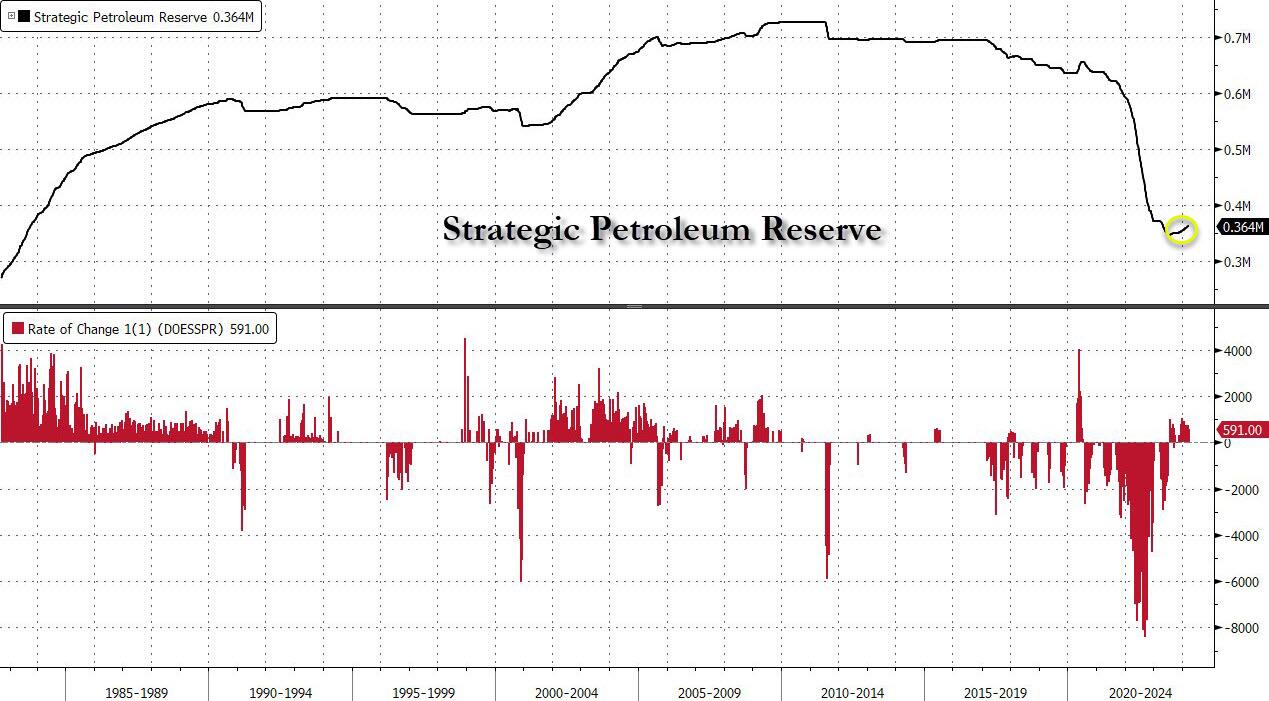
More than a year ago, we laughed at the thought that the Biden admin would actually follow through with its promise to refill the Strategic Petroleum Reserve when oil fell below $80, which in turn prompted area idiots to really rub it in our face when WTI tumbled as low as $73.

WTI is $73 now https://t.co/lqzYBr9S9Q — Joe Weisenthal (@TheStalwart) November 16, 2023

In retrospect we were, of course, right (and area idiots will continue failing upward until finally someone gives them the old rugpull) because even though WTI did indeed spend a few months below $80 before exploding back up again, this is how much oil the Biden admin purchased to refill the SPR after it intentionally drained it in 2022 to limit the surge in gas prices. Can’t see it? It’s highlighted in the yellow circle (yeah, no wonder you can’t see it).

And now that WTI is back to $86 and the Biden admin has completely missed its window to add some more oil to the SPR besides the token several hundred barrels here and there, the Biden administration has capitulated and today announced it won’t move forward with its latest plans to buy oil for the Strategic Petroleum Reserve amid rising prices.

According to Bloomberg, Biden’s Energy Department said it was “keeping the taxpayer’s interest at the forefront” in its decision not to purchase as many as 3 million barrels of oil for a Strategic Petroleum Reserve site in Louisiana. The plan for the barrels to be delivered in August and September had been announced in mid-March. It has now been canceled meaning that the already dismal rate of SPR refill will now flatline for the foreseeable future, at least until the NBER admits the US is in a recession.

See the rest here

Be seeing you

Posted in Uncategorized | Tagged: , , , | Leave a Comment »

The Great Escape from Government Schools?

Posted by M. C. on April 4, 2024

John Taylor Gatto, New York’s Teacher of the Year of 1991 (according to the New York State Education Department), observed, “Government schooling…kills the family by monopolizing the best times of childhood and by teaching disrespect for home and parents.”

by Jim Bovard

https://libertarianinstitute.org/articles/the-great-escape-from-government-schools

depositphotos 390085278 s

After enduring bullshit school shutdowns during the COVID pandemic, many students concluded that school itself must be bullshit and have skipped attending classes. Government bureaucrats are panicking since subsidies are tied to the number of students’ butts in chairs each day. Duke University Professor Katie Rosanbalm lamented that, thanks to the pandemic, “Our relationship with school became optional.”

School absences have “exploded” almost everywhere, according to a New York Times report last week. Chronic absenteeism has almost doubled amongst public school students, rising from 15% pre-pandemic to 26% currently. Compulsory attendance laws are getting trampled far and wide.

The New York Times suggested that “something fundamental has shifted in American childhood and the culture of school, in ways that may be long lasting.” Connecticut Education Commissioner Charlene M. Russell-Tucker commented, “There is a sense of: ‘If I don’t show up, would people even miss the fact that I’m not there?’” The arbitrary, counterproductive school shutdowns destroyed the trust that many families had in the government education system.

The New York Times reflected the tizzy afflicting education bureaucrats across the land: “Students can’t learn if they aren’t in school.”

Like hell.

So kids are not enduring daily indoctrination to doubt their own genders? So kids’ heads are not being dunked into the latest social justice buckets of fear, loathing, and guilt? So kids are not being drilled with faulty methods of learning mathematics to satisfy the latest Common Core catechism and vainly try to close the “achievement gap”? A shortage of indoctrination is not the same as a shortfall of education.

More than seventy years ago, University of Chicago President Robert Hutchins aptly observed, “The tremendous waste of time in the American education system must result from the fact that there is so much time to waste.” John Taylor Gatto, New York’s Teacher of the Year of 1991 (according to the New York State Education Department), observed, “Government schooling…kills the family by monopolizing the best times of childhood and by teaching disrespect for home and parents.”

My view on school absenteeism is shaped by my dissident tendencies. Government schooling was the most brain deadening experience in my life. Early in elementary school, I relished reading even more than peanut butter. But I was obliged to put down books and listen to teachers, slowing my mental intake by 80% or 90%. By the time I reached fourth grade, my curiosity was fading.

Between my junior and senior years in high school, I lazed away a summer on the payroll of the Virginia Highway Department. I came to recognize that public schools were permeated by the same “Highway Department ethos.” Teachers leaned on badly-written textbooks instead of shovels. Going through the motions and staying awake until quitting time was all that mattered. Learning became equated with drudgery and submission to bored taskmasters with chalk and erasers.

See the rest here

Be seeing you

Posted in Uncategorized | Tagged: , , , | Leave a Comment »

Do Americans Actually Want To Fight In A Global Conflict? — Very (Very) Few Say They Would

Posted by M. C. on April 3, 2024

The Ron Paul Liberty Report

Be seeing you

Posted in Uncategorized | Tagged: | Leave a Comment »