“Whether the mask is labeled fascism, democracy, or dictatorship of the proletariat, our great adversary remains the apparatus—the bureaucracy, the police, the military. Not the one facing us across the frontier of the battle lines, which is not so much our enemy as our brothers’ enemy, but the one that calls itself our protector and makes us its slaves. No matter what the circumstances, the worst betrayal will always be to subordinate ourselves to this apparatus and to trample underfoot, in its service, all human values in ourselves and in others.”
We do not oppose the free speech rights of such haters, but Ivy League schools are supposed to be the elite learning sites. What does it say of such highly respected places that some of their carefully selected students are bigots who want to replicate the “final solution” of Nazi Germany? This is total, complete, moral bankruptcy.
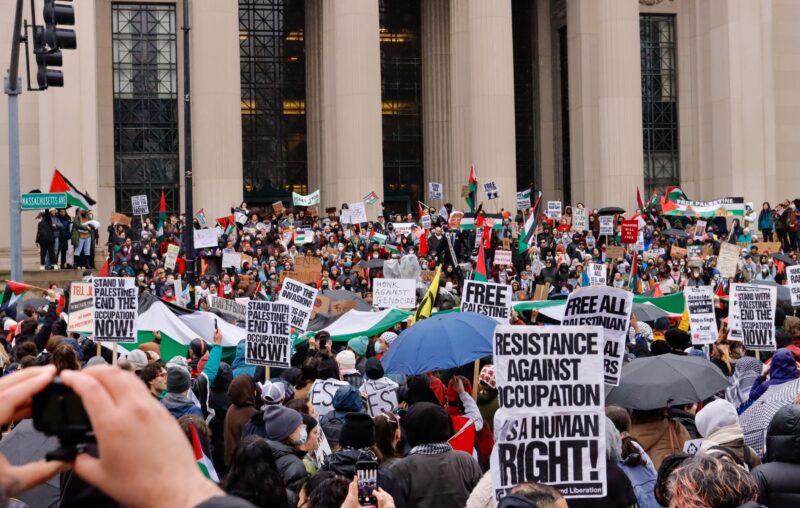
Rally for Palestine in Cambridge, Massachusetts earlier this month.
Use the wrong pronouns? You will be forthwith kicked out of school. Say “Eskimo” instead of “Inuit”? Woe betide you. Claim there are only two genders? The dean will have very harsh words for you. Oppose Diversity, Equity and Inclusion? You’ve had it. Disapprove of queer studies? You’re a homophobe. Complain about feminist studies? You’re a sexist. Criticize African-American studies departments? You’re a white supremacist.
Advocate “Palestine from the river to the sea,” that is, the end of Israel? Well, that is a highly complicated issue and we at college must be open to all shades of opinion on complex issues. Call for the death of Jews, all Jews, everywhere, not just in Israel? Hey, that’s just free speech! It is all a matter of “context.” We at university stand for the articulation of all shades of opinion (unless of course they are conservative or libertarian).
What is going on here? What is going on here is that the inmates have taken over the asylum. The leaders of major universities such as Harvard, MIT and the University of Pennsylvania are clearly biased. Their only standard is a double standard.
What, then, is a more rational analysis of this situation? We start off with the highly debatable point that incitement, paradoxically and surprisingly, should not be prohibited by law according to some commentators.
For instance, states Murray Rothbard:
Should it be illegal …. to ‘incite to riot’? Suppose that Green exhorts a crowd: ‘Go! Burn! Loot! Kill!’ and the mob proceeds to do just that, with Green having nothing further to do with these criminal activities. Since every man is free to adopt or not adopt any course of action he wishes, we cannot say that in some way Green determined the members of the mob to their criminal activities; we cannot make him, because of his exhortation, at all responsible for their crimes. ‘Inciting to riot,’ therefore, is a pure exercise of a man’s right to speak without being thereby implicated in crime. On the other hand, it is obvious that if Green happened to be involved in a plan or conspiracy with others to commit various crimes, and that then Green told them to proceed, he would then be just as implicated in the crimes as are the others — more so, if he were the mastermind who headed the criminal gang. This is a seemingly subtle distinction which in practice is clearcut — there is a world of difference between the head of a criminal gang and a soap-box orator during a riot; the former is not, properly to be charged simply with ‘incitement.’
Those students at our elite universities who are chanting “From the river to the sea…”, (that is, “Death to the Jews”) theme and variation, should not be imprisoned. They have not committed any crime.
It is one thing, however, to extol freedom of speech, and an entirely different claim that anyone may say whatever he wants anywhere. The former is correct, the latter not at all. If someone is on somebody else’s private property, the owner has the right to decide what can and cannot be “expressed” on its premises.
Thus, a university may certainly and properly announce and implement a code of conduct and ethics regarding acceptable speech. If students don’t like it, they can enroll elsewhere. In this case, Ivy League schools certainly have these codes of conduct. But they do not enforce them when Jews are being called to be killed. This decision of theirs is despicable. These administrators are hypocrites.
Right now, in America, there are efforts underway to recruit illegal aliens into the Army, as a legal pathway to citizenship.
So one day, the normal soldiers you see will include those aliens—never brought up as children with any notion of inalienable rights—never loyal to the United States. Simply trained to do their jobs.
The Governor of New York has sent armed troops into the subways of New York City, to keep them safe.
Governor Newsom of California (never to be trusted) says he’s deploying troops along the Cali-Mex border to stop the smuggling of fentanyl into the country.
Governor DeSantis has sent troops to maintain order in Miami during spring break.
All of this—to solve problems that should have been solved long ago:
Breakaway crime and illegal immigration.
Before they got out of hand.
On a deeper level, what this new military trend signals is: Create chaos and then solve it by bringing order.
Order might look good, it might feel right, but it isn’t. Because it means these troops will also be used against legitimate people and causes and protests and FREEDOM.
This is a very old pattern.
Again, create chaos (crime, illegal immigrant flood), then come in behind that and solve it; bring order.
Example: In 1978-9, a popular uprising against the Shah of Iran was turned into a massive series of riots; and the rioters were then tuned up and turned toward an ultimate solution: bring in a great solver, a bringer of order, the Ayatollah.
He was much more brutal than the Shah.
In that case, I had it from two independent sources that the underlying reason for the revolution was: the Shah was planning to use oil to build the biggest plastics manufacturing plants in the world. In the process, he would modernize the country. This sudden development was not on elite planners’ planetary chessboard.
With the help of the US Pentagon, and possibly the American intelligence establishment, an operation was mounted to reverse Iran to a more primitive condition—and the Ayatollah was the man to make that happen.
Back to today and here in the US: An expanding military presence on home soil would be directed, step by step, toward eliminating what remains of a Constitutional government.
The elimination would be seen as necessary, in light of out of control crime. Crime made possible by treasonous elements of the present government, operating under orders from Globalist elites bent on leveling America, cutting away all traces of Nationalism and subsuming the country under planet-wide governance: the long-term goal.
Well, it’s a proposed disorder. Advocates have so far failed to get it listed in the official bible of the American Psychiatric Association.
Orthorexia is defined as an obsession for eating healthy pure food.
It can lead to social isolation, because those afflicted can’t find anything to munch at parties. They also tend to show disgust when in the vicinity of impure food.
When the obsession reaches great height, profound weight loss and even death can result.
Proponents of the “disorder” tend to talk like this: “Orthorexia is caused by a combination of underlying genetic predisposition and environmental factors…”
As if they knew anything about supposed genetic reasons for anything. When in doubt, when bloviating, cite genetics.
Well, we’ve all known “orthorexia” people. They have super-strict standards for food. They’re cranky. They tend to go on unexpected sudden rants against food they consider “unclean.”
The Republican Party of the post-war era was dominated by “militarists of the period [who] shared with many … industrialists the belief that it was the nation’s inherent right to colonize the continent westward and southward to its geographical limits, and then push ever westward across the waters” (Brodsky, p. 228).
Grover Cleveland considered this imperialistic fantasy to be “every bit as odious as imperialism and misguided nationalism” (p. 228). He was determined that “we never get caught up in conflict with any foreign state unless attacked or otherwise provoked,” in the spirit of George Washington and Thomas Jefferson. If he were alive today, Grover Cleveland would be the chief nemesis of the neocons.
After the War to Prevent Southern Independence and the assassination of Lincoln the federal government was said to possess a “treasury of virtue.” The Republican Party, which was the federal government, with a decades-long monopoly of power rivaled only by the Bolsheviks in Russia, made sure that the government-run schools would preach this Virtuous State Philosophy to generations of school children.
And what did the Party of Virtue do with its “treasure”? A first order of business was to commence a campaign of ethnic genocide against the Plains Indians. Initiated just three months after the end of the war, and with Generals Grant, Sherman and Sheridan in charge, all of the Plains Indians — women and children included — would be either murdered or imprisoned on government reservations (“where they can be watched,” said Sherman) by 1890. The Party of Virtue even cynically recruited ex-slaves (the “Buffalo Soldiers”) to assist in its campaign of genocide against another colored race.
The Party of Virtue also broke up the union, which it had supposedly just “saved,” by disenfranchising all the adult white male southerners and denying them congressional representation unless the southern states ratified the 14th Amendment. At the same time, every last adult male ex slave was registered to vote Republican, and assisted in the Republican Party’s twelve-year plundering expedition in the South, also absurdly known as “Reconstruction.”
Onerous taxes were imposed on a region that was in dire need of tax amnesty. Property taxes in South Carolina, for example, were thirty times higher in 1870 than they were in 1860. The purpose of such confiscatory taxation was to force southern property owners to either pay bribes to Republican Party hacks employed as tax collectors, or sell them their land at fire sale prices. Nothing much was “reconstructed” but a great many carpetbaggers became very wealthy.
Then there was the massive corruption and criminality associated with building the government-subsidized transcontinental railroads, a project begun when Abraham Lincoln called a special session of congress to get the ball rolling just a few months after taking office. The infamous corruption of the Grant administrations was an inevitable consequence of these policies.
The average U.S. tariff rate was escalated to nearly 50 percent during the Lincoln administration and remained in that range until the income tax was adopted in 1913. Thus, the Party of Virtue engaged in fifty years of legal plunder through protectionist trade policies.
The taxpayers were plundered further by being forced to pay more and more for veterans’ pensions, for the war created a well-oiled lobby of Union Army veterans. Veterans’ pensions comprised 29 percent of all federal expenditures by 1884.
Government bureaucrats proliferated at all levels of government, as did taxes. The regulatory state was also greatly expanded, imposing regulations on freight rates, grain warehouses, trusts, and myriad occupations.
Fortunately for the ex slaves, very little was done for them by the federal government, allowing them the freedom and independence to pursue their own livelihoods, quite often with astonishing success despite all the roadblocks they faced.
The Great Libertarian from Buffalo
In the post-war years the Democratic Party possessed most of what was left of the states’ rights, strict constructionist Jeffersonians in American politics. The party had its share of scoundrels, politics being what it is, but it still generally championed free trade over the legal plunder of protectionism, and laissez faire over Lincolnian mercantilism. Its greatest spokesman in this regard was President Grover Cleveland, who served two terms as president: 1885—1889 and 1893—1897. His political philosophy was perhaps best expressed in his second inaugural address, where he said, “The lessons of paternalism ought to be unlearned and the better lesson taught that while the people should patriotically and cheerfully support their Government its functions do not include the support of the people.” He was a nineteenth century James Ostrowski.
Cleveland began his political career as sheriff of Erie County, New York in 1871, where he earned a reputation for fearlessness and incorruptibility. He was then elected mayor of Buffalo in 1882 where he became known as “the veto mayor.” He earned this noble designation for repeatedly vetoing inflated government contracts with politically-connected firms doing business with the city. He also insisted on competitive bidding on all city contracts, a practice almost unheard of in New York.
Ascending to the governor’s mansion, Cleveland became known as “the veto governor” for vetoing numerous Tammany Hall patronage bills put before the state legislature. Inevitably, this reputation would follow him into the White House where he would veto hundreds of bills, including forty-nine that he pocket vetoed on his very last day in office, March 4, 1897 (see Alyn Brodsky, Grover Cleveland: A Study in Character New York, St. Martin’s Press, 2000, p. 57).
During his first term as president Cleveland vetoed hundreds of pension expansion bills as unwarranted raids on the U.S. Treasury. He became Public Enemy Number One in the eyes of the “Grand Army of the Republic,” the Union army veterans lobbying organization that consistently agitated to plunder the taxpayers. Despite the dwindling number of veterans, expenditures on veterans’ pensions had increased by some 500 percent in the previous twenty years (Brodsky, p. 182), purely because of the political clout of Union army veterans. (Southerners paid taxes to finance the pensions, but did not qualify for them).