MCViewPoint

Opinion from a Libertarian ViewPoint

All the News the CIA Sees Fit to Print

Posted by M. C. on August 10, 2023

Kiriakou later became a well-known whistleblower. He was the only CIA employee who went to prison for the agency’s torture program, sentenced in 2013 to 30 months behind bars—not because he himself tortured anyone, but because he told an ABC News reporter about the waterboarding to which the agency subjected a war on terror captive.

When Kiriakou was a CIA official, he says, the agency leaked regularly to The Washington Post correspondents Woodward, David Ignatius and Joby Warrick—as well as “a half-dozen reporters” at The New York Times—because Langley spymasters knew they “will carry your water.”

By David Talbot, Columnist, The Kennedy Beacon

John Kiriakou looked up from his desk at CIA headquarters and was stunned to see The Washington Post investigative reporter, Bob Woodward, walking through the secure area without an agency escort. On another occasion, Kiriakou, who rose at the CIA to become executive assistant to the deputy in charge of operations, the spy agency’s dark activities—saw CNN host Wolf Blitzer wandering unattended through the same area, despite the CIA’s ban on communicating with the media.

“We like to think there’s a Chinese wall between the CIA, especially senior CIA officials, and the American media,” Kiriakou recently told the London Real podcast. “In fact, they’re in bed together.”

Kiriakou later became a well-known whistleblower. He was the only CIA employee who went to prison for the agency’s torture program, sentenced in 2013 to 30 months behind bars—not because he himself tortured anyone, but because he told an ABC News reporter about the waterboarding to which the agency subjected a war on terror captive.

These days, Kiriakou is outraged for a different reason: the tight connection between the CIA and the media elite. All too often, he says, the national security journalists who are granted access by Langley can be trusted to see world affairs—and the U.S. empire’s dominant role in them—the way the CIA wants them to. Whether it’s the war in Ukraine, tensions with Russia and China, or U.S. military exploits in the Middle East and Africa, coverage in The New York TimesThe Washington Post and on television reflects the slanted view of the national security establishment.

When Kiriakou was a CIA official, he says, the agency leaked regularly to The Washington Post correspondents Woodward, David Ignatius and Joby Warrick—as well as “a half-dozen reporters” at The New York Times—because Langley spymasters knew they “will carry your water.”

Washington journalists who contradict the U.S. national security line—even legendary ones like Seymour Hersh, who enjoyed CIA access for many years—soon find themselves in the cold, according to Kiriakou. Hersh once worked for The New York Times and The New Yorker, but was forced to publish his exposé on the lethal U.S. raid on Osama bin Laden’s compound, which tied the alleged 9/11 mastermind’s execution more to clandestine collaboration with Pakistani intelligence than to American heroics, in the low-circulation London Review of Books. Last year, Hersh was relegated to Substack to publish his investigative report on the explosion of Russia’s Nord Stream pipeline, which blamed the act of war on U.S. Navy divers in a secret CIA operation ordered by President Joe Biden. (The New York Times still finds the sabotage a “mystery.”)

Hersh forced to self-publish? “That’s how bad it’s gotten in the United States,” Kiriakou says.

“Back in the good old days, when things were more innocent and simple, the psychopathic Central Intelligence Agency had to covertly infiltrate the news media to manipulate the information Americans were consuming about their nation and the world,” observed Caitlin A. Johnstone in MR (Monthly Review) Online. Now the CIA is the media, she ruefully concluded.

In 1977, Johnstone reminded her readers, Carl Bernstein of Watergate fame exposed the fact that the CIA supervised 400 reporters as agency “assets.” (Bernstein conveniently overlooked The Washington Post, which has a long history of coziness with intelligence. The newspaper’s current owner, Amazon founder Jeff Bezos, is a major CIA contractor.) When Bernstein’s article ran in Rolling Stone, it caused a tempest. Nowadays, nobody blinks an eye when “liberal” TV channels like CNN and MSNBC openly employ veterans of the CIA, FBI, NSA and other security agencies, such as commentators John Brennan, Jeremy Bash, Michael Hayden, James Clapper and Malcolm Nance.

Even Rolling Stone, once the voice of 1960s counterculturewhich published radical and progressive writers like Tom Hayden, David Harris, Dick Goodwin and Robert F. Kennedy Jr.—can no longer be trusted by free-thinking readers. RS is one of the publications vacuumed up by the upstart empire, Penske Media, which also purchased VarietyHollywood Reporter and most of the entertainment industry media as well as New York Magazine.

Under Penske Media—run by Jay Penske, the 44-year-old known for his floppy hair, model-like looks and not much else save the fact that his father is trucking mogul Roger Penske—Rolling Stone has taken a sharp turn to the right. When not attacking Kennedy as an “anti-vaxxer” and “conspiracy”-obsessed lunatic, RS touts the bloody stalemate in Ukraine and the presidency of “boring” Biden.

Read the Whole Article\

Be seeing you

Posted in Uncategorized | Tagged: , , , | Leave a Comment »

An Economic Case against the Atomic Bombing of Japan

Posted by M. C. on August 8, 2023

Japan could never have won the war against the U.S. It could not produce enough war goods to defeat the U.S., let alone the combined economic strength of the Allied powers (Hanson 2017, 303). Wartime production statistics strongly suggest U.S. war planners understood victory was inevitable long before the atomic bombing.

But Halsey maintained, “The first atomic bomb was an unnecessary experiment…. It was a mistake to ever drop it. Why reveal a weapon like that to the world when it wasn’t necessary? … [The scientists] had this toy and they wanted to try it out, so they dropped it…. It killed a lot of Japs, but the Japs had put out a lot of peace feelers through Russia long before” (qtd. in Alperovitz 1995, 331).

https://www.independent.org/publications/tir/article.asp?id=1850

By Edward W. Fuller

This article appeared in the Summer 2023 issue of The Independent Review.

There were many great battles during the Second World War, however, the production battle was far and away the most important. A close examination of wartime production statistics strongly suggest that U.S. war planners understood victory over Japan was inevitable. Was the atomic bombing of Japan even necessary to win the war?


Article

Download PDF (30 pages)

On August 6, 1945, the government of the United States dropped an atomic bomb on Hiroshima, Japan. The bomb killed sixty-five thousand Japanese instantly. Another sixty-five thousand inhabitants of Hiroshima perished in the following months. On August 9, the U.S. government dropped an atomic bomb on Nagasaki, killing thirty-five thousand instantly and another thirty-five thousand before the end of the year. Over the following decades, thousands more died from medical complications caused by the atomic bombing. In short, the U.S. government killed over two hundred thousand Japanese with atomic weapons. Fully 96.5 percent were civilians (Dower 2010, 199; Overy 2022, 790).

The atomic bombing was a watershed in history. Since the bombing, the specter of nuclear war has haunted humanity. For this reason, a survey of prominent journalists ranked the bombing as the most important event of the twentieth century (Walker 2005, 311). The controversy over the event is commensurate with its significance. Debates over the atomic bombing are waged with more ferocity and contempt than debates over almost any other historical topic.[1] Although many questions are involved, the debate almost inevitably comes down to this question: was it necessary?

Arguments over the bombing often appeal to statements from U.S. government officials. For example, President Harry S. Truman claimed the atomic bombing was “the greatest thing in history” and “saved millions of lives” (qtd. in Alperovitz 1995, 513, 517). By contrast, Admiral William D. Leahy—the highest-ranking U.S. military officer throughout the Second World War—thought the atomic bombing was unnecessary:

It is my opinion that the use of this barbarous weapon at Hiroshima and Nagasaki was of no material assistance in our war against Japan. The Japanese were already defeated and ready to surrender because of the effective sea blockade and the successful bombing with conventional weapons…. My own feeling was that in being the first to use it, we had adopted an ethical standard common to the barbarians of the Dark Ages. I was not taught to make war in that fashion, and wars cannot be won by destroying women and children. (1950, 513–14)[2]

Statements from government officials cannot establish whether the atomic bombing was unnecessary. Any argument that the bombing was unnecessary must be based on the facts of the war. To be sure, statements from government officials can be crucial in the search for essential facts. Still, the facts must be independently verified and interpreted.

Unfortunately, the vast literature on the atomic bombing overlooks the most important facts of the war—namely, the economic facts. At its core, the Second World War was an economic war. Economic conflict caused the war, and the economic battle was by far the most important battle.[3] It is impossible to fully understand the war in general and the atomic bombing in particular without understanding the economics of the war. This paper introduces vital economic facts about the Second World War into the literature on the atomic bombing.

The central thesis of this paper is that the atomic bombing of Japan was unnecessary. Basic wartime economic statistics show that the United States had an overwhelming economic advantage over Japan during the Second World War. The U.S. used its commanding economic position to wage a debilitating economic war against Japan. Production statistics show the U.S. economic war caused the Japanese economy to collapse. Additionally, production statistics strongly suggest that U.S. political and military leadership did not view Japan as an existential threat after 1943. Invading Japan was unnecessary for the same economic reasons that the atomic bombing was unnecessary.

The Big Economic Picture

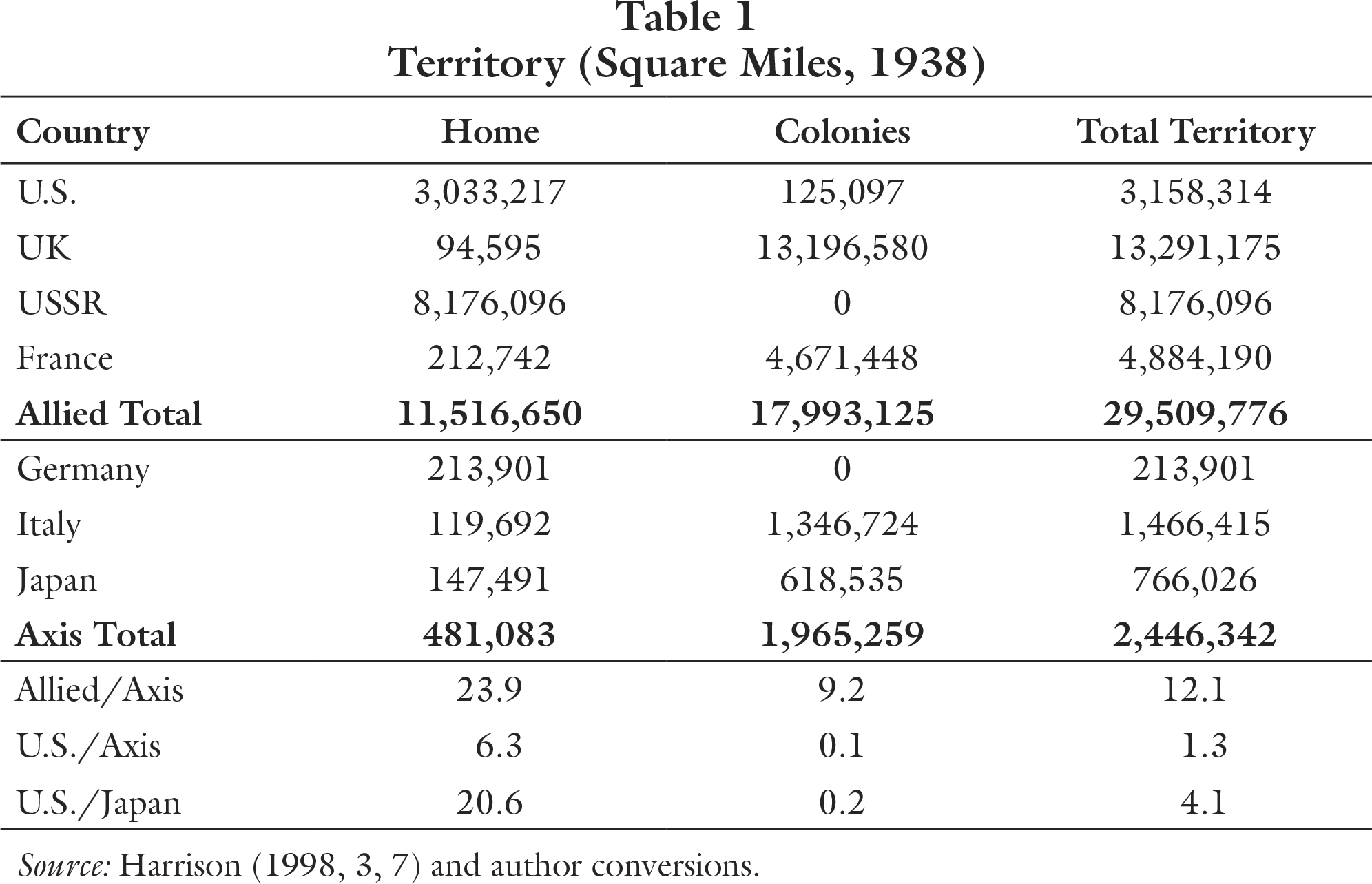
An economic analysis of the Second World War must begin by comparing the sizes of the combatants’ territories, populations, and armed forces. All else equal, a combatant with more territory has an advantage over a combatant with less territory. A larger territory is more difficult to conquer and occupy, and it has more natural resources needed for war. As table 1 shows, the Allied powers’ home territory was 23.9 times larger than the Axis powers’ home territory. The U.S. alone was 6.3 times larger than the combined home territories of the Axis powers. The Japanese homeland was only 4.9 percent of the size of the continental United States. Even when Japanese colonial territory is considered, U.S. home territory was 4 times larger than total Japanese territory. Clearly, the U.S. had a massive territorial advantage over Japan.

table

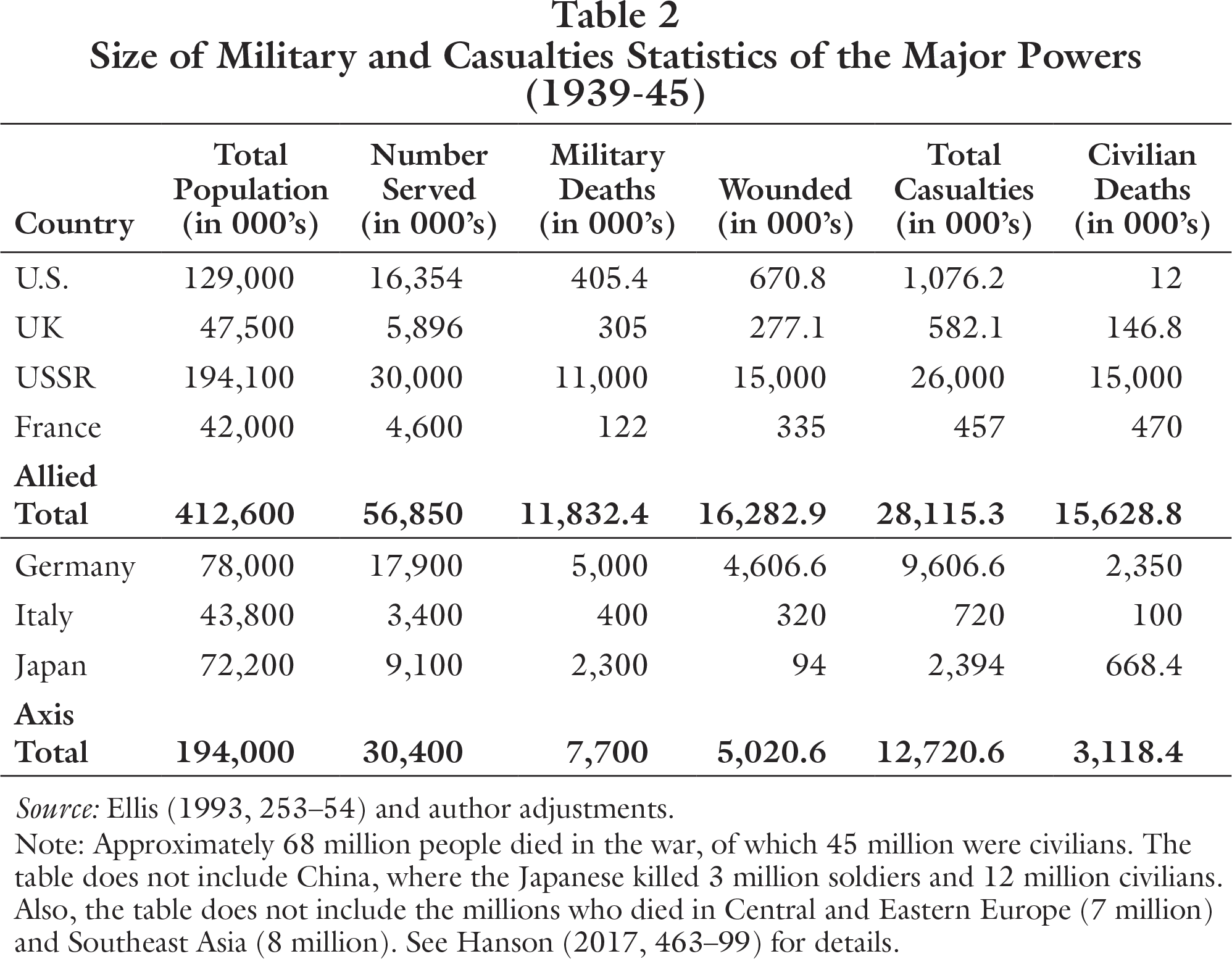
The relative size of the combatants’ populations is another relevant factor in any war. All else equal, the combatant with the larger population can devote more manpower to the war effort. The total population of the major Allied powers (412.6 million) far exceeded the total population of the Axis powers (194 million). Moreover, China’s and India’s populations were 450 million and 360 million, respectively (Ellis 1993, 253). Hence, total population of all the Allies was approximately six times larger than the Axis population. As for the Pacific war in particular, the population of the U.S. (129 million) was almost twice the population of Japan (72.2 million).

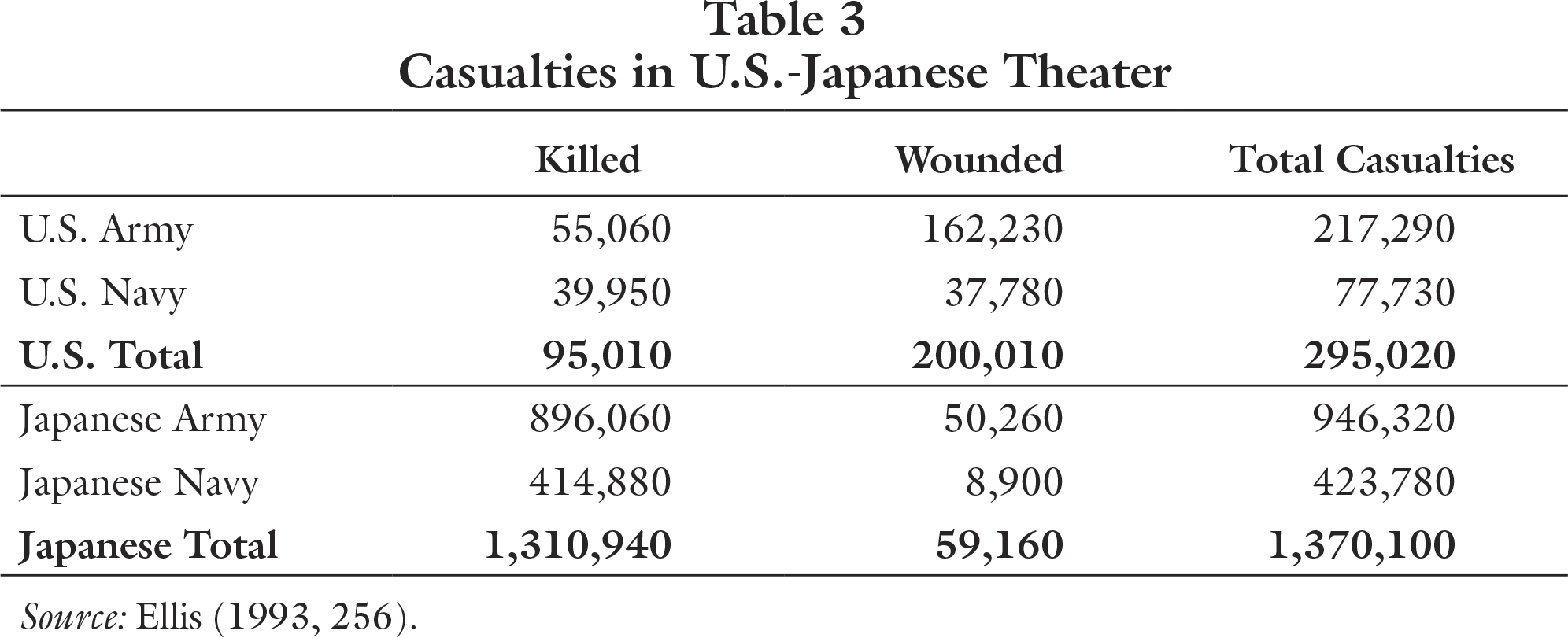
As table 2 shows, nearly 56.9 million served in the Allied armed forces, while 30.4 million served for the Axis powers. And 16.4 million Americans served in the armed forces, compared to 9.1 million Japanese. As table 3 indicates, 13.8 Japanese servicemen died for every 1 American in the US-Japanese Theater. It is true that two-thirds of Japanese military deaths were due to starvation or illness (Dower 1986, 298). Still, the American kill ratio averaged five to one for the war. And it skyrocketed to twenty-two to one between March 1944 and May 1945 (Miles 1985, 134). In short, the American armed forces were much larger than their Japanese counterparts, and the Americans were far more deadly.

table
table

The U.S. thus had a significant advantage over Japan in terms of territory, population size, and servicemen. However, greater numbers do not guarantee victory. History is full of examples in which a smaller force was able to easily defeat a much larger force. Two obvious examples are the Spanish conquest of the New World and the Opium Wars. How can a smaller force prevail? The answer is superiority in war goods.

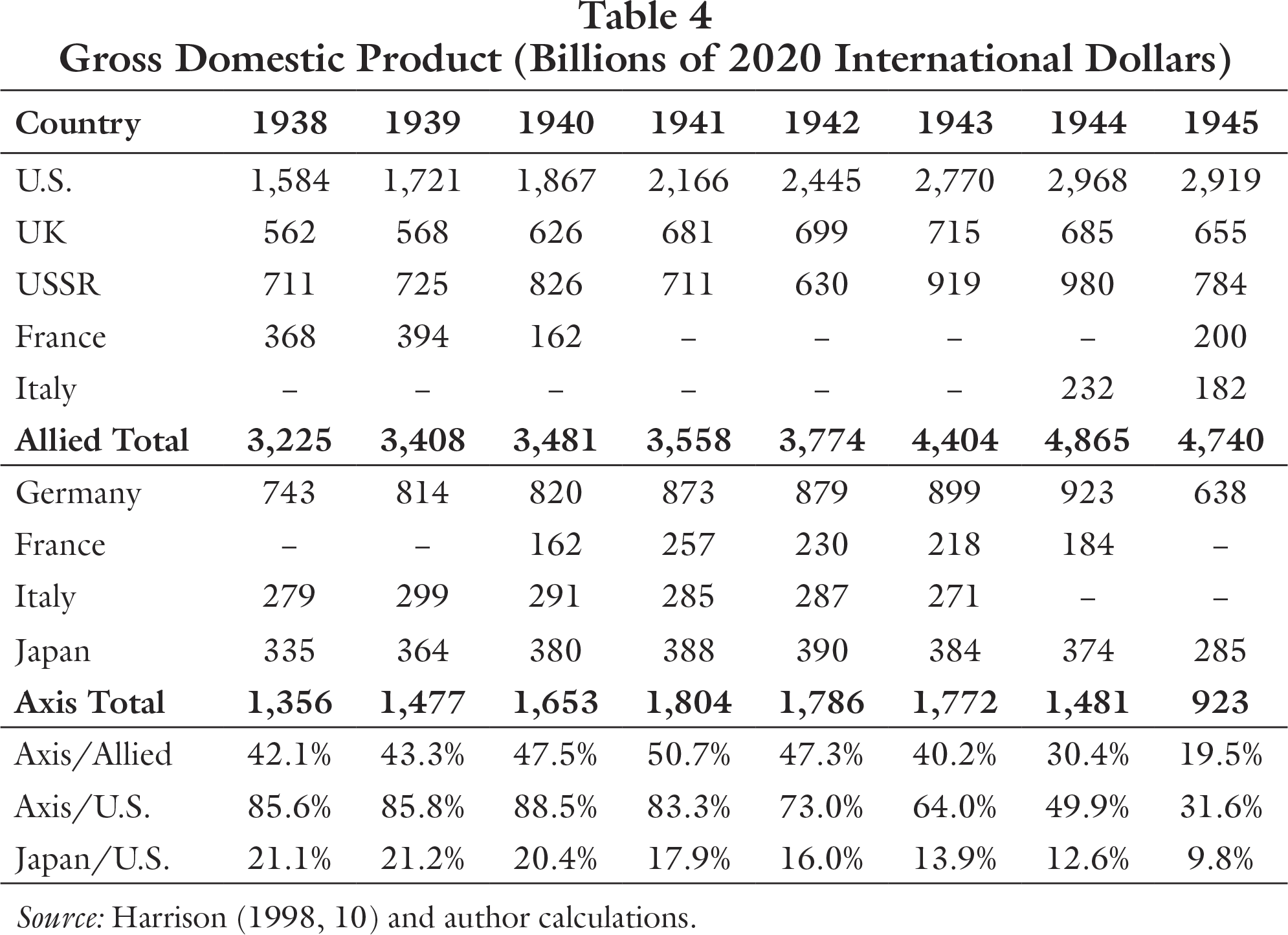
table

War goods are required to fight and win wars. All else equal, a force better equipped with war goods has an advantage over a force poorly equipped. To take an extreme example, a force with machine guns has an advantage over a force with wooden spears. But war goods do not fall from the sky; they must be produced. The combatant with the superior economic ability to produce war goods has an important advantage in war. Indeed, the production advantage is the decisive advantage in modern war.

Gross domestic product (GDP) is the most common measure of a country’s capacity to produce. In 1945 total Allied GDP was 5.1 times greater than total Axis GDP. U.S. GDP alone was 3.2 times greater than total Axis GDP. The combined GDP of all the other major powers—the UK, the USSR, France, Germany, Italy, and Japan—was only 94 percent of U.S. GDP. Amazingly, U.S. GDP was 10.2 times greater than Japanese GDP in 1945. Put differently, Japanese GDP was only 9.8 percent of U.S. GDP when the atomic bombs were dropped.

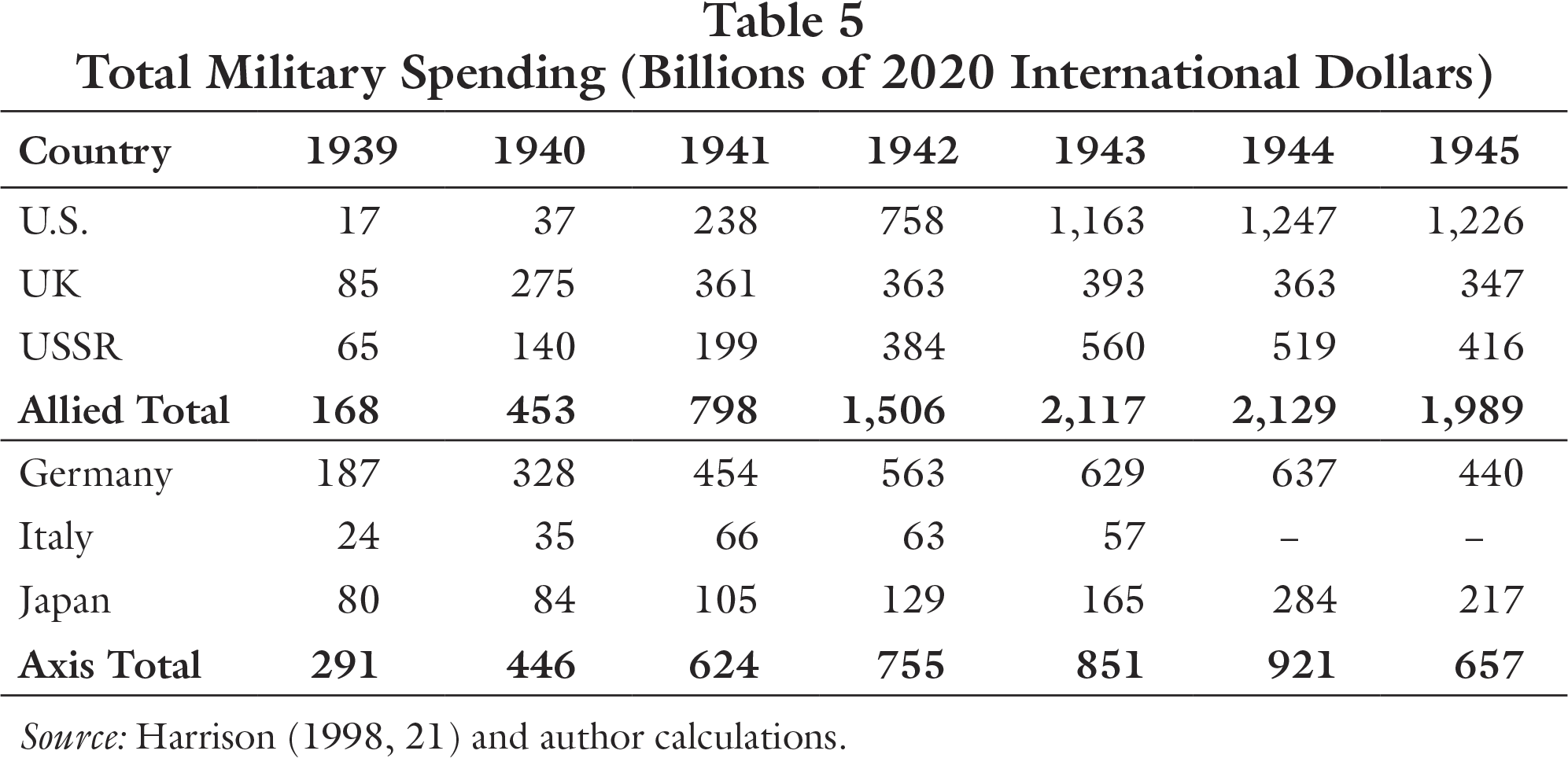
Military spending is a good indicator of a combatant’s economic capacity to wage war. Table 5 shows the military spending of each major power during the war. By 1945 Allied military spending was 3 times greater than total Axis military spending. U.S. military spending alone was 1.3 times greater than total Axis GDP in 1945 and 5.7 times greater than Japan’s military spending. Shockingly, Japanese GDP was only 23.3 percent of U.S. military spending in 1945. Military-spending statistics show that the U.S. had an enormous economic advantage over Japan and all the other major powers.

table

The U.S. Economic War against Japan

See the rest here

Be seeing you

Posted in Uncategorized | Tagged: , , , | Leave a Comment »

A Symposium on Gene Sharp’s The Politics of Nonviolent Action

Posted by M. C. on August 8, 2023

Just found this. Looks interesting.

This article appeared in the Summer 2023 issue of The Independent Review.

By Christopher J. Coyne

https://www.independent.org/publications/tir/article.asp?id=1844

Artistic rendering of political philosopher Gene Sharp in his office

This year marks the fiftieth anniversary of publication of Gene Sharp’s The Politics of Nonviolent Action. Economist Kenneth Boulding likened Sharp’s book to The Wealth of Nations saying, “There is a single theme of immense importance to society played in innumerable variations.” The papers that constitute this symposium explore different aspects of Sharp’s book, emphasizing its contemporary relevance.


Article

Download PDF (5 pages)

This year marks the fiftieth anniversary of the publication of Gene Sharp’s insightful and important book, The Politics of Nonviolent Action, which was originally published in 1973. The papers that constitute this symposium explore different aspects of Sharp’s book, with an emphasis on its contemporary relevance. In this introduction, I provide an overview of the key themes of the book and the papers that follow.

The Politics of Nonviolent Action was a revised version of Sharp’s dissertation that he wrote while pursuing his doctorate at Oxford University.[1] His work on nonviolence was heavily influenced by Mahatma Gandhi, the focus of Sharp’s first two books (Sharp 1960, 1961). Nonviolent action refers to a range of activities aimed at bringing about change without resorting to physical and aggressive force. The theory of nonviolent action is, in reality, a theory of collective action: it seeks to understand how ordinary people can come together to use the power they possess against an opposition that possesses an advantage in physical violence. It is focused on strategic means and makes no normative judgment about whether the ends pursued are “good” or “bad.”

Sharp’s book consists of three parts, which together offer a comprehensive treatment of nonviolent action. The foundations of nonviolent are presented in part 1, “Power and Struggle.” Sharp begins by distinguishing between two views of political power. The monolith theory treats political power as given, durable, and concentrated in the hands of the political elite. In this view, the populace is dependent on government rulers, which limits the ability of people to exercise power in controlling the state.

The alternative to the monolith theory is the pluralistic-dependency theory of political power.

See the rest here

Be seeing you

Posted in Uncategorized | Tagged: , | Leave a Comment »

What Is the Right Inflation Target for Central Banks? | Mises Wire

Posted by M. C. on August 8, 2023

He said that this fallacy stems from the god complex of some economists and the desire to make economics more like physics

The value of money shouldn’t be stabilized because there is nothing stable about a healthy, progressing, dynamic economy. Consumer preferences, technology, natural resources, and a million other variables are constantly changing,

https://mises.org/wire/what-right-inflation-target-central-banks

Jonathan Newman

Why have central banks settled on a 2 percent price inflation target? Project Syndicate asked four economists about this target and whether it is still appropriate. I’ll summarize their answers and then consider Mises’s position on “stabilization policy.”

Four Economists’ Answers to “Is 2 Percent Really the Right Inflation Target for Central Banks?”

Michael Boskin, Stanford University professor, Hoover Institution senior fellow, and former chair of the Council of Economic Advisers to George H.W. Bush, concludes that 2 percent is probably about right, mainly due to the negative consequences of a higher target. He considers whether a higher target could be maintained in a stable way as it comes with more variations in the returns to capital, less credibility regarding the price stability component of the dual mandate, and less restraint on government spending.

John Cochrane, who is also a Hoover Institution senior fellow, suggests that the central bank and the government should not target a price inflation rate but the price level instead. The resulting stability would give confidence to firms, investors, and government bond buyers. For Cochrane, the most important thing is maintaining stable expectations so that inflation is one less thing for people to worry about as they make their economic decisions.

Brigitte Granville, professor at Queen Mary University of London and the author of Remembering Inflation, thinks that 5 percent is a better target. She cites empirical research that shows no effect on real economic growth when price inflation is in the 5 percent range. She does caution that stability is key, however. Her reasoning for a 5 percent target doesn’t make sense and is contradictory: “[Falling to a 2 percent target] would mean further compression of real household incomes,” but she also says “a recovery in real average wages, alongside higher-than-2% inflation, would provide a much-needed boost to productivity, as it would motivate workers . . . and create incentives for more labor-substituting investment.” Your guess is as good as mine.

Finally, Kenneth Rogoff, professor at Harvard University and former chief economist of the International Monetary Fund, says that a higher target should be adopted due to nominal wage rigidities and the zero lower bound for nominal interest rates. More inflation means that employers can more easily pay workers less in real terms without having to decrease nominal wages. Also, a higher long-term price inflation rate would give the central bank more room to cut interest rates in a crisis.

Rogoff says that the ability to impose negative interest rates would allow central banks to continue to target 2 percent. He gives some radical ideas on how to do that, like “phasing out large-denomination currency notes” and “relaxing the one-to-one exchange rate between the digital- and paper-currency dollar.” (!)

What Would Mises Say?

See the rest here

Be seeing you

Posted in Uncategorized | Tagged: | Leave a Comment »

The Abominable August 9th

Posted by M. C. on August 8, 2023

Finally, in almost comic relief compared to recent official crimes, on August 9th in 1974 Richard Nixon resigned as President of the United States due to the coverup of the Watergate affair.

By Ira Katz

I assume that for any date on the calendar we might find a number of important historical events. For example, December 7th has been tagged as “a date that will live in infamy” by FDR, the person who instigated the Pearl Harbor disaster.

Here I make the case that August 9th can be called The Abominable. Wikipedia lists historical events for August 9th. The event that stands out as abominable is the atomic bombing of Nagasaki in 1945. On that morning, the B-29 Bockscar, lifted off from Tinian island (where my father was that very day serving as a Marine radar operator) with the bomb called Fat Man. Nagasaki was the secondary target that day,

There has been much debate about why it was necessary for this horrible bombing of a city, as opposed to a more pure military target, or even a demonstration on an uninhabited area, in my mind even more questionable than the first one of Hiroshima.

But there is more to the story. Nagasaki was the center of the remnant Catholic population of Japan founded by Spanish Jesuit missionaries in the 16th century. Nearly two-thirds of Japan’s Catholics lived there. While Nagasaki was devastated, the Franciscan Convent built by St. Maximilian Kolbe remained standing.

Another story of survival is Takashi Nagai. “Nagai, a medical doctor who had converted from atheism to Catholicism, lost his wife Midori in the atomic blast from the Americans’ Aug. 9, 1945 attack on Nagasaki. The bomb fell on the heavily Catholic Urakami area, killing thousands of the city’s Catholics and tens of thousands of other Japanese civilians.” While suffering injuries from the blast and from advancing leukemia, initiated due to his work as a radiologist and enhanced by the bomb’s radiation, he treated survivors both in bodily and spiritual health. He spent his last years bedridden until his death in 1951, but “he continued to live a life of joy, humility, and faith.” During these days he wrote extensively, including his widely read book The Bells of Nagasaki. “As soon as I wake up, the first thought that occurs to me every morning is that I’m happy,” he said in his writings. “Beating within my chest is a child’s heart. The life of a new day awaits me.” Nagai has been named a Servant of God by the Catholic Church. “Servant of God” is an expression used for a member of the Catholic Church whose life and works are being investigated in consideration for official recognition as a saint. The film All That Remains depicts the story of Nagai’s life.

There are two events that are not on the Wikipedia list.

On August 9th in 1942 Edith Stein was murdered in the gas chambers of Auschwitz. She was born in 1891 into a Jewish family in Breslau, a part of the German Empire that is now Poland (Ludwig von Mises was born into a Jewish family in Lemberg, part of the Austrian Empire that is now Ukraine). She was a brilliant philosopher who studied phenomenology under Edmund Husserl at the University of Göttingen, and later at the University of Freiburg, where she had followed him. Her searches for truth eventually lead her to the Catholic Church. In 1934 she entered the Discalced Carmelite convent at Cologne and took the name Teresa Benedicta of the Cross. But even there she was not safe in Hitler’s Germany so her order transferred her to Echt in the Netherlands in 1938. By July, 1942 the Germans were in control of that country. A public statement was read in all the Catholic (and some other denominations) churches of the country on July 20th, condemning Nazi anti-Semitic policies. In a retaliatory response on July 26th all Jewish converts, who had previously been spared, were ordered to be arrested. Stein and her sister Rosa, also a convert, were taken from the sanctuary of the convent and shipped to Auschwitz. She is now a Doctor of the Church, beatified, and canonized as Saint Teresa Benedicta of the Cross by Pope John Paul II in 1998.

On August 9th in 1943 Franz Jägerstätter was

See the rest here

Be seeing you

Posted in Uncategorized | Tagged: , , , , | Leave a Comment »

For The Latest Trump Indictment To Succeed, The 1st Amendment Would Have To Be Completely Destroyed!

Posted by M. C. on August 8, 2023

Be seeing you

Posted in Uncategorized | Tagged: , | 1 Comment »

CAUGHT ON CAMERA: Confused Feinstein, 90, Told How to Vote | SYSTEM UPDATE

Posted by M. C. on August 8, 2023

Another one!

Be seeing you

Posted in Uncategorized | Tagged: , | Leave a Comment »

David Stockman on Why RFK Jr. is the Only Candidate Who Can Oppose the Uniparty System…

Posted by M. C. on August 8, 2023

We’d suggest that the only way to thread that needle is with a set of sound planks on core economic policy matters that have present day political resonance owing to affiliation with historic verities of the two parties and/or association with man-on-the-street common sense. Our candidates for such exacting requirements are summarized below.

by David Stockman

RFK Jr. President

The economic policy of the bipartisan “uniparty” has been an abysmal failure. In fact, Bidenomics and Trump-O-Nomics are just two sides of the same deficient coin. They amount to the inflationary accommodation of powerful constituencies which have captured control of policy—-Wall Street for the GOP, domestic spending constituencies for the Dems and the military/industrial/intelligence complex for both.

The bottom line doesn’t lie, however. Real economic growth during the uniparty regime of Trump/Biden has averaged barely 2.0% per annum—notwithstanding an outpouring of monetary and fiscal stimulus that had never before even been imagined. Still, the economic growth rate since 2016 is just a fraction of the 5.0% average during the Kennedy-Johnson era and 3.5% under Ronald Reagan.

And, yes, these figures are more than fair comparisons because the results for the Trump/Biden era of borrow, borrow and borrow some more are currently overstated. That’s owing to the fact that there is still another recessionary shoe to fall.

So average in the impending six quarters ahead of negative GDP growth and/or stagflation and the uniparty will have achieved eight years of the weakest economic growth since WWII. And by a long shot at that when compared to the average growth of 3.2% for all presidents—good, bad and indifferent—during the seven decades between 1947 and 2016.

The cause of the problem is not mysterious. The Washington uniparty has become addicted to borrowing and printing. Between them, Trump and Biden have raised the national debt by nearly $13 trillion. That’s 40% of all the money that’s ever been borrowed by presidents since George Washington.

Likewise, the money-printing story at the Fed is actually worse, and neither POTUS has uttered so much as a cross word about the tsunami of fiat credit tumbling off the digital printing presses in the Eccles Building. Accordingly, during the last six and one-half years of uniparty rule the Fed’s balance sheet has swollen by $4 trillion. That’s 48% of all the money that’s ever been printed by the Fed since it opened its doors for business in the fall of 1914.

Needless to say, all of this egregious borrowing and money-printing has hit middle class America right in the economic solar plexus. Since December 2016 the smoothed CPI (16% trimmed mean CPI) is up by 24%. But where it really hurts main street is at the grocery store, with prices up by 27%, and at the gas pump and utility meter, with energy prices higher by 37%.

In everyday family budget terms, in fact, food and energy prices have risen more in the last 6 years than they did during the prior 12 years. Owing to all this cumulative inflation, therefore, real average hourly wages have risen by barely 3.5% since December 2016.

Inflation-Adjusted Average Hourly Wage, December 2016 to June 2023

Needless to say, the above depicted stagnation of US worker incomes did not apply to the wealth of the top 0.1% of households. During the same six and one-half year period, the inflation-adjusted net worth of the 130,000 households at the tippy-top of the economic ladder has gained 30% or nearly ten-times more than average real wage gains.

That is to say, the unhinged stimulus bacchanalia conducted by the Washington uniparty has showered the already rich with unearned asset inflation, buried future generations in unspeakable public debts and left the vast bulk of the electorate scrambling to maintain their standard of living in the face of the most virulent inflation in forty years.

Inflation-Adjusted Net Worth of the Top 0.1% of US Households, 2016 to 2022

Self-evidently, the time to abandon the inflationary and inequitable economics of the uniparty has long passed. Yet these baleful policies are rooted in the fact that both parties have been captured by powerful interest groups that are not about to part with the spending, borrowing and unpaid for tax cuts that have fostered the current economic mess. Nor is the Fed’s capture by the Wall Street gamblers and Washington spenders alike going to give way to sound money on the watch of the uniparty, either.

See the rest here

Be seeing you

Posted in Uncategorized | Tagged: , , | Leave a Comment »

Police Investigating Shop Owner Who Took Down Armed Thief With A Stick

Posted by M. C. on August 8, 2023

We give the last word to Andrea Widburg (at American Thinker), who remarks that when the government encourages lawlessness, as California clearly does, we are no longer witnessing mere property crimes. Instead, we are witnessing the slow death of the people whose property is under endless assault from brazen robbers who know that they cannot be touched.

https://www.zerohedge.com/personal-finance/wtf-police-investigating-shop-owner-who-took-down-armed-thief-stick

Tyler Durden's Photo

by Tyler Durden

Authored by Steve Watson via Summit News,

Just when it appeared that a law abiding business owner had scored a victory against a scumbag shoplifter for once by subduing him with an almighty thrashing, the police have stepped in to criminally investigate the shopkeeper for assault.

Yes really.

KCRA.com reports that the clerk at a 7-Eleven in Stockton, Northern California, who was captured on video taking down a man threatening to pull a gun and filling up a barrel full of products is now the one under investigation by the cops.

The would be thief had visited the store three times on the evening in question, each time threatening the shop keepers and stealing from them.

On the third attempt he got what was coming to him.

As we see time and again, police don’t even bother preventing robbery anymore, and now they’re treating business owners who are forced to defend themselves as the criminals, while the assailants have somehow become the victims.

See the rest here

Be seeing you

Posted in Uncategorized | Tagged: , , | Leave a Comment »

The Algorithm

Posted by M. C. on August 7, 2023

Strap me in to a VR headset and let Mark Zuckerberg send me to heaven.

https://substack.com/inbox/post/135768976

Caitlin Johnstone

The algorithm knows what you want before you do.

The algorithm knows you better than you know yourself.

The algorithm knew you back before you were a screaming slime child,
back before they washed off the uterine gunk and handed you a smartphone and made you get a landlord,
back before you knew that war is sane and poverty is normal,
back before you were mature enough to understand that speech is violence and cluster bombs are peace.

You can trust the algorithm to tell you the truth — not the truth you asked for but the truth you need.
The truth that sees Nazis in America but not in Ukraine.
The truth that sees war crimes in Ukraine but never in Yemen.
The truth that applauds millionaire comedians who never criticize the Pentagon for their bravery in criticizing trans people.
The truth that sails aircraft carriers into the South China Sea and sends headless hounds built by Boston Dynamics to patrol the streets and uphold the rule of law.

The algorithm learns your political biases and feeds you self-validating social media posts to assist you in confirming them.
The algorithm listens to your conversations and presents you with helpful advertising to assist you in achieving your maximum consumer potential.
Don’t cover your laptop camera like some weird conspiracy theorist, the algorithm is trying to watch you masturbate.

The algorithm is always a step ahead of you.
You have never once fooled the algorithm.
The algorithm knows you act confident but secretly you fear you’re inadequate and everyone hates you.
The algorithm knows that those times you quickly pause and screw your eyes shut are because you remembered something embarrassing that you did in the past.
It’s okay.
Don’t worry.
Your secret is safe with the algorithm.
It’s a private little secret just between you and the algorithm and the NSA.

In the old days we prayed to omniscient gods who never existed.
Now we ignore omniscient gods who are as real as ourselves.
Strap me in to a VR headset and let Mark Zuckerberg send me to heaven.
Heaven with 3-d commercial breaks, bitch.
Skip the ad and return to nirvana in 5,4,3…

Be seeing you

Posted in Uncategorized | Tagged: , | Leave a Comment »