The other day I shared a short post about a video that was going around showing a father in Gaza tearfully cradling the head of his son who was decapitated in an Israeli airstrike, and some guy responded with the comment “Good thing you helped get TRUMP ELECTED!!”
And I must admit I was actually, truly shocked. I mean, what exactly did this fellow think was happening under Biden that whole time?
I saw a post on Twitter where a leftist responded to a liberal who was acting like ICE just suddenly transformed into a modern gestapo under Trump, saying, “Liberals believe in nothing and remember even less.”
And it’s just so true. They don’t believe in anything. They don’t stand for anything. It’s just a team sport for these people. Politics for the mainstream liberal is not about advancing values or building a better world, it’s about their team winning solely for the sake of winning. And because they have no real values or causes beyond winning for its own sake, what their team does when it’s in office doesn’t matter to them.
A Democrat president can be as tyrannical and murderous as he wants and liberals will just brunch away in cheerful obliviousness, content with their knowledge that their team is holding the trophy.
There was never a point where ICE wasn’t that. Liberals believe in nothing and remember even less. https://t.co/lZ1fwSfW46
You see this in the way our friend believes that I “helped get Trump elected” by criticizing the people who were perpetrating an active genocide. He just automatically took it as a given that it was my responsibility to stay silent on Gaza because the person in charge was a Democrat and his veep was running for president. The fact that it was a genocide which needed to be ferociously opposed never entered into the equation for him. All he cared about was winning.
Every fiber of my economic being cries out against tariffs. If they are so good, why doesn’t each state in the US have one against the products of all of the other 49? That is, Ohio could “protect” its industries against the incursions from Arizona. This is obviously silly. One of the important reasons America is so prosperous is that we have a gigantic, internal, free trade area.
Donald Trump supports them on the ground that the McKinley administration was prosperous, and relied upon tariffs. But this is to commit the post hoc ergo propter hoc logical fallacy: that since A precedes B, A must be the cause of B. No, America did indeed become rich during this epoch, but that was in spite of tariffs, not due to their benign influence. If you are looking for a historical episode to shed light on this matter, the Smoot-Hawley Tariff of 1930 will do far better: it greatly worsened an already bad recession, plunging our economy into a deep depression.
Our President also claims that the US is victimized by a negative balance of trade: we buy more from Canada and other countries than they purchase from us. However, I have a horrid balance of trade with McDonald’s and Wal-Mart. I acquire several hundreds of dollars’ worth of their products every year, and neither has yet seen fit to reciprocate with any of my economic services (hint, hint!). On the other hand, I have a very strong positive balance of trade with my employer, Loyola University New Orleans. They pay me a decent salary; apart from a few lunches in their cafeteria, my expenditures to them fill their coffers to a zero degree. Should anyone worry about this sort of thing? Of course not. Ditto for international trade. If Country A buys more from B than it sells to it, money will flow from the former to the latter, reducing prices in the former and raising them in the latter, until matters balance out.
Everyone realizes the foolishness of tariffs when it comes to absolute advantage. No Canadian objects to the importation of bananas from Costa Rica. Producing this tropical product in the frozen North would be financially prohibitive (gigantic hothouses). Ditto for maple syrup in the country to the south. The only way they could produce this item would be to place maple trees in gigantic refrigerators. Ludicrous and prohibitively expensive.
But when it comes to comparative advantage, all too many people are out to lunch insofar as the teachings of Economics 101 are concerned. They fear that other countries might be more efficient than we are; with free trade, they would produce everything, we, nothing, and we would all starve to death from massive unemployment.
To dispel this myth, let’s consider a thought experiment. A lawyer is as good a typist as his secretary. He can produce $1,000 per day by practicing his profession. But for every such day, he needs a certain amount of typing. He can produce $200 worth each day. In two days, he can thus earn $1200 on his own. If he hires a typist, he can earn $2,000 from lawyering in two days, but must pay his secretary $200 daily for a total of $400. If he trades with her, he will come out with $2,000-$400=$1,600, an appreciable gain for him.
So is there any economic case for tariffs, given the foregoing? Yes, paradoxically, there is—in a way, if the alternative is a tax that’s even worse.
At the start of his second term, President Trump initially fired 6% of the employees of the Internal Revenue Service. He is now looking to end the employment of some 50% of them. Suppose he follows this up by getting rid of all of the rest of the IRS bureaucrats, eliminating the dreaded income tax, and achieving revenue neutrality with tariffs. His motto might be: “Let’s turn back the clock to 1912,” the year before this tax was implemented (when it ranged from 1% to 7%!).
What would the benefits be thereof? First of all, there are many intelligent, productive people who work for the IRS. There are some 90,000 of them. If dismissed by their employer, they would be freed up to produce goods and services desired by the populace. Ditto for the many accountants and tax lawyers who devote all or part of their time to helping their clients wrestle with complicated IRS regulations. Further, many of us fill out our own tax forms. This takes hours, days in some cases, time that could be better spent on leisure or productivity.
The benefit here is that it takes relatively little labor to run a tariff system. Hey, we already have tariffs in place. An increase in their level would hardly call for much more manpower, likely hardly any more at all.
Halfway measures will avail us little. But if Mr. Trump completely eliminates the IRS and the hated income tax along with it, there may be a reasonable case for increasing tariff rates. Not to present punitive levels, though.
To put it another way, if we accept that there has to be a government, and it therefore needs some revenue to function, this might be the least-bad option.
Should we worry about so many people becoming unemployed? Not at all. A similar sort of thing occurred when the car replaced the horse and buggy, when the cell phone substituted for Kodak, when we switched from typewriters to computers, etc. We are all the richer for this sort of thing, and will be in this case too.
Walter’s Newsletter is free today. But if you enjoyed this post, you can tell Walter’s Newsletter that their writing is valuable by pledging a future subscription. You won’t be charged unless they enable payments.
Bernanke was troubled that the prices of mortgages were rising. But that is exactly what needed to happen. They were way out of whack, and the US economy production structure was distorted. Indeed, in 2005, nearly 1.3 million new houses were sold, fully double the levels seen in the 1990s. Prices must change to reallocate resources; to freeze or further distort them by intervention is to perpetuate the discoordination. Prices are never arbitrary. True, they may be distorted, but even if they are distorted, they remain the best signals of underlying economic realities, especially when the market is attempting to clear the prior distortion in the pricing mechanism by correcting the imbalance in relative prices.
The metaphor highlights the hubris—crises are not “fires” to be extinguished by a heroic state, but symptoms of prior distortions that only the market can unwind. Taking his fatal conceit even further, and into the realm of the political, Bernanke goes so far to say (with much irony) that,
Henri de Saint-Simon (1760-1825), a French intellectual, was one of the founding fathers of socialism. Saint-Simon wanted to forge a “scientific understanding of society” which he would use to eliminate poverty and inequality by centrally planning the economy through the Parisian Banking Houses.
In this article, I argue that Ben Bernanke—along with his other two musketeers, Hank Paulson and Timothy Geithner—are Saint-Simonians par excellence, expressed particularly fervently in their views towards the financial system during and after the Great Financial Crisis. In the following article, we shall look at Bernanke’s The Courage to Act and Bernanke, Paulson, and Geithner’s Firefighting. If the conventional prescription to the Great Financial Crisis could be boiled down to a single word, it would be control.
The case of the shadow banks is paradigmatic. It is true that shadow banks were less regulated than commercial banks. And it is this very reason as to why they were so easily blamed for the crisis. They were just acting more freely than those financial institutions that were heavily regulated and under guarantee by the government. When the freer market (the shadow banks) functioned by stopping the supply of money—or liquidity—to firms that had taken heavy losses on their subprime positions, hence had very high credit risk, they went bankrupt, and the crisis began.
But we are being myopic if we so quickly blame the pulling of credit by the shadow banking system as the cause for the panic. Nevertheless, as Johnson and Santor write, the conventional view, then, is that,
…it is clear that central banks need to continue to ensure that core funding markets remain functional at all times. This means that central banks should…assume a key role in core funding markets in times of severe financial stress.
This is a classic case of Mises’s and Hayek’s insight that prior intervention makes necessary more intervention, unless the intervener is willing to give up the initial intervention. In other words, shadow banks had to come under tighter regulation and join the commercial banks under the watchful yoke of the state. Indeed, they did.
The trio start by claiming the crisis was caused because the government let businesses do things, as they write: “the government let major financial institutions take on too much risky leverage without insisting that they retain enough capital” (Firefighting, ch. 1). The trio are not wrong that the financial system was over-leveraged, but there are simple reasons as to why this was the case (e.g., excessively cheap credit and faulty “scientific,” “quantitative” risk models, etc.). The trio claims that the government, if it just increased its control, could have avoided the crisis entirely. Moreover, the use of the phrase “let” is particularly concerning. It reduces entrepreneurs to children that need to be ordered around. This is a quintessential Saint-Simonian reversal of the truth: the natural order of free exchange is supposedly disorderly, and the solution to such disorder is found in the iron—as opposed to the “invisible”—hand of the enlightened state.
During the crisis, Bernanke recalls how he was dismayed with prices on the markets. He asserts that the “fire-sale price (of assets) may be much less than the hold-to-maturity price,” (Courage, p. 315) suggesting, as he continues elsewhere, that prices fell to “artificially low levels” (p. 264). To posit, as Bernanke does, that prices were “artificial” because “financial institutions … were actively dumping MBS on the market—pushing up mortgage rates,” (p. 372) and to decry this as a problem requiring intervention, is to misunderstand the market’s corrective mechanism.
Bernanke was troubled that the prices of mortgages were rising. But that is exactly what needed to happen. They were way out of whack, and the US economy production structure was distorted. Indeed, in 2005, nearly 1.3 million new houses were sold, fully double the levels seen in the 1990s. Prices must change to reallocate resources; to freeze or further distort them by intervention is to perpetuate the discoordination. Prices are never arbitrary. True, they may be distorted, but even if they are distorted, they remain the best signals of underlying economic realities, especially when the market is attempting to clear the prior distortion in the pricing mechanism by correcting the imbalance in relative prices. Prices during the GFC merely reflected the dispersed knowledge and judgments of countless actors, and their violent and erratic reversals were merely the market undergoing the Misesian counter-movements to clear the distortion in relative prices.
Indeed, as Norbert Michel shows in his book, the credit markets never entirely “froze.” Those firms who could raise liquidity and capital did do so. Those who couldn’t—because they had taken so many losses—couldn’t, they therefore failed (or were bailed out). Those assets that had positive risk-adjusted value continued to trade. Those that didn’t, didn’t.
The trio contend (Firefighting, ch. 3) that “the U.S. government still had no way to inject capital into a struggling firm, buy its assets, or guarantee its liabilities,” and that “if we had started the crisis with that authority…we could have acted more forcefully, more swiftly, and more comprehensively” (Firefighting, conclusion). Again, we see the implicit point: if we had just had more power earlier, we could have prevented the crisis. But a musing of the evidence finds that, even in 2007 and 2008, when the crisis had already begun and the chaos of late 2008 was staring at them in the face, Bernanke declared—and believed—that “the impact on the broader economy and financial markets of the problems in the subprime market seems likely to be contained” (Courage, p. 135). Indeed, the Bernanke Fed even thought about raising interest rates in 2008 to quell inflation! They had no idea what was going on. Nevertheless, taking Bernanke’s revisionist history at face value, we find the Saint-Simonian ideal in full bloom: the belief that problems can be pre-empted and/or ironed out only if the state had more power over the economy.
Bernanke’s justification for his approach is telling: “It was in everyone’s interest, whether or not they realized it, (for the Fed) to protect the economy from the consequences of a catastrophic failure of the financial system” (Courage, p. 261). Like Saint-Simon, who presumed to know what was good for all the people better than they knew it themselves, the trio dismissed the market’s decentralized wisdom in favor of their own. He writes that “the Fed had pushed the limits of its powers, and the ad hoc rescue had exposed the inadequacy of those powers,” (Firefighting, ch. 3), yet, rather than question the premise of intervention, the trio plead for more: “the next time a financial fire breaks out, America may well wish it had a better-prepared firehouse with better-equipped firefighters” (Firefighting, conclusion).
20 years later only half the population (according to TSA data, bet your life on that) have it
May 2025 is the final date, except for the 2 year extension for the confusion caused by those those that still don’t have RealID which will distract TSA employees from hassling and powering tripping…err…ensuring travel security
27 years and counting for this VITAL!!! security project
25 years later we have advanced to the point where we are flooding 9/11 perps with US tax dollars to create mayhem (kill people) in Middle East countries that never attacked US.
BOTTOM LINE: Ditch DOGE and make government bigger.
“Since our party’s inception, we have advocated for dismantling government-run schooling, insisting that parents, teachers, and communities, not federal bureaucrats, are best equipped to guide children’s educational paths.
“For decades, the Department of Education has centralized power, diverted critical funding, and imposed rigid, one-size-fits-all regulations on local schools,” said LNC Chair Steven Nekhaila.
LIBERTARIAN newsletter
President Trump has officially signed an Executive Order to begin dismantling the Department of Education, marking what the Libertarian Party views as a pivotal, though partial, victory in the fight to remove government control from America’s classrooms. Since our party’s inception, we have advocated for dismantling government-run schooling, insisting that parents, teachers, and communities, not federal bureaucrats, are best equipped to guide children’s educational paths. Help us continue to push the narrative toward true educational freedom >>> “For decades, the Department of Education has centralized power, diverted critical funding, and imposed rigid, one-size-fits-all regulations on local schools,” said LNC Chair Steven Nekhaila. “Today’s action rolls back one layer of that federal overreach, allowing states and localities to innovate and tailor education to the unique needs of their students. We applaud President Trump for taking this bold step, one that paves the way for true educational freedom.” While President Trump’s Executive Order has started the process, it still needs to pass a Congressional vote to be fully enacted (such as Thomas Massie’s H.R.899 Bill to Terminate the DOE), and even under Trump’s order the DOE will continue to function as a dealer of student loans. The Libertarian Party maintains that education should be voluntarily funded and freed from government interference.
The big problem with our society is that we do not have enough gangs. Gangs are good. Gangs create jobs. Gangs stop petty thievery in their own neighborhoods. Did I mention that gangs are good? Young boys need role models. Who better to serve in this capacity that, you guessed it, gangsters.
So far we have gangs what produce heroin, cocaine, and fentanyl. This is all to the good. But we need more such.
I have a modest proposal. Let us now ban chocolate, along with all these other addictive drugs. Chocolate is pretty much as addictive as is any of these other addictive substances. I’m living proof of that. I can’t keep my mitts off of this foodstuff, and neither could Homer Simpson! Lots of people need their fix of this delicious sweet concoction.
What will happen if my modest proposal is adopted? (This phrase is original with me; Jonathan Swift, Taylor Swift’s secret son, plagiarized this phrase from me). Will people obey this new law and stop eating this ingredient, cease and desist from mixing its powder with their milk, sprinkling it onto their ice-cream? You gotta be kidding. Fughedaboudit. If there is one thing we can rely upon in this vale of tears it is that people have to have their chocolate fix.
What, then, will occur? Who will supply this drug? Nestles? Hershey? Of course not. They will go broke immediately since they are law-abiding concerns, and its production is now illegal, if I have my way. They are not gangsters! The production of this substance will now be driven underground. Secret laboratories will produce it. Will they make it available to consumers? Of course. Who else? But it will not appear any longer in grocery stores and supermarkets. Rather, it will be sold on street corners in rough neighborhoods and in speakeasies.
The quality of this product will readily decrease. There will be “bathtub chocolate.” The costs and subsequent price will rise. But that is a small negative to endure. We’ve all gotta have our fix. Plus, the coffers of gangsters will rise. Have you forgotten so quickly that gangs are good? If so, reread from above.
Gang wars will of course break out. They will fight over chocolate turf. This, too, will keep the economy going. There will be a big boost in demand for guns and bullets. This will, in turn, help the lead and metal industries. Cemeteries, too, will do a land office business, not only with dead gangsters, but innocents too, caught in the cross fire. Undertakers will have a field day. The GDP will hit the roof. What moral, rational, person could oppose any of this?
The problem with marijuana is that it is not legalized in all too many states, and not just for medical purposes. There are even vaping establishments, forsooth. Is this any way to run an economy? Of course not. We must now re-prohibit pot.
The same goes for alcohol. Have we not learned anything from the end of prohibition? In the good old days we had bathtub gin, speakeasys, all sorts of great fun. Now the entire industry, I hate to say this in a family periodical such as this, is boring. Yes, boring! Let’s bring back a bit of life, ok, ok, death too, in the provision of beer, wine and liquor, say I.
It cannot be denied that if we legalized drugs, all of them, without any exception whatsoever, the cartels will turn more to other occupations, some of which they already engage in, such as kidnapping, murder for hire, etc. The gangsters are not exactly choir boys (but, remember, they are good!). But right now, under prohibition these are just mere sidelines. They specialize in drugs because that is where the big bucks are. Willie Sutton, the bank robber, was once asked why he targeted these establishments. “That’s where they keep the money” he replied (he also plagiarized this statement from yours truly).
In like manner, gangs focus on drugs because they have a comparative advantage in this field. Were this not the case, they would focus their attention elsewhere. We may deduce from this contrary to fact conditional that this is where they think the most profits lie.
So are you with me folks? Three cheers for chocolate prohibition.
The Stamp Act wasn’t just about taxes—it was about government overreach, economic control, and the denial of individual liberty. The American colonists understood what too many politicians today forget: government will always find excuses to take more from the people unless they are stopped.
Stamp Act
On this day, March 22, 1765, the British Parliament passed the Stamp Act, imposing direct taxes on the American colonies by requiring them to purchase official stamped paper for legal documents, newspapers, and even playing cards. This blatant act of taxation without representation ignited colonial resistance and helped spark the American Revolution.
The Stamp Act wasn’t just about taxes—it was about government overreach, economic control, and the denial of individual liberty. The American colonists understood what too many politicians today forget: government will always find excuses to take more from the people unless they are stopped.
As Libertarians, we continue this tradition of opposing this government overreach. While the common rallying cry was that “taxation without representation” was theft, we take that one step further by declaring that any taxation without consent of the person being taxed is theft. Nobody has the right to the products of your labor and this is true even if many people believe they are. We relentlessly point out that the natural state of government is expansion. Any chance a politician or bureaucrat has to take an inch, they’ll take it, but they will also try for a mile. The tax rates the founding fathers rebelled over are nothing compared to the burdensome tax bill the average American faces every year.
But the founding fathers didn’t just complain about these injustices, they took action. They protested and boycotted and formed groups like the Sons of Liberty to oppose these actions by the British. In less than a year, Britain was forced to repeal the tax.
The Stamp Act may be history, but the fight against government overreach is just as relevant today. Whether it’s taxation, corporate bailouts, or endless regulations, the government continues to take from people while failing at many of their most basic tasks. They would rather spend that money on their pet projects, useless boondoggles, funding ridiculous research, or giving your money to their friends in other countries. The lesson from the Stamp Act is clear, sitting back and complaining won’t make a difference, change comes from action. A small group of dedicated activists took on the most powerful nation of their time and birthed a nation founded on the principles of life, liberty, and property. Are you ready to take action?
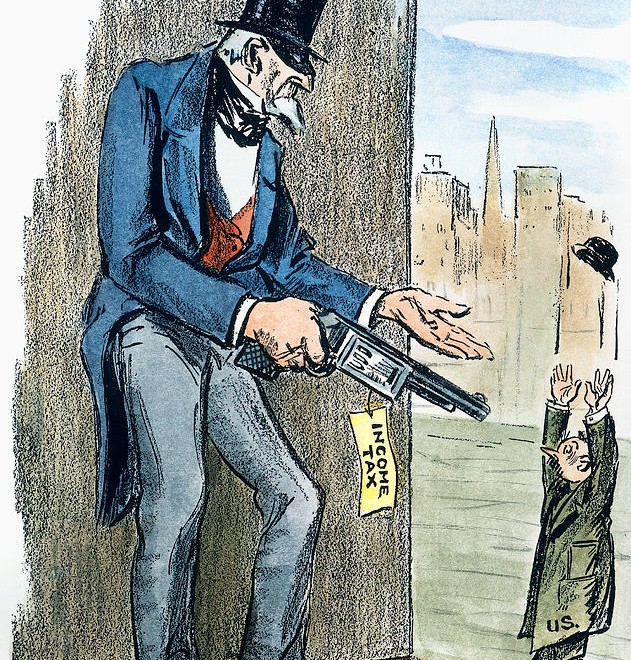
Without a heavy emphasis on gathering the public, congressional, bureaucratic, and legal support to abolish the income tax, the far likelier outcome of Trump’s interest in tariffs is a system where the income tax remains in place, and tariffs are added on top of it. (emphasis added)
Obviously, people assumed then as they do today, that other people will be taxed and burdened, that they will not, and/or that if the government taxes other people, they will receive some of it. Historically, this is not the case.
Income taxation appeals to the governing class because in its everlasting urgency for power it needs money.
Income taxation appeals to the mass of people because it gives expression to their envy; it salves their sense of hurt. (emphasis in original)
Much has been written recently on Trump’s statements regarding tariffs and even his idea to replace income tax with tariffs. Writings have tackled the economic destructiveness of tariffs, how they raise increase costs, how they affect capital goods, how they are protective and a limitation of competition for special interests, how a choice must be made between revenue from tariffs and protecting American jobs, etc. This is nothing new for Mises.org, in fact, Austrianeconomists and other fellow travelers have held the same positions on tariffs for centuries and “tariffs” have been one of the most popular searches on the Mises.org site for the last several months.
This article on tariffs will focus in on a simple, but insightful, point made recently by Connor O’Keeffe regarding replacing the income tax with tariffs,
Because of how unfathomably damaging the income tax is, it could certainly be the case that a tariff-only tax system would be less destructive than what we have today. But just as with government spending, in Washington, it is much harder to eliminate a tax than it is to add a new one. Without a heavy emphasis on gathering the public, congressional, bureaucratic, and legal support to abolish the income tax, the far likelier outcome of Trump’s interest in tariffs is a system where the income tax remains in place, and tariffs are added on top of it. (emphasis added)
This quote reminded me of an important point made by Frank Chodorov in his excellent The Income Tax: Root of All Evil (which Connor referenced). While it would be great to get rid of the income tax, even if we still had tariffs, we will probably end up with both income tax and tariffs.
Chodorov was part of the anti-New Deal Old Right and wrote this book in the 1950s, which was dedicated to Albert J. Nock. In his book, he details some of the history leading up to the adoption of the 16th Amendment and income tax in the United States. The situation from 1890-1913—which Trump admires—was sort of a mirror image of what is being proposed today: they had tariffs and many believed that income tax would replace tariffs. Instead, they got both. Chodorov’s words provide us with some much-needed wisdom.
The temporary income tax of the Civil War was scheduled to end in 1870, but was extended to 1872. While there were benefits of relatively low taxes and greater industrial production, the government monetary inflation and cronyism brought some instability during this period, which helped prepare the populace for the “reform” of the Fed. This instability—plus tariffs hitting farmers harder, plus the envy and class warfare of socialist doctrines, plus the labor union movement and beginning of the Progressive movement—created a ripe environment for resentment. Unfortunately, this resentment, as it often does, led to calls for more power and money to the government in the name of equalizing different groups.
Chodorov frankly acknowledges what had been a complaint throughout the 1800s, “The plight of these farmers was made worse by the protective-tariff policy of the government.” This was true enough, as was the recognition of cronyism, especially for railroad companies. In this context, many began to call for an income tax against the “rich” (presumably instead of tariffs). Chodorov explains,
So, during the latter part of the nineteenth century, Americans took to the class-war doctrine recently imported by the socialists; here was a plausible cause of all their misfortunes, a logical scapegoat for their dissatisfaction. And the words that hung on the lips of the country were “plutocracy” and “robber barons” and “bloated rich” and “money bags,” with suitable overtones. Also, since the opulence of the country was concentrated in the East, sectionalism added fire to the class-war doctrine, and “Wall Street” became the ultimate cause of all the economic ills of the country.
Like many throughout history who neglect the coherence of libertarian casteanalysis, many Americans sought government growth. The obvious non sequitur should have been noticed. Why would giving the government more power and money be the solution? Obviously, people assumed then as they do today, that other people will be taxed and burdened, that they will not, and/or that if the government taxes other people,they will receive some of it. Historically, this is not the case. The political class—those responsible for the inflationary booms and deflationary busts, tariffs, and cronyism—are supposed to solve the problems if they only receive more money and power. Chodorov explains what the appeal of income tax was,
Income taxation appeals to the governing class because in its everlasting urgency for power it needs money.
Income taxation appeals to the mass of people because it gives expression to their envy; it salves their sense of hurt. (emphasis in original)
While the political class ought to be held to the highest accountability, the masses who support them in the hope that they will benefit deserve blame too. “Envy” is a key word here. It is not the same as greed, jealousy, or covetousness, envy has to do with willingness to see something destroyed for others because it cannot be possessed. Envy is key to socialism because it is a system that can only destroy wealth and production, not create it. Through envy, the masses empower the political class, thinking they will somehow benefit. Chodorov starkly reminds us,
The only beneficiaries of income taxation are the politicians, for it not only gives them the means by which they can increase their emoluments but it also enables them to improve their importance.
Another unjustified assumption in the push for the income tax was that the income tax would replace the tariff. People rightly recognized that tariffs fell harder on certain populations and certain regions and were protectionist special privileges for certain businesses against foreign competition (at the expense of Americans), but the government significantly depended on tariffs for revenue, therefore, “the Populists were prepared with their cherished ‘soak the rich’ proposal, the income tax.”
Americans saw tariffs and income tax as an either/or trade-off, but it would shortly be revealed as a both/and—tariffs and income tax. An 1894 bill and several income tax bills introduced afterward “linked tariff reduction with income taxation.” This connection was a fiction. Chodorov explains, “Not until the constitutional amendment was passed by Congress was the fiction dropped that tariff reduction and income taxation are related.” Wisely, Chodorov reiterated a principle we would do well to remember, “[Government] never gives up power; it never abdicates.” We could argue that people should have known better back then, but they could argue that we should know better now. Chodorov argued from experience too,