The best way to live a life based in truth, and the best way to be of use to the world, is to expand consciousness both inwardly and outwardly. Deeply investigate your own consciousness, divest yourself of the misperceptions and erroneous assumptions around thought, perceiving and selfhood which are driving your behavior, and discover your true nature.
Years ago I watched a video clip by a philosopher named Ken Wilber that I still find myself referencing from time to time. In it, Wilber is asked about the plight of our world and how the struggles of our species relate to the enlightened perspective, or “big mind”.
I’m still not terribly familiar with Wilber’s work, but in the clip he very eloquently addresses the paradoxical relationship between (A) spiritual enlightenment as a realization of perfect peace and (B) the heartbreaking compassion that expansion of consciousness brings in for the suffering of all beings in our world. He does this with a very simple phrase: he says that as you awaken, that suffering “hurts more, but it bothers you less.”
In essence he says that awakening brings in an awareness of both the “absolute” perspective from which the world is seen as an illusion with no ultimate reality wherein no imperfection could possibly exist, and the “relative” perspective in which the suffering or happiness of others matters deeply to you.
“I don’t know anyone who has simply resolved that,” Wilber says of this paradox. “And I don’t think you’re supposed to. And I think the people that do are just playing on one side or the other side of that street. And we have to give ourselves plenty of room to both feel absolute perfection in everything that’s arising, and yet see one person starving and you will start crying so hard it will kill you. And if you’re not doing both, you’re doing something wrong.”
It seems likely to me that anyone who has sincerely dedicated themselves to expanding their awareness both inwardly and outwardly will eventually find themselves resonating with this “hurts more, bothers you less” perspective. As your awareness of your own inner processes expands you become liberated from the delusions which used to pull your strings and make you suffer from behind the shadows of the unconscious, and as your awareness expands outwardly the profound suffering and cruelty in our world will bring you howling to your knees.
This is why I think it’s so important for those who are sincerely dedicated to truth to work on expanding consciousness both outwardly and inwardly.
One thing is clear: the corporate media in the United States will continue to ignore anything that runs contrary to DC’s chosen narrative of a unified chorus of willing southeast Asian allies ready to contain China, as well as anything that hints at unpleasant complications or possible dangers in DC’s chosen course. And in the event of an accident, they will doubtlessly howl for escalation rather than de-escalation, as they always do.
Apart from its well-practiced habit of uncritically repeating whatever the Pentagon, State Department, White House (or really any other government agency) have to say on a particular subject, of equal importance in any indictment of the so-called Fourth Estate is what the corporate media does not report at all. Admittedly, to borrow from Sir Arthur Conan Doyle, a dog that fails to bark is not as readily noticeable as one which does; but when it comes to the fake China threat, several recent examples are particularly instructive.
First, U.S. House Speaker Kevin McCarthy’s loudly applauded meeting in late March with Taiwanese leader Tsai Ing-wen. Apart from failing to note that the first meeting on U.S. soil of a sitting Taiwanese leader with the third-highest ranking elected American government official since the U.S. supposedly severed relations with Taipei and recognized Beijing as legitimate government of China in 1979 clearly violated the agreed prohibition on high level government-to-government contacts between the two, the corporate media failed to report that at the same time Kevin McCarthy was posturing to show everyone that he was as tough as Nancy Pelosi, the leading members of the Taiwanese opposition party (the KMT) were in Beijing effectively showing their commitment to the status quo and good relations with the mainland.
Though readily available to anyone who cared to look, this inconvenient fact was doubtlessly ignored as it did not fit the narrative of a nation uniformly ready to die in a cross-strait fight with U.S.-made weapons in their hands. Given the sound shellacking Tsai Ing-wen’s Democratic Progressive Party received in local elections this past year, one would be unsurprised to see them lose the presidency in 2024, just as they did after the last round of independence-agitating by the party during the early 2000s.
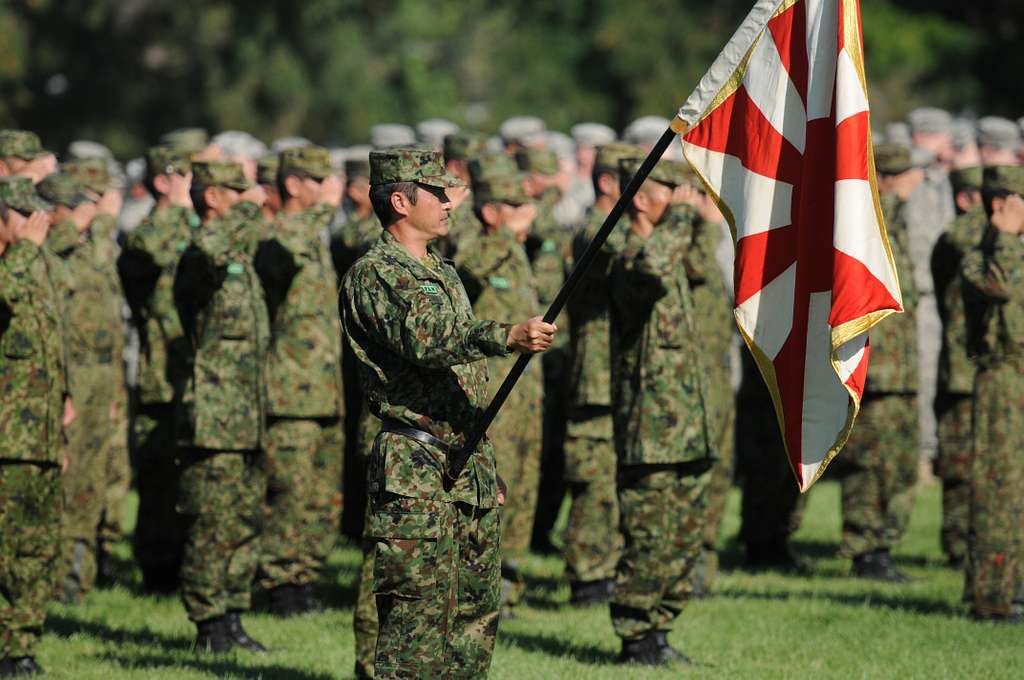
(For a bit of additional context on this admittedly obscure issue, Ryukyu was long a tributary kingdom of the Chinese Imperial state before being annexed and renamed by Imperial Japan in the late nineteenth century as the Qing dynasty disintegrated. The islands, for there are some dozens that comprise the Okinawa Prefecture, were unilaterally given to Japan by the United States in 1971 in exchange for continued basing rights for U.S. forces over the objections of the local native inhabitants).
For a long time; I along with countless others who are better informed than me have wondered at the strange nature of our governments actions upon the citizens they are supposed to represent and protect. If one didn’t know any better, it would seem that rather than being constituted to fight for the rights of their fellow countrymen, there has been an increasing shift at all levels of government that puts the needs, concerns and priorities of it citizens beneath government’s own – almost to the point of outright animosity. Rather than providing for “the common defense”, it increasingly feels to me like our government at all levels views us citizens as their enemy.
If this is true in any measure, why would that be the case? What purpose would driving public opinion down and fostering anger serve a government that ostensibly is only in power or control at the will of the people? There are a million theories I have heard espoused in prepper blogs and on the comments of survival forums, but the only thing that makes sense to me is that this is not accidental. This is not just the offshoots of our decaying culture where respect is a victim thrown in the gutter long ago. This is not a generational shift that speaks to our increasing lack of values. I believe the rising conflict and confrontation is all being done with a specific goal in mind. The goal of government agency abuses and apparent lack of remorse or responsibility to their citizens is to drive an agenda that foresees a world much differently than what we have now. I believe that on some level, our government is willingly complicit. Could it be that it is the people we elected, who say they are protecting us are, who we actually have most to fear from? Is our government building the terrorists they need in order to enact the changes they want in our country.
You have to have a bad guy
Many of you will read that paragraph above and naturally go with the conspiracy theory angle. I understand how simple that conclusion would be, but I don’t have grand answers, blueprints or reasons. I only have observations that I will list below. I don’t know the specifics, but I do think I have a lot of anecdotal evidence that when viewed together paints a picture. Answering the question of who painted that picture or why they painted it in the first place isn’t the purpose of this article, but I do hope to outline a trend. For many of you this is nothing new, but for some I hope that I can phrase this argument in a way that will at a minimum make you consider the changes our country has undergone and to question if possibly there isn’t something more worth investigating.
Everyone who has ever seen a movie or read a book knows that you must have a bad guy. There has to be some conflict that your hero can rise above. This bad guy can come from anywhere, have any motivation and they simply just need to be the person your hero struggles against. In this struggle, if the author has done a good job of developing the story and making your hero loveable, you will cheer on the hero and start to hate the bad guy. Maybe hate is too strong in all cases, but you have a clear allegiance to the hero and willingly believe all manner of situations as long as those eventually put your hero in the winning spot.
I maintain that national politics behave in a similar fashion, at least in our country even if I am making this overly simplistic. Our government is the hero to our country, national pride is easy to come by and chants of “USA, USA” are almost comical now. But like any good story, our hero needs a bad guy to fight against in order for this to work. This bad guy has taken on many forms in the past. The Indians, British, The Southern States, Germany, Japan and Russia, Cuba, Drugs, Russia again, Poverty, Iran, Iraq, Sugar, Al Qaeda, ISIS and more recently returning veterans and gun owners. At various times we have always had someone we needed to fight but have you ever questioned why that is?
It seems logical in war-time situations that when an aggressor comes to your land they must be fought off. This has morphed via treaties into extending our military to protect the interests of our friends and some would say our own national interests in the form of natural resources. I can understand almost all of those situations even when I don’t agree with them.
What I can never understand, absent some ulterior motive, and this is the thought that prompted me to write this article, is when the enemy becomes the citizens of our country. Don’t you have to wonder what the goal is when our government with its national security apparatus and all of the other forces a nation of our size can mobilize, is identifying its own citizens as targets for scrutiny? The following are just a few examples of this trend.
Labeling returning veterans as domestic terrorists – In 2009 a report from DHS was leaked via the Washington times, which you can read here naming returning veterans, gun owners and people who are opposed to abortion or illegal immigration as right-wing extremists – essentially equating them with terrorists. Police and government agencies are now often war gaming scenarios where the disturbance is caused by “sovereign citizens” or people opposed to the government and to make things interesting, gun confiscations are practiced.
Military exercises in Civilian areas – Operation Jade Helm is a multi-state training exercise that has a lot of implications that can be viewed as being war-gamed for potential use in the U.S. 1200 military special operations forces will be working to operate undetected among civilian populations. There are some reports that these exercises are preparations for martial law, which isn’t completely ridiculous when you consider that Texas and Utah, both large populations of gun owners and veterans are listed as “Hostile” in the exercise materials.
Denying Veterans medical treatment – What better way to both ensure that your veterans are simultaneously angry and less able to resist you than by denying their prompt medical treatment after they return wounded from serving the same country who now labels them as a potential threat.
Stifling of protests and dissent – Our Constitution guarantees our freedom of speech and the right to lawfully assemble, but these rights are increasingly under attack and marginalized. From high-profile cases like the Bundy ranch standoff where a cordoned area was set aside for protests (free speech as long as you do it where we say) to the FCC controlling the internet. Our freedoms are being taken away and you must ask why.
Ignoring the wishes of voters – This is probably the most in your face example of how our government is directly working in ways contradictory to our wishes and it begs the question why anyone would do something so seemingly counter intuitive to a politician’s survival instincts. From Immigration Amnesty that is overwhelmingly opposed by Americans to NSA spying and legislation that increases debts to continuing risky practices that got us into massive debt in the first place. Our government has shown repeatedly that they do not care what you want. The only logical conclusion is they do not care if you are happy with what they are doing – they want you angry.
The potential outbreak of a civil war sparked by a factional fight within Sudan’s military government poses a destabilization threat beyond the nation’s borders – into Africa, West Asia, and the emerging multipolar order. This suits the west just fine.
The story of Sudan is one of contrasts and contradictions. It is a country with tremendous potential and resources, yet it is plagued by poverty, conflict, and exploitation. The forces currently pulling Sudan apart are complex and multifaceted, but one thing is certain: the future of this nation is inextricably linked to the broader geopolitical landscape.
In order to fully comprehend the dynamics of this growing conflict, it is essential to look beyond Sudan’s borders. Attention must be paid to the broader geopolitical chemistry at play in the Horn of Africa, the Persian Gulf, the wider West Asian region, and even Ukraine.
Once the largest African nation with a population of 46 million and the third largest landmass, Sudan underwent a seismic shift in 2011 with a western-championed Balkanization, which divided the country into a “Muslim north” and a “Christian/Animist south.”
Extremes of wealth and poverty
The country is blessed with one of the most water-rich zones of the earth. The White and Blue Niles combine to form the Nile River, which flows northward into Egypt. Sudan’s water abundance is complemented by fertile soil and immense deposits of gold and oil.
The majority of these resources are located in the south, creating a convenient geological divide that western strategists have exploited for over a century to promote secession.
Despite its abundance of resources, Sudan is also one of the poorest nations in the world. Thirty-five percent of its population lives in extreme poverty, and a staggering 20 million people – or 50 percent of the population – suffer from food insecurity.
Although Sudan achieved political independence in 1956, like many other former colonies, it was never truly economically independent. The British utilized a strategy they had previously employed before leaving India in 1946 – divide and conquer – carving out “northern” and “southern” tribes, which led to civil wars that began months before Sudan’s independence in 1956.
General against General
After achieving independence in 2011, South Sudan was plunged into a brutal civil war that lasted for seven years. In the meantime, the north was hit by two coups; the first in 2019, which ousted President Omar al-Bashir, and the second in 2021, resulting in the current power-sharing military-led transitional government led by the president of the Sovereign Council, General Abdel Fattah al-Burhan, and his deputy, General Mohamed Hamdan Dagalo.
It is these two former allies-turned-rivals who now find themselves at the center of the conflict pulling Sudan in two opposing directions against the backdrop of the rapidly developing multipolar order.
Following the 2021 coup in Sudan, the two rival generals, Dagalo and Burhan, continued the momentum toward building large-scale projects. China funded a program to rehabilitate 4725 km of defunct colonial-era railways connecting the port of Sudan to Darfur and Chad.
A recent report by The Cradle suggests that if peace is maintained in the Horn of Africa and the new Iran-Saudi Arabia entente results in a durable peace process in Yemen, then the revival of the Bridge of the Horn of Africa project, which was last proposed in 2010, could become a reality.
Global South benefits from China-Russia co-op
In the past decade, the strategic partnership between China and Russia has been rapidly gaining favor among countries in the Global South. With the five BRICS member states accounting for over 3.2 billion people and 31.5 percent of global GDP, China and Russia have been providing financial support for major infrastructure, water, and energy projects while also backing the military needs of nations facing destabilization.
And there we have it. Americans are being asked to accept the force-feeding of an incredibly radical set of policies with a price tag that is unprecedented in global history to achieve a “carbon neutrality” goal, whose benefits are so nebulous, negligible and wholly reliant on the cooperative actions of other countries beyond U.S. control that they cannot be measured in any reliable way.
Instead, we are being told by senior political appointees forcing those policies into being that we should simply trust them because they think it is the right thing to do in their “heart of hearts.”
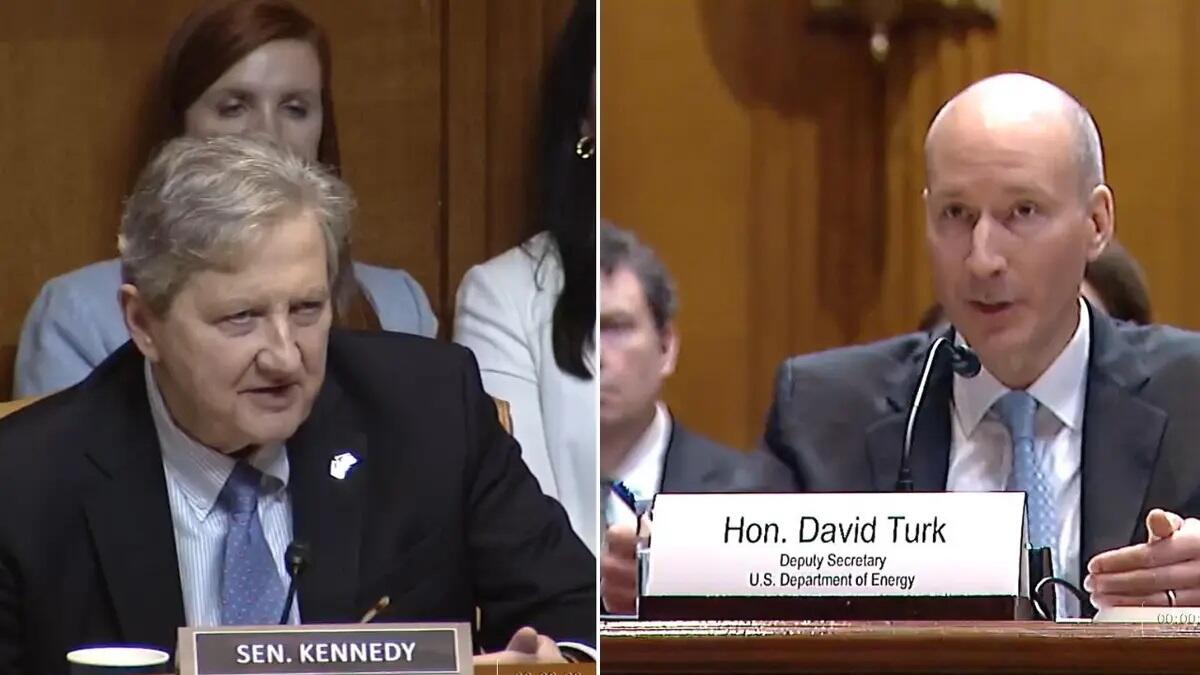
Biden Deputy Secretary of Energy David Turk highlighted the absurdity of the climate grift this week during a Senate Appropriations Subcommittee hearing, when Sen. John Kennedy (R-LA) couldn’t get a straight answer out of him over the cost of going ‘carbon neutral.’
In a tense exchange, Kennedy repeatedly attempted to get Turk to give a straightforward answer to just how much American taxpayers will have to pay to achieve the Biden administration’s goal of reaching US carbon neutrality by 2050.
When Kennedy asked whether some of the “experts” Turk referred to earlier were correct in a $50 trillion estimate, Turk nodded his head, and said “It’s gonna cost trillions of dollars, there’s no doubt about it.”
“f we spend $50 trillion to become carbon neutral by 2050 in the United States of America, how much is that going to reduce world temperatures?” Kennedy replied. The conversation continued (transcription via the Daily Caller)
Turk: “So, every country around the world needs to get its act together. Our emissions are about 13% of global emissions right now…”
Kennedy: “Yeah, but if you could answer my question. If we spend $50 trillion to become carbon neutral in the U.S. by 2050, you’re the Deputy Secretary of Energy, give me your estimate of how much that is going to reduce world temperatures.”
Turk: “So, first of all, it’s a net cost. It’s what, um, benefits we’re having from getting our act together and reducing all of those costs and climate benefits…”
James Madison, who most people would consider was a patriot, pointed out that “A standing military force, with an overgrown Executive, will not long be safe companions to liberty. The means of defence against foreign danger, have been always the instruments of tyranny at home.” (Emphasis added.)
A recent article in the Wall Street Journal demonstrates what a huge disaster conservatives are for our nation and for the rights and liberties of the American people. The article is entitled “The Military Recruitment Crisis Is a Symptom of Cultural Rot.” Co-written by a conservative veteran named David McCormick, the article laments the fact that fewer Americans are signing up to join the military. McCormack views this as a sign of “cultural rot” in America, a rot that, he suggests, entails a reduction of patriotism and love of country.
But McCormack is wrong. Actually, the reduced recruitments numbers are a very positive sign for our country. In fact, they might well reflect that the American people are finally waking up to the fact that America has become a military nation, one that is taking our country down from within.
Our nation was founded as a limited-government republic, one with a relatively small, basic army. If the Constitution had proposed the national-security state form of governmental structure under which we live today, there is no possibility that our American ancestors would have accepted it. That would have meant that the United States would have continued operating under the Articles of Confederation, a type of governmental structure whose powers were so weak that the federal government didn’t even have the power to tax.
Our American ancestors hated standing armies, which was the term used at that time to describe an enormous military-intelligence establishment, like the one under which all of us today have been born and raised.
That’s because they knew that the biggest threat to their freedom and well-being lay not with Russia, China, or any other foreign regime. They knew that the biggest threat to the freedom and well-being of a citizenry lies with their very own government, especially one that has an enormously powerful military-intelligence establishment to impose its will on people.
James Madison, who most people would consider was a patriot, pointed out that “A standing military force, with an overgrown Executive, will not long be safe companions to liberty. The means of defence against foreign danger, have been always the instruments of tyranny at home.” (Emphasis added.)
Mises—using the subjectivist-utilitarian method of analyzing society: subjective value, entrepreneurial innovation, consumer sovereignty, and action guided by ideas about ends and means—argues that in reality all de jure government is ultimately de facto government by public opinion, which is guided by ideologies.
From a Misesian perspective, the establishment of a representative democracy is a quest for a de jure government of public opinion. This could deal both with the social fact of the power of ideologies and public opinion and with the regulative ideal of a peacefully adapting to changes in the ideological preferences of the population.
Previously I explained Ludwig von Mises’s descriptive philosophy of the consent of individuals as the only thing that gives value to norms and authority. Individuals interpret norms and authority as useful—whether or not they are useful in reality for individuals’ purposes of coexistence. I continue with the explanation of how group consent originates and how it sustains norms and authorities with the help of ideologies and public opinion.
Ideologies and Ideological Entrepreneurs
In the first place, the consent of the governed refers to individual consent to ideas, more specifically to systems of ideas that Mises calls “ideologies.” From Misesian theory, the act of consenting to norms and authorities is influenced by an ideology that guides action. Ideologies are standardized sets of purposes and means that facilitate the creation of groups by simplifying individual choices. In Mises’s words:
What creates a group activity is a definite end sought by individuals and the belief of these individuals that cooperating in this group is a suitable means to attain the end sought. A group is a product of human wishes and the ideas about the means to realize these wishes. Its roots are in the value judgments of individuals and in the opinions held by individuals about the effects to be expected from definite means. To deal with social groups adequately and completely, one must start from the actions of the individuals. No group activity can be understood without analyzing the ideology that forms the group and makes it live and work.
Mises’s subjectivist-utilitarian individualism helps us to understand social phenomena on the basis of minimum certainties and by avoiding metaphysical speculations: only individuals exist in a real way, while groups exist only as the action of individuals who share the same ideologies.
In Misesian philosophical individualism, since individuals act, there are no “natural” forms of organization of society; all forms of organization are ideological, and ideologies are human inventions and choices. Therefore, ideologies are explained as immaterial products or social technologies created by concrete individuals and not by an anonymous mass or some metaphysical phantom. Groups are consumers of these products, and social phenomena are the result of these products. Mises explains ideologies as entrepreneurial creations:
There are pioneers who conceive new ideas and design new modes of thinking and acting; there are leaders who guide people along the way these people want to walk, and there are the anonymous masses who follow the leaders. There can be no question of writing history without the names of the pioneers and the leaders. . . . To ascribe the ideas producing historical change to the mass psyche is a manifestation of arbitrary metaphysical prepossession. . . . Mass movements are not inaugurated by anonymous nobodys but by individuals. We do not know the names of the men who in the early days of civilization accomplished the greatest exploits. But we are certain that also the technological and institutional innovations of those early ages were not the result of a sudden flash of inspiration that struck the masses but the work of some individuals who by far surpassed their fellow men.
There is no mass psyche and no mass mind but only ideas held and actions performed by the many in endorsing the opinions of the pioneers and leaders and imitating their conduct. Mobs and crowds too act only under the direction of ringleaders. The common men who constitute the masses are characterized by lack of initiative. They are not passive, they also act, but they act only at the instigation of abetters.
In short, ideologies are sets of standardized ends and means created by intellectuals—the ideological entrepreneur. When adopted by others, ideologies generate group actions, including the action of group consent to certain norms and authorities.
Unless the BRICS are willing to give up the power to create money out of thin air and create a currency that is backed 100 percent by gold or other commodities, any new currency will likely suffer the same problems as the dollar and other fiat currencies.
Money first originated through the voluntary exchange of commodities, such as gold and silver, in order to eliminate the inefficiencies of barter.
As Austrian school of economics founder Carl Menger explained:
Money is not an invention of the state. It is not the product of a legislative act. Even the sanction of political authority is not necessary for its existence. Certain commodities came to be money quite naturally, as the result of economic relationships that were independent of the power of the state.
However, governments quickly learned that they could gain enormous wealth and power by taking control of money. Ludwig von Mises detailed in his magnum opus Human Action how this control has harmed human progress and noted that “For two hundred years the governments have interfered with the market’s choice of the money medium. Even the most bigoted étatists [statists] do not venture to assert that this interference has proved beneficial.”
government meddling with money has not only brought untold tyranny into the world; it has also brought chaos and not order. It has fragmented the peaceful, productive world market and shattered it into a thousand pieces, with trade and investment hobbled and hampered by myriad restrictions, controls, artificial rates, currency breakdowns, etc. It has helped bring about wars by transforming a world of peaceful intercourse into a jungle of warring currency blocs. In short, we find that coercion, in money as in other matters, brings, not order, but conflict and chaos.
We see this chaos every day, with the economy bouncing from inflation to deflation and boom to bust. How did we reach this point and could it change going forward?
Devolution Of Money from Gold to Fiat Currencies
Prior to World War II, the British pound was the world’s “reserve currency.” However, after the war, the United States had the strongest economy and largest amount of gold reserves in the world.
At the Bretton Woods Conference in 1944, the US dollar was tied to gold at thirty-five dollars per ounce, and all other currencies were tied to the US dollar at fixed exchange rates. That made the dollar the “world reserve currency,” which means it was the only currency accepted throughout the world for the settlement of international trade accounts.
In the 1960s and early 1970s, the US government’s out-of-control spending spurred a run on US gold reserves by foreign governments. In response, President Richard Nixon ended all ties between the US dollar and gold in 1971. Since then, there has been no commodity backing for any currencies in the world. This led to higher inflation and lower living standards than would have otherwise occurred.
Following the Arab oil embargo of 1973, the US government agreed to provide military support to Saudi Arabia in exchange for Saudi Arabia agreeing to sell oil only in US dollars. This “petrodollar” arrangement helped solidify the dollar as the world’s reserve currency for the past fifty years.
What can compete with the US dollar now?
Rise of the BRICS
“BRICS” is an acronym for five of the largest emerging countries: Brazil, Russia, India, China, and South Africa. The BRICS countries comprise about 42 percent of the global population and 32 percent of global gross domestic product (GDP). By contrast, the US has only 4 percent of the global population and 16 percent of global GDP.
In addition, several countries are rumored to be joining the BRICS alliance in the future, including Saudi Arabia, the United Arab Emirates, Egypt, Turkey, Thailand, and Indonesia.
I say we arm Russia against Russia. If it’s bombing its own government buildings, its own pipelines, its own captured power plants, then it’s the best proxy force against Russia we’ve got. Send the Russians tanks and F-16s immediately...
And of course they don’t looks so special because they aren’t so special. All the people we used to regard as superior to ourselves were always just schmucks like us.
Your rulers do not care what race you are. They do not care if you are gay, transgendered or nonbinary. They do not care how many bullets you are allowed to have in your gun. They do not care whether you are allowed to have an abortion or not. They do not care if you are racist, sexist, ableist, ageist, xenophobic, homophobic, transphobic or fatphobic. They do not care about diverse representation in politics or media, and they do not care about any lack thereof. All they care about is that we all keep thinking, speaking, working, consuming and voting in ways which keep them rich and powerful and keep us poor and powerless. And they will happily keep us arguing as intensely as possible about the things they do not care about so that we don’t turn our attention to the things they do care about.
This doesn’t mean those other issues aren’t real concerns, and in fact our rulers stand everything to gain by exacerbating the injustices involving issues they don’t care about in order to keep attention in those convenient areas. But the solution to the problems our rulers don’t care about is the same as the solution to the problems our rulers do care about: overthrow our rulers.
❖
Western mass media are saturating the airwaves with the narrative that Wednesday’s drone bombing of the Kremlin was a “false flag”, by which they mean that Russia did it to themselves to advance some nefarious agenda.
False flags are a thing and they do happen, but to act like that’s the most likely explanation for the Kremlin bombing when Russia is currently at war with a neighbor who has the means, motive and opportunity is something only a propagandist would do. Especially when oligarchs from that neighboring nation are openly incentivizing people to attack Russia with drones for cash rewards, when Zelensky’s coinciding absence from the country prevented immediate retaliation, and when Atlantic propagandists are writing enthusiastically about the sophisticated drone facilities they visited in Ukraine.
❖
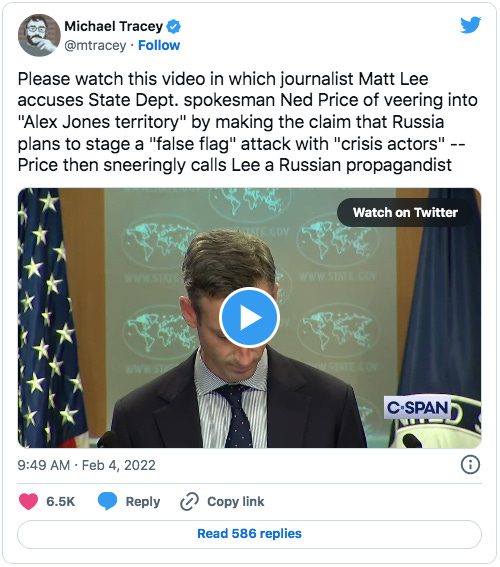
In 2017 I was temporarily suspended by Facebook for posting an article about known false flags, because until 2022 mainstream narrative managers considered false flags to be a crazy crackpot concept. That changed the moment the idea became useful to western propagandists.
When this changed in early 2022 it initially took journalists by surprise, because until then they’d only ever heard “false flag” used to dismiss people like Alex Jones:
I say we arm Russia against Russia. If it’s bombing its own government buildings, its own pipelines, its own captured power plants, then it’s the best proxy force against Russia we’ve got. Send the Russians tanks and F-16s immediately.
Russia’s fighting Russia over there so we don’t have to fight Russia over here.
❖
A westerner who spends half their time criticizing the US empire and half their time criticizing the US empire’s enemies isn’t providing “balance”, they’re just spending half their time contributing to an already wildly unbalanced information environment that is overwhelmingly biased in favor of US-friendly narratives.
❖
Westerners constantly respond to criticism of US foreign policy with “You love Putin and think he is good” because they really, truly subscribe to a children’s cartoon “Good Guys vs Bad Guys” worldview. To them, saying one side is Bad means you think the other side is Good.
Perhaps the most recent—and alarming—demonstration of the Fed’s disconnect from reality comes from the Fed’s repeated failures to foresee or address mounting bank failures.
2023 has already seen three major banks failures. As The New York Post reported on Monday:
The Federal Reserve’s Federal Open Market Committee (FOMC) on Wednesday raised the target policy interest rate (the federal funds rate) to 5.25 percent, an increase of 25 basis points. With this latest increase, the target has increased 5 percent since February 2022. This is the highest rate reached since August 2007, shortly before a recession began in December of that year.
With an increase of only 25 basis points, the May meeting is the third month in a row during which the Fed has pulled back from its more substantial rate hikes of 2022. After four 75-basis-point increases in 2022, the committee approved a 50-point increase in December, followed by 25-point increases in February and March, and another on Wednesday.
Although CPI inflation has remained at or above five percent in recent months the FOMC has slowed down in its monetary tightening over the past four months. This is spite of the fact Powell today characterized price inflation as “well above” the two-percent target while concluding the Fed “has a long way to go” in terms of getting price inflation under control. Nonetheless, indications continue to mount that the Fed is maintaining its drift toward more dovish policy.
The Fed Readies for a “Pause” on Interest Rates
This was apparent in Powell’s comments on the state of the economy on Wednesday. The Fed uses most indications of economic weakness as excuses to embrace monetary easing, and the Fed now increasingly points to weakening growth. In his remarks, Powell said “the US economy slowed significantly last year” while noting the pace of growth “continued to be modest” into the spring. Although Powell, as usual, pointed to “strong” job growth numbers, he did not present this as a clear indicator of the overall economy. Instead, the discussion turned toward the Fed’s economic forecasts which, according to Powell, point to a “mild recession.” Sticking to the usual script however, Powell emphasized the word “mild” and predicted employment losses as a result of a coming recession would be “smaller than is typical in recessions.” Given that the Fed has demonstrated no prescience whatsoever in terms of forecasting inflation rates or economic growth in recent years, it’s unclear as to what gives Powell the confidence to make such a precise prediction.
The FOMC’s press release text also points toward a policy turn away from monetary tightening. For example, in March’s press release, the FOMC noted:









 MCViewPoint