MCViewPoint

Opinion from a Libertarian ViewPoint

In Praise of Paper and Ink

Posted by M. C. on April 9, 2024

But an “F” for 21st Century Education

RT: Restoring Truth

Most P.E. teachers now resemble NCAA coaches in quick-dry, school logo regalia, and the sweaty outdoor feats can be achieved through “online P.E.”

Today’s experience thus lacks the paper and ink that lent both precision and finality to the labors of students and teachers. What now exists in the glitchy haze of digital notifications and maddening logins was, just 20 years ago, presented with handwritten—if perhaps disheartening—clarity. The school experience for both students and parents has metastasized into a digital disease that hollows out both brains and souls, all under the guise of “21st Century education.”

A couple days ago, I received an email informing me that I had a message in a special app called “ParentSquare”. In this special app—not in regular, low-tech email—the teacher had written an important message about my daughter’s schoolwork So, the email was a digital middleman that informed me of a message in a completely separate digital system. The email then repeated the contents of the app’s message anyways, making the separate app completely unnecessary. Confused? Me too.

You might wonder why an important message to or from a teacher could not be delivered through old-fashioned, direct email, without the redundancy of the fancy gatekeeper app. You might wonder what’s wrong with regular email—that breakthrough invention that supposedly enabled quicker business communication. If so, you wouldn’t be alone; most parents wonder these things, too.

Alas, things have changed for American education, and copious data suggests none of it is for the better. I’m not statistician, but I’ve noticed a couple things. First, schools are more expensive and tech-driven than ever, with textbooks and attention spans slowly disappearing from classrooms. Second, students are dumber and more out-of-shape than ever, belying the promises of special taxes and funding drives for the new technology and fancy gyms now nearly ubiquitous in American schools.

Something real has been lost in the rush to upgrade K-12 schools into campuses that rival community colleges. I’d say they’re a bit too smart for their own good. Members of the football team now look like sponsored athletes, with an array of warm-up gear suitable for a Nike campaign. It’s not just the kids getting fancy, though; where are the wrestling coaches wandering campus in their double-knit polyester shorts? These guys once doubled as physical education teachers and had us running the mile and climbing wooden walls in street shoes—feats many students are able to avoid nowadays. Most P.E. teachers now resemble NCAA coaches in quick-dry, school logo regalia, and the sweaty outdoor feats can be achieved through “online P.E.”

How about the other suffering that made us strong—the bulky textbooks with student names inscribed inside the front cover, or school lunches with only basic selections, including the world’s best rectangular pizza? I even miss the smell of damp, blue printer ink, the pink carbon-copy report card, and the very rare need to meet with teachers. It isn’t just a sentimental idea, either; paper and pencil make better brains. One of my kids desperately needed help with his math practice “sheet” a while back; when I went to help him, the “sheet” was on his screen, sending me on an education diatribe.

Today’s experience thus lacks the paper and ink that lent both precision and finality to the labors of students and teachers. What now exists in the glitchy haze of digital notifications and maddening logins was, just 20 years ago, presented with handwritten—if perhaps disheartening—clarity. The school experience for both students and parents has metastasized into a digital disease that hollows out both brains and souls, all under the guise of “21st Century education.”

See the rest here

Be seeing you

Posted in Uncategorized | Tagged: , | Leave a Comment »

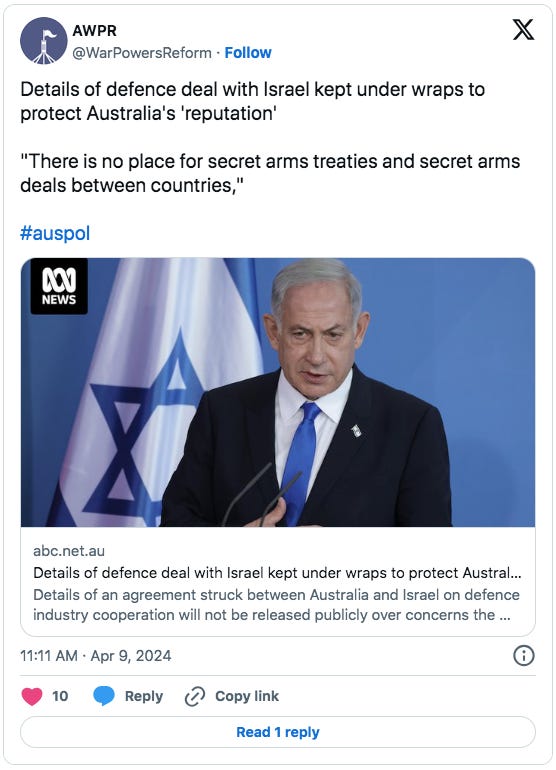
Australian Military Refuses To Disclose Arms Deal With Israel To Protect Its ‘Reputation’

Posted by M. C. on April 9, 2024

It’s like coming home to find your husband frantically burning clothes and mopping up blood and asking him what’s going on, and he says “I can’t tell you because the truth would harm your opinion of me.” Your very first thought after that is going to be that he must have done something very, very bad if that’s the best answer he could give you.

Caitlin Johnstone

Australia, like Israel, is not a real country. Like Israel, Australia is nothing other than a settler-colonialist outpost of western imperialism built on genocide, ethnic cleansing and theft, and now operates in a way that is inseparable from the US war machine. This land will never know peace or justice until we have extricated ourselves from the talons of the empire.

https://substack.com/inbox/post/143404243

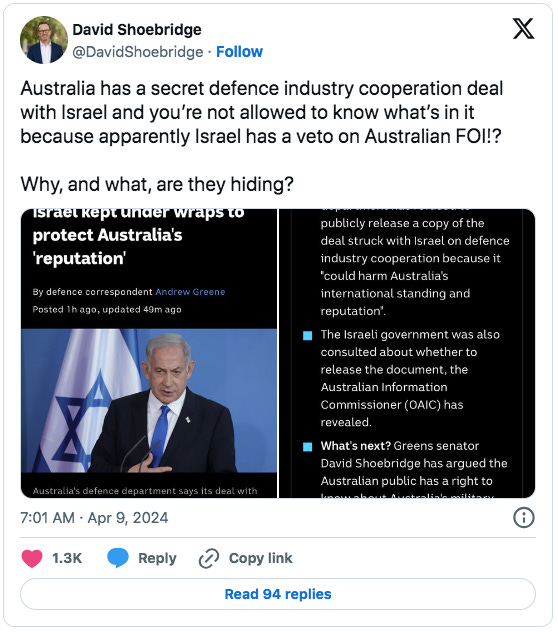
Australia’s Defence Department has refused a Freedom of Information request about the details of an arms deal with Israel on the grounds that such information “could harm Australia’s international standing and reputation,” which suggests the details must be pretty damning. Equally as scandalous, this refusal was reportedly made in consultation with the Israeli government.

In an article titled “Details of defence deal with Israel kept under wraps to protect Australia’s ‘reputation’,” the ABC’s Andrew Greene details how the Australian military snubbed a Freedom of Information request by the Australian Greens regarding a “Memorandum of Understanding” between Australia and Israel that was signed in 2017. 

“The document within the scope of this request contains information which, if released, could reasonably be expected to damage the international relations of the Commonwealth,” the Defence Department said in a letter explaining its rejection.

“A summary provided by the Australian Information Commissioner (OAIC) to the Greens reveals that the Israeli government was also consulted about releasing the document before Defence ultimately rejected the FOI request,” the ABC reports.

“The document contains information communicated to Australia by a foreign government and its officials under the expectation that it would not be disclosed,” a Defence official wrote in justification of its decision.

Greens senator David Shoebridge objected, saying “There is no place for secret arms treaties and secret arms deals between countries, and there is certainly no place for giving other countries veto power over what the Australian government tells the public about our government’s defence and arms deals.”

“Over 30,000 people have been killed by the State of Israel in Gaza in the past six months. In this context, the Australian public has a right to know about the military trade relationship with the State of Israel,” added Shoebridge.

It’s wild to think about the fact that the Australian warmakers determined this admission, that the truth would harm Australia’s reputation, to be the option that was least destructive to Australia’s reputation. When someone tells you “I can’t tell you the truth about that because the truth will make everyone dislike me,” it means they’ve ruled out every other option before coming to that position because the truth really is that ugly.

See the rest here

Be seeing you

Posted in Uncategorized | Tagged: , , , , | Leave a Comment »

A Competent Surgeon or Diversity Hired Surgeon, Who’d You Choose For Your Surgery? Thomas Sowell

Posted by M. C. on April 9, 2024

“Diversity” has become one of the most often used words of our time– and a word almost never defined. Diversity is invoked in discussions of everything from employment policy to curriculum reform and from entertainment to politics. Nor is the word merely a description of the long-known fact that the American population is made up of people from many countries, many races, and many cultural backgrounds. All that was well known long before the word “diversity” became an insistent part of our vocabulary, an invocation, an imperative, or a bludgeon in ideological conflicts.

Be seeing you

Posted in Uncategorized | Tagged: , , | Leave a Comment »

Eclipse Anthem

Posted by M. C. on April 8, 2024

Sing along while waiting for the rain to stop in Erie.

Be seeing you

Posted in Uncategorized | Tagged: | Leave a Comment »

Ukraine – Faking News Still Does Not Help Winning

Posted by M. C. on April 8, 2024

https://www.moonofalabama.org/2024/04/ukraine-faking-news-still-does-not-help-winning.html

Moon of Alabama

I find it amusing how little western media have learned from their own reporting on the war in Ukraine.

Two years ago a mystic ‘Ghost of Kiev’ was allegedly shooting down Russian aircraft left and right. The ghost turned out to be a fake character. The Ukrainian air force had never had such successes.

Two years on it is still the same story. The Ukrainian government claims something and western media print it as if it had really happened.

When the claim is debunked, often sooner than later, its simply vanishes from the headlines.

Yesterday we had this media wave:

The Russia side confirmed the attacks but denied any significant damage:

Rybar Force @rybar_force – 9:58 UTC · Apr 5, 2024

During the night, the AFU launched drones into Russian territory.

🔻The primary target was the Morozovsk airfield in the Rostov region, where Ukrainian forces dispatched 44 drones. The exact type remains unknown and will be determined upon analyzing the debris. However, there is a high likelihood that these are the same UAVs that the enemy has been utilizing in recent weeks.

Out of these, 26 drones were intercepted by Pantsir-S1 air defense missile systems, and 18 by rifle squads. Based on the videos circulating online, it is evident that the drones were flying at an extremely low altitude, enhancing the level of stealth.

There was no significant damage to the infrastructure. The debris hit a few buildings. Additionally, the substation suffered damage, resulting in a temporary power outage.

❗️ Thanks to the swift response of the air defense crews, any severe repercussions from the attacks were averted – claims from Ukrainian sources about the alleged destruction of six aircraft are fakes coming from enemy propagandists.

The Russia claim of no significant damage has been confirmed by the anti-Russian Institute for the Study of War:

See the rest here

Be seeing you

Posted in Uncategorized | Tagged: , , | Leave a Comment »

The Science of Oil, Water, Climate, and Guessing

Posted by M. C. on April 6, 2024

Posted by Helena

In the end – there is no reliable alternate source of oil and gas.   Manipulating weather has increased disease.   Science is simply guessing.   And messing with the Ice Shelves in Antarctica is likely to have very dire consequences.  Call in the aliens who built the pyramids…. And find trusted ways to grow crops utilizing significantly less water.  Solved.

As long as there is War, people die.   As long as people die, there is more water to go around.   The Middle East is a quagmire of water scarcity.   Water scarcity means food crisis as farmer’s water allocations continue to dry up.   Desalinization is not considered the solution given its cost and environmental impact, so what is the solution other than depopulation?

As agriculture in the Middle East scaled back in order to conserve water, unemployed farmers moved into the urban areas creating density issues.   The countries with the largest urban density include:  Kuwait, Qatar, and Israel – among others.  The irony of course is that the Middle East is scaling back agriculture in order to preserve the 15 million gallons of water necessary to frack a single well.   Oil produces money – agriculture can be imported.

According CSIS, global temperatures will rise by 4-5 degrees over the next 2-3 decades.   Net Zero is a farce and oil still represents 82% of global consumption.   In line with this, Saudi Aramco CEO, Amin Nasser, invoked a bit of reality into the equation by saying, “The world should “abandon the fantasy of phasing out oil and gas and instead invest in them adequately reflecting realistic demand assumptions.”

Nothing is being done to preserve the Water.

The interest in Antarctica has little to do with research and more to do with finding a way to extract the freshwater which represents 70% of global supply.   It isn’t simply the ice sheets of Antarctica, it is recently discovered massive freshwater lakes beneath the surface.   Seven countries maintain territorial claims in Antarctica, but the United States and most other countries do not recognize those claims.  Those seven countries include: Argentina, Australia, Chile, France, New Zealand, Norway, and the United Kingdom.   Why?   Water is MONEY.

In the near future, the value of water will likely surpass that of oil.   Finding ways to extract Antarctica’s water and transport it to individual countries remains the problemo.  But there is an even larger issue at stake;  extracting the freshwater from icebergs and underground lakes will cause temperatures to rise even more.  As the temperatures heat up – more water evaporates.

The Ross Ice Shelf is the largest in Antarctica.  It is a massive floating iceberg roughly the size of France.  Ice shelves play a significant role in regulating the planet’s climate. They do so by reflecting solar radiation back into the atmosphere and by acting as a barrier that controls the flow of glaciers into the ocean.    These shelves keep the ice in Antarctica from melting into the ocean.  Freshwater leakage into salt water oceans has multiple effects.

  • When the ice shelves melt the freshwater causes the sea’s to rise.
  • A depletion of the ice shelves would cause temperatures to rise.
  • Too great a depletion will affect marine wildlife.
  • When countries make ‘claims’ they won’t work in collaboration but for themselves making the chance of inappropriate handling, ie destruction,  much more likely.

Scientists are concerned over the fact that the Ross Shelf moves in a lurching motion 6” per day.  Because this lurch has only recently been noted, it is unknown how and why?   Speculation of underground ice quakes has been put forth with no evidence.    The fear is that anything abbienormal would have tremendous consequences for earth’s climate.  Given there is zero science to support what is normal vs what is abbienormal, scientists err on the side of abbienormal.  Tinkering with what is quite possibly a natural stress release, science may once again become the cause instead of the cure.

Perhaps, the global cloud seeding and weather manipulation is the actual criminal in altering natural weather patterns.  Some scientists have become much more fearful that this is the case.  Others, bent over their slides and algorithms, have deduced that deep water beneath Antarctica is warming…  based on pathetic evidence observed over less than two decades.  So “Science” wants to reverse what is naturally occurring.   What could go wrong?

Climate Change.

See the rest here

Be seeing you

Posted in Uncategorized | Tagged: , , , , , | Leave a Comment »

The Growing Fissures in NATO Unity

Posted by M. C. on April 6, 2024

Nothing that a US taxpayer cash infusion won’t cure.

by Ted Snider

https://libertarianinstitute.org/articles/the-growing-fissures-in-nato-unity

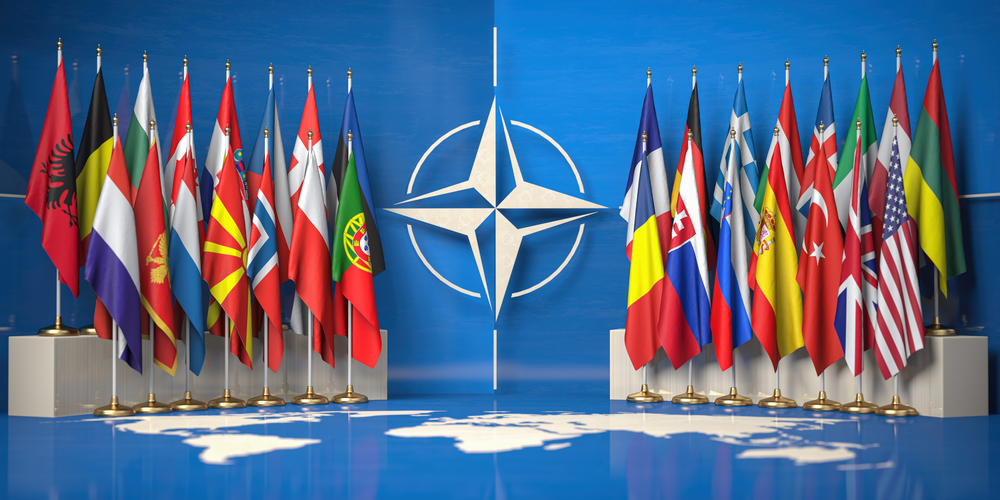
nato. flags of members of north atlantic treaty organization and

Despite the damage done in Ukraine and NATO’s now apparent inability to support Ukraine’s defense against Russia strongly enough, one item in the western win column is the claim that NATO is more unified following the damage done by Donald Trump. Even aside from NATO preparing for the possible consequences of a second Trump term, that win may not be so unequivocal.

Vladimir Putin “thought NATO would fracture and divide. Instead, NATO is more united and more unified than ever—than ever before,” President Joe Biden said on February 21, 2023 and again in Europe on July 13. “I would argue NATO is stronger than it’s ever been,” he said. “President Putin’s war continues to be a strategic failure,” Secretary of State Antony Blinken said on February 8, 2023. “In fact, that alliance—NATO—is stronger and more united than it’s ever been.”

But fissures have appeared. The smaller NATO powers are mad at the larger ones, as are the middle powers, and the large NATO powers are mad at each other.

The smaller and newer NATO countries have recently raised the divisive question of “whether there are first-rank and second-rank countries in NATO.” “Are we equals or are we not equals?” asked Estonian Prime Minister Kaja Kallas.

The Eastern European members of NATO feel passed over in two ways. First is their lack of representation in the top NATO jobs. The second is the dismissal of their more aggressive stance against Russia and their dismissal of Russian and NATO red lines.

Senior officials in the small Baltic nations of Lithuania, Latvia, and Estonia, which were all once part of the Soviet Union, maintain that the big NATO powers in Western Europe push them off to the side because of their more aggressive position in support of Ukraine against Russia. They complain that the large Western powers “do Russia policy without consulting people who know far more about Russia than [they] do.”

The Eastern European members of NATO have consistently seen themselves as dragging a reluctant, Western-centric NATO into the battle against Russia in defense of Ukraine. The East, led by Poland and the Czech Republic, has much more aggressively pushed for maximally arming Ukraine and dismissing the risk of escalating the war. Poland led the campaign to send tanks and fighter jets to Ukraine. The Czech Republic recently announced that it was on the verge of purchasing 300,000 artillery shells from countries outside of Europe to make up for European Union shortfalls and has said that the EU could obtain half a million more. By percentage of GDP, Estonia is the leading donor to Ukraine with Lithuania third, Latvia fifth, and Poland eighth. That is ahead of the United States, United Kingdom, France, and Germany.

See the rest here

Be seeing you

Posted in Uncategorized | Tagged: , , , | 1 Comment »

Antitrust Policy in a Free Society

Posted by M. C. on April 6, 2024

D. T. Armentano

Professor of Economics, University of Hartford

Both the normative and economic case for free markets and against any antitrust law is impressive. Since the law inevitably interferes with both rivalry and cooperation, it must tend to make the economy less efficient. And since the law inevitably interferes with individual rights and with peaceful exchange, it must tend to make the social system less fair and just. In short, the law appears to have lost any claim to legitimacy.

https://imprimis.hillsdale.edu/antitrust-policy-in-a-free-society

The primary concern of political economy is the appropriate role of government in social affairs. The debate, in brief, is whether the economy should be left free to establish a “spontaneous order,” or whether government regulation is necessary to maintain efficiency and economic welfare. Some liberals, most conservatives, and all libertarians would argue that government regulation of industry generally tends to reduce efficiency and economic growth and should be avoided. Since the late 1950s, and at an accelerated pace since the 1970s, free market economists and others have repeatedly argued that many governmental policies are unworkable, and that these policies often tend to achieve results that are the opposite of those intended. Indeed, theoretical and empirical criticisms of government regulation in industries such as transportation, telecommunications, and banking have been the primary rationale to deregulate these markets, and to allow free competition to determine the allocation of scarce resources.

Antitrust Deregulation

Antitrust policy has now joined the growing list of government “regulations” subject to theoretical and empirical revisionism. It wasn’t always so. Indeed, for most of the 20th century, antitrust policy was relatively immune from serious criticism. Its intentions and (apparent) results enjoyed wide academic and political support. It was generally assumed that the antitrust laws were based on solid theoretical foundations, and that vigorous enforcement was necessary to preserve business competition. What muted criticism there was of antitrust policy concerned the blatantly anti-consumer Robinson-Patman Act (1936). But aside from Robinson-Patman, the rest of the antitrust laws were seen by most as necessary to “preserve competition.”

The antitrust world has changed rather dramatically over the last 10 years. The enforcement of traditional antitrust policy has generally been curtailed sharply, and a “new direction” in antitrust enforcement has clearly emerged.

We might take a moment to contrast traditional enforcement policies with the current practices of the Federal Trade Commission and the Department of Justice. Traditional antitrust concern over the growth of “big” companies has been sharply reduced. Business arrangements whose sole probable effect is to expand market output and reduce market price can safely be excluded from antitrust prohibition. Conglomerate and vertical mergers (rarely a threat to any restriction of market output), and even many horizontal mergers (within certain reworked merger guidelines) can be permitted. Price discrimination and many vertical business agreements are now generally seen as part of the competitive market process and not as elements of monopoly power. Finally, and most importantly, antitrust enforcement efforts have been initiated recently against certain state and local regulations and ordinances that legally restrict entry and competition.

Why has antitrust policy changed? Is the new direction correct? Do we still require antitrust prohibition of certain “horizontal” agreements? Are antitrust supervision of trade association activity and rate bureaus necessary? Is there a rationale for any antitrust policy in a free society?

Monopoly Theory and Antitrust Policy

The most important reason for the collapse of traditional antitrust policy is the absence of any intelligent theory that would explain how private monopoly power could exist and be harmful to consumer welfare. Assume, for instance, that we have some industrial market with no legal barriers to entry. Business organizations will enter that market and prosper if they can allocate resources in generally efficient ways to consumers. The firms that grow and accumulate market share will have earned their market positions through exceptional performance, and holding or advancing their position will depend upon a continuously exceptional performance.

On the other hand, firms that misallocate resources (from a consumer perspective) would likely lose market position relative to more efficient business organizations. Organizations, for example, with relatively higher costs, restricted outputs, higher prices, poor quality products, repressed innovation and generally restrictive practices would likely lose profit and market share to rivals.

What useful role could antitrust policy play in this open market process? To employ antitrust against the successful firms would be anti-consumer and destructive to industrial efficiency. Yet to employ antitrust against firms that perform poorly would be unnecessary since strong economic incentives exist for such firms to change their behavior or, given failure, for the market process to reallocate resources away from such organizations. Any government action would be either premature or redundant. Thus in the absence of any intelligent theory of how resources could continue to be misallocated in open markets, the theoretical justification for traditional anti-monopoly enforcement tends to evaporate.

In a last-ditch effort to save traditional enforcement, it was argued that certain non-legal “barriers to entry” protected large firms from competition. On analysis, however, the “barriers to entry” doctrine self-destructed. Most of the so-called “barriers” turned out to be economies and efficiencies that leading business organizations had earned in the marketplace. For example, certain large firms enjoyed economies of scale that often permitted low-cost production and sale. Certain firms enjoyed an excellent reputation for high quality products and service. Certain firms successfully differentiated their product, successfully advertised their product, and successfully engaged in uncertain research and development to keep a flow of products available to accommodate the everchanging tastes of consumers.

From a competitor’s perspective, all of these achievements represented economic “barriers” that served to “limit” competition. It should be obvious, however, that from the relevant consumer perspective, these so-called barriers represented economic values that consumers willingly supported and sustained. Attack these values with antitrust policy and you attack the very economic virtues that the competitive process serves to discover and perpetuate. The non-legal barriers-to-entry discussion represented the final bankruptcy of conventional anti-monopoly theory.

Antitrust History and Policy

See the rest here

Be seeing you

Posted in Uncategorized | Tagged: , , | Leave a Comment »

Squatters’ Rights

Posted by M. C. on April 5, 2024

Suppose, that on your month’s vacation, you also leave your car unattended. Upon your return, you note that your automobile is not where you left it. It has been stolen, you surmise. You call the police. They duly trace it down. Unfortunately for you, if we can extrapolate from this home stolen by squatters, the new “owner” has been using your vehicle for 30 days. Bye, bye car for you.

The closest communist country to US is not Cuba.

by Walter E. Block

Girl in a Room —by Richard Diebenkorn, 1958

You go on vacation for a month. You return home, glad to be back, but to your amazement and chagrin, there are strange people living in your house. You have never seen hide nor hair of them before this very moment. They leave the apartment. You pounce. You call a locksmith to change all the locks in your home. You, not these trespassers, are then arrested for unlawfully evicting tenants. According to New York law, if these squatters were occupying your home for 30 days, they are in effect tenants, even though you never signed a lease with them. In this jurisdiction, it takes about 20 months in landlord-tenant court for your case to even be heard and there is far from any guarantee you will prevail before the judge.

This nightmare was actually suffered by Adele Andaloro, owner of a million-dollar home in Flushing, Queens. Well, this might not be accurate. Perhaps I should say, instead, ex-owner of a house she had previously inherited from her parents.

Philosopher Norman Malcolm said of his teacher and mentor, Ludwig Wittgenstein, “On one walk he ‘gave’ to me each tree that we passed, with the reservation that I was not to cut it down or do anything to it, or prevent the previous owners from doing anything to it: with those reservations it was henceforth mine.”[*]

Adele Andaloro is in grave danger of “owning” the house her parents gave her in the same manner as Norman Malcolm “owned” those trees. That is, not at all. Well, at best, partially. She still owns the home, but cannot legally occupy it.

See the rest here

Be seeing you

Posted in Uncategorized | Tagged: , | 1 Comment »

You Ain’t Seen Nothin’ Yet

Posted by M. C. on April 5, 2024

Abuse masked by words of economic opportunity results in a situation where the abuser convinces the abused a third party is solely to blame, and so tens, if not hundreds, of thousands each year have a view of the world constructed for them based on pure fantasy. These workers send money home and support a rising middle class back in their own country; a segment of the population who are viewed as having ‘made it’ or seen as having an increasingly bright future by their less privileged neighbours. Exported with this wealth are anti-Western and anti-Semitic ideas; political and racist views which must be right if the people expressing them are models of success. Abuser and abused become united against a common enemy, conspicuous by its absence.

by Nikos Akritas

Sheikh Zayed Grand Mosque, Abu Dhabi

Contrary to popular opinion, Dubai is not the richest emirate of the United Arab Emirates. That stroke of luck goes to Abu Dhabi. The rulers of Dubai, recognizing its oil wealth would not last forever, decided much earlier than their plutonic neighbours to use their abundance in this natural resource to invest heavily in infrastructure, banks and foreign companies.

Abu Dhabi, capital of the UAE but much sleepier than its more well-known fellow emirate, owns 74% of the country’s known oil reserves and has, until recently, taken comfort in this fact to leave things as they are. This is no longer the case and within a decade or so looks set to overtake its more popular neighbour as a nexus for business, travel and leisure.

From the lure of artificial islands with golden beaches to the opening of reputable scholarly institutions [1] and cultural establishments,[2] Abu Dhabi is gradually buying its way into Western culture as well as business. The next step, taking its cue from Dubai (whose buying into The Times tainted that paper with the rife antisemitism that is the norm in Muslim countries), was to buy into Western media outlets. Hence, its failed bid for The Telegraph. Arab ownership of well-known Western newspapers will only exacerbate anti-liberal, anti-Semitic news-reporting through such brands, giving the content an air of legitimacy.

Anti-liberal regimes, like those of the Gulf states, which understand the West’s weaknesses are using these to gain a questionable influence in Western countries—through capitalism and liberalism. The former via trade and capital flows, allowing illiberal regimes to gain influence over Western economies and politics, and the latter by claiming the right to maintain and promote intolerance, in the guise of tolerance.

See the rest here

Be seeing you

Posted in Uncategorized | Leave a Comment »