MCViewPoint

Opinion from a Libertarian ViewPoint

Posts Tagged ‘401K’

No, Taxing Corporations Is Not How You ‘Stand Up’ For Workers | The Libertarian Institute

Posted by M. C. on March 1, 2020

Because “corporations” don’t pay taxes, people do.

The real victim of corporate taxation? 

Workers. 

As the Tax Foundation states, research indicates “that in a global economy, where capital is highly mobile but workers are not, labor is bearing the brunt of corporate taxation.”

https://libertarianinstitute.org/articles/no-taxing-corporations-is-not-how-you-stand-up-for-workers/

by

It’s hypocritical to claim to support workers but also want to heavily tax corporations.

Leading Democratic presidential candidates like Bernie Sanders and Elizabeth Warren will constantly tell us they are for protecting and standing up for workers, while at the same time insist that the government levy heavy taxes on corporations.

But basic economic analysis tells us that taxing corporations is not a way to stand up for workers, but rather punish them.

Why?

Because “corporations” don’t pay taxes, people do.

But if corporations cannot pay taxes, who does end up bearing the burden of corporate taxes?

To answer that question, we need to look beyond the mere legal requirement of a corporation paying the tax. What really needs to be evaluated are the harder-to-detect consequences of who truly bears the burden of corporate taxes.

In short, people and businesses respond to changes in taxes by altering their behavior.  The real question is: Who really is harmed or helped by this change in economic behavior?

Economists refer to the true costs or benefits resulting from this change in economic behavior as the “tax incidence.”

Claiming to advocate for workers while also demanding higher corporate taxes ignores who is truly impacted by the ways corporations will respond to those tax hikes.

Many observers make the claim that such taxes are merely “passed along to consumers” as companies raise prices to compensate for the added burden. This common notion, however, does not reflect economic realities of the marketplace.

Businesses cannot arbitrarily raise prices. Rather, prices are determined by what consumers are willing to pay for a specific product, regardless of a company’s tax bill. A change in the corporate tax rate does not shift the demand curve for a corporation’s product, consumers will not magically be willing to pay more for the good. Besides, if the company could raise prices on the product, it already would have. So corporations cannot pass along the cost of their tax to consumers without risking a drop in customer demand that would damage their profitability.

Another common fallacy is the notion that corporate taxes are at least in part passed on to “wealthy shareholders” in the form of lower returns or dividends. For starters, it’s hard to argue that corporate taxes affect only wealthy shareholders when the majority of people reading this article are invested in a 401k. More to the point, empirical research shows this is not the case either.

The real victim of corporate taxation?

Workers.

As the Tax Foundation states, research indicates “that in a global economy, where capital is highly mobile but workers are not, labor is bearing the brunt of corporate taxation.”

For instance, a Journal of Applied Economics article surveyed a panel of 66 countries over 25 years and concluded that “Higher corporate tax rates depress wages.” Specifically, the researchers estimated “that a one percent increase in the corporate tax leads to a 0.5 percent decrease in wage rates.”

Also, the Tax Foundation reported in 2017 that “The Council of Economic Advisers (CEA) has just estimated the amount borne by labor at 250 percent of the tax.”

Making matters worse, the negative effect of corporate taxation on wages falls hardest on lower-skilled workers and those on the margins of employment. While politicians often express a desire to further cut income taxes for lower- and middle-income taxpayers, many of these taxpayers already have virtually no income tax burden. In reality, these taxpayers would benefit more from a cut in the corporate tax rate.

A 2007 Tax Foundation study examined the federal corporate tax burden on workers based on income level and determined that “a cut in corporate taxes would provide a greater benefit to low-income households than would more cuts in individual taxes.”

Moreover, the unseen effects of business taxation are the jobs never created that otherwise would have been had the taxes not been in effect.

Politicians cannot lead the charge about taxing corporations while simultaneously claiming to be in favor of working families. Economic analysis, and the evidence, suggests that punishing businesses via taxation makes workers worse off. If they truly wanted to fight for workers, politicians would instead demand that the burden of taxation be lifted off of businesses to enable a more thriving job market.

Be seeing you

Which Companies are Required to File VAT in India? - iPleaders


Posted in Uncategorized | Tagged: , , , , , , | Leave a Comment »

Of Two Minds – OK Boomer, OK Fed

Posted by M. C. on December 19, 2019

https://www.oftwominds.com/blogdec19/OK-fed12-19.html?fullweb=1

Charles Hugh Smith

Eventually the younger generations will connect all the economic injustices implicit in ‘OK Boomer’ with the Fed.

Much of the cluelessness and economic inequality behind the OK Boomer meme is the result of Federal Reserve policies that have favored those who already own the assets (Boomers) that the Fed has relentlessly pumped higher, to the extreme disadvantage of younger generations who were not given the opportunity to buy assets cheap and ride the Fed wave higher.

OK Fed: you’ve destroyed price discovery, driven housing out of reach of all but the wealthy and hollowed out the economy, all the while patting yourselves on the back for being so smart and fabulous.

OK Fed: you’ve waged generational war without even acknowledging how disastrous your policies have been for younger generations. You’ve bloated the paper wealth of everyone old enough to have bought a home 20, 30 or 40 years ago and who’s had a Corporate America or government job who’s seen their 401K or pension soar because “the Fed has our back” and Fed policies have inflated one bubble in stocks and bonds after another for 25 years.

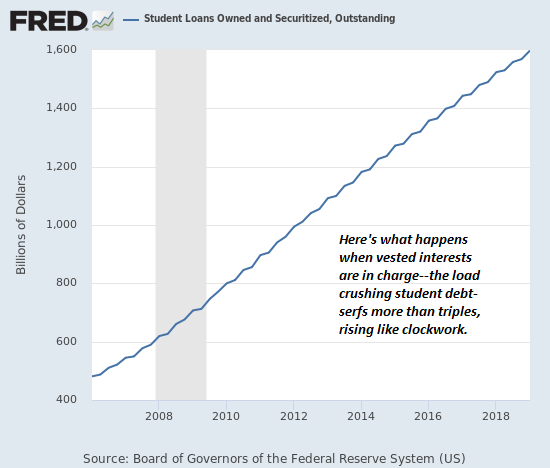
OK Fed: as a direct consequence of your free-money-for-financiers policies, inflation has gutted the purchasing power of younger generations. As the bogus consumer price (CPI) claims inflation is near-zero year after year, two generations of Americans have been crushed by student loan debt that tops $1.5 trillion– a debt serfdom that would have been impossible had interest rates been settled by market forces.

The clueless higher education cartel would have been forced to innovate decades ago rather than pass on their administrative bloat to those least able to pay, the students. Without the Fed and other federal agencies, student debt would not have exploded.

OK Fed: as a direct consequence of your pump-up-speculative-excess policies, speculation has ruined the U.S. economy as banks, financiers and corporations all skim hundreds of billions of dollars via leveraging Fed cheap money while younger generations get credit cards with nosebleed interest rates and rapacious banks that charge $25 and up for every overdraft that they engineer by manipulating when deposits are credited.

OK Fed: while you’ve been hectoring young people to buy assets so they can join your speculative asset-bubble party, they’ve been dealing with the broken mess of an economy you’ve created while patting yourself on the back, an economy where only the already-wealthy can buy a house in hot job market regions, where young workers have to work crazy-hard to keep their precarious jobs or get by on the gig economy, a happy-story code phrase for an economy in which corporations have transferred the risk to their workers while they get rich buying back their own shares with cheap Fed money.

OK Fed: eventually the younger generations will connect all the economic injustices implicit in OK Boomer with the Fed that created the ever-widening wealth and income inequality between the generations: those who effortlessly rode the Fed’s asset-bubbles to wealth and those who have been priced out of the assets and left the shards of a once-functioning economy, an economy destroyed by the Fed’s toxic worship of speculative exploitation and serial asset-bubbles.

As I have repeatedly observed here: if we don’t change the way money is created and distributed by the Fed, we change nothing.


Posted in Uncategorized | Tagged: , , , , | Leave a Comment »