MCViewPoint

Opinion from a Libertarian ViewPoint

Posts Tagged ‘Biden family’

Call the Exorcists!

Posted by M. C. on June 17, 2023

James Howard Kunstler

“Modern states are powerful things, vast machines built of human components that act according to their own logic and towards their own ends.” — Eugypius on Substack

As a Jewish American, and a connoisseur of my people’s folklore, I bring to your attention the troublesome figure of the dybbuk (dih-bik), a disembodied demon that, because of its sins, wanders restlessly among us and can enter the flesh of a living person, who will then afflict and torment the community until properly exorcised by a minyan of rabbis garbed in white burial shrouds wielding sacred oaths.

    Thus, I give you Andrew Weissmann, Esq., attorney at law, the American chief dybbuk, on the scene for decades now, sowing mischief and woe, leading an unholy host of fellow dybbukim calling itself Lawfare to infest the courts and meddle in elections. Think: Michael Sussmann, an imp of RussiaGate; Michael Bromwich, former DOJ Inspector General (!) and then advisor to one Christine Blasey Ford (remember her?); David Laufman, erstwhile DOJ counter-intel goblin and Blasey Ford “beach friend” errand boy; Marc Elias, engineer extraordinaire of ballot harvesting operations in the 2020 election and many related pranks; Dan Goldman, lead counsel for the House Judiciary Committee’s impeachment against Donald J. Trump…dybbuks all!

     The dybbuk Weissmann is best known, of course, for directing the Special Counsel’s “Russian Collusion” campaign (2017 – 2019) in the mental absence of its nominal chief, Robert Mueller, an endeavor that, in the end, could not find any instance of then-President Trump colluding with said Russians — but did, via a firehose of media leaks, succeed in casting a Trump derangement spell over half the US population. Dybbuk Weissmann lately haunts the MSNBC cable news channel as a “legal analyst.”

      And yet, this shape-shifting fiend turns up again now in the Biden family global bribery matter, of all things. See if you can follow the convoluted tale coming out of Dybbuk Central a.k.a. Ukraine and the FBI. You may already know that in May, 2014, R. Hunter Biden, son of then-vice president Joe Biden, was appointed to the board of the Ukrainian natgas company Burisma, where he was paid $80,000-a-month for his expertise (he had none) in the global gas industry. As it happened, at exactly the same time Veep Joe Biden was appointed as then-President Barack Obama’s “point man” in Ukraine after the 2014 Maidan Coup, engineered by Assistant Secretary of State Victoria Nuland and the CIA, that ousted elected President Viktor Yanukovych.

     By and by, Ukraine elected a new American-friendly president, Petro Poroshenko. Burisma was owned by an oligarch name of Mykola Zlochevsky. Apparently, the $80-K-a-month for Hunter Biden was not enough. The friendly American veep, Joe Biden, pressed Burisma’s Zlochevsky to provide $5-million payment each to Hunter and himself for additional Biden family services in Ukraine.

      President Petro Poroshenko had a political confidant and fixer (problem solver) named Oleksandr Onyshchenko, then a member of Ukraine’s parliament. In the 2015-16 time-frame, Onyshchenko conveyed a message to Zlochevsky that paying large sums of money to the Bidens might not be a good idea. Somehow, Onyshchenko’s complaints about the Bidens’ grift operation made it into the leading Kiev newspaper. As we all know, in November, 2016, Donald Trump was elected US President. Catastrophe! Freak-out in the US embassy in Kiev!

      December, 2016, American Ambassador to Ukraine, Marie Yovanovitch, sent panicky emails to the folks back home about Onyshschenko’s allegations of Biden bribery. One of the recipients was a CIA agent implanted in the National Security Council name of Eric Ciaramella, later known as the Ukraine Phone Call Whistleblower.

     Now, you may recall that in the summer of 2019, the owner of a Delaware computer repair shop, one John Paul Mac Isaac, came into possession of a laptop abandoned by Hunter Biden — under law, being left 90-days after repairs were made — and seeing its startling contents, tried to give it to the FBI, but was rebuffed. By then, CIA agent Eric Ciaramella had blown his whistle over a phone call Mr. Trump made to new Ukraine President Volodymyr Zelensky inquiring about the Bidens’ doings there. Later that fall, with impeachment proceedings started against President Trump, FBI agents came back at Mr. Mac Isaac and took the computer into the agency’s possession.

     Consider that FBI Director Christopher Wray must have known about the laptop coming into his HQ and what it contained — and known that throughout the impeachment and Senate trial proceedings of Mr. Trump, And, of course, Mr. Wray did not volunteer any of this evidence about the Bidens to Mr. Trump’s defense attorneys. Nor did then-Attorney General William Barr, Mr. Wray’s superior. Odd, a little bit?

See the rest here

Be seeing you

Posted in Uncategorized | Tagged: , , , , , | Leave a Comment »

New Proof Emerges of the Biden Family Emails: a Definitive Account of the CIA/Media/BigTech Fraud – by Glenn Greenwald – Glenn Greenwald

Posted by M. C. on September 25, 2021

An axis of the CIA, Big Tech and the DNC-allied wing of the corporate media spread an absolute lie in the weeks before the 2020 election. We now have definitive proof.

https://greenwald.substack.com/p/new-proof-emerges-of-the-biden-family

Glenn Greenwald
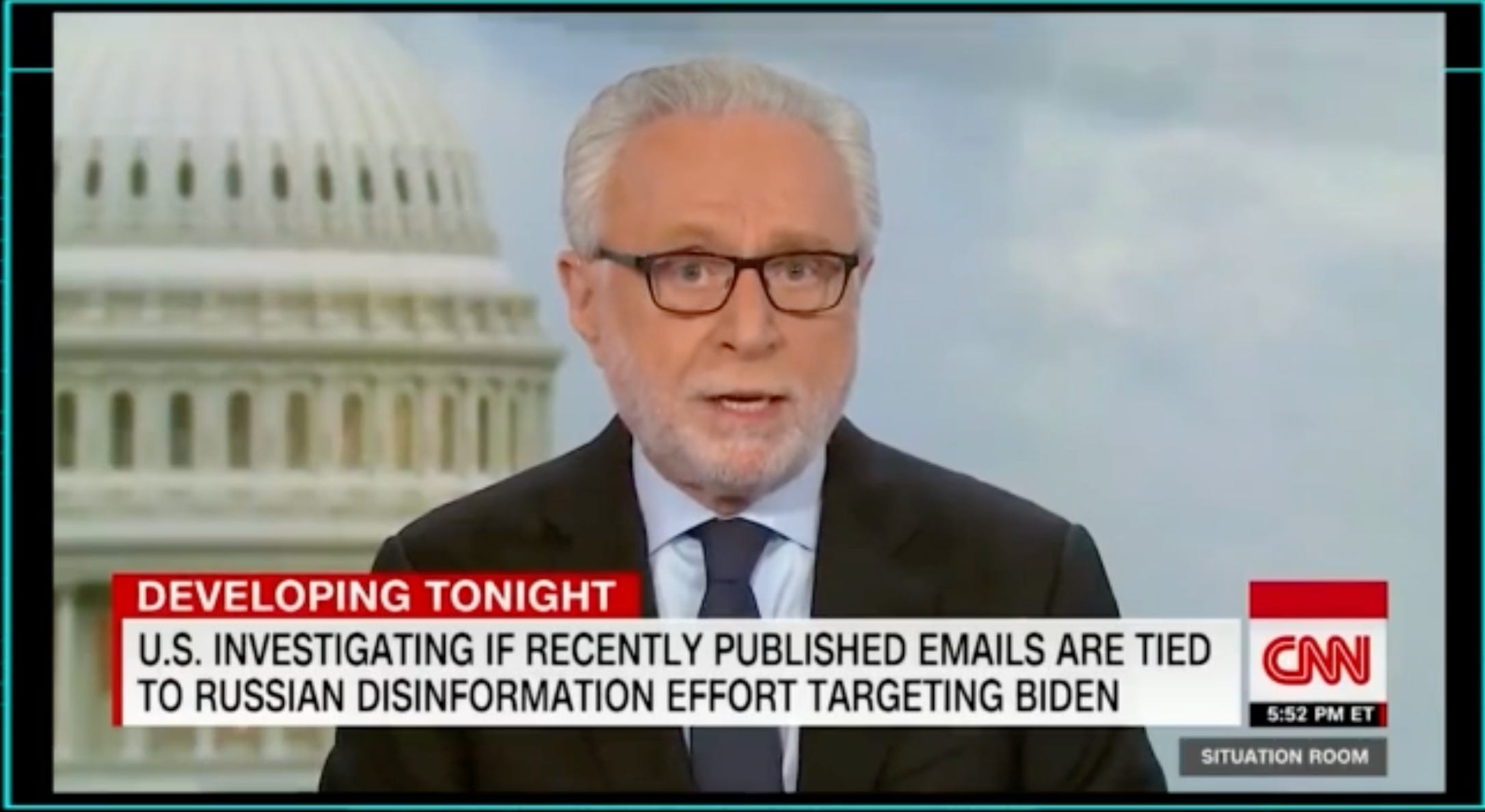
CNN’s Wolf Blitzer warns that emails and other documents reported on by The New York Post about Joe Biden’s activities in Ukraine and China may be “Russian disinformation,” Oct. 16, 2020.

A severe escalation of the war on a free internet and free discourse has taken place over the last twelve months. Numerous examples of brute and dangerous censorship have emerged: the destruction by Big Tech monopolies of Parler at the behest of Democratic politicians at the time that it was the most-downloaded app in the country; the banning of the sitting president from social media; and the increasingly explicit threats from elected officials in the majority party of legal and regulatory reprisals in the event that tech platforms do not censor more in accordance with their demands.

But the most severe episode of all was the joint campaign — in the weeks before the 2020 election — by the CIA, Big Tech, the liberal wing of the corporate media and the Democratic Party to censor and suppress a series of major reports about then-presidential frontrunner Joe Biden. On October 14 and then October 15, 2020, The New York Post, the nation’s oldest newspaper, published two news reports on Joe Biden’s activities in Ukraine and China that raised serious questions about his integrity and ethics: specifically whether he and his family were trading on his name and influence to generate profit for themselves. The Post said that the documents were obtained from a laptop left by Joe Biden’s son Hunter at a repair shop.

From the start, the evidence of authenticity was overwhelming. The Post published obviously genuine photos of Hunter that were taken from the laptop. Investigations from media outlets found people who had received the emails in real-time and they compared the emails in their possession to the ones in the Post‘s archive, and they matched word-for-word. One of Hunter’s own business associates involved in many of these deals, Tony Bobulinski, confirmed publicly and in interviews that the key emails were genuine and that they referenced Joe Biden’s profit participation in one deal being pursued in China. A forensics analyst issued a report concluding the archive had all the earmarks of authenticity. Not even the Bidens denied that the emails were real: something they of course would have done if they had been forged or altered. In sum, as someone who has reported on numerous large archives similar to this one and was faced with the heavy burden of ensuring the documents were genuine before risking one’s career and reputation by reporting them, it was clear early on that all the key metrics demonstrated that these documents were real.

Despite all that, former intelligence officials such as Obama’s CIA Director John Brennan and his Director of National Intelligence James Clapper led a group of dozens of former spooks in issuing a public statement that disseminated an outright lie: namely, that the laptop was “Russian disinformation.”

See the rest here

Be seeing you

Posted in Uncategorized | Tagged: , , , , | Leave a Comment »

How to Limit Social Media’s Power without Growing Government | Mises Wire

Posted by M. C. on October 27, 2020

Doing what we can to help narrow Section 230 immunities back to a free speech interpretation could solve this while actually reducing government involvement in speech. Naïvely throwing up our hands and hoping some free speech startup someday survives the woke gauntlet is equivalent to quitting the field of ideas while the other side is very much on the march.

https://mises.org/wire/how-limit-social-medias-power-without-growing-government?utm_source=Mises+Institute+Subscriptions&utm_campaign=980090c04d-EMAIL_CAMPAIGN_9_21_2018_9_59_COPY_01&utm_medium=email&utm_term=0_8b52b2e1c0-980090c04d-228343965

Peter St. Onge

Censorship by private companies is a topic that divides free marketers but has suddenly become important in the wake of Twitter and Facebook’s recent attempts to squash a New York Post story alleging corruption in the Biden family. Last year, economist James Miller argued that just as the power company can’t turn off your electricity for being a Trump supporter, social media companies shouldn’t be able to silence you for your political opinions. Others have argued that companies can silence whomever they like because it’s their company. This is a red herring that misses the fact that reform would actually reduce government intervention by narrowing something called Section 230 immunity.

First, what free marketers agree on: regulation of speech by government is both unconstitutional and a very bad idea. From 1949 to 1987, the so-called fairness doctrine was used to utterly silence the Right—Rush Limbaugh was a salesman for the Kansas City Royals until Reagan finally repealed the rule, and Murray Rothbard famously could fit the entire libertarian movement in a living room. The doctrine’s repeal opened the floodgates for talk radio, then Fox News, and now content from the Mises Institute to Praeger University to the Babylon Bee. Given that the vast majority of federal workers remain partisan Democrats—the “Deep State,” if you will, hasn’t changed its colors. Reimposing regulation of speech likely means a return to socialist domination of speech.

However, actual solutions being proposed involve not more regulation, but less. In particular, narrowing an immunity that was granted to online platforms in Section 230 of the 1996 Communications Decency Act. This was a special immunity from liability for user-posted content so long as the company was acting as a platform open to all comers—think “common carrier” rules like with the phone company.

Ironically, an original selling point of Section 230 was to prevent censorship by creating a safe harbor so companies could let people express themselves online. And that’s how Section 230 worked for the first twenty years, on the understanding that active censorship would convert an online platform into a publisher with the same liability exposure as, say, a newspaper.

From a business perspective, this platform-publisher distinction was existential for social media companies. Because liability exposure would mean either ruinous lawsuits for crazy things users say, or it would require an army of content-moderating lawyers to meticulously preapprove the 500 million tweets per day that are sent on Twitter. This meant, up until 2016, that social media companies were very careful to maintain a hands-off policy, allowing essentially all legal speech so they wouldn’t lose that shield.

This started changing in 2016, as progressive pressure was brought against social media companies for the sin of giving voice to conservatives during the Brexit referendum, followed soon after by Donald Trump’s election victory. Meanwhile, individual judges increasingly interpreted 230 more broadly as permitting censorship at will. In fact, European regulators actually started requiring censorship for any speech individual regulators personally regarded as too right-wing. This, unfortunately, built a broad censorship capability in social media companies.

Given the existential importance of the shield, social media companies started gradually demonetizing users so they couldn’t earn money on their channels. They moved on to outright bans, again starting gradually by banning intentionally provocative users like former Breitbart editor Milo Yiannopolos and Alex Jones of Infowars, and now on to increasingly mainstream users, including, last week, the largest conservative newspaper in the US, the New York Post.

Because a divided Congress won’t rewrite 230, practical reform involves narrowing 230 immunities so that egregious censorship becomes, once again, a bad choice for social media. Supreme Court justice Clarence Thomas has openly wished for a test case so the court can do this, while market-friendly FCC director Ajit Pai has proposed rules narrowing 230 immunities back to what they used to be.

These solutions highlight that social media censorship isn’t a binary question of market versus regulation, rather it’s a question of an existing government intervention now being used to censor rather than give voice. Indeed, the pure free market position would be repealing 230 altogether, so that Twitter or Facebook face the same liability as the New York Post or, indeed, as you and I.

The alternative to reforming 230, of course, is to leave it to the market. After all, MySpace was the dominant platform until Facebook came along. Unfortunately, the market isn’t as competitive as it used to be. Conservative-friendly social media startups such as Gab and Parler have faced a gauntlet of harassment and choke points, from being denied bank accounts or payment accounts to being denied essential services like web hosting or hacker protection. Given the recent explosion in corporate “wokeness,” this harassment isn’t going away, and in fact is likely to increase.

Beyond harassment and the natural network effects of social media, there are other anticompetitive tactics that hobble new entrants. Facebook itself rose by “scraping” user information from MySpace, something it now forbids, and other social media companies have copied this anticompetitive strategy. Meanwhile, Facebook in particular buys promising competitors like Instagram or WhatsApp, essentially buying an insurance policy against future competition. As a result, the competitive landscape in social media has changed markedly from the MySpace era. Of course, regulators could punish these strategies with aggressive antitrust, but, again, that brings government uncomfortably close to patrolling speech, so it’s playing with fire.

At this point, there is broad consensus that censorship is problematic—not only among libertarians and conservatives. Fully 76 percent of Americans think tech has too much influence on political discourse—just 6 percent think too little. Progressives would never tolerate being silenced by a roomful of activists on Twitter or Facebook, and neither should we.

Doing what we can to help narrow Section 230 immunities back to a free speech interpretation could solve this while actually reducing government involvement in speech. Naïvely throwing up our hands and hoping some free speech startup someday survives the woke gauntlet is equivalent to quitting the field of ideas while the other side is very much on the march.

Author:

Peter St. Onge

Peter St. Onge blogs on economics at Profits of Chaos.

Be seeing you

Posted in Uncategorized | Tagged: , , , , | Leave a Comment »