MCViewPoint

Opinion from a Libertarian ViewPoint

Posts Tagged ‘bourgeois’

TGIF: The Glorious Bourgeois Peace Movement

Posted by M. C. on November 3, 2023

Let’s not forget these great figures who were vital to the development of today’s high living standards and of the universally applicable philosophy of individual liberty, private property, free markets, and peace. This proper foundation for domestic and foreign policy was and today remains explicitly pro-freedom in all spheres and anti-aggression.

https://libertarianinstitute.org/articles/tgif-bourgeois-peace-movement/
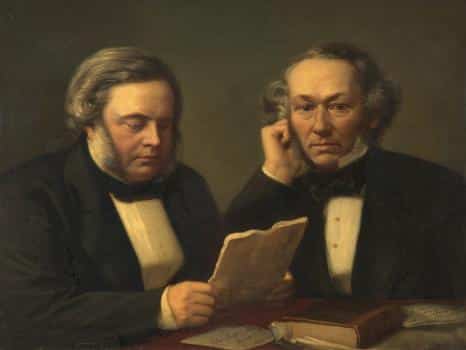
by Sheldon Richman

bright cobden

Those of us whose pro-peace/antiwar principles are of the bourgeois classical-liberal variety need reminding now and again that we have a glorious tradition going back hundreds of years. We need not get lost in the dominant rhetoric that opposes war, empire, and its deadly accouterments from a flawed anti-individualist, anti-Western, and socialist position.

No, we can draw on a proud history of writers and activists who opposed war and intervention not just for the obvious reason —  harm to others — but also because peace and nonintervention are required for reaping the full benefits of private property, specialization and the division of labor, free global trade, and the unobstructed movement of people in search of better lives. It would be mistaken to regard this as a union of humanitarian and so-called “economic” justifications for peace-mongering. For those classical liberals, freedom to produce, trade, and consume was simply another humanitarian reason to oppose the disruption of war.

Two of the best exemplars of bourgeois pro-market peace activism were the Englishmen Richard Cobden and John Bright, both members of Parliament, manufacturers, orators, and activists. In the mid-19th century, they built a movement that has been in the history books ever since. They are best known for opposing England’s tariff on imported grain (“corn”), which raised the price of bread to enrich the land-owing aristocracy. Cobden and Bright successfully fought their battle through the Anti-Corn Law League.

Cobdden and Bright did not compartmentalize but rather explicitly linked free trade to peace and opposition to military spending and intervention. They had a friend and ally on the continent in the French laissez-faire liberal Frédéric Bastiat.

These classical liberals understood that if a social conflict is to be avoided and society is to develop for all, then the industrious members of the population — entrepreneurs and employees, both of whom produce valuable goods through their labor — must be free from those who use government-granted privileges to legally steal from the industrious. (Ironically, Marx credited the classical liberals with devising this class analysis, but then screwed it up by putting business creators in the exploiter class.)

Cobden and Bright were not only clear and analytical; they were also passionate. They were great orators inside of Parliament and outside. The liberals’ association of peace and free trade can be seen in this example of Cobden’s eloquence:

How shall a profession which withdraws from productive industry the ablest of the human race, and teaches them systematically the best modes of destroying mankind, which awards honours only in proportion to the number of victims offered at its sanguinary altar, which overturns cities, ravages farms and vineyards, uproots forests, burns the ripened harvest, which, in a word, exists but in the absence of law, order, and security — how can such a profession be favourable to commerce, which increases only with the increase of human life, whose parent is agriculture, and which perishes or flies at the approach of lawless rapine?

He finishes this passage with a rebuke to those who wanted the English government to compel foreign populations to do business with privileged government-granted monopoly interests:

They who propose to influence by force the traffic of the world, forget that affairs of trade, like matters of conscience, change their very nature if touched by the hand of violence; for as faith, if forced, would no longer be religion, but hypocrisy, so commerce becomes robbery if coerced by warlike armaments.

See the rest here

Be seeing you

Posted in Uncategorized | Tagged: , , , , | Leave a Comment »

SJWs As Bourgeois Bolshies | The American Conservative

Posted by M. C. on October 23, 2019

https://www.theamericanconservative.com/dreher/social-justice-warriors-bourgeois-bolsheviks/

By Rod Dreher

I’m reading one of the best books I’ve ever seen, historian Yuri Slezkine’s The House of Government: A Saga of the Russian Revolution. It’s a massive — over 1,000 pages — history of the Bolshevik movement, focusing on the people who lived in a vast apartment building constructed across the Moskva River from the Kremlin, for party elites. In the 1930s, during the purges, it was the most dangerous address in the country. The secret police came for people there all the time.

The book has given me a breakthrough in understanding why so many people who grew up under communism are unnerved by what’s going on in the West today, even if they can’t all articulate it beyond expressing intense but inchoate anxiety about political correctness. Reading Slezkine, a UC-Berkeley historian, clarifies things immensely. Let me explain as concisely as I can. All of this is going into the book I’m working on, by the way.

In my book, I identify two main factors that make the “soft totalitarianism” we’re drifting into different from the hard totalitarianism of the communist years. One is the vastly greater capabilities of surveillance technology, and its penetration into daily life in this current stage of capitalism. The other is the pseudo-religion of Social Justice, the holy trinity of which is Equity, Diversity, and Inclusion. The mathematician James Lindsay last year wrote an insightful essay analyzing Social Justice ideology as a kind of postmodern religion (“faith system,” he writes). Reading Slezkine on Bolshevism illuminates this with new depth.

To be clear, Social Justice religion is not the same thing as Bolshevism, which conquered a nation and turned it into a charnel house. But the psychological dynamics are so similar that I can understand now why Soviet-bloc emigres feel in their bones that something wicked is coming, and coming fast.

I’m going to give a brief overview of the ideas in this part of Slezkine’s book. Slezkine describes the Bolsheviks as “millenarian sectarians preparing for the apocalypse.” He gives a short history of apocalyptic sects, which he said began in the Axial Age, the period between the 8th and the 3rd centuries BC that saw parallel developments in civilizations — Chinese, Indian, Middle Eastern, Greco-Roman — that caused a fundamental shift in human consciousness. The Axial Age introduced some concepts that are still with us today, including the idea that history is linear. Religion and philosophical systems of the Axial Age developed a sense of separation from the Real (that is, what is material), and the Ideal (what is transcendent). They also introduced the idea that time would culminate in a final battle between Good and Evil that would result in the End of History and the everlasting reign of Justice. The rich will be conquered, and the poor will triumph.

Slezkine writes at some length about these themes in the Hebrew Bible (Old Testament), but points out that they also existed in parallel in other religions of the era. The two Abrahamic religions that emerged from Axial Age Judaism — Christianity and Islam — modified these same concepts for themselves. The Book of Revelation in the Christian Bible is the standard Western account of the Apocalypse, but not the only one.

In the 16th century, the radical Protestant theologian Thomas Müntzer, leader of an apocalyptic Reformation sect, led an armed revolt against the Catholic Church, Martin Luther, and feudal authority. He and his followers believed the Last Days were upon the world, and that revolutionary violence was necessary to prepare for them.

These movements, says Slezkine, often depend on the virtuous mutually surveilling each other to keep everyone in line. Calvin’s Geneva was like this, and had laws prescribing the death penalty for relatively minor violations of its purity code. In the 17th century, the English Puritan movement under Thomas Oliver [the mistake was mine — RD] Cromwell (the “Puritan Moses”) was in this same vein.

The Enlightenment birthed apocalyptic millenarianism without God…

Here’s another interesting difference, and an important one: SJWs may want to destroy the oppressive practices, but unlike the Bolsheviks, they don’t want to destroy the institutions of society. Rather, they want to conquer them and administer them. The religion of Social Justice has already conquered the university, as James Lindsay points out, and is moving quickly into other institutions: media (the NYT is its Pravda), law, tech, entertainment, and corporate America. The Social Justice faith system can be easily adapted by the institutions of bourgeois capitalism — a fact that conceals its radicalism.

The people who have lived in societies suffused with this kind of ideology — emigres from Soviet-bloc countries — can see through the veil. With this new book I’m working on, I’m going to do my best to help readers see through their eyes. Meanwhile, if you are really interested in the Russian Revolution, I strongly urge you to read The House Of Government — all 1,128 pages of it. Yuri Slezkine is a masterful storyteller. It reads like a novel.

Be seeing you


Posted in Uncategorized | Tagged: , , , , | Leave a Comment »

Why Do Socialists Hate Families? | Mises Wire

Posted by M. C. on April 27, 2019

Yet, Marx, Engels, and many of their modern followers are anti-family. Marx and Engels write in The Communist Manifesto:

Abolition of the family! […]

https://mises.org/wire/why-do-socialists-hate-families

…Interestingly, another key tenet of socialism, besides abolishing the ownership of the factors of production, is abolishing the family. This is strange because the traditional nuclear family seems like it could be used in producing convincing socialist rhetoric: it is a good example of social bonds without private property, prices, and “capitalist exploitation.”

Yet, Marx, Engels, and many of their modern followers are anti-family. Marx and Engels write in The Communist Manifesto:

Abolition of the family! […] On what foundation is the present family, the bourgeois family, based? On capital, on private gain. In its completely developed form, this family exists only among the bourgeoisie. But this state of things finds its complement in the practical absence of the family among the proletarians, and in public prostitution.

The bourgeois family will vanish as a matter of course when its complement vanishes, and both will vanish with the vanishing of capital.

Do you charge us with wanting to stop the exploitation of children by their parents? To this crime we plead guilty.

Marx and Engels make a distinction between bourgeois and proletariat families, but “both will vanish” once communism is realized, apparently because — according ot Marx — bourgeois families are predicated on exploitation. Men exploit their wives and parents exploit their children, all for “private gain.”

Engels writes in Principles of Communism:

What will be the influence of communist society on the family?

It will transform the relations between the sexes into a purely private matter which concerns only the persons involved and into which society has no occasion to intervene. It can do this since it does away with private property and educates children on a communal basis, and in this way removes the two bases of traditional marriage – the dependence rooted in private property, of the women on the man, and of the children on the parents.

The communist society includes the public education of children and a breakdown of social norms on monogamy, family responsibilities, and dependence on any individual. According to ReviseSociology.com:

Marxists argue that the nuclear family performs ideological functions for Capitalism – the family acts as a unit of consumption and teaches passive acceptance of hierarchy. It is also the institution through which the wealthy pass down their private property to their children, thus reproducing class inequality.

Modern Marxists argue that families are just propaganda channels for capitalism. Families instill acceptance of hierarchy and give the bourgeoisie a way to “reproduce class inequality” through inheritances. To this end, Engels approvingly quotes Marx in The Origin of the Family, Private Property and the State:

The modern family contains in germ not only slavery (servitus), but also serfdom, since from the beginning it is related to agricultural services. It contains in miniature all the contradictions which later extend throughout society and its state.

For Marx, the family represents a microcosm of capitalism. But why didn’t he identify it as a microcosm of socialism to argue that if socialism is feasible at the family level, then it could be feasible at a larger scale?…

Be seeing you

vene social

Is that Sean Penn?


Posted in Uncategorized | Tagged: , , , , , | Leave a Comment »