MCViewPoint

Opinion from a Libertarian ViewPoint

Posts Tagged ‘Bureaucracy’

Why the Bureaucracy Keeps Getting Bigger

Posted by M. C. on February 22, 2025

Hence, for example, the phenomenon of President Nixon, thinking he knew more than anyone else about the Vietnam War and yet actually knowing less than the astute reader of the New York Times. For the CIA and other intelligence warnings of what was going on, developed by many of the lower officers, were screened out by the higher-ups, for being contrary to the President’s preferred line, i.e., that all was going well.2

Contrast the hilariously satirical, but all too perceptive account of “Parkinson’s Law” of bureaucracy. Thus, Professor Parkinson asserted that, in a government bureaucracy, “there need be little or no relationship between the work to be done and the size of the staff to which it may be assigned.”3 The continuing rise in the total of government employees “would be much the same whether the volume of the work were to increase, diminish, or even disappear.”4 Parkinson identifies two “axiomatic” underlying forces responsible for this growth: (1) “An official wants to multiply subordinates, not rivals”; and (2) “Officials make work for each other.”

Mises WireMurray N. Rothbard

[This article is adapted from “Bureaucracy and the Civil Service in the United States.”]

Bureaucracy is necessarily hierarchical, first because of the Iron Law of Oligarchy, and secondly because bureaucracy grows by adding more subordinate layers. Since, lacking a market, there is no genuine test of “merit” in government’s service to consumers, in a rule-bound bureaucracy seniority is often blithely adopted as a proxy for merit. Increasing seniority, then, leads to promotion to higher ranks, while expanding budgets take the form of multiplying the levels of ranks under you, and expanding your income and power. Bureaucratic growth occurs, then, by multiplying levels of bureaucracy.

The theory of hierarchical government bureaucracy is that information is collected in the lowest ranks of the organization, and that at each successive higher rank, the manager culls the most important information from his subordinates, separates the wheat from the chaff, and passes the culled information higher up, so that, in the end, the President, for example, dealing with intelligence operations, receives a two-page memo distilling the most important information gathered and culled from hundreds of thousands of intelligence agents. The President, then, knows more than anyone else, say, about foreign affairs. One problem with this rosy model, as Professor Gordon Tullock points out in his illuminating book, The Politics of Bureaucracy,1 is that the model doesn’t ask whether or not each bureaucrat has the incentive to pass the best distillate of truth on to his superiors. The problem is that bureaucratic favor, especially at the higher levels, depends on pleasing one’s superiors, and pleasing them largely rests on telling the President and the higher bureaucrats what they want to hear. One of the great truths of human history is that one tends to shoot, or at least react badly, to the bearer of bad news. “Sire, your policy is working badly in Croatia,” is not the sort of message that the President, say, wants to hear from his envoy, and, while the outcome in Croatia remains in doubt, the President and his aides want to continue to believe that their policy is doing well. Hence, the dissident is set down as a trouble-maker if not a subversive, and his career in the hierarchy is side-tracked, often permanently. In the meanwhile, the envoys or foreign service people who assure the President “things are going very well in Croatia,” are hailed as perceptive fellows and their careers are advanced. And then, if years later, the dissident is proved correct, and the Croatian policy lies in shambles, is the president or any other ruler likely to turn in warm gratitude to the former dissident? Not hardly. Instead, he will still remember the dissident as a troublemaker, and he will not blame his aides, who, along with himself, have been proved wrong. For after all, didn’t the great mainstream of experts make the same error? How common is sincere soul-searching and repentance for past errors among Presidents or other rulers?

Those bureaucrats who are shrewd analysts of human nature, then, and who understand the way rulers operate, will, if they see that the cherished policy of their President is in grave error, tend to keep their mouths shut, and let some other sucker be the messenger of bad news and get shot down.

Every human activity and institution will tend to reward those who are most able to adapt to the best route to success in that activity. Successful market entrepreneurs will be those who can best anticipate, and satisfy, consumer demands. Success in the bureaucracy on the contrary, will go to those who are most apt at (a) employing propaganda to persuade their superiors, the legislators, or the public about their great merits; and therefore (b) at understanding that the way to rise is to tell the President and the top bureaucrats what they want to hear. Hence, the higher the ranks of the bureaucracy, the more yes-men and time-servers there will tend to be. The President will often know less about what is going on than those in the lower ranks.

See the rest here

Be seeing you

Posted in Uncategorized | Tagged: , , , | Leave a Comment »

TGIF: Efficient Bureaucracy?

Posted by M. C. on January 10, 2025

The real bosses, in the capitalist system of market economy, are the consumers. They, by their buying and by their abstention from buying, decide who should own the capital and run the plants. They determine what should be produced and in what quantity and quality. Their attitudes result either in profit or in loss for the enterpriser. They make poor men rich and rich men poor. They are no easy bosses.

https://libertarianinstitute.org/articles/tgif-efficient-bureaucracy/

by Sheldon Richman

bureaucracy

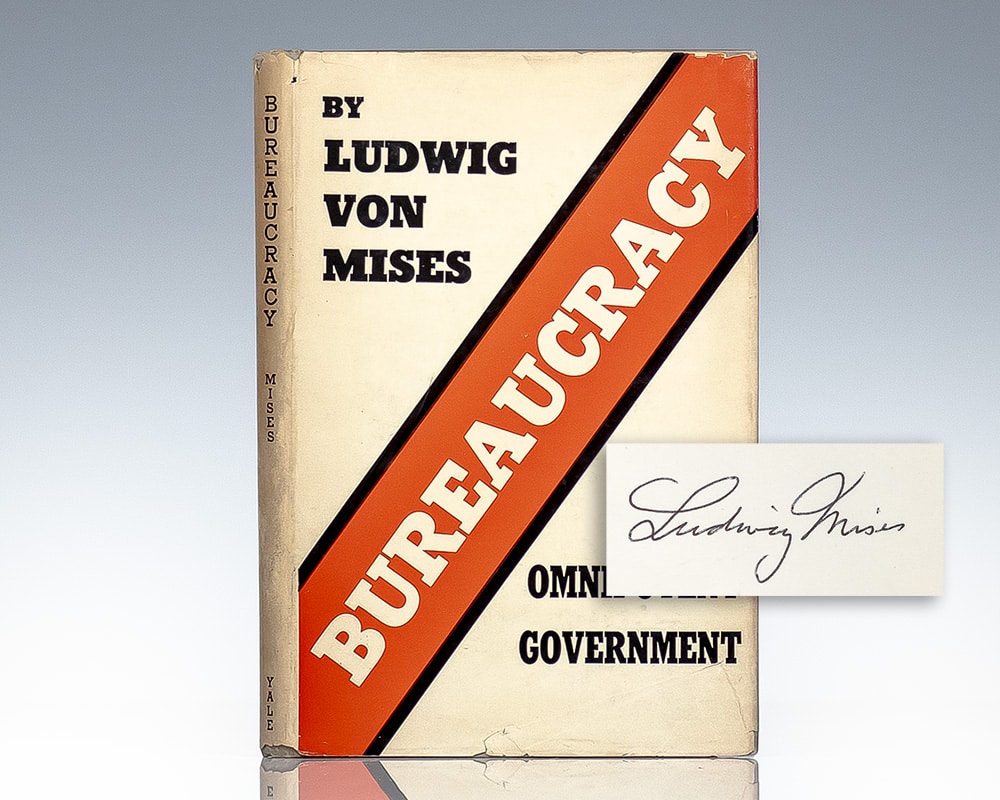
With all the talk about government efficiency, it would be useful to remind ourselves why bureaucracies differ radically from for-profit businesses. Ludwig von Mises devoted a short but enlightening volume to this subject in 1944, Bureaucracy. Elon Musk and Vivek Ramaswamy, who will co-chair the nongovernmental Department of Government Efficiency, should do some homework by reading that book.

Mises, as an advocate of limited government, did not argue that bureaucracy has no place in a free society. In contrast to anarcho-capitalists, he thought government and therefore some bureaucracy was necessary to protect what he valued most: peaceful social cooperation through the division of labor—that is, the market economy. Violence against persons and property was clearly antithetical to the continuing welfare-enhancing collaboration we call the market process. But Mises did not want bureaucracies trying to do what free, private, and competitive enterprises could do better. Moreover, if the government went beyond its mere peacekeeping duties, it would undermine the market process and make us all less well off despite any good intentions.

Mises began by reminding readers (or perhaps teaching them from scratch) what the free market is and what it accomplishes. It’s a great primer for those who lack the time to read his longer works. He wrote:

Capitalism or market economy is that system of social cooperation and division of labor that is based on private ownership of the means of production. The material factors of production are owned by individual citizens, the capitalists and the landowners. The plants and the farms are operated by the entrepreneurs and the farmers, that is, by individuals or associations of individuals who either themselves own the capital and the soil or have borrowed or rented them from the owners. Free enterprise is the characteristic feature of capitalism. The objective of every enterpriser—whether businessman or farmer—is to make profit.

The uninitiated might ask who runs things. He replied: “The capitalists, the enterprisers, and the farmers are instrumental in the conduct of economic affairs. They are at the helm and steer the ship.”

However, let’s not jump to conclusions about who really runs things, Mises advsed:

But [the capitalists, etc.] are not free to shape [the ship’s] course. They are not supreme, they are steersmen only, bound to obey unconditionally the captain’s orders. The captain is the consumer.

Neither the capitalists nor the entrepreneurs nor the farmers determine what has to be produced. The consumers do that. The producers do not produce for their own consumption but for the market. They are intent on selling their products. If the consumers do not buy the goods offered to them, the businessman cannot recover the outlays made. He loses his money. If he fails to adjust his procedure to the wishes of the consumers, he will very soon be removed from his eminent position at the helm. Other men who did better in satisfying the demand of the consumers replace him.

All the conventional controversy about bosses and workers overlooks the critical point:

See the rest here

Be seeing you

Posted in Uncategorized | Tagged: , , , | Leave a Comment »

The Rightwing View on Bureaucracy Is Wrongheaded

Posted by M. C. on August 6, 2024

by Jacob G. Hornberger

The thing to keep in mind about bureaucracy is that it will always, without fail, come with inefficiencies, mistakes, faults, foibles, or, in the classic rightwing phrase, “waste, fraud, and abuse.” Inevitably, it also comes with measures that infringe liberty and even constitute tyranny.

Leave it to Donald Trump’s vice-presidential candidate J.D. Vance to enunciate the rightwing view on bureaucracy, a view that is diametrically opposed to the libertarian view. According to an article in yesterday’s Wall Street Journal, which criticizes Vance for his “disregard for the constitutional balance of powers and the rule of law,” Vance stated in a 2021 interview: “Fire every single midlevel bureaucrat, every civil servant in the administrative state. Replace them with our people.” It would be difficult to better capture the rightwing view on bureaucracy than that.

The perfect demonstration of this rightwing perspective is with respect to the Covid crisis. Every day throughout the crisis, rightwingers would exclaim, “Fauci! Fauci! Fauci!” in their articles, speeches, podcasts, interviews, and other presentations. They would complain about how Anthony Fauci was implementing destructive and tyrannical polices in his roles as director of the National Institute of Allergy and Infectious Diseases and as chief medical advisor to the president.

Anthony Fauci

What was the rightwing solution to such policies? Their position was summarized by the words of J.D. Vance — fire Fauci and replace him with a rightwinger, one who would supposedly make better decisions and implement better healthcare policies than Fauci and other leftwing bureaucrats who were in charge of healthcare.

The same phenomenon occurred on the state and local level. Every day throughout the Covid crisis, the Internet was replete with rightwing articles, podcasts, and the like criticizing the lockdowns, the mask mandates, the vaccine requirements, the social-distancing requirements, and other policies and practices that violate the principles of a free society.

What was the rightwing solution to all this Covid tyranny? J.D. Vance sums it up perfectly: Fire the healthcare tyrants and replace them with rightwingers.

The thing to keep in mind about bureaucracy is that it will always, without fail, come with inefficiencies, mistakes, faults, foibles, or, in the classic rightwing phrase, “waste, fraud, and abuse.” Inevitably, it also comes with measures that infringe liberty and even constitute tyranny.

Thus, anyone can spend every day for the rest of his life pointing out the faults and failures, inefficiencies, and anti-freedom measures of both federal and state bureaucrats. That’s what was happening throughout the Covid crisis. It was never difficult for rightwingers or anyone else to come up with bad, inefficient, and tyrannical things that federal and state bureaucrats were doing as part of their anti-Covid crusade.

See the rest here

Be seeing you

Posted in Uncategorized | Tagged: , , , | Leave a Comment »

Lifecycle of Bureaucracy

Posted by M. C. on June 6, 2023

Posted in Uncategorized | Tagged: , | Leave a Comment »

The Problem With Public (Government) School Superintendents Is the Same Problem With Jon Stewart, But With the Additional, Lethal Yoke of Bureaucracy

Posted by M. C. on April 16, 2022

It’s become abundantly clear that the people most loudly accusing America of being a bastion of “systemic racism” are either economic ignoramuses, or self-serving cowards. In the case of Jon Stewart, it’s a bit of both.

To whit, the superintendent asked me what I would do to address the disparities. I first replied what I would not do, which is scapegoat “systemic racism.” I then informed him that there is no perfect “solution,” but only trade-offs, and that beyond disparities, the best way to foster and facilitate better opportunities for all individuals of all colors, is to at least start addressing the anti-liberty public policies destroying culture and economy. Ending these policies will at least help to restore liberty-based culture which will necessarily foster and facilitate better opportunities for all individuals, to pursue meaningful, productive lives.

By Jason Peirce

It’s become abundantly clear that the people most loudly accusing America of being a bastion of “systemic racism” are either economic ignoramuses, or self-serving cowards. In the case of Jon Stewart, it’s a bit of both.

Case-in-point is a recent episode of Stewart’s show “The Problem with Jon Stewart.” In the episode, entitled “The Problem with White People,” Stewart joined two of his guests in eagerly condemning a third, Andrew Sullivan, as a racist. Sullivan’s transgression was his mere willingness to question Stewart and the other guests’ assertions that America today is a hotbed of “systemic racism.” Stewart displayed ignorance regarding America’s complicated history with race, as well as the role current economic policies play in destroying the lives of individual Americans of all races. He displayed cowardice by defaulting to the virtue-signaling, mob-appeasing accusation of “racist.” I don’t want to spend too much more time discussing Stewart. That said, there is much to learn from Sullivan’s must-read summary of the episode.

The fact is that the obsession with “systemic racism,” driven by Critical Race Theory (CRT), is pervasive throughout all American institutions, from “woke” corporate America, to the federal government’s alphabet bureaucracies, to academia and public education. Everything driven by CRT only serves to agitate more social conflict, while distracting from the anti-liberty economic policies which demonstrably harm individuals of all races. This problem is arguably most evident at the intersection of CRT and America’s public (government) education system.

This brings us to a meeting I had last summer with the superintendent of my local school district on the Space Coast of Florida, Brevard Public Schools, (BPS). Like many districts across the country, BPS is skirting responsibility for racial disparities in educational outcomes, by blaming “systemic racism.” In BPS’ case, blacks and Hispanics lag behind whites (though it’s interesting to point out BPS’ apparent lack of concern that all races, including whites, lag behind Asians.)

The leadership of BPS suffers the same shortcomings as Jon Stewart. But BPS is a public bureaucracy. All public bureaucracies extend a unilateral power relationship to the people they ostensibly exist to serve, at the people’s expense. Bureaucracies are inherently geared toward self-preservation. Criticize or seek to change the bureaucracy, and the bureaucracy will defend itself by any means it can.

By blaming “systemic racism,” BPS is sacrificing the well-being of students of all colors. For example, the message to white students is, that they’re guilty of “white privilege” and beneficiaries of “systemic racism.” The message to black students is, that they’re helpless victims of oppression, with the chances for a successful life stacked against them, and therefore they must be held to different educational and disciplinary standards (a form of soft bigotry). The effect on society is  destruction of goodwill and greater conflict in communities.

“Systemic racism” is also being used to expand the BPS bureaucracy. For example, the disparities, along with George Floyd’s death, and BLM’s subsequent daily lootings, beatings and burnings of people and cities across the US over the summer and fall of 2020, were used to Trojan Horse-in BPS’ CRT-informed Diversity and Equity (DE) Program. [Sadly, the BPS school board’s conservative members, including the co-founder of the national, conservative, parental rights organization Moms For Liberty, supported “overcoming racism” trainings (school board agenda minutes, page 4) and the creation of the DE program. Yes, there’s many lessons to be learned here, beyond the scope of this article.]

BPS’ new DE director wasted no time in identifying “systemic racism” as the program’s cause du jour:

“(BPS) Leadership is also doing a great job of understanding how systemic racism, biases, how mindsight really helps in driving all of these necessary changes (sic).”

She continued, to refer to Floyd’s death as a catalyst for similar DE programs across the country, even though there was zero evidence Floyd’s death was due to “racism.”

The DE director then declared her dedication to “Antiracism,” which is anything but “anti-racist” (and more just another way to attack capitalism), before expressing her grand-plan to root-out  “unconscious bias” in teachers and administrators:

“One of the things we will be doing within the district is really being more conscious and committed to unconscious bias training. Also, trying to not only create this shared awareness, of not only what biases are, this systemic racism, things of that nature…(sic)”

Beyond the tossed word-salad, the director offered zero evidence to back her claim that disparities are due to “systemic racism.” Nor did she attempt to prove the existence of “unconscious bias” in teachers and administrators.

As to the latter, outside of explicit word or deed, how can anyone truly divine if racism is in another’s heart and head? They can’t, unless they’re a mind-reader.

As to the former, “systemic racism,” those obsessed with it never do provide current evidence of its existence. The simple truth, is disparities do not necessarily prove “systemic racism.” Furthermore, “systemic racism,” requires two things to exist. One, is codified law. The other is mass social acceptance of racism. Neither can be found in America today. (Of course, this is hardly to say that “systemic racism” never existed in the US, or that America’s unfortunate and complicated history regarding race, should not be discussed and analyzed.)

As for how my meeting with BPS’ superintendent came about, over the previous school year, I had reached out via email on numerous occasions, regarding my family’s objections to the racist, CRT-informed material my 6th-grade daughter was bringing home from her elementary school. The superintendent offered an in-person meeting to discuss the matter. I accepted.

For the record, I advocate for freeing the children, and ending compulsory, government education altogether. At the least, full school choice would be a great step in the right direction. So, even though my perspective on education amounts to an existential threat to BPS and the superintendent’s livelihood, I looked forward to the opportunity to meet him on his home field, so to speak, firsthand, to try and wrap my head around his logic (or lack thereof) regarding why he’s comfortable with racist, CRT-based material in BPS.

The meeting unfolded as I thought it would. I provided evidence CRT was in the district. I informed the superintendent that he was presiding over the destruction of children in BPS, and the district itself. Parents of students in BPS were already at war over CRT, the DE program, LGBTQ+ issues, and the effects of covid lockdowns, and mask mandates, for example. Sides were forming. I told the superintendent he had chosen a side against many children and families he’s supposed to work and advocate for. I added that CRT was doing exactly what its proponents designed it do: create conflict to divide, destroy, and ultimately conquer.

The superintendent played both ignorant and cowardly, alternately deflecting, denying, and defending CRT’s existence in the district. He failed to commit to do anything about it. Rather, he circled-the-wagons, attacking all criticism of BPS and of himself. This confirmed firsthand, my concerns that CRT and bureaucracies like BPS pose an existential threat to America.

This is not hyperbole. CRT is a radical, Marxist ideology. Its own proponents liked it to a virus, designed to destroy Western Civilization, starting with the nuclear familyBureaucracies are inherently inefficient and ultimately unsustainable. Bureaucracies radicalized by CRT, the growing trend across America, are at war with all-things liberty. Simply, liberty, and racist, CRT-driven bureaucracies cannot co-exist. Suffice to say, if liberty doesn’t win – liberty, the rising tide which lifts all boats – every American loses, sooner than later.

To whit, the superintendent asked me what I would do to address the disparities. I first replied what I would not do, which is scapegoat “systemic racism.” I then informed him that there is no perfect “solution,” but only trade-offs, and that beyond disparities, the best way to foster and facilitate better opportunities for all individuals of all colors, is to at least start addressing the anti-liberty public policies destroying culture and economy. Ending these policies will at least help to restore liberty-based culture which will necessarily foster and facilitate better opportunities for all individuals, to pursue meaningful, productive lives.

Posted in Uncategorized | Tagged: , , , , | Leave a Comment »

All they wanted was to open a noodle shop. Their tangle with S.F. bureaucracy has them regretting they tried

Posted by M. C. on November 15, 2021

Reading this is a pain because of the subscription ads. But the answer is obvious. Do what Washington does with failed programs, increase the budget and pass a thousand page set of new regulations to make things simpler.

The reason bureaucracies like this are started in the first is to make it hard for the competition.

https://www.sfchronicle.com/sf/bayarea/heatherknight/article/All-they-wanted-was-to-open-a-noodle-shop-S-F-16613993.php

Heather Knight

Yoko and Clint Tan taught themselves how to cook ramen that was hailed as “mind-blowing” by The Chronicle and recognized at the World Ramen Grand Prix in Japan. They taught themselves how to run the beloved Noodle in a Haystack pop-up out of their Daly City kitchen, serving thousands of customers over five years.

So when fans urged them to open a restaurant in San Francisco, they figured they could do that too. But it turns out even the most determined entrepreneurs are no match for the city’s hidden pitfalls and notorious red tape.

All the Tans wanted to do was take over a small restaurant space that was available and serve ramen to 10 guests per evening, three nights a week. They figured that turning one Japanese restaurant into another Japanese restaurant would be straightforward, but little about opening a business in San Francisco ever is.

Now they’re $100,000 in the hole, far from opening and full of regrets.

While acknowledging they’re like “deer in the headlights” when it comes to navigating the city’s byzantine permitting process, they still wish they had more guidance. Or, perhaps, that they’d hired a professional permit expediter to get the job done for them.

Even reporting on their attempt was confusing, as city officials and restaurant experts didn’t always have the answers.

See the rest here

Be seeing you

Posted in Uncategorized | Tagged: , , , | Leave a Comment »

Why Businessmen Make Such Unimpressive Politicians | Mises Wire

Posted by M. C. on October 6, 2021

But it does not matter whether or not he was a competent businessman, because the minute he took his oath of office, he became part of a bureaucracy and any expectations of fiscal or monetary responsibility were immediately lost. This is because it is impossible to run a government “like a business.” There’s no economic calculation and no way of measuring profit.

https://mises.org/wire/why-businessmen-make-such-unimpressive-politicians

Connor Mortell

In 2016, we watched time and time again as polls stated that people liked Donald Trump because he is a businessman and came from outside the world of politics. Dozens of factors led to his election but there is no doubt that among voters this mindset of the potential for a savvy businessman in charge was at play. However, looking at it in hindsight, can we really say that a savvy businessman was ever in charge? Perhaps the most successful libertarian there has ever been, the great Dr. Ron Paul, wrote explaining that when it comes to spending the argument was always “Trump vs. Trump.” He’d speak seeking to cut taxes and then would ask for raises on spending and print money to close the gap. Dr. Paul goes as far as to say, “Following the President’s constantly changing policies can make you dizzy.” So why is it that this businessman would come into office and then act in direct opposition to the business-oriented nature he claimed he’d demonstrate? The easy answer would be that it turned out that he was never really a good businessman to begin with. There may or may not be merit to this argument. But it does not matter whether or not he was a competent businessman, because the minute he took his oath of office, he became part of a bureaucracy and any expectations of fiscal or monetary responsibility were immediately lost. This is because it is impossible to run a government “like a business.” There’s no economic calculation and no way of measuring profit.

What makes an entrepreneur so successful is his ability to allocate scarce resources to their most profitable ends. This is achieved through economic calculation. Under normal market conditions, prices allow a bright entrepreneur to take the necessary risks to direct resources where he understands they would be most profitable. Some are unsuccessful in their attempts but the ones that do this correctly are the people we as a society end up deeming as savvy businessmen and businesswomen.

The difference between such an individual and a bureaucrat is described by Ludwig von Mises in his book Bureaucracy: a bureaucrat is one who manages “affairs which cannot be checked by economic calculation.” A government official finds him-/herself in a completely different environment where prices do not adequately reflect market conditions, and as a result, even one who would’ve been the most successful of entrepreneurs is now stripped of his most useful tool and can no longer calculate successfully. This is one of the most pressing reasons that governments time and time again make such atrocious decisions. It is also why the minute a businessman/-woman takes an oath of office, he/she is no longer a bright entrepreneur but is immediately dropped to the level of bureaucrat. This is explained best by Mises, later in Bureaucracy:

It is vain to advocate a bureaucratic reform through the appointment of businessmen as heads of various departments. The quality of being an entrepreneur is not inherent in the personality of the entrepreneur; it is inherent in the position which he occupies in the framework of market society. A former entrepreneur who is given charge of a government bureau is in this capacity no longer a businessman but a bureaucrat. His objective can no longer be profit, but compliance with the rules and regulations. As head of a bureau he may have the power to alter some minor rules and some matters of internal procedure. But the setting of the bureau’s activities is determined by rules and regulations which are beyond his reach.

It is for this reason that I claim it never mattered whether Donald Trump is a savvy businessman or not. If he is not, then the point is moot; but even if he is, no bureaucrat has the tools to steer in the right direction. This, however, is most important not looking back at Donald Trump, but rather looking forward at future elections. In 2024 we are likely to see presidential candidates explaining their past experience, in 2022 we are likely to see candidates in the midterm elections leaning on the same kinds of credentials, and most certainly in your own local elections you will hear budding young bureaucrats claim their business experience will give them the ability to more successfully lead your town. This is not to say one must never support business-experienced candidates—plenty of them do understand a great many things and may be skilled in other ways. But it’s also helpful to remember that business experience is not an especially helpful tool that a candidate brings to the table.  Author:

Connor Mortell

Connor Mortell graduated from Texas Christian University with a BBA in finance, minoring in Chinese language and culture. After graduation, he worked as a legislative aide in the Florida House of Representatives from 2019–21. Currently he is an MBA student at Florida State University. Additionally, he is a graduate of Mises University, where he passed the Mündliche Prüfung Viva Voce Exam on economics.

Be seeing you

Posted in Uncategorized | Tagged: , , , , | Leave a Comment »

It’s the Bureaucracy, Genius: How Bureaucracy Has Lowered Productivity and Income | The Libertarian Institute

Posted by M. C. on March 1, 2020

…“the size of the [White House’s] National Security Council staff went from a few dozen under Henry Kissinger and Zbigniew Brzezinski to nearly 600 under President Obama.”

Do you feel more secure?

Companies eventually collapse from the deadweight and are replaced by more nimble and efficient competitors.  The same with nations, but it just takes a lot longer.

It’s more important to study regulations than to study the work of pioneers in the study of management and organizations, such as Henry L. Gantt, Max Weber, G. Elton Mayo, Mary Parker Follett, Kurt Lewin, F. J. Roethlisberger, Peter Drucker, Herbert A. Simon, Abraham Maslow, W. Edwards Deming, and others.  

https://libertarianinstitute.org/articles/its-the-bureaucracy-genius-how-bureaucracy-has-lowered-productivity-and-income/

by

The supposed brightest minds, educated in the supposed best universities, can’t figure out why American productivity has languished in this era of technological innovation, resulting in income growth being lower than it would otherwise be.

Well, my mediocre mind came up with the reason 29 years ago and wrote about it in my book and in scores of subsequent journal and newspaper articles.  This was certainly not a great intellectual feat, because the root problem was, and continues to be, obvious to anyone who is not isolated in an ivory tower, as the problem pervades corporations, nonprofits, universities, school districts, cities, states, and the federal government.

The problem is bureaucracy.

At the federal level, this destroyer of productivity and wealth can be seen in the 40,000 pages of the tax code, the thousands of pages of new federal rules every year in the Federal Register, and the proliferation of jobs in the private and public sectors to decipher the rules, comply with the rules, consult on the rules, and lobby on the rules.  Holders of these jobs then become a constituency that will fight to protect their jobs, including those on the right who rail against big government.

Then there are the jobs that propagate because the natural course of bureaucracy is to beget more bureaucracy.

Two recent letters to the editor of the Wall Street Journal gave examples of this.  One letter said that “the size of the [White House’s] National Security Council staff went from a few dozen under Henry Kissinger and Zbigniew Brzezinski to nearly 600 under President Obama.”

Do you feel more secure?

The other letter said that since the Defense Intelligence Agency (DIA) was established in 1961, it has ballooned to 17,000 employees.  The agency was established because the Army, Navy and Air Force had been issuing conflicting military assessments instead of working as a team in developing a joint assessment.

Is it any wonder that the top-heavy military became mired in Afghanistan and made the strategic blunder of the Iraq War?

The DIA is a textbook example of one of the major causes of bureaucracy:  A new bureaucracy is put over existing bureaucracies because the silos of the existing bureaucracies are lousy at communicating, cooperating and coordinating with each other.

The proper fix would be to kick the executives at the top of the silos in the ass, demand that they and their respective organizations work as a team, incentivize them to do so, and fire them if they don’t change their ways.  The proper fix is not to bury the underlying problem under another layer of management.

The Department of Homeland Security is another example of burying the underlying problem under another layer of management.  The department was established after 9/11 because different federal agencies had missed the terrorist threat, because they hadn’t shared critical information.  Was anyone fired over this?

Unnecessary jobs have also propagated in universities, where the number of administrators has doubled over the last 25 years, surpassing the growth in faculty and increasing the cost of a college degree—which in turn has increased tuition debt, which in turn has led to presidential candidates on the left calling for the erasing of the debt and making college free.  Tellingly, they don’t call for a reduction in administrative jobs, because many of the jobs exist to deal with regulations that they have sired.

Bureaucracy is not just a problem with universities and governments; it also pervades the private sector.  Sears is in its death throes today because it built the Sears Tower in the 1970s to house its burgeoning corporate staff and their fiefdoms and miles of red tape.   At the same time, Sam Walton was expanding his business in Rogers, Arkansas, where he was close to the customer.

Is it a coincidence or a case of cause and effect that Boeing’s disaster of the 737 MAX happened after it had relocated its headquarters to Chicago, far away from where its planes are designed and assembled in Seattle?

Is it a coincidence or a case of cause and effect that the Democrat and Republican parties became out of touch with Middle America, due to spending too much time in the wealthy imperial city of Washington, DC?

What does it portend for Google and Apple that they have built Versailles-like headquarters in locales that rival the Imperial City in being removed culturally and economically from mainstream America?  And what does it portend for the tech industry in general that its workforce is congregated in hip urban centers, where everyone has similar values, politics, interests, and glaring blind-spots about their imagined social awareness and moral superiority?

These questions raise the question of where a corporate headquarters should be located:  near where the main work of the business gets done, or near customers, or near suppliers, or near a talent pool, or what?  Actually, the location is less important than what the company does to ensure that the top of the organization doesn’t become out of touch with the employees on the firing line who make products or deal directly with customers; and, similarly, that dysfunctional behavior at the top—backstabbing, Machiavellian maneuvering, and poor coordination and communications—aren’t amplified throughout the lower levels of the organization.

To make matters worse, companies have bought organizational snake oil from tech companies and consultants, in the form of communications systems and message boards that supposedly connect all levels and departments, making it easier for employees to be in the know, to coordinate their work, and to give feedback to management.  But these systems can’t overcome dysfunctional politics, distrust, conflicting priorities, and lousy leadership.  Believing that they do is akin to believing that serious marital problems can be solved by spouses texting each other more.

Judging by the ever-increasing number of highly-paid and powerful staffers at corporate headquarters whose jobs and careers are dependent on pleasing the Leviathan in Washington, companies should move their headquarters to the Imperial City, as Amazon did with its second headquarters.  That way, the scores of tax attorneys, SEC lawyers, accountants, OSHA specialists, human resources managers, benefits managers, government affairs executives and others who specialize in brain-deadening government regulations—and who are often hardcore conservatives who rail against big government—could be close to the regulatory rice bowl that is the source of their income, influence and prestige.

In a 1995 commentary in the Wall Street Journal, I detailed the phony professionalization of the human resources function and its growth in power and pay, a growth that was in lockstep with the growth of workplace regulations, the increasingly counterproductive machinations of the Equal Employment Opportunity Commission and the Office of Federal Contract Compliance, and the burgeoning rules governing 401(k) plans and employer-provided health insurance.  Naturally, the president of the Society of Human Resources Management took umbrage to what I wrote.

There is no room in today’s HR department for people who are grounded in human behavior, organizational dynamics, motivational theory, teambuilding, job design, productivity, and effective management practices.  It’s more important to study regulations than to study the work of pioneers in the study of management and organizations, such as Henry L. Gantt, Max Weber, G. Elton Mayo, Mary Parker Follett, Kurt Lewin, F. J. Roethlisberger, Peter Drucker, Herbert A. Simon, Abraham Maslow, W. Edwards Deming, and others.

Advertisements and commercials by firms selling HR software make it appear that the software will improve the workplace, when in actuality the software facilitates regulatory recordkeeping and further entrenches the HR bureaucracy.

Bureaucracy also pervades small businesses.  A noticeable example is the useless HIPAA privacy form that you sign in your doctor’s office, where a clerk is paid to give you the form, check if you signed and dated it, and then file it.   But what you don’t see are the high-priced consultants and software vendors behind the scenes who have become indispensable to physicians in complying with a plethora of regulations and reporting requirements, most of which has nothing to do with your health but can ensnare the physician in legal difficulties if not followed to the letter of the law.

A consequence has been that physicians are foregoing private practice to join large hospital groups, which have the economies of scale and staffing to handle the regulatory workload.   This means that the most personal of business relationships—your one-on-one relationship with a doctor—is being replaced by a relationship with a faceless corporation.

The private sector tends to be the realm of Republican bureaucrats who feed off the regulatory state, while the huge social-welfare and education complex tends to be the realm of Democrats, whose livelihoods depend on providing social services, housing, medical care, financial aid, and schooling to the underprivileged, at a cost of trillions of dollars over the decades.  Neither side has an interest in making themselves unnecessary or shrinking their rice bowls.

Imagine, for example, how much smaller the social-welfare complex would be if root socioeconomic problems had been addressed decades ago—or more specifically, if Daniel Patrick Moynihan’s warning had been heeded 55 years ago about the welfare state making black men unnecessary and thus destroying two-parent black families, which in turn has led to an increase in crime, in learning and behavioral problems in school, and in a political clamor for social justice without an understanding of how social justice was thwarted by the very same progressives now clamoring for social justice.

Not learning from what the welfare state has inflicted on blacks, the same institutional injustices have been inflicted on poor whites, with similar results:  broken marriages, one-parent families, drug abuse, obesity, low test scores, and dependency on welfare and disability payments.

As I calculated years ago, over 60% of voters live in a household where at least one member either works for the government or in a job dependent on the regulatory state, or receives welfare, an entitlement, or disability payments.  And in many locales in the country, the biggest employers are the defense industry or the medical industry, which is dependent on Medicare and Medicaid for half of its revenue.

In conclusion, you might want to know what needs to be done about bureaucracy.  Well, nothing needs to be done, because the problem is self-correcting.  Companies eventually collapse from the deadweight and are replaced by more nimble and efficient competitors.  The same with nations, but it just takes a lot longer.

Be seeing you



Posted in Uncategorized | Tagged: , , , , , | Leave a Comment »

How So Many Bad Ideas Manage to Win on Election Day | Mises Wire

Posted by M. C. on November 9, 2018

The reason is well-captured by a quote from Jonathan Swift, in 1710: “Falsehood flies, and the truth comes limping after it.” At the last minute, lies, damned lies and statistics, not to mention unsupported claims, rumors, innuendo, etc., can have their greatest power, because there is not time for serious thought, research, and effective rebuttal before voters must cast what will therefore be far more misinformed ballots.

https://mises.org/wire/how-so-many-bad-ideas-manage-win-election-day

What struck me most as an example this year was “Rent control could spur more building,” by Gary Painter, in the Los Angeles Times (10/31). It was written in favor of California’s Proposition 10, which would have re-enabled majority-renter communities to vote themselves large benefits from others’ pockets by imposing new rent control laws (currently banned by state law).

While many studies have shown that rent control reduces construction, Painter offered an alternate theory to convince voters who oppose rent control for that reason. The core of his argument, which he intimated was a standard Econ 101 lesson (despite over 90% of economists expressing disagreement with his conclusion), was:

Price controls can actually spur an increase in supply. When housing developers have too much power in the market, they can maximize profits by raising rents on the apartments they already own. But if rent control limits that option, developers have to go to Plan B if they want to make more money: Build more units.

The core of Painter’s argument was that the consolidation of the homebuilding industry due to the great recession (the number of builders was approximately halved from 2007 to 2012) and further subsequent concentration in the industry, had given builders monopoly power, which they were using to reduce construction. Consequently, he argued that imposing rent control would be able to tame their monopoly power to increase rents, and leave them with building more rental housing as their sole means to higher profits.

There were many holes in this argument, but there was too little time to it to effectively rebut it before the election. Read the rest of this entry »

Posted in Uncategorized | Tagged: , , , , | Leave a Comment »