Senator Bernie Sanders’ call for socialism has resonated among many Americans, particularly young Americans. They’ve fallen prey to the idea of a paradise here on Earth where things are free and there’s little want. But socialists never reveal what turns out to be their true agenda. Let’s look at the kind of statements they used to gain power. You’ll note that all of their slogans before gaining power bore little relation to the facts after they had power.
Vladimir Lenin promised, “Under socialism all will govern in turn and will soon become accustomed to no one governing.” That’s Friedrich Engel’s prediction about “the withering away of the state.” Lenin also promised, “Communism is Soviet power plus electrification,” and “No amount of political freedom will satisfy the hungry masses.” Lenin’s successor, Joseph Stalin, said, “Advance towards socialism cannot but cause the exploiting elements to resist the advance, and the resistance of the exploiters cannot but lead to the inevitable sharpening of the class struggle.” He also said, “Gaiety is the most outstanding feature of the Soviet Union,” and that “Gratitude is a sickness suffered by dogs.”
Then there’s China’s Chairman Mao Zedong, who said: “Socialism must be developed in China, and the route toward such an end is a democratic revolution, which will enable socialist and communist consolidation over a length of time. It is also important to unite with the middle peasants, and educate them on the failings of capitalism.” Mao advised: “A communist must be selfless, with the interests of the masses at heart. He must also possess a largeness of mind, as well as a practical, far-sighted mindset.”
Cuban dictator Fidel Castro said: “Capitalism has neither the capacity, nor the morality, nor the ethics to solve the problems of poverty. We must establish a new world order based on justice, on equity, and on peace.” He added, “I find capitalism repugnant. It is filthy, it is gross, it is alienating… because it causes war, hypocrisy and competition.”
Venezuelan dictator Hugo Chavez promised: “I am going to do my best to try to create a country in which children are not living in poverty, in which kids can go to college, in which old people have health care. Will I succeed? I can’t guarantee you that, but I can tell you that from a human point of view it is better to show up than to give up.” Adding, “I am convinced that the path to a new, better and possible world is not capitalism, the path is socialism.”
His successor Nicolas Maduro said: “Fidel Castro represents the dignity of the South American continent against empires. He’s a living legend: an icon of independence and freedom across the continent.”
Bernie Sanders’ statements are not that different from those of Lenin, Stalin, Castro, Chavez and other tyrants. Sanders says, “Let us wage a moral and political war against the billionaires and corporate leaders, on Wall Street and elsewhere, whose policies and greed are destroying the middle class of America,” and “We need to change the power structure in America, we need to end the political oligarchy.”
Stalin’s campaign didn’t mention that he would enact policies that would lead to the slaughter of 62 million people in the Soviet Union between 1917 to 1987. Mao Zedong didn’t mention that his People’s Republic of China would engage in brutal acts that would lead to the loss of 76 million lives at the hands of the government from 1949 to 1987. The late Professor Rudolph J. Rummel of the University of Hawaii documented this tragedy in his book “Death by Government: Genocide and Mass Murder Since 1900.”
Because socialism is a fight against basic human nature, it requires brute force in the attempt to reach its goals. The best warning about socialism comes from Aesop, who said, “Those who voluntarily put power into the hands of a tyrant … must not wonder if it be at last turned against themselves.” We shouldn’t ignore Martin Luther King Jr.’s warning, “Never forget that everything Hitler did in Germany was legal.”
Everything about this virus situation is making me crazy.
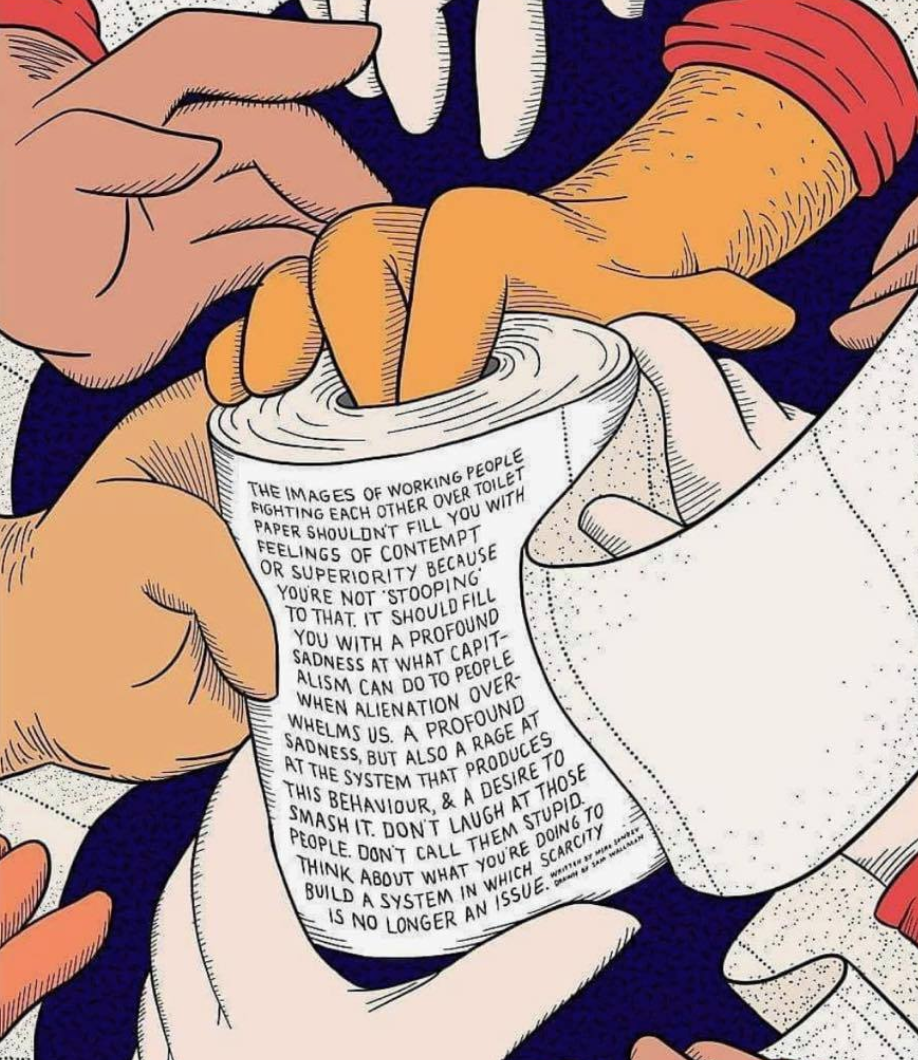
Including this kind of thing, from socialists:
So it’s “capitalism” that makes people fight over toilet paper at a time when toilet paper isn’t a product they particularly need.
Socialism, they tell us, is “a system in which scarcity is no longer an issue.”
So when there’s an unanticipated pandemic, socialism will evidently have huge warehouses of toilet paper sitting there for no reason, waiting for consumers who don’t actually need it to get all they need.
Well, that seems like a rational approach to production.
How about the fact that it’s capitalism itself that’s made it seem normal and unremarkable that everybody you know readily purchases and uses soap, disinfectants, and sanitizers?
Which European king had all of these?
Scarcity is always an issue. If we produce A with resources B, C, and D, we cannot simultaneously produce F with B, C, and D. If we employ labor in the service of one line of production, we cannot simultaneously employ it in the service of another.
Here is the situation we face:
Billions of people have an enormous number of conflicting preferences.
We have to figure out a way to satisfy as many of those preferences as possible, but arrange the means of production in such a way that in satisfying one preference we are not inadvertently depriving more urgent preferences of the resources necessary for them to be satisfied.
The market economy, with its price system, accomplishes this seemingly impossible task — or at least approaches it as closely as mankind is capable of — without coercion or central direction.
It does it so well that people consider it automatic, like a spontaneously occurring feature of human existence.
Instead of marveling at it, they complain — and risk destroying the very thing that in all likelihood makes their own existences possible.
I might add, incidentally, that one thing the market provides that socialism surely would not, is home education.
The kind of system being described above would place indoctrination of the young fairly high on its list of goals, so good luck homeschooling.
Meanwhile, we’ve created the Ron Paul Curriculum, which — gasp — presents students with more than one point of view, while at the same time giving them a top-notch education in all the major subjects, plus others: like how to speak effectively, how to run a small business, how to operate a blog, or how to manage money.
There’s going to be more demand for it in the coming weeks, for obvious reasons.
Curious? Join through my link and I throw in three bonuses I created myself:
The wealthy and powerful, the ruling class, are wealthy and powerful in part because they are better at killing; the one thing they cannot do is carry on forever the fiction that their interests coincide with the interests of most of the community. They cannot forever con people into believing that it is in their own interests and that of their families to work or to die for the profit of the ruling class.” -Herbert McCabe, OP
“I am convinced that those societies (as the Indians) which live without government enjoy in their general mass an infinitely greater degree of happiness than those who live under the European governments. Among the former, public opinion is in the place of law and community moral restrains act as powerfully as laws ever did anywhere. Among the latter, European governments, under pretense of governing they have divided their nations into two classes, wolves & sheep. I do not exaggerate. This is a true picture of Europe. If once our people become inattentive to the public affairs, you, Carrington, and I, and Congress, and judges, and governors shall all become wolves. It seems to be the law of our general nature, in spite of individual exceptions; experience declares that man is an animal which devours his own kind, for I can apply no milder term to the governments of Europe, and to the general prey of the rich on the poor.”
— Thomas Jefferson, Letter to Edward Carrington – January 16, 1787
“Class warfare is not, in the first place, a struggle between the haves and the have-nots. It has very little to do with what people in England call ‘class distinctions,’ meaning a peculiarly English kind of snobbery. It is not differences of wealth that cause class differences, but class differences that cause differences of wealth. The worker by his labor creates a certain amount of wealth, only part of which is returned to him in the form of wages, etc. The rest is appropriated by the capitalist, so called because his function is to accumulate capital in this way. The capitalist receives from a great many workers the extra wealth which they produce but do not need for their subsistence and minimal contentment, and bringing all this wealth together he is able to invest, to provide the conditions under which more work may be done — and so on. On this fundamental division between worker and employer the whole class system rests.
The worker is whoever by productive work actually creates wealth. The employer is not simply anyone who makes overall decisions about what work shall be done and how; he is the one who takes the surplus wealth created by the worker and uses it (in his own interests of course) as capital. Capitalism is the system in which capital is accumulated for investment, in their own interests, by a group of people who own the means of production and employ large numbers of other people who do not own the mean of production but produce both the wealth which they receive back in wages and the surplus wealth which is used for investment by the owners in whatever way they desire. The wealthy and powerful are wealthy and powerful, they are the ruling class, in part because they are better at killing; the one thing they cannot do is carry on forever the fiction that their interests coincide with the interests of most of the community. They cannot forever con people into believing that it is in their own interests and that of their families to work or to die for the profit of the ruling class
The wealthy and powerful, the ruling class, are wealthy and powerful in part because they are better at killing; the one thing they cannot do is carry on forever the fiction that their interests coincide with the interests of most of the community. They cannot forever con people into believing that it is in their own interests and that of their families to work or to die for the profit of the ruling class.” -Herbert McCabe, OP
Others were traditional welfare state redistributionists. Bergoglio was among this group.
Since then, the percentage of world’s poor has been reduced to under 10%. The Bookings Institution, a Keynesian, middle-of-the-road think tank, recently announced this.
This is what the present world economy is delivering. But the Pope doesn’t see it this way. He thinks the world needs a new taxation system and a new ethic.
This week, the Pope called for international economic redistribution. I have reprinted his speech here.
Liberation theology was popular with a hard core of far-Left Catholic priests in Latin America from the mid-1960’s until December 25, 1991. A few of them were outright Marxists. They believed in armed revolution against the state. The Pope, then Father Bergoglio, , criticized this interpretation of Christianity.
Others were traditional welfare state redistributionists. Bergoglio was among this group. With the disintegration of the Soviet economy in the late 1980’s, followed by Gorbachev’s announcement of the suicide of the USSR on December 25, 1991, liberation theology ceased to be the latest and the greatest. It became passé overnight. It began to fade.
Bergoglio was the head of the Jesuit order in Argentina in the mid-1970’s. A decade earlier, the Jesuits had been a formidable force for theological conservatism within the Catholic Church. Then, within ten years, the Jesuits moved to the left theologically and politically. They abandoned four centuries of tradition in a decade. The story of this astounding transformation is recorded in Malachi Martin’s book, The Jesuits: The Society of Jesus and the Betrayal of the Roman Catholic Church (1987). Martin was appalled by the change. In contrast, Garry Wills applauded it in his book, Bare Ruined Choirs: Doubt, Prophecy, and Radical Religion (1972), which I reviewed in The Wall Street Journal.
From the foundation of the Jesuits in the mid-16th century until about 1965, the Jesuit order had been militant in its defense of the papacy. Pope Paul VI (1963-78) radicalized the Jesuits. He was the most theologically liberal Pope in history. He was also the most radical in terms of his social views. Pope Francis is extending his legacy after a four-decade gap. His predecessor, Benedict XVI, was the most conservative Pope since Pius XII, who died in 1958. That was a gap of almost five decades. He was a staunch opponent of liberation theology. The magnitude of this change is conveyed in the new Netflix movie, The Two Popes. The dialogue is fictional, but the theological confrontation was real. To get some idea of the change, imagine Calvin Coolidge deciding that the best person to follow him as President would be Franklin Roosevelt.
THE POPE’S CALL TO ACTION
This week, the Pope called for international economic redistribution. I have reprinted his speech here.
Last June, the Vatican posted his statement on the need to care for the poor. In that statement, he did not mention the need for state action. I have posted it here. In terms of traditional Catholic views on voluntary charity, there was nothing new in the presentation from a theological standpoint. But his language and his rhetoric was clearly that of liberation theology.
We can build any number of walls and close our doors in the vain effort to feel secure in our wealth, at the expense of those left outside. It will not be that way for ever. The “day of the Lord”, as described by the prophets (cf. Am 5:18; Is 2-5; Jl 1-3), will destroy the barriers created between nations and replace the arrogance of the few with the solidarity of many. The marginalization painfully experienced by millions of persons cannot go on for long. Their cry is growing louder and embraces the entire earth. In the words of Father Primo Mazzolari: “the poor are a constant protest against our injustices; the poor are a powder keg. If it is set on fire, the world will explode”.
This statement was issued to promote the Church’s World Day of the Poor: November 17. Why his statement was published five months early, I do not know.
His latest declaration reveals his commitment to a non-Marxist, meaning non-revolutionary, form of liberation theology. It is also consistent with what is sometimes called the new social gospel, best represented in the United States by political activist Jim Wallis. I devote a department to his theology and his tax-exempt political mobilization. It is here. The Pope has a lot more followers than Jim Wallis does. But his rhetoric is the same.
Structures of sin today include repeated tax cuts for the richest people, often justified in the name of investment and development; tax havens for private and corporate profits; and, of course, the possibility of corruption by some of the world’s largest corporations, not infrequently in line with some ruling political sector.Every year hundreds of billions of dollars, which should be paid in taxes to finance health care and education, accumulate in tax haven accounts, thus preventing the possibility of dignified and sustained development for all social actors.
Impoverished people in heavily indebted countries are suffering from overwhelming tax burdens and cuts in social services as their governments pay off insensitive and unsustainable debts. In fact, public debt incurred, in not a few cases to promote and encourage a country’s economic and productive development, can become a factor that damages and harms the social fabric. When it ends up being directed towards another purpose.
THE ELIMINATION OF POVERTY
One of the most astounding facts of the last two decades is the dramatic reduction in life-threatening poverty around the world. Nothing like this has ever taken place in man’s history. It is becoming a well-known phenomenon because of the remarkable 2007 TED talk video by Swedish statistician Hans Rosling.
Since then, the percentage of world’s poor has been reduced to under 10%. The Bookings Institution, a Keynesian, middle-of-the-road think tank, recently announced this.
Looking at poverty trends worldwide, World Data Lab now estimates that on New Year’s Day 2019, just under 600 million people across the world (excluding Syria) will live in extreme poverty. By 2030, this figure is expected to fall to some 436 million.The good news is that 2019 will start with the lowest prevalence of extreme poverty ever recorded in human history—less than 8 percent. In all likelihood, this level will set the “ceiling” for a new era of even lower single-digit global poverty rates for the foreseeable future.
This is what the present world economy is delivering. But the Pope doesn’t see it this way. He thinks the world needs a new taxation system and a new ethic.
You, who have so kindly gathered here, are the world’s financial leaders and economic specialists. Together with your colleagues, you help set global tax rules, inform the global public about our economic condition, and advise the world’s governments on budgets. They know first-hand what the injustices of our current global economy are, or the injustices of individual countries.Let us work together to end these injustices. When the multilateral credit agencies advise the different nations, it is important to take into account the high concepts of fiscal justice, responsible public budgets in their indebtedness and, above all, the effective and leading promotion of the poorest in the social network. Remind them of their responsibility to provide development assistance to impoverished nations and debt relief for heavily indebted nations. Remind them of the imperative to stop man-made climate change, as all nations have promised, so that we do not destroy the foundations of our Common House.
The Pope’s mindset was formed by 1975. His worldview has not changed. His rhetoric has not changed. Meanwhile, the world is getting steadily richer. The poor are steadily getting richer.
While I don’t have a biblical passage to support the following, I recommend to Pope Francis a familiar slogan in American life: “If it ain’t broke, don’t fix it.”
THE BIBLE PROMOTES CAPITALISM
For over half a century, I have been arguing that the system of property rights mandated by the commandment against theft (Exodus 20:15) and also by the Mosaic laws defending private property inevitably produce a free market society when they are widely respected by the public and defended by civil government. In turn, free market society inevitably increases per capita wealth. I have defended this position in 31 volumes of economic commentaries on the Bible. I have defended it in four volumes of detailed economic analysis.
The Pope does not believe that biblical law and biblical ethics promote a private property social order which in turn produces capitalism. The theologians in Salamanca, Spain, argued that this was the case back in the 1500’s. But the Pope either is unaware of this or does not believe what the school of Salamanca taught.
I hope that a future Pope spends his years as a priest, a bishop, and a cardinal reading and re-reading the economics books written by members of the school of Salamanca. Even better, maybe he will read my books. I can always hope. After all, I’m postmillennial.
In this train of thought, free market economies are nothing more than gigantic voluntary systems of cooperation based on reciprocity, where people who do not know each other can cooperate to get what they need or want without excessive waste.
But Hanauer can’t bring himself to praise that kind of cooperation and reciprocity because market exchange also involves self-interest and competition. Hanauer, as many before him, desires a specific kind of cooperation. Hanauer only wants cooperation when he deems it to be sufficiently virtuous. Free cooperation isn’t acceptable among self-interested people, Hanauer contends. It can only be allowed if the people involved have the right motivations.
This has long been a fantasy among critics of market freedom.
“Successful economies are not jungles, they’re gardens, which is to say that markets, like gardens, must be tended, that the market is the greatest social technology ever invented to solving human problems, but unconstrained by social or democratic regulation, markets inevitably create more problems than they solve.”
These are the words of Nick Hanauer, a self-described capitalist. And a billionaire.
He was an early investor in Amazon.com and founded Aquantive Inc., which was purchased by Microsoft for $6.4 billion.
More recently, he has been receiving a lot of attention as a “thinker.” According to a TEDtalks, “Nick Hanauer is one of the world’s most provocative thinkers about our society’s growing inequality and the dire consequences it creates for our democracies.”
In his 2019 TED lecture, titled “The dirty secret of capitalism—and a new way forward” Hanauer warns us of the supposed dangers of capitalism and economists who have supported market freedom:
“If we truly want a more equitable, more prosperous and more sustainable economy; if we want high-functioning democracies and civil society, we must have a new economics. […] But how do we leave neoliberalism behind and build a more sustainable, more prosperous and more equitable society? […] It’s becoming painfully obvious that the fundamental assumptions that undergird neoliberal economic theory are just objectively false […]. It isn’t self-interest that promotes the public good, it’s reciprocity. And it isn’t competition that produces our prosperity, it’s cooperation”.
In his talk, Hanauer stresses reciprocity and cooperation while blasting self-interest and competition.
Reciprocity and cooperation are indeed good things. But contrary to what Hanauer thinks, they are, in fact, the very basis of capitalism, a system of voluntary exchanges. In a system of voluntary exchange, I give you something you want if you give me back something I want. In this case, money is just an instrument (transferable and deferrable) to make trade easier and flexible (feasible in complex societies).
In this train of thought, free market economies are nothing more than gigantic voluntary systems of cooperation based on reciprocity, where people who do not know each other can cooperate to get what they need or want without excessive waste.
But Hanauer can’t bring himself to praise that kind of cooperation and reciprocity because market exchange also involves self-interest and competition. Hanauer, as many before him, desires a specific kind of cooperation. Hanauer only wants cooperation when he deems it to be sufficiently virtuous. Free cooperation isn’t acceptable among self-interested people, Hanauer contends. It can only be allowed if the people involved have the right motivations.
This has long been a fantasy among critics of market freedom.
In 1714, for example, the Dutch writer Bernard Mandeville was responded to this criticism with his poem The Fable of the Bees. In his story, a beehive was thriving on the “vices” (self-interested behavior) of its bees. But then bees became virtuous. They demanded a new kind of cooperation, no longer acting in their own self-interest but for the greater good of the hive. The result? The beehive collapsed.
For theorists like Mendeville and Adam Smith, self-interested behavior wasn’t necessarily good. But it was assumed to be human nature, and thus any good political economy, they thought, should take this into account.
Hanauer disagrees, which is hardly surprising. He affirms acerbically that the “neoliberal assumptions (of free-market) are just objectively false.” The economy must be “tender,” constrained by social norms and regulations, which means a state-organized cooperation. His point is that a good system replaces voluntary cooperation with forced cooperation. Socialists have been trying to do this for centuries. Moreover, cooperation based on coercion cannot be taken as a sign of prosperity.
Let us examine the historical record. Some historians reported that after Germany was divided into two following the Second World War, East Germans displayed a high degree of “cooperation.” But this wasn’t because of a change in human nature. It was because people who lived there were forced to use their social network for basic survival. A simple drain clogged up would turn into a matter of calling in favors. The solution was not a simple matter like calling for a plumber. Inhabitants of the East had to know someone who knew someone who could help — there was little money, few accessible equipment and tools, and no available spare parts. In West Germany, on the other hand, people were reported not to be so “cooperative,” so to speak. True enough, because they could simply hire some (unknown and self-interested, perhaps moody) plumber, who would impersonally fix the problem. Guess which Germany had a higher standard of living?
Of course, even in a heavily regulated and centrally planned society — one designed to abolish all the excesses and problems of the marketplace — there’s no reason to believe self-interest was actually abolished.
Why Not Teach by Example?
On a personal level, however, it appears Hanauer is not a big fan of voluntary action.
At the end of the lecture, the interviewer asked Hanauer why he should not just give all his money away and join the 99 percent? If he cares so much about taxes, why doesn’t he pay more voluntarily? If he cares so much about wages, why doesn’t he pay more?
He could be a role model, such as Henry Ford, who shocked the business world by paying higher (doubled) wages for his employees even (or especially) in times of crisis.
Nick Hanauer answered he could do that. But (according to him) it would not make that much of a difference. He said to had discovered a strategy that works a hundred thousand times better: using his money to build narratives and to pass laws that will require all the other rich people to pay taxes and to pay their works better – for example, the minimum wage.
Here, a basic moral principle is removed. As Frédéric Bastiat noted: “it is impossible for me to separate the word fraternity from the word voluntary. I cannot possibly conceive fraternity legally enforced, without liberty being legally destroyed, and justice legally trampled under foot.”
People frequently allege that, under capitalism, people aren’t paid what they are worth to employers. As a measure of how frequently that gets repeated, a Google search of “underpaid” I just did turned up 1,770,000 hits. And there is one sense in which that allegation may be true. But the commonly-drawn implication that state coercion will improve things is false.
The competitive market process does not guarantee that your payment equals your value to your employer. It guarantees you are paid at least as much (adjusted for a host of other circumstances and preferences) as your next-best known alternative.
Say Bob and Bill are your potential employers. Bob offers you $50,000. If Bill values your additional productivity at $70,000, what will he offer you? It is indeterminate. All we know is that it must be enough to outbid Bob, other things equal, to attract you. Bill need not pay you what you are worth to him. But even if you are paid less than your value to Bill, your supposed “underpayment” does not harm you. You are made better off than you would have been by any offer you accept from Bill.
If, however, Barbara joins those who seek your services, and offers you $60,000, Bill will have to beat that, rather than $50,000, to keep your services. If Betty then also joins the pursuit of your labor services at $69,000, that becomes the number that must be beaten. In other words, the more competitive the market for your labor becomes, the closer your pay approaches what you are worth to your employer, because the value of your alternatives approaches your value to your chosen employer. And only the free market guarantees that you will be paid that well.
Better Wages Come from More Competition Among Employers
This reveals why government coercion is not the path to increased worker well-being. Governments and their “big labor” progeny are constantly advancing mandates that impose barriers to entry and competition for their favored groups from other workers. When reduced barriers to entry and increased competition are the means by which workers become paid nearly what they are worth to employers, such coercive government “solutions” actually guarantee that many workers will be paid far less than they would otherwise have been.
Government is also a major source of other reasons why workers’ paychecks are less than their value to employers.
Government-mandated worker benefits provide one example. The costs of those benefits must ultimately come out of employees’ total compensation. So while government sponsors claim credit from recipients for mandated health coverage, worker training, family leave, workman’s compensation, etc., workers’ earnings are reduced to cover their added cost. But because these act as hidden taxes, employers get the blame for the lower wages that result.
Employer “contributions” for state unemployment and disability insurance, as well as their half of Social Security and Medicare taxes, are another source of such worker “underpayment.” Employers, knowing they will be on the hook for these bills, over and above wages paid, offer less in wages. Again, the money ultimately comes from employees’ pockets, but they blame their employers instead of the government for reducing what they take home as a result. When workers say “I was robbed,” they may be correct — but they finger the wrong suspect.
And these costs are substantial, An article in the September 29 Los Angeles Times noted that they can comprise 30% of employers’ labor costs.
Corporate taxes have similar effects. To the extent that such taxes’ effects reduce net-of-tax earnings, they reduce the value of workers to employers. Yet again, government gets the money and accolades from beneficiaries of added expenditures financed, while businesses are scapegoated as if they caused the underpayment. In, fact, Steven Entin summarized recent data-based studies on corporate tax incidence as showing that “labor bears between 50 percent and 100 percent f the burden of the corporate income tax, with 70 percent or higher the most likely outcome.”
The widespread assertion that people aren’t paid what they are worth to employers may be true in one sense, but not in the sense those making the assertion usually imply. “Greed” or some faulty “ism” is not to blame, and more government interferences provides no magic solution. The maximum such “underpayment” in a competitive labor market is the extent that your value to your highest valuing employer exceeds that of your second-highest valuing employer. And that difference gets smaller as labor markets get more competitive. On the other hand, there are many ways government’s coercive power reduces what workers take home well below their value to their employers (or how valuable they would be if they were freely allowed to compete for all jobs), in order to fill their treasuries and protect their “friends” from competition, while blaming others for what they have imposed. So, if being paid what someone is worth to an employer is the standard, government is the problem and competition is the answer.
Presumably Monbiot would say that past success is no guarantee of future performance, but as a different Guardian article explains, the UN reports that the world has seen “astonishing” improvements in human welfare just since 1990.
Presumably bolstered by the fiery claims of Greta Thunberg and the general theme of Climate Week, people on Twitter have been declaring that capitalism threatens humanity. This angst rekindled interest in a Guardian article that ran a few months ago, in which author George Monbiot argued that the very nature of capitalism is “incompatible with the survival of life on Earth.” Not only do such claims ignore the obvious progress of humanity staring us in the face—and the environmental activists are supposed to be the empirical ones in this debate—but even if Monbiot’s worries about the climate were correct, capitalism would still be the best social system to deal with the crisis.
Monbiot’s Case Against Capitalism
The following excerpt summarizes Monbiot’s two-pronged argument for why capitalism threatens our entire species:
Capitalism’s failures arise from two of its defining elements. The first is perpetual growth. Economic growth is the aggregate effect of the quest to accumulate capital and extract profit. Capitalism collapses without growth, yet perpetual growth on a finite planet leads inexorably to environmental calamity.
…The absolute decoupling needed to avert environmental catastrophe (a reduction in material resource use) has never been achieved, and appears impossible while economic growth continues. Green growth is an illusion.
A system based on perpetual growth cannot function without peripheries and externalities. There must always be an extraction zone – from which materials are taken without full payment – and a disposal zone, where costs are dumped in the form of waste and pollution. As the scale of economic activity increases until capitalism affects everything, from the atmosphere to the deep ocean floor, the entire planet becomes a sacrifice zone: we all inhabit the periphery of the profit-making machine.
…
The second defining element is the bizarre assumption that a person is entitled to as great a share of the world’s natural wealth as their money can buy. This seizure of common goods causes three further dislocations. First, the scramble for exclusive control of non-reproducible assets, which implies either violence or legislative truncations of other people’s rights. Second, the immiseration of other people by an economy based on looting across both space and time. Third, the translation of economic power into political power, as control over essential resources leads to control over the social relations that surround them.
Monbiot’s critique of capitalism is entirely unfounded. In the first place, it defies all empirical grounding, which is ironic because it’s my side of this debate that’s allegedly composed of unscientific “deniers.” Especially as formerly communist countries move towards freer markets, the world has seen dramatic improvements in living standards, while the relevant availability of “depletable” resources has increased; even climate-related deaths have plummeted over time.
But it gets even worse for Monbiot’s thesis. Even if we imagine a scenario—contrary to reality—where humanity did run into a crisis because of natural resource crunch, the best way to deal with the situation would be reliance on private property and market prices. To blame capitalism for the potential problems of a finite world is like blaming thermometers for the flu.
Just the Facts: It’s Getting So Much Better All the Time
In this section I’ll illustrate some of the basic facts, documenting that human welfare has drastically improved during the same period that we have ostensibly seen the ravages of human-induced climate change.
First, consider a chart from Bjørn Lomberg (and reproduced by Marlo Lewis) that shows climate-related deaths from 1920-2017:
It’s hard to see evidence of impending disaster in the above chart.
As the chart shows, U.S. “proved reserves” of crude are at an all-time high at some 39.2 billion barrels (as of 2017), up from 13.6 billion barrels in 1930. The increase in crude reserves has occurred despite the fact that the U.S. has produced an enormous amount of crude oil over this period.
Indeed, as the separate EIA chart shows below, since 1950 U.S. crude production has rarely fallen below 5 million barrels per day, and it’s currently (as of June 2019) at a record high of some 12.1 million barrels per day.
U.S. Field Production of Crude Oil
The pattern is similar for world oil reserves and production, but I chose to use U.S. data because it is the most reliable. There’s also a similar pattern for natural gas and coal; as this 2011 IER report shows, North America alone has enough fossil fuels in the broader category of “recoverable resources” to satisfy current consumption rates for literally centuries. And they are growing. According to the Potential Gas Committee’s latest report, U.S. reserves of natural gas increased by the energy equivalent of 100 billion barrels of oil in just the last 2 years.
Now how can this be possible? How can the U.S., for example, have more “proved reserves” of oil now, than it did in (say) 1950? The answer is that it doesn’t make sense for humans to go out and find every last drop of oil (or lump of coal) housed in planet Earth. At any given time, it’s only sensible to have located the precise deposits of a healthy margin of such depletable resources, which is only a small fraction of the physical stockpile.
Yes, since there is a finite amount of crude oil, it must be the case that humanity will eventually have to switch to some other energy source. But humanity—especially in the modern age of relatively capitalistic institutions—has so far had no trouble maintaining consistent increases in total output, notwithstanding the “finite” resources on Earth (or the physical universe, for that matter).
Presumably Monbiot would say that past success is no guarantee of future performance, but as a different Guardian article explains, the UN reports that the world has seen “astonishing” improvements in human welfare just since 1990. Specifically, more than a billion people were lifted out of “extreme poverty,” with “the number of people living on less than $1.25 a day [falling] from 1.9 billion in 1990 to 836 million in 2015.”
What would the data have to look like to vindicate capitalism from the charges of Monbiot?
Even in a Collapsing World, Capitalism Would Be Our Best Defense…
Conclusion
George Monbiot alleges that capitalism, left unchecked, will cause the literal extinction of humanity. His arguments ignore all of the evidence of capitalism’s benefits staring us in the face. Yet even on a theoretical level, private property and market prices help organize human activity so that we can deploy our scarce resources in the most efficient manner. Empirically, capitalism has allowed humanity to flourish with an ever-rising standard of living. But even in a catastrophic scenario where we hit a hard resource constraint, capitalism would still be an important tool in our defense, just as we would badly need math and science to help us cope with the emergency.
Brainwashing our youngsters is a serious matter. The people responsible for the California Department of Education’s proposal ought to be summarily fired.
Just when we thought colleges could not spout loonier ideas, we have a new one from American University. They hired a professor to teach other professors to grade students based on their “labor” rather than their writing ability. The professor that American University hired to teach that nonsense is Asao B. Inoue, who is a professor and associate dean in the College of Integrative Sciences and Arts at Arizona State University. He is also the director of the university’s writing center. Inoue believes that a person’s writing ability should not be assessed, in order to promote “anti-racist” objectives. Inoue taught American University’s faculty members that their previous practices of grading writing promoted white language supremacy. Inoue thinks that students should be graded on the effort they put into a project.
The idea to bring such a professor to American University, where parents and students fork over $48,459 a year in tuition charges, could not have been something thought up by saner members of its academic community. Instead, it was probably the result of deep thinking by the university’s diversity and campus life officials. Inoue’s views are not simply extreme but possibly hostile to the academic mission of most universities. Forgiving and ignoring a students’ writing ability would mostly affect black students. White students’ speaking and writing would be judged against the King’s English, defined as standard, pure or correct English grammar…
Not holding students accountable to proper grammar does a disservice to those students who overall show poor writing abilities. When or if these students graduate from college, they are not going to be evaluated in their careers by Inoue’s tailored standards. They will be judged according to their objective abilities, and it probably follows that if they fail to meet those objective standards, the standards themselves will be labeled as racist.
There’s another very dangerous bit of academic nonsense happening, this time at the K-12 level of education. One America News Network anchor interviewed Mary Clare Amselem, education specialist at the Heritage Foundation, about the California Department of Education’s proposed ethnic studies curriculum. The proposed ethnic studies curriculum would teach children that capitalism and father figures are racist.
The proposed ethnic studies proposal has been removed from the California Department of Education website. House Minority Leader Kevin McCarthy, R-Calif., said, “While I am relieved that California made the obvious decision to revisit this wholly misguided proposal, we need to know why and how a blatantly anti-Semitic, anti-Israel, factually inaccurate curriculum made its way through the ranks of California’s Department of Education.” He added, “This was not simply an oversight — the California Department of Education’s attempt to institutionalize anti-Semitism is not only discriminatory and intolerant, it’s dangerous.”
Brainwashing our youngsters is a serious matter. The people responsible for the California Department of Education’s proposal ought to be summarily fired.
The government — we are told — is necessary to protect us from the excesses of capitalism, and whatever gripes the average person might have about their elected officials, almost all of them can agree upon this.
But there’s a problem with thinking the government can ever enter the economy as a fair referee rather than merely playing into the hands of whatever factions are most rich, powerful, and influential; because as soon as a corporation can make more money by angling for government favors than they can by serving customers, that is exactly what they are going to do. Not necessarily because they are evil — but because it becomes the rational thing to do.
On an open market where only voluntary exchanges are permitted a business can only turn a profit by providing something that the general buying public wants. No matter how greedy the corporate fat-cats may be, if they fail to “cough up the goods” (and services) that people want, they will be out of luck. In this way, the market forces of otherwise self-interested people will apply their self-interest to social ends.
Critics may still complain about “tooth and nail” competition, but at least on a free market firms are competing to serve you better and win your disposable income. As soon as the government intervenes in the economy one thing is for sure: companies will compete for control over legislative bodies and the strings of the public purse. This is where the real “tooth and nail” begins…
According to the Sunlight Foundation, America’s 200 most politically active corporations spent $5.8 billion on federal lobbying and campaign contributions. That’s $5.8 billion spent on political gaming instead of invested in jobs and product development.
These incentives drive companies to misallocate resources by making products that the general public doesn’t want profitable, and products that they do unprofitable. In other words, the government has become the client of these corporations rather than their customers. And companies often must lobby in self defense.
Firms might lobby or contribute to political campaigns to earn the exclusive right to provide government with their products. This will give them a huge advantage over competitors even if they are producing inferior or more expensive services. They can lobby for subsidies on their own goods or tariffs on cheaper or superior competitors.They can get the government to pass laws about who can and cannot operate in their sector.
Mandatory licenses, fees, reviews, huge stacks of forms, inspections, make it expensive for small start up businesses to enter the market and compete on an equal playing field. Companies spend millions of dollars on accountants, lawyers, actuaries and bureaucrats — not to mention tens of thousands of hours — to make sure they comply with the entangling webs of red tape, and make no mistake this harms the public. The costs are reflected in the price of products, and those are millions of dollars and tens of thousands of hours that are not being spent on more productive work that would benefit others. The rounds of “regulation” inflate corporate profits more and more, by cutting small firms out of the market and directing sales to bigger firms who can afford specialists or whole departments to play the game.
By changing the incentive structure of the economy to favor profit through political influence over serving customers the government corrupts the market rather than moderating its excesses.



 Bernie Sanders’ statements are not that different from those of Lenin, Stalin, Castro, Chavez and other tyrants. Sanders says, “Let us wage a moral and political war against the billionaires and corporate leaders, on Wall Street and elsewhere, whose policies and greed are destroying the middle class of America,” and “We need to change the power structure in America, we need to end the political oligarchy.”



 MCViewPoint