MCViewPoint

Opinion from a Libertarian ViewPoint

Posts Tagged ‘capitalism’

Stop Hating on Self-Checkouts – Foundation for Economic Education

Posted by M. C. on August 22, 2019

https://fee.org/articles/in-praise-of-self-checkouts/

Tyler Curtis

If you’ve been to the grocery store lately, then you’ve probably had to make this choice: regular cashier or self-checkout? For many shoppers, the choice often depends on which option has a line, how many items they have in their basket, and sometimes they’ll just choose whichever lane is closest. Others, however, hate self-checkouts with a visceral passion. Not only do they refuse to use the machines, they don’t want self-checkouts to exist at all.

This attitude is woefully misguided. While there is nothing wrong with preferring to engage with a human cashier, a fair number of shoppers enjoy the benefits self-checkouts have to offer. Indeed, there is much about self-checkouts to praise.

Why All the Fuss?

Though most shoppers who tacitly boycott self-checkouts do so with respect, patiently waiting in line for a human cashier, there is a vocal minority who would like nothing more than to take a Louisville slugger to the dastardly appliances.

One such malcontent is Kaitlyn Tiffany, a Vox writer who presumably would have felt comfortable with mobs destroying power-looms in 19th century England. In an article bluntly entitled, “Wouldn’t it be better if self-checkout just died?” Tiffany laid out precisely why she believes retail stores ought to eliminate the machines.

Her first objection is a simple one: self-checkouts are annoying. And admittedly, that’s hard to argue with. Those who’ve been scolded for placing an “unexpected item in the bagging area” will understand. “Seemingly everyone hates them,” writes Tiffany.

As someone who worked as a self-checkout attendant for three years, I can confidently say that Tiffany’s generalization is way off base. Not only are self-checkouts not universally loathed, there are a large number of shoppers who actually prefer them over a human cashier.

To the self-checkout haters, this is ludicrous. “Why would I want to scan and bag my own groceries?” they ask with haughty indignation. Well, there are a number of reasons.

First, no one is going to treat your items with as much care as you do. One does not have to be a cynic to understand that there are reckless cashiers who will bruise your fruit or smash your bread. You can also bag your groceries in whichever way you prefer. For those worried about breaking their eggs, or mixing that leaky package of meat with the vegetables, being able to bag your own groceries is nothing to scoff at. Self-service often means better service.

Second, using the self-checkout is frequently the fastest option, at least for those who feel comfortable with the technology (no unexpected items in the bagging area!). Even its relative unpopularity with other customers is a bonus for those who like them; after all, if fewer people want to use the self-checkout, the chance of there being a line is diminished…

The great thing about the free market is that it doesn’t force everyone into one-size-fits-all products. Sadly, there are many who see this as a bug rather than a feature. Market skeptics like Kaitlyn Tiffany observe shoppers scanning their own groceries and see nothing but capitalist trickery. But for those who value having more choices, the only complaint can be: I wish this had been available sooner!

Be seeing you

vene social

Is that Sean Penn?


Posted in Uncategorized | Tagged: , , , | Leave a Comment »

Our Planet Is Not Fragile – LewRockwell

Posted by M. C. on August 4, 2019

Occasionally, environmentalists spill the beans and reveal their true agenda. Barry Commoner said, “Capitalism is the earth’s number one enemy.” Amherst College professor Leo Marx said, “On ecological grounds, the case for world government is beyond argument.”

https://www.lewrockwell.com/2019/03/walter-e-williams/our-planet-is-not-fragile/

By

Rep. Alexandria Ocasio-Cortez claims that “the world is going to end in 12 years if we don’t address climate change.” The people at the Intergovernmental Panel on Climate Change agree, saying that to avoid some of the most devastating impacts of climate change, the world must slash carbon emissions by 45 percent by 2030 and completely decarbonize by 2050.

Such dire warnings are not new. In 1970, Harvard University biology professor George Wald, a Nobel laureate, predicted, “Civilization will end within 15 or 30 years unless immediate action is taken against problems facing mankind.” Also in 1970, Paul Ehrlich, a Stanford University biologist, predicted in an article for The Progressive, “The death rate will increase until at least 100-200 million people per year will be starving to death during the next ten years.” The year before, he had warned, “If I were a gambler, I would take even money that England will not exist in the year 2000.” Despite such harebrained predictions, Ehrlich has won no fewer than 16 awards, including the 1990 Crafoord Prize, the Royal Swedish Academy of Sciences’ highest award.

Leftists constantly preach such nonsense as “The world that we live in is beautiful but fragile.” “The 3rd rock from the sun is a fragile oasis.” “Remember that Earth needs to be saved every single day.” These and many other statements, along with apocalyptic predictions, are stock in trade for environmentalists. Worse yet, this fragile-earth indoctrination is fed to the nation’s youth from kindergarten through college. That’s why many millennials support Rep. Ocasio-Cortez.

Let’s examine just a few cataclysmic events that exceed any destructive power of mankind and then ask how our purportedly fragile planet could survive. The 1883 eruption of the Krakatoa volcano, in present-day Indonesia, had the force of 200 megatons of TNT. That’s the equivalent of 13,300 15-kiloton atomic bombs, the kind that destroyed Hiroshima in World War II. Before that was the 1815 Tambora eruption, the largest known volcanic eruption. It spewed so much debris into the atmosphere that 1816 became known as the “Year Without a Summer.” It led to crop failures and livestock death in the Northern Hemisphere, producing the worst famine of the 19th century. The A.D. 535 Krakatoa eruption had such force that it blotted out much of the light and heat of the sun for 18 months and is said to have led to the Dark Ages. Geophysicists estimate that just three volcanic eruptions — Indonesia (1883), Alaska (1912) and Iceland (1947) — spewed more carbon dioxide and sulfur dioxide into the atmosphere than all of mankind’s activities during our entire history.

Our so-called fragile earth survived other catastrophic events, such as the floods in China in 1887, which took an estimated 1 million to 2 million lives, followed by floods there in 1931, which took an estimated 1 million to 4 million lives. What about the impact of earthquakes on our fragile earth? Chile’s 1960 Valdivia earthquake was 9.5 on the Richter scale. It created a force equivalent to 1,000 atomic bombs going off at the same time. The deadly 1556 earthquake in China’s Shaanxi province devastated an area of 520 miles.

Our so-called fragile earth faces outer space terror. Two billion years ago, an asteroid hit earth, creating the Vredefort crater in South Africa, which has a diameter of 190 miles. In Ontario, there’s the Sudbury Basin, resulting from a meteor strike 1.8 billion years ago. At 39 miles long, 19 miles wide and 9 miles deep, it’s the second-largest impact structure on earth. Virginia’s Chesapeake Bay crater is a bit smaller, about 53 miles wide. Then there’s the famous but puny Meteor Crater in Arizona, which is not even a mile wide.

My question is: Which of these powers of nature could be duplicated by mankind? For example, could mankind even come close to duplicating the polluting effects of the 1815 Tambora volcanic eruption? It is the height of arrogance to think that mankind can make significant parametric changes in the earth or can match nature’s destructive forces. Our planet is not fragile.

Occasionally, environmentalists spill the beans and reveal their true agenda. Barry Commoner said, “Capitalism is the earth’s number one enemy.” Amherst College professor Leo Marx said, “On ecological grounds, the case for world government is beyond argument.”

Be seeing you


Posted in Uncategorized | Tagged: , , , , | Leave a Comment »

A young person with MORE Sense than 50% of Our Politicians.

Posted by M. C. on July 31, 2019

https://raptureonline.blog/2019/05/24/a-young-person-with-more-sense-than-50-of-our-politicians/

This article was written by a 26 year old college student by the name of Alyssa Ahlgren, who’s in grad school for her MBA. It’s a short article but definitely worth a read. I would love to see this go viral!!

“College Student: My Generation Is Blind to the Prosperity Around Us

I’m sitting in a small coffee shop near Nokomis trying to think of what to write about. I scroll through my newsfeed on my phone looking at the latest headlines of Democratic candidates calling for policies to “fix” the so-called injustices of capitalism. I put my phone down and continue to look around. I see people talking freely, working on their MacBook’s, ordering food they get in an instant, seeing cars go by outside, and it dawned on me. We live in the most privileged time in the most prosperous nation and we’ve become completely blind to it. Vehicles, food, technology, freedom to associate with whom we choose. These things are so ingrained in our American way of life we don’t give them a second thought. We are so well off here in the United States that our poverty line begins 31 times above the global average. Thirty. One. Times. Virtually no one in the United States is considered poor by global standards. Yet, in a time where we can order a product off Amazon with one click and have it at our doorstep the next day, we are unappreciative, unsatisfied, and ungrateful.

Our unappreciation is evident as the popularity of socialist policies among my generation continues to grow. Democratic Congresswoman Alexandria Ocasio-Cortez recently said to Newsweek talking about the millennial generation, “An entire generation, which is now becoming one of the largest electorates in America, came of age and never saw American prosperity.”

Never saw American prosperity! Let that sink in. When I first read that statement, I thought to myself, that was quite literally the most entitled and factually illiterate thing I’ve ever heard in my 26 years on this earth. Many young people agree with her, which is entirely misguided. My generation is being indoctrinated by a mainstream narrative to actually believe we have never seen prosperity. I know this first hand, I went to college, let’s just say I didn’t have the popular opinion, but I digress.

Why then, with all of the overwhelming evidence around us, evidence that I can even see sitting at a coffee shop, do we not view this as prosperity? We have people who are dying to get into our country. People around the world destitute and truly impoverished. Yet, we have a young generation convinced they’ve never seen prosperity, and as a result, elect politicians dead set on taking steps towards abolishing capitalism.

Why? The answer is this, my generation has only seen prosperity. We have no contrast. We didn’t live in the great depression, or live through two world wars, the Korean War, The Vietnam War or see the rise and fall of socialism and communism. We don’t know what it’s like to live without the internet, without cars, without smartphones. We don’t have a lack of prosperity problem. We have an entitlement problem, an ungratefulness problem, and it’s spreading like a plague.”

Be seeing you


Posted in Uncategorized | Tagged: , , , | Leave a Comment »

Capitalism Didn’t Invent “Keeping Up with the Joneses” | Mises Wire

Posted by M. C. on July 29, 2019

https://mises.org/wire/capitalism-didnt-invent-keeping-joneses

Anti-capitalists long ago lost the argument about whether or not capitalism is the most effective way to increase living standards. Thanks to the spread of a largely-capitalistic marketplace, global poverty rates have fallen precipitously, life expectancy has risen, and standards of living continue to rise. The greatest gains have been in the so-called “developing world.”

But this hasn’t stopped anti-capitalists from coming up with new reasons — reasons unrelated to overcoming poverty — as to why capitalism ought to be abandoned.

One common complaint along these lines is that the capitalist system — mostly through advertising — makes us miserable by convincing us we must continually compete with others to raise our economic and social status within society.

Perhaps the most famous and still-talked-about example of this capitalism-makes-you-miserable narrative is found in 1999’s film Fight Club. The film centers around characters who attempt to escape their dull, depressing lives otherwise ruined by a desire for capitalist excess. At one point, the character named Tyler Durden delivers a monologue concluding that consumers in the capitalist society are

slaves with white collars. Advertising has us chasing cars and clothes. Working jobs we hate so that we can buy sh-t we don’t need.

At the root of this contention is the idea that capitalism causes consumerism, and consumerism drives us to strive ever harder to attain higher levels of material comfort and social status. Rather than enjoying a simple care-free lifestyle, the argument goes, we sacrifice our free time and happiness to working long hours in pursuit of needless consumption and competition.

[RELATED: “Capitalism Doesn’t Cause Consumerism — Governments Do” by Ryan McMaken]

But is capitalism really to blame for this sort of thinking? Is the insatiable quest for higher social status something newly invented by modern market economies?

Hardly.

Unfortunately, the desire to be popular, desirable, and possessing of high levels of social status is not tied to any particular economic system. It is found in all societies, and was certainly not something that suddenly appeared as economies began to industrialize.

What capitalism and industrialization did do was create more options available to people seeking to improve their positions within the social hierarchy. In ages past, status was closely tied to one’s family lineage or to how much favor one enjoyed with the imperial court. In capitalist times, these old criteria have not vanished, but a new  pathway to status was opened up: wealth obtained through success in the marketplace.

Social Status and Wealth Attainment in Pre-Capitalist Times

Prior to indistrialization, social mobility was — with only rare exceptions — open only to people who were already born into a relatively high social strata. Those who were born into the nobility or high-ranking levels of government bureaucracy could perhaps aspire to reach even higher levels of rank within the ruling classes.

The average peasant had no such hopes. For an average person in the pre-capitalist world, the methods of raising one’s status in society were few and exceedingly difficult.

In the ancient world, competition for social status was high-stakes and ever-present. Given the absence of a middle class and the grinding poverty experienced by the overwhelming majority of human beings in these times, those who had managed to rise above the peasantry fought hard to stay there.

The methods of maintaining and increasing status included:

  • Successful military service.
  • Winning favor with government officials through displays of personal loyalty.
  • Marriage into a family of higher social status.
  • Excellence in athletic competitions (most notably in Greece).

Military service was an especially fruitful means of increasing one’s social status. In the Neo-Assyrian empire, to list just one example,

To kill a prominent enemy was a conspicuous way for a soldier to distinguish himself and prove his loyalty to the king … [and this method was] explicitly highlighted as a method of raising a warrior’s profile.1

Material rewards were meted out by rulers to “those who brought in the heads of high-ranking enemy leaders.”2

Military service was a key factor in improving one’s fortunes throughout the ancient world, which is to be expected since warfare — and not commerce — was among the most easily available means to increase one’s wealth in a pre-capitalist world.

Social Status in Socialist Systems

Read the rest of this entry »

Posted in Uncategorized | Tagged: , , , , | Leave a Comment »

Judy Shelton’s Remarkable Attack on the Fed | Mises Institute

Posted by M. C. on June 13, 2019

https://mises.org/power-market/judy-sheltons-remarkable-attack-fed

Jeff Deist

Judy Shelton’s recent interview with the Financial Times is nothing short of remarkable…

…Consider this salvo against the Fed’s inescapable role as central planner:

How can a dozen, slightly less than a dozen, people meeting eight times a year, decide what the cost of capital should be versus some kind of organically, market supply determined rate? The Fed is not omniscient. They don’t know what the right rate should be. How could anyone?” Ms Shelton said. “If the success of capitalism depends on someone being smart enough to know what the rate should be on everything . . . we’re doomed. We might as well resurrect Gosplan,” she said, referring to the state committee that ran the Soviet Union’s planned economy.

And her attack on the Fed’s outsized role in the economy:

She also said that the Fed should continue to reduce its balance sheet below the $3.5tn target set by Jay Powell, the chairman. “I would rather the Fed be less of an entity. When a central bank buys up government debt, that’s the beginning of compromised finances.”

She also recognizes malinvestment:

“It’s the distorting aspect of the Fed that is the worst aspect — it’s a wag-the-dog situation. People are fixated on the Fed and are making money by arbitraging, trillions of a second after the latest FOMC announcement,” she added.

And she isn’t afraid to support a role for gold in monetary policy:

Ms Shelton has long been sympathetic to the gold standard, which the US fully abandoned in the early 1970s in favour of a flexible exchange rate for the dollar. “People call me a goldbug, and I think, well, what does that make them? A Fed bug,” she says.

“Fed Bugs”! Why didn’t we think of this?

Shelton, who works as an economic adviser to Trump, is not an economist by training. Her PhD in business administration, from Utah State no less, is sure to draw jeers from the Ivy League central bank crowd. But it’s Ivy League economists, after all, who created the last crisis in 2008. And needless to say they’re sounding alarm bells about Mrs. Shelton. The worst offender is former Treasury official Larry Summers, who shamelessly calls Shelton “dangerous.”

Sorry, but a financial terrorist and chief architect of the weaponized derivatives market in the 2000s should have the simple decency to keep quiet and thank his lucky stars he’s not in jail…

Be seeing you

Regulation blizzard: Government adds 1,516 pages to the ...

Posted in Uncategorized | Tagged: , , , | Leave a Comment »

Socialist Promises – LewRockwell

Posted by M. C. on May 22, 2019

Socialism promises a utopia that sounds good, but those promises are never realized. It most often results in massive human suffering. Capitalism fails miserably when compared with a heaven or utopia promised by socialism. But any earthly system is going to come up short in such a comparison.

https://www.lewrockwell.com/2019/05/walter-e-williams/socialist-promises/

By

Presidential contenders are in a battle to out give one another. Senator Elizabeth Warren proposes a whopping $50,000 per student college loan forgiveness. Senator Bernie Sanders proposes free health care for all Americans plus illegal aliens. Most Democratic presidential candidates promise free stuff that includes free college, universal income, “Medicare for All” and debt forgiveness.

Their socialist predecessors made promises too. “Freedom and Bread” was the slogan used by Adolf Hitler during the National Socialist German Workers’ Party (Nazi) campaign against president Paul von Hindenburg. Hitler even promised, “In the Third Reich every German girl will find a husband.” Stalin promised a great socialist-Marxist society that included better food and better worker conditions. China’s Mao Zedong promised democratic constitutionalism and the dream that “farmers have land to till.” These, and other promises, gave Mao the broad political support he needed to win leadership of the entire country in 1949…

Capitalism, or what some call free markets, is relatively new in human history. Prior to capitalism, the way individuals amassed great wealth was by looting, plundering and enslaving their fellow man. With the rise of capitalism, it became possible to amass great wealth by serving and pleasing your fellow man. Capitalists seek to discover what people want and produce and market it as efficiently as possible as a means to profit. A historical example of this process would be John D. Rockefeller, whose successful marketing drove kerosene prices down from 58 cents a gallon in 1865 to 7 cents in 1900. Henry Ford became rich by producing cars for the common man. Both Ford’s and Rockefeller’s personal benefits pale in comparison to the benefits received by the common man who had cheaper kerosene and cheaper and more convenient transportation. There are literally thousands of examples of how mankind’s life ha been made better by those in the pursuit of profits. Here’s my question to you: Are the people who, by their actions, created unprecedented convenience, longer life expectancy and a more pleasant life for the ordinary person — and became wealthy in the process — deserving of all the scorn and ridicule heaped upon them by intellectuals and political hustlers today?..

By the way, I’m not making an outright condemnation of socialism. I run my household on the Marxist principle, “From each according to his ability, to each according to his needs.” That system works when you can remember the names of all involved.

Be seeing you

The Socialist Utopia [MYTH] of Nordic Countries - Ben ...


Posted in Uncategorized | Tagged: , , , , , | Leave a Comment »

How College Profs Push Students to Socialism | Mises Wire

Posted by M. C. on May 11, 2019

The true aim of these “scholar activists,” as many academics have begun calling themselves, is to propagate socialism by redefining capitalism to encompass every evil of human history.

https://mises.org/wire/how-college-profs-push-students-socialism

After the collapse of the housing market in 2008, professional historians gave birth to a new sub-field of history usually referred to as “the new history of capitalism.” Economic history is hardly novel, but the new history of capitalism takes the approach that capitalism is the “thing” that needs to be explained. In the past decade, this field has become one of the most fashionable trends in the history profession, with centers for the study of capitalism being established at Cornell and the University of Georgia.

Predictably, the scholarship that falls under this label is replete with problems. Most self-described “historians of capitalism” know nothing of economic theory even as they try to incorporate it into their writings. Seth Rockman, from Brown University, for instance, supports his analysis of antebellum Baltimore by quoting Adam Smith’s exposition of the labor theory of value. Rockman seems to be taking a sly shot at proponents of capitalism—“even your precious Adam Smith believes labor is the source of value”—but he appears to be entirely unaware that economists abandoned the labor theory of value more than a century ago.1

These historians have also uniformly accepted that slavery and capitalism are inextricably linked. This idea has been around since at least 1944, when the Marxist historian Eric Williams published Capitalism and Slavery, arguing that British industrialization depended on the slave economy of Barbados.2 But the idea has evolved to the point that historians have established a consensus on claims that defy empirical substantiation… Read the rest of this entry »

Posted in Uncategorized | Tagged: , , , , , , | Leave a Comment »

Capitalism Isn’t the Problem Here – LewRockwell

Posted by M. C. on April 15, 2019

If a company is creating value, it is rewarded with profits. If it is destroying value, it is punished by losses.

The Federal Reserve and its manipulation of the monetary system short-circuits this process. You end up with a misallocation of recourses and all kinds of asset bubbles — not to mention piles of debt.

The only joy I would receive from the War Street Journal was in the comments section after Janet Yellen would repeat the state of the economy address (which was always the same as the last). The Journal would bloviate on what a great job Yellen was doing. The commenters would mostly all agree she didn’t have a clue and was worthless.

It made me wonder why all these commenters read the journal to begin with.

https://www.lewrockwell.com/2019/04/no_author/peter-schiff-capitalism-isnt-the-problem-here/

SchiffGold.com

How are all of these unprofitable companies staying afloat and even making big splashes with media-hyped IPOs?

Peter Schiff addressed this question, along with the supposed “failure” of capitalism in his most recent podcast.

The rideshare company Lyft had its lowest close since going public yesterday (April 9). In fact, the company has only closed above its IPO price twice – the day it went public and last Friday. This probably shouldn’t shock anybody, given that the company has never turned a profit. The

Meanwhile, social media company Pinterest is gearing up for its IPO with a lot of media hype. The company has been around since 2010. It’s never made any money either.

Peter asked a poignant question. What makes people think these companies will ever make any money?

[Pinterest] has been around for 10 years. If they haven’t figured out how to make a profit yet, are they ever going to do it? Because at least in the frenzy of the dot-com mania, people were saying, ‘Look, the company hasn’t made a profit yet because it’s only been around for a year. But don’t worry because it’s got all of this explosive growth.’ You know, ‘We’re grabbing eyeballs,’ or whatever it was. But people were willing to bet the companies would eventually be profitable, and they didn’t have a lot of data to go on because the companies hadn’t even been in existence for very long before they were going public. It was a rush to the market. But now that you’ve got these companies that have been going on for 10 years — I mean, they’ve had 10 years at Pinterest to try to figure out how to make a profit and they haven’t done it.”

But as Peter pointed out, because of the easy-money policies of the Federal Reserve and the resulting availability of cheap capital, companies have been able to continue to operate even though they don’t make any money.

A lot of companies are able to attract funding and stay in business that under a normal free market system – a capitalist system – they would have gone bankrupt.”

This is one of the unseen impacts of central bank monetary policy. It distorts the market.

Consider Pinterest. The company has a lot of employees. It consumes a lot of resources to operate its website – land, labor and capital. These are resources that could be put to some other use if they weren’t being consumed by Pinterest. So, how do you know whether these resources being put to their best use? In a capitalist system, profits provide that information. Profits signal that resources are being well-used. The lack of a profit tells us these resources are not being put to good use. If the lack of profit persists, the company goes under and frees up those resources for better uses.

As Peter put it, if a company can combine resources to produce a product and then sell it at a higher price then the resources that it consumed, it is adding value to the economy. The consumer gets more enjoyment out of that product then the resources consumed in producing it.

You see, resources are scarce, but demand is unlimited. And the idea behind an economy is how to satisfy unlimited demand with limited resources. And resources that are utilized for one purpose are not available for another purpose. And if a company though is losing money, then the market is basically saying, ‘Hey, you’re destroying value. You’re creating products, but your customers don’t even value those products as much as the resources were worth that you used to make them.’”

If a company is creating value, it is rewarded with profits. If it is destroying value, it is punished by losses.

The Federal Reserve and its manipulation of the monetary system short-circuits this process. You end up with a misallocation of recourses and all kinds of asset bubbles — not to mention piles of debt

Be seeing you

Bernie

Posted in Uncategorized | Tagged: , , , , | Leave a Comment »

Capitalism Turns Luxuries Into Necessities | Mises Wire

Posted by M. C. on March 23, 2019

Finally, critics of luxury expenditures allow their loathing of the rich to blind them to the fact that many of their working class neighbors are employed making luxury items.

Recall the “yacht tax” of 1990? In an effort to soak the rich deciding to buy an expensive boat, the federal government imposed a 10 percent tax on the purchase of boats valued over $100,000. Predictably, the sale of such boats plummeted, and an excess of 100,000 blue collar jobs were eliminated. The rich were still rich, but many working class people were driven to the unemployment line.

https://mises.org/wire/capitalism-turns-luxuries-necessities

Bashing the rich is all the rage these days. In a clear appeal to envy, Democratic leaders are trying to outdo each other with escalating bids on how much of rich’s wealth should be stolen by government.

In one tweet, Elizabeth Warren called out a billionaire NFL owner for paying $100 million for a “superyacht,” insisting that instead he should be paying Warren’s proposed “Ultra Millionaire Tax” to those less wealthy.

The wealthy’s purchase of luxury items invites scorn from statists looking to tax their wealth, as well as those believing it is crass consumerism to indulge in such unnecessary extravagance.

How Luxury Goods Benefit Everyone

But the wealthy’s purchase of “luxury goods” serves a social purpose.

For starters, as Ludwig von Mises wrote, today’s luxuries turn into tomorrow’s necessities.

Indeed, years ago, people would say ‘nobody needs such luxuries’ about things like air conditioning, air travel, telephones, color TV, refrigerators, and other items that are common household items now owned by the masses. Never mind modern items like the internet, laptops and smartphones that sci-fi writers a generation ago couldn’t have conjured up in their wildest imaginations that are now taken for granted and virtually considered necessities for the common man.

As Mises related in a passage from his 1962 book Economic Freedom and Interventionism:

About 60 years ago Gabriel Tarde (1843–1904) the great French sociologist, dealt with the problem of the popularization of luxuries. An industrial innovation, he pointed out, enters the market as the extravagance of an elite before it finally turns, step by step, into a need of each and all and is considered indispensable. What was once a luxury becomes in the course of time a necessity.

With the progress enabled by capitalism, the process by which luxuries turn into necessities is drastically shortened. “There was in the past a considerable time lag between the emergence of something unheard of before and its becoming an article of everybody’s use,” wrote Mises. “It sometimes took many centuries until an innovation was generally accepted at least within the orbit of Western civilization,” he continued, adding “Centuries passed before the fork turned from an implement of effeminate weaklings into a utensil of all people.”…

Be seeing you

tax crime

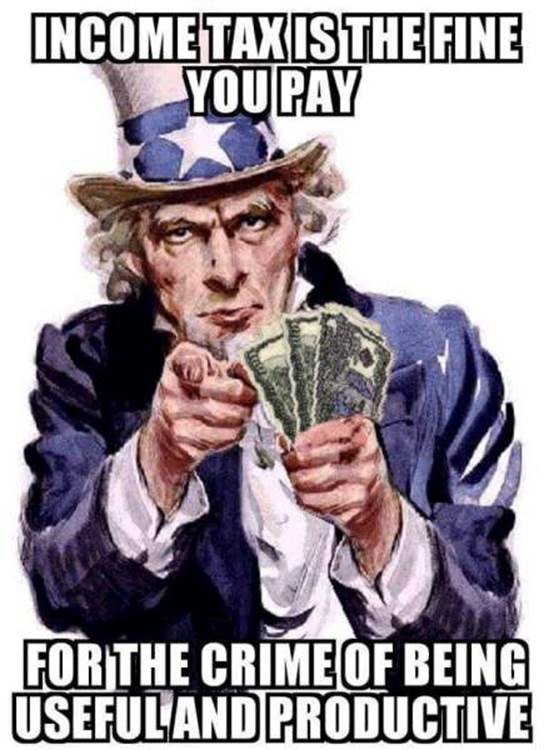
Change that to ANY TAX.


Posted in Uncategorized | Tagged: , , , | Leave a Comment »

EconomicPolicyJournal.com: A Sophisticated Defense of Free Market Capitalism (From a Former Governor)

Posted by M. C. on March 13, 2019

The blind pig (WSJ) finds an acorn.

https://www.economicpolicyjournal.com/2019/03/a-sophisticated-defense-of-free-market.html

Wow, who has the ear of former Louisiana governor Bobby Jindal?

In a Wall Street Journal op-ed piece, he has written a pretty sophisticated defense of free market capitalism.

A key snippet:

Liberal politicians, abetted by the mainstream media, regularly document the alleged shortcomings of free-market capitalism. Politicians like Sen. Bernie Sanders and Rep. Alexandria Ocasio-Cortez point to rising inequality and a supposed lack of upward mobility to make the case for socialism. Today, American Democrats have a more positive view of socialism than capitalism, and less than half of young adults have a positive view of capitalism. But the debate isn’t merely between left-wing socialists and right-wing capitalists. Even President Trump argues that capitalism generates prosperity abroad at the expense of American workers. Years of wage stagnation and diminished economic prospects have soured many Americans on the system that made the U.S. the world’s largest economy…

The problem isn’t market dynamics, but the increased government intervention in the economy that discourages competition. Rather than relying on innovation, many companies often now seek to exploit licensing arbitrage opportunities and engage in other rent-seeking behaviors. They try to beat competitors through regulatory capture and crony capitalism rather than making better products for less.

Almost every large company has calculated the benefits of lobbying government. It is no coincidence that the seemingly recession-proof Washington area dominates the list of the nation’s wealthiest counties. For consumers, this means fewer meaningful choices. For new producers, the goal is often not to displace an incumbent firm but to be purchased by one. Even many tech entrepreneurs hope to sell to Google or Facebook rather than become the next big thing…

Some argue that targeted government economic intervention is necessary to fix capitalism’s errors and prevent more-radical political elements from gaining power. Some historians credit President Franklin D. Roosevelt with saving free markets from rising support for socialism fed by the Great Depression. They argue the New Deal, by dramatically expanding the role of government, vaccinated capitalism against a more virulent form of socialism propounded by Huey Long and others. More-moderate modern leaders than Mr. Sanders and Ms. Ocasio-Cortez see today’s economic challenges as profound and argue they warrant similar inoculating shots of regulation.

These recommendations come from all across the political spectrum. Sen. Marco Rubio proposes paid parental leave, while Manhattan Institute scholar Oren Cass argues that some short-term growth should be sacrificed to strengthen families and prepare communities for long-term growth. President George W. Bush labeled his version of this approach “compassionate conservatism.”

Democrats, meanwhile, argue for a higher minimum wage, a more progressive income-tax code, stronger unions, and ObamaCare’s Medicaid expansion and exchange subsidies as the best alternative to a single-payer system. Others have pushed for breaking up larger companies—especially tech giants—expanding the earned-income tax credit, raising tariffs, and adopting a universal basic income as possible responses to the displacement caused by globalization and automation.

Small-government conservatives and their libertarian brethren still reject these notions. The biggest threat to American capitalism, they say, comes from liberalism and its incremental—but constant and accumulating—push for a larger, costlier and more powerful government. They see reform proposals from moderate Republicans as attempts to be partway pregnant. They wonder why the GOP would want to become a weaker, cheaper version of the Democratic Party. Free-market Republicans argue that conservatives should be consistently pulling in the direction of lower taxes, less regulation and smaller government.

RW

Be seeing you

Posted in Uncategorized | Tagged: , , , , | Leave a Comment »