
MCViewPoint

Opinion from a Libertarian ViewPoint

Posts Tagged ‘Classical Liberal’

The Lockean Delusion

Posted by M. C. on September 25, 2023

The state generally does not cede power back to the people. The influx of the power-hungry into lofty positions prevents that. Continuous political battle between passionate ideological factions wastes the people’s time and energy, impoverishes them, and gives the state opportunities to usurp even more power.

https://libertarianinstitute.org/articles/the-lockean-delusion/
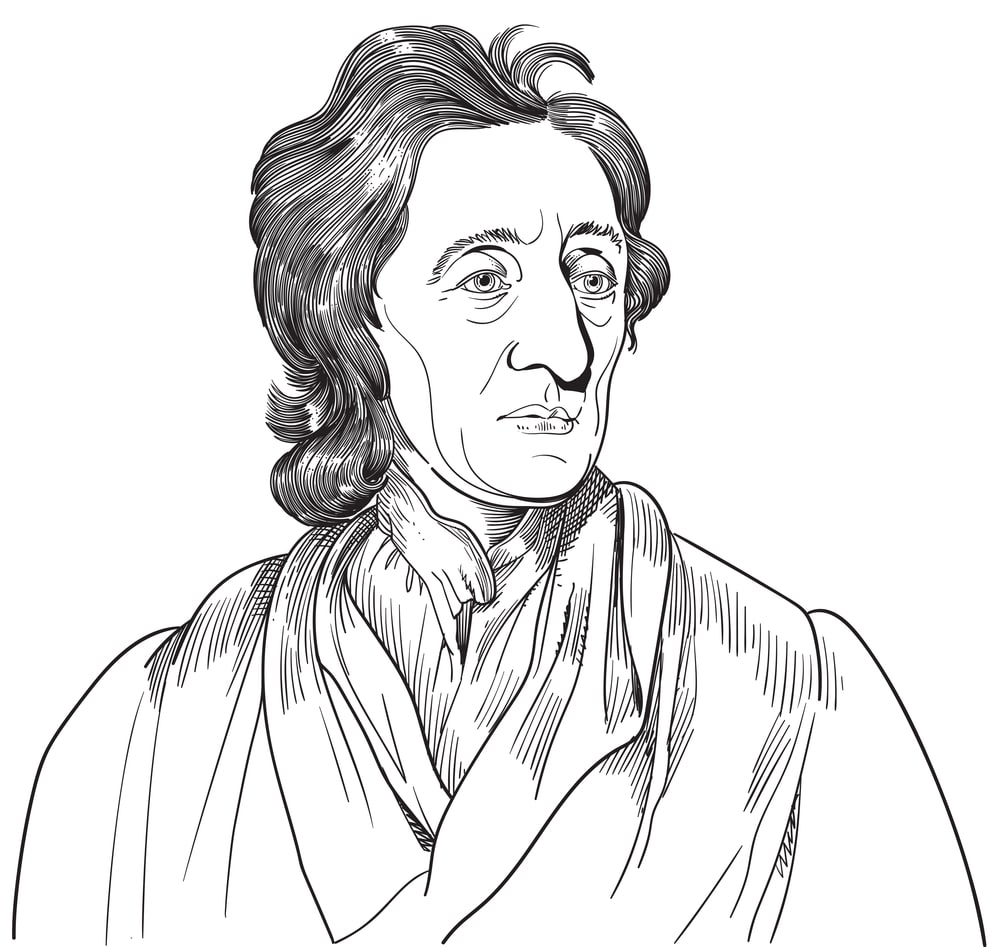
john locke

John Locke known as the Father of Liberalism, was an English philosopher and physician. Locke’s theoriesillustration, drawing, sketch, engrawed were usually about identity and the self. Locke thought that we are born without thoughts, and that knowledge is instead determined only by experience.

The classical liberal revolution, starting in the 1600s and continuing through the 1700s, created a new ideal for government. Instead of hoping for just rulers who limited the use of their sovereign power, thinkers like Algernon Sidney, John Locke, and many of the American Founding Fathers aimed at a different goal: government derived from the idea of a sovereign people and carefully established to serve their interests. Many of these thinkers saw government as a necessary evil: a coercive force with just enough power to deal with criminals, enforce contracts, and defend the people from foreign attack.

The American founders envisioned a federal government strictly limited by powers enumerated in a written constitution, held in check by the more powerful (yet still limited by written constitutions) states and the people. These states created the federal government to ensure free trade across state lines and military cooperation against other encroaching governments. At least, that was what they told the people at the time.

A government with such limited powers can serve diverse peoples because it legislates on few issues, and no issue it touches presents significant disagreement. This was the Lockean ideal.

However, the incentive for any coercive state is to grow its power. The ways it does so are numerous, ranging from the simple incentive for power-hungry individuals to seek power and abuse it to whatever limit they can get away with, to the tendency for the words in any written constitution to be reinterpreted, redefined, and even ignored as time goes on. When a state decides its own limits, it will expand them whenever it can. As its power grows, special interest groups clamor for legislation providing them rents or giving them control over various issues. The body of laws grows, and self-contradictions become rampant, allowing judges to reach any desired conclusion by selective interpretation.

See the rest here

Be seeing you

Posted in Uncategorized | Tagged: , , , | Leave a Comment »

Rothbard: The Free-Market and Antigovernment Roots of the American Revolution

Posted by M. C. on July 8, 2023

The State, in short, was to be kept extremely small, with a very low, nearly negligible budget. The classical liberals never developed a theory of taxation, but every increase in a tax and every new kind of tax was fought bitterly — in America twice becoming the spark that led or almost led to the Revolution (the stamp tax, the tea tax).

By Murray N. Rothbard

Mises.org

Historians have long debated the precise causes of the American Revolution: Were they constitutional, economic, political, or ideological? We now realize that, being libertarians, the revolutionaries saw no conflict between moral and political rights on the one hand and economic freedom on the other. On the contrary, they perceived civil and moral liberty, political independence, and the freedom to trade and produce as all part of one unblemished system, what Adam Smith was to call, in the same year that the Declaration of Independence was written, the “obvious and simple system of natural liberty.”

The libertarian creed emerged from the “classical liberal” movements of the seventeenth and eighteenth centuries in the Western world, specifically, from the English Revolution of the seventeenth century. This radical libertarian movement, even though only partially successful in its birthplace, Great Britain, was still able to usher in the Industrial Revolution there by freeing industry and production from the strangling restrictions of State control and urban government-supported guilds. For the classical liberal movement was, throughout the Western world, a mighty libertarian “revolution” against what we might call the Old Order — the ancien régime which had dominated its subjects for centuries. This regime had, in the early modern period beginning in the sixteenth century, imposed an absolute central State and a king ruling by divine right on top of an older, restrictive web of feudal land monopolies and urban guild controls and restrictions. The result was a Europe stagnating under a crippling web of controls, taxes, and monopoly privileges to produce and sell conferred by central (and local) governments upon their favorite producers. This alliance of the new bureaucratic, war-making central State with privileged merchants — an alliance to be called “mercantilism” by later historians — and with a class of ruling feudal landlords constituted the Old Order against which the new movement of classical liberals and radicals arose and rebelled in the seventeenth and eighteenth centuries.

The object of the classical liberals was to bring about individual liberty in all of its interrelated aspects. In the economy, taxes were to be drastically reduced, controls and regulations eliminated, and human energy, enterprise, and markets set free to create and produce in exchanges that would benefit everyone and the mass of consumers. Entrepreneurs were to be free at last to compete, to develop, to create. The shackles of control were to be lifted from land, labor, and capital alike. Personal freedom and civil liberty were to be guaranteed against the depredations and tyranny of the king or his minions. Religion, the source of bloody wars for centuries when sects were battling for control of the State, was to be set free from State imposition or interference, so that all religions — or nonreligions — could coexist in peace. Peace, too, was the foreign policy credo of the new classical liberals; the age-old regime of imperial and State aggrandizement for power and pelf was to be replaced by a foreign policy of peace and free trade with all nations. And since war was seen as engendered by standing armies and navies, by military power always seeking expansion, these military establishments were to be replaced by voluntary local militia, by citizen-civilians who would only wish to fight in defense of their own particular homes and neighborhoods.

Thus, the well-known theme of “separation of Church and State” was but one of many interrelated motifs that could be summed up as “separation of the economy from the State,” “separation of speech and press from the State,” “separation of land from the State,” “separation of war and military affairs from the State,” indeed, the separation of the State from virtually everything.

See the rest here

Be seeing you

Posted in Uncategorized | Tagged: , , , | Leave a Comment »

My Philosophical Evolution – LewRockwell

Posted by M. C. on June 15, 2020

Over my life, I have supposedly gone from “liberal” to” libertarian” to “conservative” to “deplorable” to “conspiracy theorist” to “racist”.  Yet my worldview had never changed.

https://www.lewrockwell.com/2020/06/no_author/my-philosophical-evolution/

By Robert Mish

As a young high school then college student in the 1960’s, I was told I was a “liberal”.  (OK, a classical liberal.)  I was for a color-blind society, valuing individuals by merit, from my own experience.  I was for freedom of association, freedom to choose, and personal responsibiity.  Sound and stable money, charity by choice from personal passion, upward mobility and equal rights under the law were my ideals.   I was opposed to a military draft and foreign wars for the benefit of connected corporations and client governments.  Peace & Love.

I questioned authority.

As a young entrepreneur in the 1970s & 80s, I was told that I was not a liberal anymore.  I was a “libertarian”, accused of not having a heart for the “disadvantaged”.   Working hard while taking care of my own and those known was not enough shown.  Advocating the lowering or termination of taxes in favor of user fees, volitional financing and competitive privatization threatened the “liberal” agendas, those of the political class who wanted me to pay for intervention programs to enact their social ideals.  I still believed in owning one’s own body and what you put in it, as well as the right to be wise or unwise, and live with and learn from the consequences.  Leave us alone, and a market would arise for most anything.

I questioned the use of force.

As a long hours family man & businessman in the 1980s & 90s, I was told I must be a “conservative” because I did not subscribe to special quotas for politically fashionable “minorities” nor taxation and redistribution through social engineering agencies and organizations working against my own values and sovereignty.  I still believed in live and let live.  But for the social critics, that was not enough.  Worse, I was a “gold bug” – saving, rather than borrowing to make the economy more prosperous (for banks and cooperating corporations), nor donating to make the connected more powerful.  I practiced defense, not tribute.

I questioned the political class.

As an innocent bystander to the media propaganda wars of the 2000s, the corruption of information, education, public administration and the business world left me reluctant to participate.  Apparently my silence or refusal to join the cultural Marxist social engineers and their globalist corporate puppeteers in expressing postured outrage at selected “misdeeds” was my disgrace.  I was now a “deplorable”.   For being knowledgeably skeptical as to political agendas, soundbites & stunts, identity politics, government decrees, false science, scamdemics, planned chaos and misleading or fake “news”, I was labeled a “conspiracy theorist”.  It is how the enlightened are discredited.  It is how any spotlight on or resistance to the deep state is deplatformed.

I questioned the official narratives.

As a witness to the social chaos of June 2020, I am told that I am part of the problem.  My failure to offer vocal and financial support to the racial racketeers, my failure to “confess” and ask for “forgiveness” for things I have not done nor condone, for attitudes that are not of my own mind nor application, are somehow acts of “enabling”.   For not “excusing” the rioters and looters, for pointing out the real statistics of crime and policing, for observation that the problems with law enforcement are less racial, but more structural, I must be a “white supremist racist”.  (Actually that puts me in the good company of accomplished black Americans as Thomas Sowell, Candace Owens, Larry Elder, Walter Williams, Shelby Steele, Herman Cain, Ben Carson and Allen West).

I questioned the new normal.

Funny thing.  Over my life, I have supposedly gone from “liberal” to” libertarian” to “conservative” to “deplorable” to “conspiracy theorist” to “racist”.  Yet my worldview had never changed.

Be seeing you

Posted in Uncategorized | Tagged: , , , , | 2 Comments »

“Libertarian” Is Just Another Word for (Classical) Liberal | Mises Wire

Posted by M. C. on September 16, 2019

https://mises.org/wire/libertarian-just-another-word-classical-liberal

Long post…

But rest assured, Lew Rockwell reminds us, things could be far worse “were it not for the efforts of a relative handful of intellectuals who have fought against socialist theory for more than a century. It might have been 99% in support of socialist tyranny. So there is no sense in saying that these intellectual efforts are wasted.”

Moreover, the success of liberalism is demonstrated in the fact that non-liberals have long attempted to steal the mantle of liberalism for themselves. In the English speaking world, it is no mere accident of history that social democrats and other non-liberal groups often insist on calling themselves liberal. The effort to expropriate the term “liberal” in the twentieth century was a matter of political expediency. Liberalism was a popular and influential ideology throughout the nineteenth and early twentieth century. So it only made sense to attempt to apply the term to non-liberal ideologies and coast on liberalism’s past success.3

Today, we continue to see the legacy of liberalism worldwide in discussions over human rights, in efforts to increase freedom in trade, and greater autonomy from state intervention.  The fact that socialists and other types of interventionists win victories proves nothing about the irrelevance of liberalism. They only remind us how much worse things would be were it not for liberalism’s occasional successes. Moreover, efforts by governments to co-opt liberal vocabulary for purposes of building state power are to be expected. We see this often in the call for government managed “human rights” efforts and in calls for globally managed “free trade.” These measures aren’t liberal, but governments know saying liberal things and professing to pursue liberal goals makes for great PR.

Meanwhile, the answer to gains made by social democrats and socialists lies in strengthening the intellectual movement that is liberalism, which over time translates into political action. If liberalism is eclipsed today by other ideologies, the fault lies with us who have done too little, and with the defeatists who declare intellectual fights to be irrelevant to real life, or not worth the trouble.

Liberalism — that is libertarianism — has a long and impressive history that is all too often neglected. But it is, as Raico contended, an indispensable part of “our own civilization.” We’d do well to know more about its history.

Be seeing you

Difference Between Classic Liberalism & Progressivism Defined


Posted in Uncategorized | Tagged: , , , , | Leave a Comment »