


Know what you are doing before you do it. A concept usually lacking in government.
https://www.voltairenet.org/article210727.html
by Thierry Meyssan
After dealing with the equality of men and the difference of cultures, and then reminding us that we distrust people we do not know, the author discusses four aspects of the Middle East: the colonial creation of states; the need for people to hide their leaders; the sense of time; and the political use of religion.
This article is a follow-up to :
“Understanding International Relations (1/2)“, by Thierry Meyssan, Voltaire Network, August 18, 2020.
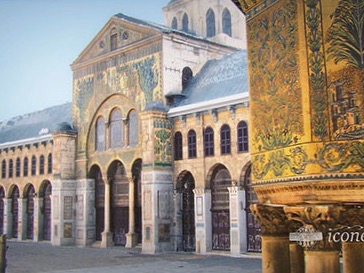
- The Great Mosque of Damascus is the only place of worship in the world where every day for centuries Jews, Christians and Muslims have prayed to the same one God.
A historical region, artificially divided
Contrary to popular belief, no one really knows what the Levant, the Near East or the Middle East is. These terms have different meanings depending on the times and political situations.
However, today’s Egypt, Israel, the State of Palestine, Jordan, Lebanon, Syria, Iraq, Turkey, Iran, Saudi Arabia, Yemen and the Gulf principalities have several millennia of common history. Yet their political division dates back to the First World War. It is due to the secret agreements negotiated in 1916 between Sir Mark Sykes (British Empire), François Georges-Picot (French Empire) and Sergei Sazonov (Russian Empire). This draft treaty had fixed the division of the world between the three great powers of the time for the post-war period. However, as the Tsar had been overthrown and the war did not go as hoped, the draft treaty was only applied in the Middle East by the British and French alone under the name of the “Sykes-Picot agreements”. They were revealed by the Bolsheviks, who opposed the Tsarists, notably by challenging the Treaty of Sèvres (1920) and helping their Turkish ally (Mustafa Kemal Atatürk).
From all this, it emerges that the inhabitants of this region form a single population, composed of a multitude of different peoples, present everywhere and closely intermingled. Each current conflict is a continuation of past battles. It is impossible to understand current events without knowing the previous episodes.
For example, the Lebanese and the Syrians of the coast are Phoenicians. They commercially dominated the ancient Mediterranean and were overtaken by the people of Tyre (Lebanon) who created the greatest power of the time, Carthage (Tunisia). This was completely razed to the ground by Rome (Italy), then General Hannibal Barca took refuge in Tyre (Lebanon), and in Bithynia (Turkey). Even if one is not aware of it, the conflict between the gigantic self-proclaimed coalition of the “Friends of Syria” and Syria continues the destruction of Carthage by Rome and the conflict of the same so-called “Friends of Syria” against Sayyed Hassan Nasrallah, the leader of the Lebanese Resistance, continues the hunt for Hannibal during the fall of Carthage. In fact, it is absurd to limit oneself to a state reading of the events and to ignore the trans-state cleavages of the past.
Or again, by creating the Daesh jihadist army, the United States magnified the revolt against the Franco-British colonial order (The Sykes-Picot agreements). The “Islamic State in Iraq and the Levant” claims no more and no less than to decolonize the region. Before trying to disentangle the truth from the propaganda, one must accept to understand how the events are felt emotionally by those who live them.
Perpetual War
Since the beginning of history, this region has been the scene of wars and invasions, sublime civilizations, massacres and more massacres of which almost all the peoples of the region have been victims each in turn. In this context, the first concern of each human group is to survive. That is why the only peace agreements that can last must take into account their consequences for other human groups.
For example, for seventy-two years it has been impossible to reach an agreement between the European settlers in Israel and the Palestinians because the price that other actors in the region would have to pay has been neglected. The only peace attempt that brought all the protagonists together was the Madrid conference convened by the USA (Bush senior) and the USSR (Gorbachev) in 1991. It could have been successful, but the Israeli delegation was still clinging to the British colonial project.
The peoples of the region have learned to protect themselves from this conflicting history by hiding their true leaders.
For example, when the French exfiltrated the Syrian “Prime Minister”, Riad Hijab, in 2012, they thought they could rely on a big fish to overthrow the Republic. However, he was not constitutionally the “Prime Minister”, but only the Syrian “President of the Council of Ministers”. Like the White House chief of staff in the United States, he was just a senior government secretary, not a politician. His defection was of no consequence. Even today, Westerners still wonder who the men around President Bashar al-Assad are.
This system, indispensable for the country’s survival, is incompatible with a democratic regime. Major political options should not be discussed in public. The states of the region are therefore asserting themselves either as republics or as absolute monarchies. The President or Emir embodies the Nation. In the Republic, he is personally accountable to universal suffrage. The large posters of President Assad have nothing to do with the cult of personality that is observed in some authoritarian regimes, they illustrate his office.
 MCViewPoint