MCViewPoint

Opinion from a Libertarian ViewPoint

Posts Tagged ‘Consent of the governed’

Consent of the Governed? | Robert Higgs

Posted by M. C. on June 19, 2021

I raise this question because in regard to the so-called social contract, I have often had occasion to protest that I haven’t even seen the contract, much less been asked to consent to it. A valid contract requires voluntary offer, acceptance, and consideration. I’ve never received an offer from my rulers, so I certainly have not accepted one; and rather than consideration, I have received nothing but contempt from the rulers, who, notwithstanding the absence of any agreement, have indubitably threatened me with grave harm in the event that I fail to comply with their edicts.

To be GOVERNED is to be kept in sight, inspected, spied upon, directed, law-driven, numbered, enrolled, indoctrinated, preached at, controlled, estimated, valued, censured, commanded, by creatures who have neither the right, nor the wisdom, nor the virtue to do so.

https://blog.independent.org/2010/06/01/consent-of-the-governed/

Robert Higgs

What gives some people the right to rule others? At least since John Locke’s time, the most common and seemingly compelling answer has been “the consent of the governed.” When the North American revolutionaries set out to justify their secession from the British Empire, they declared, among other things: “Governments are instituted among Men, deriving their just Powers from the Consent of the Governed.” This sounds good, especially if one doesn’t think about it very hard or very long, but the harder and longer one thinks about it, the more problematic it becomes.

One question after another comes to mind. Must every person consent? If not, how many must, and what options do those who do not consent have? What form must the consent take ― verbal, written, explicit, implicit? If implicit, how is it to be registered? Given that the composition of society is constantly changing, owing to births, deaths, and international migration, how often must the rulers confirm that they retain the consent of the governed? And so on and on. Political legitimacy, it would appear, presents a multitude of difficulties when we move from the realm of theoretical abstraction to that of practical realization.

I raise this question because in regard to the so-called social contract, I have often had occasion to protest that I haven’t even seen the contract, much less been asked to consent to it. A valid contract requires voluntary offer, acceptance, and consideration. I’ve never received an offer from my rulers, so I certainly have not accepted one; and rather than consideration, I have received nothing but contempt from the rulers, who, notwithstanding the absence of any agreement, have indubitably threatened me with grave harm in the event that I fail to comply with their edicts. What monumental effrontery these people exhibit! What gives them the right to rob me and push me around? It certainly is not my desire to be a sheep for them to shear or slaughter as they deem expedient for the attainment of their own ends.

Moreover, when we flesh out the idea of “consent of the governed” in realistic detail, the whole notion quickly becomes utterly preposterous. Just consider how it would work. A would-be ruler approaches you and offers a contract for your approval. Here, says he, is the deal.

I, the party of the first part (“the ruler”), promise:

(1) To stipulate how much of your money you will hand over to me, as well as how, when, and where the transfer will be made. You will have no effective say in the matter, aside from pleading for my mercy, and if you should fail to comply, my agents will punish you with fines, imprisonment, and (in the event of your persistent resistance) death.

(2) To make thousands upon thousands of rules for you to obey without question, again on pain of punishment by my agents. You will have no effective say in determining the content of these rules, which will be so numerous, complex, and in many cases beyond comprehension that no human being could conceivably know about more than a handful of them, much less their specific character, yet if you should fail to comply with any of them, I will feel free to punish you to the extent of a law made my me and my confederates.

(3) To provide for your use, on terms stipulated by me and my agents, so-called public goods and services. Although you may actually place some value on a few of these goods and services, most will have little or no value to you, and some you will find utterly abhorrent, and in no event will you as an individual have any effective say over the goods and services I provide, notwithstanding any economist’s cock-and-bull story to the effect that you “demand” all this stuff and value it at whatever amount of money I choose to expend for its provision.

(4) In the event of a dispute between us, judges beholden to me for their appointment and salaries will decide how to settle the dispute. You can expect to lose in these settlements, if your case is heard at all.

 In exchange for the foregoing government “benefits,” you, the party of the second part (“the subject”), promise:

(5) To shut up, make no waves, obey all orders issued by the ruler and his agents, kowtow to them as if they were important, honorable people, and when they say “jump,” ask only “how high?”

Such a deal! Can we really imagine that any sane person would consent to it?

Yet the foregoing description of the true social contract into which individuals are said to have entered is much too abstract to capture the raw realities of being governed. In enumerating the actual details, no one has ever surpassed Pierre-Joseph Proudhon, who wrote:

To be GOVERNED is to be kept in sight, inspected, spied upon, directed, law-driven, numbered, enrolled, indoctrinated, preached at, controlled, estimated, valued, censured, commanded, by creatures who have neither the right, nor the wisdom, nor the virtue to do so. To be GOVERNED is to be at every operation, at every transaction, noted, registered, enrolled, taxed, stamped, measured, numbered, assessed, licensed, authorized, admonished, forbidden, reformed, corrected, punished. It is, under pretext of public utility, and in the name of the general interest, to be placed under contribution, trained, ransomed, exploited, monopolized, extorted, squeezed, mystified, robbed; then, at the slightest resistance, the first word of complaint, to be repressed, fined, despised, harassed, tracked, abused, clubbed, disarmed, choked, imprisoned, judged, condemned, shot, deported, sacrificed, sold, betrayed; and, to crown all, mocked, ridiculed, outraged, dishonored. That is government; that is its justice; that is its morality. (P.-J. Proudhon, General Idea of the Revolution in the Nineteenth Century, trans. John Beverley Robinson. London: Freedom Press, 1923, p. 294)

Nowadays, of course, we would have to supplement Proudhon’s admirably precise account by noting that our being governed also entails our being electronically monitored, tracked by orbiting satellites, tased more or less at random, and invaded in our premises by SWAT teams of police, often under the pretext of their overriding our natural right to decide what substances we will ingest, inject, or inhale into what used to be known as “our own bodies.”

So, to return to the question of political legitimacy as determined by the consent of the governed, it appears upon sober reflection that the whole idea is as fanciful as the unicorn. No one in his right mind, save perhaps an incurable masochist, would voluntarily consent to be treated as governments actually treat their subjects.

Nevertheless, very few of us in this country at present are actively engaged in armed rebellion against our rulers. And it is precisely this absence of outright violent revolt that, strange to say, some commentators take as evidence of our consent to the outrageous manner in which the government treats us. Grudging, prudential acquiescence, however, is not the same thing as consent, especially when the people acquiesce, as I do, only in simmering, indignant resignation.

For the record, I can state in complete candor that I do not approve of the manner in which I am being treated by the liars, thieves, and murderers who style themselves the Government of the United States of America or by those who constitute the tyrannical pyramid of state, local, and hybrid governments with which this country is massively infested. My sincere wish is that all of these individuals would, for once in their despicable lives, do the honorable thing. In this regard, I suggest that they give serious consideration to seppuku. Whether they employ a sharp sword or a dull one, I care not, so long as they carry the act to a successful completion.

Addendum on “love it or leave it”: Whenever I write along the foregoing lines, I always receive messages from Neanderthals who, imagining that I “hate America,” demand that I get the hell out of this country and go back to wherever I came from. Such reactions evince not only bad manners, but a fundamental misunderstanding of my grievance.

I most emphatically do not hate America. I was not born in some foreign despotism, but in a domestic one known as Oklahoma, which I understand to be the very heart and soul of this country so far as culture and refinement are concerned. Moreover, for what it is worth, some of my ancestors had been living in North America for centuries before a handful of ragged, starving white men washed ashore on this continent, planted their flag, and claimed all the land they could see and a great deal they could not see on behalf of some sorry-ass European monarch. What chutzpah! I yield to no one in my affection for the Statue of Liberty, the Rocky Mountains, and the amber waves of grain, not to mention the celebrated jumping frog of Calaveras County. So when I am invited to get out of the country, I feel like someone living in a town taken over by the James Gang who has been told that if he doesn’t like being robbed and bullied by uninvited thugs, he should move to another town. To me, it seems much more fitting that the criminals get out.

Robert Higgs is Retired Senior Fellow in Political Economy at the Independent Institute, author or editor of over fourteen Independent books, and Founding Editor of Independent’s quarterly journal The Independent Review.
Posts by Robert Higgs | Full Biography and Publications

Be seeing you

Posted in Uncategorized | Tagged: , , , , | Leave a Comment »

Pelosi’s “Mandate”: What “Consent of the Governed” Really Means | Mises Wire

Posted by M. C. on December 23, 2020

So, even if we define “the governed” or “the people” as merely the adults—most of whom presumably pay taxes, by the way—then neither Biden nor Trump managed to even get a plurality, let alone a majority. The plurality of these American adults chose to vote for neither of these candidates.

The plurality of people did not bother. Disdain, ignorance, apathy…?

https://mises.org/wire/pelosis-mandate-what-consent-governed-really-means

Ryan McMaken

The 2020 election failed to live up to the projections of many pollsters and Democratic strategists. The predicted landslide failed to materialize, and the Democrats lost seats in the House. This means in 2022 the Democrats will be defending a razor-thin majority in the House—a majority they’re almost certain to lose in a midterm election if Biden is the final victor. The Democrats did well. But not that well.

Nonetheless, Nancy Pelosi in the days following the election reportedly declared the Democrats “have a mandate!” But do they?

ye-join-button_250x55.png

Let’s consider what constitutes a democratic victory given the standard handed down to us by pundits and politicians on the left. According to the current narrative, the legitimacy of a president’s electoral victory depends on the number of votes he receives through the “popular vote.” That is, when it comes to votes from the overall national population, the candidate with a majority—or a plurality, depending on the standard one is using—ought to be declared the victor.

At this time, it appears the popular vote doesn’t exactly scream “landslide” for the presumed winner, Biden, no matter how you look at it. Biden’s popular election tally in 2020—as in most presidential contests—failed to get much more than a bare majority. This time, it came in at slightly above 51 percent, according to the government’s numbers.

In other words, nearly half of those who voted, voted against Biden.

Only in Washington could anyone spin this as a “mandate” to rule in whatever manner the Democrats wish. The US Senate, of course—no matter how Georgia’s runoff elections go—will be about evenly divided. In the House of Representatives, the Democrats will, at best, capture 51 percent of all seats.

The Consent of the Governed?

The vulgar version of democratic theory generally used by Washington politicians and the US news media stipulates that whichever party (or coalition of parties) receives a majority of votes has the consent of the governed.

Yet, “the governed” does not include merely those who voted in the election. It’s problematic enough that the 51 percent who voted for the victors gets to rule over the 49 percent who voted for someone else. But in this scenario we’re not only talking about people who actually voted. After all, it’s not just active voters who are subject to the laws and diktats of the regime.

So, how many of “the governed” have actually voted for Joe Biden?

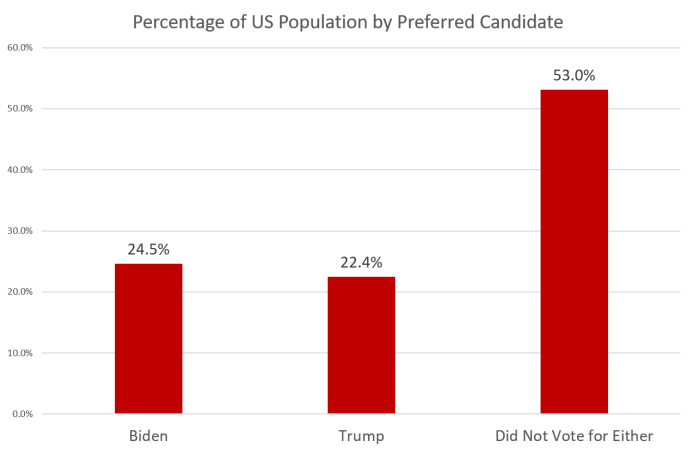
If we look to the population in its entirety, the percentage who have signed off on a Biden presidency is rather small. Out of the 330 million residents in the United States—a group we can plausibly refer to as “the governed,” 81 million of them reportedly voted for Biden. That comes to around 24 percent of the total.

At the same time, about 22 percent of the whole population voted for Donald Trump. That means 53 percent of “the governed” either voted for someone other than Trump or Biden, or didn’t vote at all. It also means about 75 percent of the population did not vote for Biden. 

mand

It’s hard to spin this as a case of “the people” signing off on the Democratic Party’s—or any party’s—agenda.

Some might take exception to this on the grounds that I’ve included children in the total. Of course, some hard-core small-d democrats on the left insist that children should indeed get to vote.  And given that today’s children will be paying trillions of dollars in interest on today’s national debt, it’s not as if children are irrelevant. But for the sake of argument, let’s include only the adult population among “the governed.” 

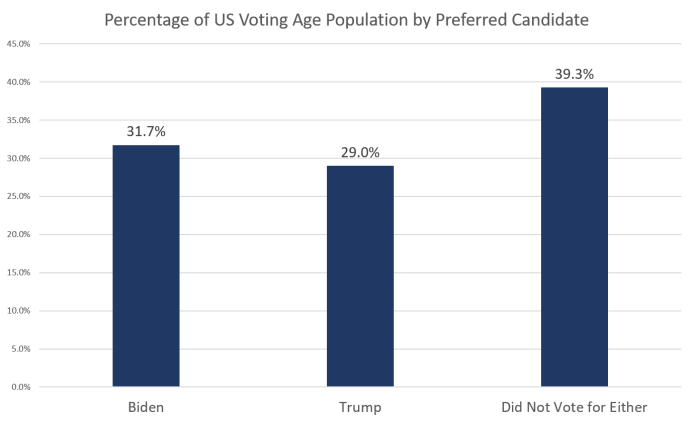
According to the Federal Register, the “estimated voting age population” in the United States as of 2019 was 255 million. That’s just people over 18. 

What proportion of the adult population cast a vote for Joe Biden?

The answer is 31 percent, or less than one-third. The total for Donald Trump was 29 percent, according to the official account. That means nearly 40 percent of eligible voters either voted for someone else, or didn’t vote at all. It also means nearly 69 percent of voting-age Americans did not vote for Biden. 

mand

So, even if we define “the governed” or “the people” as merely the adults—most of whom presumably pay taxes, by the way—then neither Biden nor Trump managed to even get a plurality, let alone a majority. The plurality of these American adults chose to vote for neither of these candidates.

In the actual US electoral system, of course, one clearly does not need to obtain a majority of the popular vote to win. The legal victor is whoever gets the most electoral votes, regardless of how many eligible voters participate. Many presidents have won the presidency—e.g., Bill Clinton, John F. Kennedy—without ever winning a majority of votes cast.

Yet the popular narrative underlying pundits’ and politicians’ appeal to democracy is that winners obtain moral legitimacy—not to be confused with legal authority—by “getting the most votes.” We see, however, that more often than not a majority of the adult population—and a lopsided majority of the overall population—never casts a vote for the victor.

Moreover, there is no reason to assume that those who voted for the winner all did so for the same reason. Do all of the tens of millions of Biden voters or Trump voters cast their votes with identical policy preferences in mind? It’s clear they do not and have not. Thus, there can be no mandate, and it would be nonsensical to conclude that it is even possible that the electoral victor, in the face of such a large and diverse voting population, can “represent” his constituents in any meaningful way.

But old myths of democracy die hard, and the winners in contests like the 2020 election will predictably spin their victories as a type of democratic mandate while portraying themselves as the instrument of “the will of the people.” Many Americans will believe them.

Author:

Contact Ryan McMaken

Ryan McMaken (@ryanmcmaken) is a senior editor at the Mises Institute. Send him your article submissions for the Mises Wire and The Austrian, but read article guidelines first. Ryan has degrees in economics and political science from the University of Colorado and was a housing economist for the State of Colorado. He is the author of Commie Cowboys: The Bourgeoisie and the Nation-State in the Western Genre.

Be seeing you

Posted in Uncategorized | Tagged: , , | Leave a Comment »

When in the Course of Human Events – LewRockwell

Posted by M. C. on July 2, 2020

https://www.lewrockwell.com/2020/07/andrew-p-napolitano/when-in-the-course-of-human-events-2/

By

“Government requires make-believe. Make believe that the king is divine, make believe that he can do no wrong or make believe that the voice of the people is the voice of God. Make believe that the people have a voice or make believe that the representatives of the people are the people. Make believe that governors are the servants of the people. Make believe that all men are created equal or make believe that they are not.”
 — Edmund S. Morgan (1916-2013)

…How is it that men and women take oaths to uphold the liberties that the founders risked all to achieve and then enter office and ignore them? If I can legally refuse health care, why can’t I legally take the chance of exercising my rights to travel and assemble whether that exposes me to contagion or not? Is not among the freedoms Jefferson wrote about the freedom to take chances?

Are laws written to preserve liberty or to enforce order? Is the concept of the consent of the governed real or is it make-believe? Does liberty expand in each generation or does it shrink?…

When Jefferson and his buddies revolted from the king, they, too, engaged in a little myth. They coined a popular phrase that they didn’t really mean but caught fire with the colonists: “Taxation without representation is tyranny.”

They didn’t mean it, because they didn’t really want to send representatives to Parliament. They wanted their own small government, and they wanted it here. But the colonists were sick of taxes imposed by London aristocrats.

Are all men created equal or are they not? Does the government have our consent or does it not? Are our liberties natural to our existence or are they not?

Be seeing you


Posted in Uncategorized | Tagged: , , , | 1 Comment »

The Nonconsent of the Governed – EPautos – Libertarian Car Talk

Posted by M. C. on March 5, 2020

It is a mockery of the concept of representation to assert that the 15,000 residents of a rural county such as mine are “represented” by two senators elected by the millions who reside in Richmond and Northern Virginia and even more risibly by a president elected by millions of people who reside in other states and thousands of miles away.

Like sausage making, it does not bear examination.

https://www.ericpetersautos.com/2020/03/03/the-nonconsent-of-the-governed/

By

The urban-rural problem waxes; it is like a bad marriage and the only solution is a divorce. But while the rural “man” would happily leave the marriage on reasonable terms and peaceably, the urban “woman” will never allow the “man” to leave.

It begs the question about consent of the governed – the supposed basis for legitimate government (assuming for the sake of discussion such a thing exists).

The answer to this question pretty much establishes the illegitimacy of the government.

In my home state of Virginia, for example, the rural (and geographic) majority of the state does not consent to being disarmed and criminalized by the government in Richmond – which represents Richmond and Northern Virginia.

90-plus percent of the state’s counties oppose the slew of gun confiscation/criminalization measures proposed and likely to be imposed upon them. The people of these rural counties did not consent to any of this. And they have no say in any of this – because the state government is controlled by the urban population centers, whose concentrated numbers give them a virtual lock on the state’s governing apparatus. The 90-plus percent geographic majority outside the urban hives of Richmond and Northern Virginia can vote but it’s becoming as meaningless a gesture as voting in the old Soviet Union, where there was one candidate on the ballot – and no option to say no.

But Saul Alinsky’s “rules for radicals” can work the other way, too. Use their (stated) principles against them by insisting they abide by them.

We do not consent. Yet you impose. This illegitimizes what you impose. We demand to be represented . . . by people who represent us. We will no longer accept being told what we must accept by you and the people who represent only you.

This applies just as logically – and morally – at the federal as well as the state level.

It is a mockery of the concept of representation to assert that the 15,000 residents of a rural county such as mine are “represented” by two senators elected by the millions who reside in Richmond and Northern Virginia and even more risibly by a president elected by millions of people who reside in other states and thousands of miles away.

Like sausage making, it does not bear examination.

And it all rests on the doublethinkian fiction of consent of the governed.

Have any of you reading this ever been specifically asked whether you consent to anything the government proposes to do to you? That question – if it were ever posed – would have to be based on the possibility of not consenting (without repercussion) else it is a parody of the concept of consent.

Of course, that question is never asked – and our answer is irrelevant. We are told we’ve “consented” – by dint of the fact that other persons claim to represent us – and that we have consented to what is done to us by dint of the having the opportunity to vote for or against these so-called representatives.

But – if words have meaning – representation must be specific, as in proxy power formally and freely given to do a particular agreed-upon thing. To be told you will do the opposite of what you wish to do – or wish not to do – by your “representative” is the oxymoronization of the very concept of representation. The defining essence of the thing is the reverse; the representative does as you command; he does not command you.

At least, not if you have consented to be represented by him.

Which, of course, none of us has consented to. It is implied, assumed – and imposed without our consent.

The fiction of representative government – and of consent – would be more believable if it were more local. If people in rural areas were in fact represented by the people who lived in those areas – and no one else. This goes just the same for those who live in urban areas.

They, too, have every right to be represented by those who represent their interests – freely consented to. If the people of Richmond and Northern Virginia consent to being disarmed, it is their right to disarm themselves.

But they have no right to bully people whom they manifestly do not represent solely by dint of their concentrated numbers. And their effrontery in asserting that the bullied have “consented” to this is a species of lunacy once found only in asylums for the criminally insane.

Who now “govern” us without consent and with contempt for the very idea of representation.

Why do we tolerate it?

That’s another question well worth answering.

Be seeing you


Posted in Uncategorized | Tagged: , , | Leave a Comment »

Secession Fever in Today’s America: What Would Lincoln Think? – LewRockwell

Posted by M. C. on February 27, 2020

In addition to closing newspapers and deporting deplorables a Lincloln of today would no doubt institute an internet gatekeeper.

https://www.lewrockwell.com/2020/02/thomas-dilorenzo/secession-fever-in-todays-america-what-would-lincoln-think/

By

A February 19 article in The Washington Times announced that “Secession Fever Spikes” in five states where “conservatives” are attempting to escape neo-Stalinist policies of the Democrat Party majority there, now that the mask is finally off and the Democrats are the proud party of socialism and omnipotent government.  Long gone are the days when they hid their true beliefs by calling themselves “liberals” and their brand of fascism “The New Deal.”  They are now the party of the Green New Deal, the crazed, Soviet-style government plan to totalitarianize all of American society under the dishonest guise of “saving the planet.”  In other words, they are all card-carrying “watermelons” – green on the outside, red on the inside.

As soon as they took control of the Virginia state government, helped along with mega-donations by billionaire fellow totalitarians Michael Bloomberg and George Soros, among others, they immediately waged political war on the First and Second Amendments to the Constitution.  Their governor, Ralph Northam, is on record in a publicly-recorded video as supporting infanticide in cases where babies survive abortions.  That’s just for starters in the first month of their rule.

Virginia politics is now dominated by the heavily-populated D.C. suburbs composed of hundreds of thousands of deep state bureaucrats, government contractors, and Third World immigrants promised the riches of the American welfare state by the Democrats.  Most of the rest of the counties in the state have declared themselves to be Second Amendment sanctuaries.  Most strikingly, there is a “Vexit” movement whose goal is for those counties to secede from Virginia and become a part of more Constitution-friendly West Virginia.  The governor of West Virginia, Jim Justice, joined with Liberty University president Jerry Falwell, Jr. in a press conference at which they invited the more conservative Virginia counties to secede.  The West Virginia legislature is on board.

In Illinois – “Land of Lincoln” – a similar movement is shaping up.  State Representative Brad Halbrook has proposed allowing the rest of the state to escape the political crutches of the hyper-Leftist Chicago political machine.  Mr. Halbrook has issued a resolution to kick Chicago out of Illinois and make it the 51st state.  His attitude is apparently “If you want to become a communist society go right ahead; just leave the rest of us out of it.”  He is frustrated that people like himself are “forced into a democracy that’s concentrated power into a small geographical area,” i.e. Chicago.

This is a recurring theme in today’s “secession fever”:  People seem to have tolerated the Democrat political machine control of cities like Chicago, Baltimore, and Detroit (and now all of Virginia) for the past seventy years or so as long as they could escape to the suburbs and rural areas and be largely left alone.  Those days are now over, with the out-of-control crime of the cities permeating all other areas; the ever-escalating tax increases to pay for their hopelessly-failed government programs and pie-in-the-sky pensions for retired bureaucrats of all sorts.  Then there’s the aggressive drive to effectively abolish the First and Second Amendments.

Thousands of New Yorkers are similarly disgusted by the far-left, self-described “communist” mayor of New York City and the just-as-far-to-the-left governor, Cuomo the Elder.  Consequently, there is a movement whose goal is to create three politically-autonomous regions in New York state, each with its own governing body, but still a part of New York state.  De facto secession, in other words.  Then there’s the “Calexit” movement that wants California to secede altogether and become an independent country.

Oregonians outside of the leftist-dominated northwest part of the state are petitioning to move the Idaho border westward to include them, for almost identical reasons given by the Virginia Vexit proponents.

All of these movements are in the spirit of American federalism, the core idea of the U.S. Constitution.  Thomas Jefferson considered the Tenth Amendment to be the most important principle of the Constitution because it said that although the citizens of the free and independent states (as he called them in the Declaration of Independence) had delegated eighteen or so powers to the federal government (Article 1, Section 8), so that it could act as their agent and for their mutual benefit, all others are reserved to the people and the states respectively.  And of course it was also Jefferson who famously wrote in the Declaration that governments derive their just powers from the consent of the governed.  And, whenever governments become destructive of the citizens’ rights to life, liberty and property it is their “duty” to abolish that government and create a new one if they wish.  Isn’t that exactly what the people of Virginia, Illinois, Oregon, California, and New York who are part of the new secession movements are all about?

The founders were aware that the European city states of antiquity assured themselves of a much higher degree of freedom and prosperity because government was so decentralized.  If one city state became annoyingly tyrannical with excessive taxes, corruption, and other such ingredients of all governments, citizens could vote with their feet and move to another city state.  This form of competition between city states worked to moderate the tyrannical impulses of Europe’s political class.  (And is why that political class worked mightily for generations to destroy the city states and create systems of consolidated, monopolistic government).  This history is part of the reason why the American founders, like the Swiss founders, created a highly decentralized system of government known to us now by the word federalism.  The original constitution, the Articles of Confederation, did not even give the central government taxing powers.  (Like the European princes and potentates, the Hamiltonian wing of the founding generation got the ball rolling to centralized, monopolistic government by scrapping the Articles of Confederation –after promising to only “revise” it– and created a much more centralized form of government with taxing powers).

With all of this talk of secession, one naturally wonders what Abraham Lincoln would think of it.  There is of course a very clear record of his thoughts on the subject; one only needs to read parts of his first inaugural address to glean them.  (See my forthcoming book, The Problem with Lincoln, for a fuller dissection of Lincoln’s first inaugural address).  There he proclaimed that the then-existing structure of the American union was “perpetual” and written in stone, even though the previous generation had seceded from the Articles of Confederation and Perpetual Union, as it was officially called, and did not repeat the word “perpetual” in the Constitution of 1789.  That the existing configuration of the union of the states was perpetual was “not expressed” in the text of the Constitution, Lincoln stated, but is “implied,” in a good example of the usual leftist tactic of proclaiming the Constitution to be a “living” document to be altered not by the formal amendment process but by the twisting or words by clever, weaselly politicians.

Lincoln claimed that if there was any change at all in the configuration of the existing American union, then it would mean the “termination” of the federal government.  A dumber theory was never put forth by an American politician.  After the Southern states seceded the federal government proceeded to explode in size, create one of the largest and best-armed armies in world history up to that point, and wage total war on the South for four years.  Hardly a disappearing act.

If any state or part of a state seceded, said the man or orchestrated the illegal and unconstitutional secession of West Virginia from Virginia, then such states will “make a precedent which in turn will divide and ruin them, for a minority of their own will secede from them . . . .  [W]hy may not any portion of a new confederacy a year or two hence arbitrarily secede again, precisely as portions of the present Union now claim to secede from it?”  Counties may secede from states, and cities from counties, he was effectively warning.  This of course sounds exactly like what freedom-loving Virginians, Illinoians, Oregonians, New Yorkers, and Californians are proposing to do.  But to Lincoln such acts are nothing less than “the essence of anarchy” and a guarantor of “despotism” (his exact words).

In other words, Lincoln defined the whole classical liberal history and theory of the virtues of voluntary government, decentralization, consent of the governed, and federalism as recipes for despotism and anarchy, exactly the opposite of that which all the great students of liberty, from Lord Acton to Ludwig von Mises and beyond, believed.  As Lord Acton wrote in his famous November 4, 1866 letter to General Robert E. Lee, “”I saw in States’ rights the only availing check upon the absolutism of he sovereign will, and secession filled me with hope, not as the destruction but as the redemption of Democracy . . . .  I deemed that you were fighting for the battles of our liberty, our progress, and our civilization; and I mourn for the stake which was lost at Richmond more deeply than I rejoice over that which was saved at Waterloo” (emphasis added).

Mises wrote in Omnipotent Government (pages 3-4) of how, with the growth of government in the U.S. and in Switzerland during the late-nineteenth and early-twentieth centuries, “New powers accrued not to the member states but to the federal government” in each country.  “Every step toward more government interference and toward more planning means . . . an expansion of the jurisdiction of the central government . . . .  It is a very significant fact that he adversaries of the trend toward more government control describe their opposition as a fight against Washington and against Berne, i.e., against centralization.  It is conceived as a contest of states’ rights versus the central power.”

Lincoln repudiated the philosophy of freedom and championed the philosophy of centralized, monopolistic governmental tyranny instead.  He even threw in one last straw-man argument by claiming that the advocates of secession were claiming that in the seceded states there would be a “perfect identity of interests among the States,” which he then ridiculed, demonstrating that he was clueless about the meaning of federalism and constitutionalism (unless he did and was simply lying for political effect).

This is why Frank Meyer, a conservative literary icon of the last generation, wrote in an August 24, 1965 article in National Review that Lincoln’s “pivotal role in our history was essentially negative to the genius of freedom of our country” with his “repressive policies” of abolishing civil liberties in the North, waging total war on civilians in the South, and how he “moved at every point . . . to consolidate central power and render nugatory the autonomy of the states . . .”

In an essay entitled “Federalism in America” historian Forrest McDonald wrote that “Political scientists and historians are in agreement that federalism is the greatest contribution of the Founding Fathers to the science of government.  It is also the only feature of the Constitution that has been successfully exported, that can be employed to protect liberty elsewhere in the world.  Yet what we invented, and others imitate, no longer exists on its native shores (emphasis added).  No one is more responsible for this than Lincoln, which is why the answer to the question of “what would Lincoln think” of the new “secession fever” in

America is so obvious.

Be seeing you

F-Secure Internet Gatekeeper | VirusLogic.com

Hillary’s server


Posted in Uncategorized | Tagged: , , , , , , , | Leave a Comment »

Essentials of Panarchism

Posted by M. C. on October 7, 2019

Panarchy means that persons may enter into and exit from social and political relations freely. It means that government exists only with the consent and by the consent of the governed.

https://www.panarchy.org/rozeff/panarchism.html

Michael S. Rozeff

Note

Those who, in the name of civilization and the protection of personal liberties, refuse categorically an imposed state religion or an economic system based on monopolies, should be ready to acknowledge that a government exerting a monopolistic territorial sovereignty leads to the same situation of lack of civilization (wars, clashes, feuding) and unfreedom (subjection to and manipulation by a central power) for everybody, irrespective of personal needs and wishes. That is why Michael Rozeff is all in favour of Panarchy because “Panarchists do not attempt to smash the governments others want. They deny no one the freedom to be unfree. However, they deny others (and their States and governments) the freedom to make them unfree.”


Panarchism is a new political philosophy that builds upon and extends the core concept of consent of the governed, which goes back primarily to John Locke. Consent of the governed is a concept that permeated revolutionary America. It appears in Article 6 of the Virginia Bill of Rights. It appears in the Essex Result. Benjamin Franklin wrote “In free governments the rulers are the servants and the people their superiors and sovereigns.” The Declaration of Independence asserts that “Governments are instituted among men, deriving their just powers from the consent of the governed.”Panarchism proposes a comprehensive extension of liberty to the consensual choice of government itself, in form and content. It proposes government by consent for any persons who arrange such government for themselves. Conversely, it proposes that a government has no authority over any persons who do not consent to it.

Panarchy is a condition of human relations in which each person is at liberty to choose his own social and political governance without being coerced. Panarchy means that persons may enter into and exit from social and political relations freely. It means that government exists only with the consent and by the consent of the governed.

Panarchism has new conceptions of what a people who are governed, a government, and consent mean. These give rise to a new conception of the nonterritorial State and revised ideas about sovereignty and authority. By viewing government as nonterritorial, panarchism reorients the movement for liberty away from destroying the governments that others may prefer and toward obtaining the governments that each of us may prefer.

Free persons in a free society already practice a degree of panarchy. By individual consent, they associate with those whom they wish to associate with (and who wish to associate with them), and they do not associate with others. By choice, they vary their associations by time, place, duration, and other dimensions. They choose companions, places to live, workplaces, clubs, and churches on the basis of individual consent rendered in a noncoercive social context. Free persons form consensual organizations, associations, and groups. They form themselves into sub-societies and “peoples,” which are groups of persons that, via individual consent, willingly aggregate on various grounds and interests. In doing so, they create multiple coexisting forms of governance whose basis is not territorial (although it may optionally be so) but relational.

Panarchism proposes that panarchy be extended to government (or functions of government) in the same way that it is already present in society. Let persons be free to form peoples and to choose their own forms of government.

Why? Because consent today is too limited to allow a meaningful sovereignty of people. Because the rulers have become the sovereign and the people their servants. Because complex systems of voting and parties have diluted consent to the vanishing point. Because would-be peoples are thwarted from forming. Liberty does not mean a vote for one of two parties that runs a single monopoly government. It means active consent over the very form, as well as the content, of one’s governing relations.

Why panarchism? Because in today’s governing relations, we find ourselves living under distant States and governments whose form is not of our choosing. Because the planet is blanketed with States and governments that too often deliver injustice, insecurity, disorder, waste, misery, death, and destruction, as States and governments historically have done. Because States and governments focus and amplify power, using it for purposes that many of us do not believe in. And because governments today legitimate and encourage contentious struggles for domination where one group’s gains is another group’s loss, and where the struggles absorb more and more resources and divert energy from productive to unproductive uses.

The liberty that is basic to panarchy promises a better way of life, by extending to each of us the capacity to engage in the social and political relations of our own choosing in accord with our own beliefs. Since persons will not freely consent to governments whose decisions in the main leave them, by their own estimation, worse off, the free choice of government will provide the kind of check-and-balance on government failures and misdeeds that is a critical missing element of today’s political arrangements.

Panarchy envisages many possible societies and sub-societies across a land, region, or province. There need not be a single sovereign authority that imposes law on all, unless it happens to be by consent. In panarchy, multiple and diverse sources of self-chosen sovereignty coexist side-by-side, each finding its source of legitimacy from the consent of those who are willing to place themselves within a particular set of governing relations. People freely place themselves within multiple non-territorial governing associations, as contrasted with finding themselves assigned by authorities on a geographical basis.

The American revolutionaries blazed a trail toward nonterritorial government when they called for consent of the governed, but they simultaneously veered away from that trail. Just as they skirted the slavery question, they skirted the issues of what constituted a people, a legitimate government, consent, and secession. Article 14 of the Virginia Declaration of Rights sought “to maintain Virginia’s sovereignty over its restless, far-flung western counties.” It proclaimed “That the people have a right to uniform government; and, therefore, that no government separate from, or independent of the government of Virginia, ought to be erected or established within the limits thereof.” This particular territorial idea of government was justified by a false appeal to a mythical right to uniform government, in order to prevent the formation of West Virginia. Some 85 years later, West Virginia, which for decades had many sound reasons not to be governed by Richmond, finally seceded from Virginia.

Little has changed. Despite hundreds of breakaway and secession movements worldwide, the territorial notion of government has not changed. Indeed, many such movements themselves view government as territorial. American federalism has become nationalism. Governments of today are making societies over, based upon claims of legitimate authority that are less rooted in consent than in territorial claims of rulership.

The idea of government needs to be severed from the idea of the territorial State and from the notion that the government of such a State is all that government is or can be. Since the State is single, territorial, and coercive, such an idea views government as single, territorial, and coercive. The territorial idea supports States in place. It empties consent of all real meaning and replaces it by the machinations of meaningless votes, party politics, lobbying, redistricting, power, and campaign money flows. The territorial idea of government without consent dooms mankind to living without one of the most basic liberties, which is the liberty to choose one’s government.

It is a mistake to identify government as the executive and administrative means of the monopoly State. When those who are pro-State do this, it leaves little or no room for those who do not consent and wish to live by their own forms of government. When those who are anti-State do this, they become anti-government, a position that does not allow those who want various forms of their own government to exercise their choices.

Government is the social coordination of human personal interactions. To the extent that human beings interact with one another, government is thus inescapable. Advocates of no government, unless they eschew all social interaction, can no more live without government than can statists. But the necessity of government does not imply that government must be nonconsensual and territorial. We have an alternative to living under a single territorial State that makes and enforces all sorts of rules, for all of us, all the time. Panarchy is that alternative.

We ourselves govern a vast range of human activities by consent, nonterritorially, and without the State. This was historically and is currently the case. Persons within human societies create governance from varied and multiple sources that include moral and ethical codes, custom, bodies of judge-discovered law, rules, principles, manners, religion, pacts, agreements, understandings, and contracts, as well as through a variety of instruments, institutions, and organizations that include family, associations, churches, schools, corporations, and business firms. Society, in this sense, which is really many interpenetrating and diverse societies, already reflects a high degree of panarchy. Societies everywhere already employ panarchy as a beneficial principle of social organization and order.

Panarchism proposes extending panarchy further. It stands for a world in which people live by the governing relations of their choice while abiding by the decisions of their neighbors to live by theirs. A society with such liberty will hold together in the same ways that societies have always held together: through a complex network of shared values, beliefs, ways, language, and other commonalities that are put to work through self-interest that is expressed in individual, associational, and cooperative endeavors. It will hold together better than today’s societies because the nonconsensual government that fertilizes today’s constant political and economic battles, rebellions, and civil wars will have been reduced.

Different people understand freedom and liberty in different ways, and even when they agree, they place different values on liberty. One woman may choose to labor for another for a wage, while another may regard wage-labor as slavery. One man may allow himself to be inducted into an army, while another may look upon the draft as slavery. These different ideas of good and bad government can coexist in panarchy. Liberty and government are not at mutually exclusive poles. Abolishing government per se does not bring liberty for all. Abolishing government and replacing it with one’s own personal vision of liberty does not bring liberty for all. Liberty for all entails the capacity for all to choose their own governments. In panarchy, men and women are free to be unfree (in the eyes of others) to any desired degree. They may enter into many different kinds of governing relations. This sets panarchy apart from political conceptions that deny them the choice of State and government. Panarchists do not attempt to smash the governments others want. They deny no one the freedom to be unfree. However, they deny others (and their States and governments) the freedom to make them unfree.

Once we open up our thinking on the question of what government is, we can get away from the idea of “a government” and “the government.” Government is a set of functions that can be identified. Change is not a question of today’s government or none. There are all sorts of intermediate possibilities.

National governments have absorbed major functions such as old age security, aid to the indigent, and health care from civil society and local government. They have done so via complex majority rules and voting procedures that circumvented consent of the governed. Governments across the world often suppress minorities of many kinds. The imposition of nation-wide rules discriminates against and suppresses all those who do not consent and who do not want their government to handle certain critical issues. Medicare, for example, involves a taking and a wealth transfer. This kind of program could become nonterritorial and consensual. Mr. K can subscribe to a plan and belong to a government that deducts from his wages, while Mr. J need not. They can be neighbors and do this.

Many of today’s government functions can remain in place for those who want them while making them voluntary for those who do not. The idea in these cases is not to end government but make it consensual. Vast amounts of regulation of labor relations, energy, education, health, and welfare are such that one neighbor can live without certain rules even if his neighbor wants them. Instead of attempting to take Medicare away or attempting to persuade voters to vote it down, which plays the game of accepting monopoly and territorial government, panarchism goes at the problem of lack of consent and unjust powers of government in a different way. Let those who want Medicare have it; let those who don’t withdraw. Panarchism seizes the moral high ground. Why should those who don’t want Medicare be impressed into it by those who do? Isn’t this like making everyone belong to the same church? How can there be consent of the governed when we are herded, whether we like it or not, into programs that affect our lives in major ways?

Coordination problems involving human interaction are not going to disappear. The reform of government even where coordination issues are not at issue may well be difficult. Panarchism does not deny these difficulties. It sets out a just and peaceful destination that can be achieved peaceably, which is a future of reform in which the State abandons its territorial claims. This may happen little by little. It may happen by degrees. It may happen partially and gradually, or it may happen by leaps. Consensual and nonconsensual government are likely to continue to exist alongside one another for some time. Reforms, small and large, are unpredictable. They are for people themselves to advance and accomplish. Every step that people take, peaceful and nonaggressive, toward devising and living by their own government is a step toward more complete panarchy and greater liberty.

The helpful comments of Adam Knott and John Zube are gratefully acknowledged, but all errors herein are solely mine.


Be seeing you

200 best images about Anarchism Voluntaryism Agorism on ...

Posted in Uncategorized | Tagged: , , , | Leave a Comment »