Naturally, law enforcement officers rarely face any sanctions for their failures to bother themselves with private property, life, or limb. The federal courts have made it clear that law enforcement officers are not obligated to actually protect the public. In other words, the taxpayers must always pay taxes to hold up their end of the imagined “social contract” or face fines and imprisonment. But the other side of that “contract,” the state, has no legal obligation to make good on its end. This, of course, is not how real contracts work.
In all the media and regime frenzy over the Janaury 6 riots and the Pentagon Leaker in recent months, it is interesting to examine the contrast between how the regime treats “crimes” against its own interests, and real crime committed against ordinary private citizens.
Witness, for example, how the Biden administration and corporate media have treated the January 6 riot as if it were some kind of military coup, demanding that draconian sentences be handed down even to small-time vandals and trespassers. Regime paranoia has led the Justice Department to ask for a 30-year sentence for Enrique Tarrio, a man who was convicted of the non-crime of “seditious conspiracy” even though he wasn’t even in Washington on January 6. In recent months, Jacob Chansley, the “QAnon Shaman,” received a sentence of three-and-a-half years, even though prosecutors admit he did nothing violent. Riley Williams was given three years for simply trespassing in Nancy Pelosi’s office. Members of the Capitol Police force have been lionized in the media as great protectors of “sacred” government buildings, and any threat to the property or persons of Washington politicians has been equated with an assault on “democracy.”
The use of the phrase “journalism is not a crime” is an interesting choice since the most common individual case you’ll hear it used in reference to is surely that of Julian Assange, who has been locked in a maximum security prison for four years while the US government works to extradite him for the crime of good journalism.
After a certain point criticizing the hypocrisy and contradictions of the US-centralized empire starts to feel too easy, like shooting fish in a barrel. But hell let’s do it anyway; the barrel’s right here, and I really hate these particular fish.
Russian security services have formally filed espionage charges against Wall Street Journal reporter Evan Gershkovich, who has been detained in Russia since his arrest last month. Gershkovich reportedly denies the spying allegations and says he was engaged in journalistic activity in Russia.
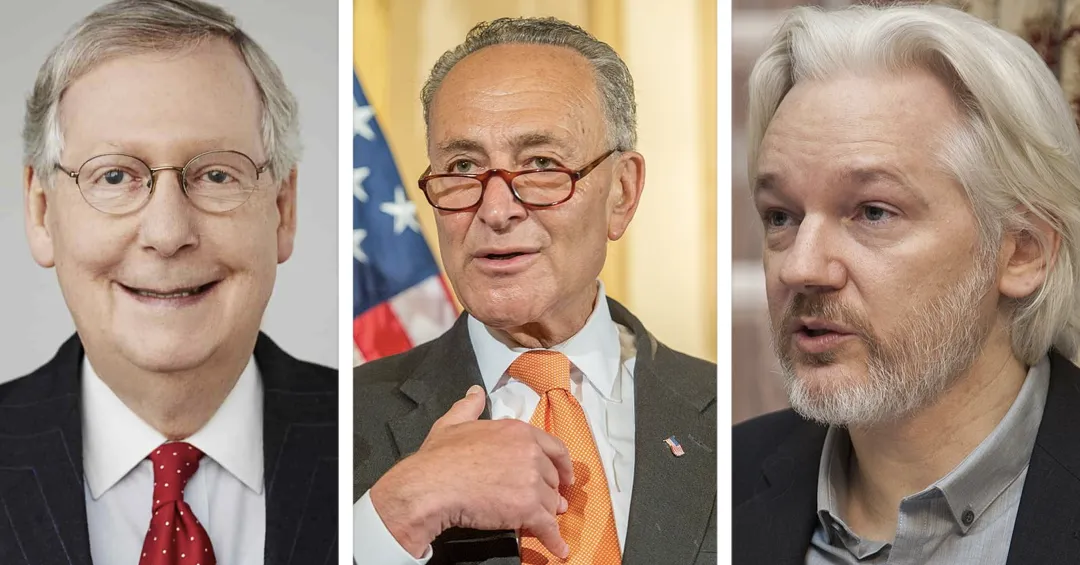
This news came out at the same time as a joint statement was published by Senate Majority Leader Chuck Schumer and Senate Minority Leader Mitch McConnell condemning Gershkovich’s detention as a violation of press freedoms.
“Let there be no mistake: journalism is not a crime,” the senators write. “We demand the baseless, fabricated charges against Mr. Gershkovich be dropped and he be immediately released and reiterate our condemnation of the Russian government’s continued attempts to intimidate, repress, and punish independent journalists and civil society voices.”
The use of the phrase “journalism is not a crime” is an interesting choice since the most common individual case you’ll hear it used in reference to is surely that of Julian Assange, who has been locked in a maximum security prison for four years while the US government works to extradite him for the crime of good journalism. Every pro-Assange demonstration I’ve ever been to has featured signs with some variation of the phrase “journalism is not a crime,” and any Assange supporter will be intimately familiar with that refrain.
So as an Assange supporter it sounds a bit odd to hear that slogan rolled out by two DC swamp monsters who have both enthusiastically supported the persecution of the world’s most famous journalist.
“He has done enormous damage to our country and I think he needs to be prosecuted to the fullest extent of the law. And if that becomes a problem, we need to change the law,” McConnell said of Assange after WikiLeaks published thousands of diplomatic cables in 2010.
“Neither WikiLeaks, nor its original source for these materials, should be spared in any way from the fullest prosecution possible under the law,” Schumer said in 2010.
“Now that Julian Assange has been arrested, I hope he will soon be held to account for his meddling in our elections on behalf of Putin and the Russian government,” Schumer tweeted when Assange was dragged from the Ecuadorian embassy in London almost exactly four years ago. (Assange has not been charged with anything related to Russia or the 2016 election, and allegations of collusion with Russia remain completely unsubstantiated to this day.)
These are two of the most powerful elected officials in the world, puffing and posing as brave defenders of press freedoms after having actively facilitated their government’s attempts to destroy those very press freedoms.
The first in an exchange between two writers on the progressive San Francisco DA’s fall from grace and what it reflects about broader national debates over crime.
One of the issues on which I have long focused — both as a journalist and, prior to that, as a lawyer — is the extraordinary rates of incarceration in the U.S. For years, the U.S. has imprisoned more of its citizens than any other country on the planet — both in absolute numbers (despite having a population far smaller than China and India) but also proportionally. An oft-cited statistic tells much of that story: roughly 25% of the world’s prisoners are located on American soil, even though the U.S. has only 5% of the world’s population.
The causes of these unique incarceration rates are varied and complex. In 2008, working in conjunction with the CATO Institute, I traveled to Portugal to research and produce the first-ever comprehensive report on the results of that country’s 2001 law which decriminalized the possession of all drugs (trafficking remains a crime). The data demonstrating its success was so clear and overwhelming that even the political parties and factions which originally opposed its enactment had come to support it. But even if that success could be replicated in the U.S. — and I believe it could be, albeit with some greater difficulty — that would not come close to moving the U.S. into alignment with the rest of the world regarding incarceration rates.
The issue of crime and incarceration policy in the U.S. has always been hotly debated in American politics, but, for a variety of reasons, has received even greater attention over the last several years. In 2019, the Trump administration worked with numerous advocacy groups including the ACLU to engineer bipartisan enactment of the First Step Act, one of the most significant criminal justice reforms laws in years. That law — which applies only to the federal justice system — “allows thousands of people to earn an earlier release from prison and could cut many more prison sentences in the future.” Given that most prisoners are in the state system, that law will have only a modest effect on incarceration rates, yet was intended to serve as a model for providing greater sentencing discretion to judges and ensuring that prisoners are motivated to engage in good behavior and to rehabilitate by offering early release.
Another more controversial response to these strikingly high rates of incarceration has been to elect so-called “criminal justice reform” prosecutors in large liberal cities. These prosecutors vow to rely less on lengthy prison terms, particularly for non-violent crimes, and more on polices of rehabilitation and “root cause” solutions, particularly for drug addiction. But high rates of violent crimes and growing perceptions of a lack of public security have made these reform prosecutors the target of public ire, culminating in the failed attempt to thwart Philadelphia DA Larry Krasner’s reelection last May, followed by the successful recall vote that removed from office San Francisco’s DA Chesa Boudin in June of this year.
Whatever one’s views are on these debates, it is hard to contest that America’s exceptionally high rates of incarceration reflect multiple policy, social, and cultural failures. A healthy society does not imprison millions of its citizens. The question of why this is happening, and what the proper responses are, are far more vexing. Just as we aired a debate over Philadelphia DA Larry Krasner’s reelection campaign last year, we asked two advocates on each side of this question to engage in an ongoing exchange about whether the fault lies with excessive punitive approaches to crimes or whether leniency is to blame. The following is an exchange between two writers, Ben Spielberg and Leighton Woodhouse, in the first of what will be a continued debate published here on Outside Voices between the two on the subject of San Francisco DA Chesa Boudin’s recent recall and what it reflects more broadly on the issue of crime policies.
Ben Spielberg is a progressive writer and activist who has lived for years in the Bay Area. Leighton Woodhouse is a journalist and documentary filmmaker who lives in Oakland, CA. Initially a supporter of Boudin, (he even produced a campaign ad for the former district attorney), Leighton grew to be a sharp critic of the San Francisco DA during his tenure, ultimately advocating for his recall and reporting on what he called Boudin’s “legacy of failure.” Woodhouse also recently worked with California gubernatorial candidate Michael Shellenberger, whose unsuccessful campaign to unseat California Gov. Gavin Newsom (D-CA) highlighted critiques of Boudin and reform polices generally. Spielberg opposed the recall of Boudin, and has written for this publication in defense of Philadelphia DA Larry Krasner and other district attorneys with similar progressive projects.
As is true of all “Outside Voices” contributions, our publishing of these articles does not signify my agreement with all or even any of what any writer expresses. It instead only reflects my assessment that this exchange will enable readers to form their own views in a more informed and less propagandized manner. We hope you find the first portion of the debate to be illuminating. As the debate continues, we will post the responses of each for as long as the debate remains illuminating.
(On a separate note: we have been working hard to develop a new and quite major project that we will unveil next month. That is what explains the lighter-than-usual output here over the last several weeks. I am very excited about what we are about to announce and believe it will significantly transform and augment all the work we have been doing here. We will try to produce as much high-quality content as we can during this development process, but it is sometimes all-consuming. I am confident our subscribers will be as excited as I am once we are able to announce it).
By Ben Spielberg
What will ensure that people feel and are safe? That, to me, is the key question underlying the debate about crime in San Francisco and the recent loss of San Francisco District Attorney Chesa Boudin in a recall election. It is also the key question behind discussions of crime and prosecutor races in other parts of the country in which attorneys with visions similar to Boudin have won recently, including Philadelphia, Iowa, and elsewhere in the San Francisco Bay Area.
In 1603, English officials arrested Sir Walter Raleigh. They charged him with treason. He was allegedly involved in a plot to overthrow and kill the new King, James I.
At his trial, prosecutors entered just one piece of evidence. It was a confession letter written by the man who allegedly planned the plot, Lord Cobham. The letter named Raleigh a co-conspirator.
Sir Walter Raleigh said the confession alone was not reliable. If he could bring Cobham to testify in court, he would at least have a chance to cross-examine the only witness against him.
But the English courts at the time were not particularly interested in due process. They convicted Raleigh without allowing him to confront or examine the witness.
He was imprisoned, and eventually executed.
Fast forward to USA, 2017. A man faces murder charges. And the main witness against him is a computer algorithm.Read the rest of this entry »
The Swedish criminal statistics agency Brå has announced it will be considering an in-depth study on the relationship between immigration and crime claiming there has been a recent surge in demand for data on the subject….
The city’s scary record of 343 homicides in 2017 affirms the city’s well-known reputation as a dangerous place to live. Even if 2018 has fewer homicides, it doesn’t take a fortune teller to predict that this year’s homicide rate will be high. Until the city substantially reduces its homicide and other crimes rates, people will continue to view the city as dangerous and be reluctant to stay or move here. Read the rest of this entry »
Newly released European Union statistics show that Sweden’s population has grown by over one per cent in 2016, an increase driven more by mass migration rather than birthrate.
The effects of mass migration to Sweden are, however, causing problems. The country is facing a massive shortage of housing due to the growth in population and other government services have become strained. Read the rest of this entry »





 MCViewPoint