
MCViewPoint

Opinion from a Libertarian ViewPoint

Posts Tagged ‘crypto’

G20 Announces Plan To Impose Digital Currencies And IDs Worldwide

Posted by M. C. on September 14, 2023

Indian Finance Minister Nirmala Sitharaman said that discussions were underway to build a global framework to regulate crypto assets

I feel safer now. How about you?

Our first president warned us about foreign entanglements. I often wonder wonder how much G20, G7, WHO…..non-sense is paid for by US.

https://www.zerohedge.com/political/g20-announces-plan-impose-digital-currencies-and-ids-worldwide

Tyler Durden's Photo

by Tyler Durden

Thursday, Sep 14, 2023 – 06:30 AM

Authored by Bryan Jung via The Epoch Times (emphasis ours),

The Group of 20 leaders have agreed to a plan to eventually impose digital currencies and digital IDs on their respective populations, despite fears that governments will use them to monitor their peoples’ spending and crush dissent.
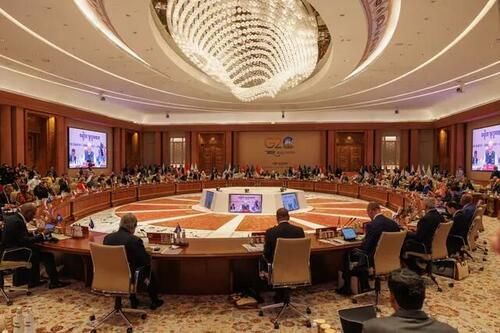
Indian Prime Minister Narendra Modi welcomes leaders during opening session of the G20 Leaders’ Summit in New Delhi, on Sept. 9, 2023. (Dan Kitwood/Getty Images)

The G20, which is currently under India’s presidency, adopted a final declaration on the subject over the weekend in New Delhi.

The meeting, which included the world’s leading economies, announced last week that they had agreed to build the necessary infrastructure to implement digital currencies and IDs.

The group said that discussions were already underway to create international regulations for cryptocurrencies, but claimed that there was “no talk of banning cryptocurrency” at the summit.

Many critics are concerned that governments and central banks will eventually regulate cryptocurrencies and then immediately replace them with central bank digital currencies (CBDCs), which lack similar privacy and security.

Indian Finance Minister Nirmala Sitharaman said that discussions were underway to build a global framework to regulate crypto assets since they believe cryptocurrencies can not be regulated efficiently without total international cooperation.

“India’s [G20] presidency has put on the table key issues related to regulating or understanding that there should be a framework for handling issues related to crypto assets,” Ms. Sitharaman said before the G20 gathering.

The top items discussed at the New Delhi summit included “building Digital Public Infrastructure, Digital Economy, Cryptoassets, [Central Bank Digital Currencies].”

Gita Gopinath, the International Monetary Fund’s first deputy managing director, said in a video posted on X that the G20 “helped shape a global perspective on how policymakers should deal with crypto assets.”

She also assured Business Today that there was “no talk of banning cryptocurrencies, indicating a global consensus against such measures” in the discussions.

However, some of the suggestions call for additional policing of cryptocurrencies, which are decentralized and do not operate under central banks’ control.

Critics say that these proposals could allow government authorities to impose a social credit score system and decide how their citizens can spend their money.

European Commission Chief Reemphasizes Need for Digital IDs

At the summit, European Commission President Ursula von der Leyen called for an international regulatory body for artificial intelligence (AI), digital ID systems similar to coronavirus vaccine passports and advocated for global cooperation to address the challenges presented by AI.

She called for the United Nations to have a role in AI regulation and called the European Union’s COVID-19 digital certificate a perfect model for digital public infrastructures (DPI), which would include digital IDs.

“Many of you are familiar with the COVID-19 digital certificate. The EU developed it for itself. The model was so functional and so trusted that 51 countries on four continents adopted it for free,” said President von der Leyen.

Today, the WHO uses it as a global standard to facilitate mobility in times of health threats. I want to thank Dr. Tedros again for the excellent cooperation,” she said, referring to WHO Director-General Tedros Adhanom Ghebreyesus.

See the rest here

Be seeing you

Posted in Uncategorized | Tagged: , , , , | Leave a Comment »

Whither Crypto? No One Knows. But Repeal Legal Tender Laws & Allow Competition In Currencies

Posted by M. C. on March 11, 2023

https://rumble.com/v2cji8q-whither-crypto-no-one-knows.-but-repeal-legal-tender-laws-and-allow-competi.html

Be seeing you

Posted in Uncategorized | Tagged: , , , | Leave a Comment »

The Dangers Lurking behind a Digital Euro | Mises Wire

Posted by M. C. on February 27, 2021

https://mises.org/wire/dangers-lurking-behind-digital-euro

Thorsten Polleit

Neosocialist China does it, Sweden does it, and many other states want to do it, too: to issue digitized central bank money for everyone. The European Central Bank (ECB) is also working on such a scheme. It wants to launch “digital euro central bank money” as soon as possible. Many economists praise the project as an “innovation,” as an important and indispensable step in an increasingly digitized world.

The ECB is also keen to make its intentions known, declaring that a digital euro will be accessible for everyone, robust, secure, efficient, and compliant with applicable law. However, it should be clear that the path to becoming a surveillance state regime will accelerate considerably if and when a digital euro is issued. But let’s not get ahead of ourselves.

A digital euro is not “better money” than the euro that is already in circulation today. The planned digital euro is fiat money, just as much as euro cash and euro bank balances represent fiat money: they are all created “out of nothing” by the ECB, which has the monopoly of euro production. Just as is the case with the existing euro, the quantity of digital euros can be increased at any time, it is backed by nothing, and the digital euro carries a 100 percent risk of devaluation. As noted earlier, a digital euro would be a fiat euro.

The digital euro can either be “account based”—you keep it in an account held with the ECB—or it can be “token based”—money users receive a “token” that can be transferred from smartphone to smartphone via an app. Hoping for “anonymity” in payment transactions would be futile in both cases, one has to fear.

A look at China probably shows where the journey is headed: the Chinese digital central bank money is supposed to have a “controlled anonymity.” In other words, “only” the People’s Bank of China—that is, the Chinese Communist Party—should have access to the payment transaction data.

The ECB says the digital euro is a “complement” to cash and bank balances. But that’s not convincing. Because those who pay in cash obviously find it convenient and want to ensure their anonymity. Otherwise, they would pay electronically, i.e., transfer balances through PayPal, Apple Pay, or debit or credit cards.

In this context, it should be noted that people don’t just hold cash for payment purposes. They also demand it to protect themselves against bank failures, for example, or they also hold cash to be liquid even in the event of power outages, to be independent of online banking.

That said, the suspicion that the ECB is more interested in taking cash out of circulation cannot be refuted easily. But if only electronic payments are possible, what little remains of “financial privacy” will be gone. The citizen becomes completely transparent, much to the liking of the state and its beneficiaries.

As soon as cash has been pushed back or stripped away entirely, monetary policymakers can implement an uninhibited negative interest rate policy to devalue debt. Customers can no longer get out of the “bank balance sheet”; the final escape door is then locked. 

It is unlikely that a digital euro will prevail naturally against cash. Rather, the ECB will have to make the use of cash unattractive: by raising the costs of cash by increasing fees at ATMs or through upper limits for cash payments, or through social stigmatization of cash (keywords: money laundering, terrorist financing, etc.).

The digital euro does not compete with crypto units such as bitcoin. After all, a digital euro is—as already mentioned—fiat money issued by the state, which is exactly what all those who are looking for better money do not want to hold.

Rather, the target group for the digital euro includes those who are basically content with the euro as it currently is and those who are worried about a potential banking crash. This group probably represents a fairly large number of people who come into question as a potential target clientele for the digital euro.

The plan is to allow for a 1:1 exchange of euro cash and commercial bank balances with digital euros. Economically speaking, this means that the ECB de facto insures the liabilities of the euro banks: the ECB transfers its creditworthiness, which is beyond any doubt stellar, to euro commercial banks.

With a 1:1 exchange option nobody has to worry about losing their money balances held at euro commercial banks, as the ECB has the monopoly of euro production. The ECB cannot go bankrupt; it can create euros at any time to settle its payment obligations, regardless of the amount.

That said, no one needs to worry that their balances held at a commercial bank could be lost if the bank goes bankrupt and the deposit protection fund fails. If a digital euro is publicly accepted, the scenario of euro commercial banks collapsing becomes unlikely; the euro money and credit system would be supported more than ever by the omnipotence of the ECB.

As is well known, in their Communist Manifesto (1848) Karl Marx and Friedrich Engels named ten “measures” the implementation of which would lead to communism. The fifth measure reads as follows: “Centralisation of credit in the hands of the state by a national bank with state capital and exclusive monopoly.” The issuance of a digital euro and the resulting consequences are undoubtedly another crucial step in bringing the Marxists’ vision of their desired revolution to fruition. Author:

Thorsten Polleit

Dr. Thorsten Polleit is Chief Economist of Degussa and Honorary Professor at the University of Bayreuth. He also acts as an investment advisor.

Be seeing you

Posted in Uncategorized | Tagged: , , , | Leave a Comment »