


History shows that smaller polities mean more decentralized governance and greater human liberty. As people can effectively vote with their feet, they can indirectly affect societal change. This is not to say that small governing bodies have no ability to coerce or become corrupt, but people living in those communities are able to more easily choose a new government right next door.
https://libertarianinstitute.org/articles/liberland-has-a-right-to-be-free/
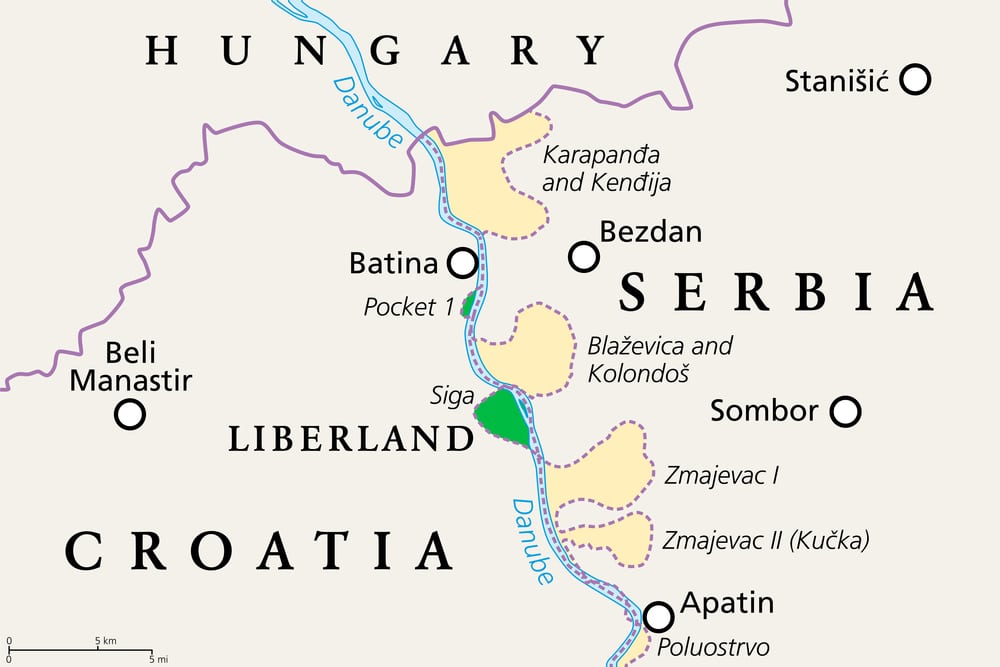
Along the Danube River in South-Central Europe rests a unique parcel of land. This roughly 2.7 square mile piece of land is sandwiched between Croatia and Serbia. Before the breakup of Yugoslavia, the autonomous regions within the federal republic established their borders following the Danube. However, after decades, the river has slightly changed its course, leaving this piece of land outside of both borders. After the breakup of Yugoslavia, neither nation claimed the land, and in fact it remained terra nullius, or no man’s land, until 2015.
Vit Jedlička and a few others proclaimed the territory as the Free Republic of Liberland on April 13, 2015. Upon international recognition, Liberland would be the third smallest sovereign state, after the Vatican City and Monaco. There are four criteria required to be considered a state according to the Montevideo Convention on Rights and Duties of States. They are as follows:
- A permanent population;
- A permanent territory;
- Government;
- Capacity to enter into relations with other states;
Liberland has met all of the requirements, meaning that it should be recognized as sovereign by the international community.
Some libertarians have questions as to the necessity of a new state. Aren’t there enough countries already? Why couldn’t Vit and the others be grateful in their original home countries? Could Liberland even be a real country anyways? All of these questions are valid but have equally valid responses.
History shows that smaller polities mean more decentralized governance and greater human liberty. As people can effectively vote with their feet, they can indirectly affect societal change. This is not to say that small governing bodies have no ability to coerce or become corrupt, but people living in those communities are able to more easily choose a new government right next door. Modern nation states are relatively new creations anyways. Thousands of smaller polities existed both inside and outside of competing empires for generations. There is no reason why groups should not be able to secede or claim uninhabited land as new self governing communities.
For Americans, one of the most important stories is that of the separatists and pilgrims who left the Old World searching for religious freedom and commercial success. Not only did they live in the New World as British citizens, but they would also eventually proclaim their own autonomy.
This sense of agency is celebrated by Americans, as well as many post-colonial states around the globe. Why shouldn’t this value be celebrated by everyone? Self-determination as an inalienable right, given by a Creator is crucial to the human experience. Without it, humans lack dignity. The idea that a human adult has no choice but to be subject to the authority of another human adult without explicit consent is dangerous, even tantamount to enslavement.
Property rights also come into play here. Famous empiricist John Locke proclaimed that a natural right to property existed because, “God gave (the world) to mankind in common” for the purpose of stewardship and survival. He argues that individuals can only survive by laboring, and appropriating parcels of land. Thus, property is a natural right to those who contribute their labor to its sustainment.
Be seeing you
 MCViewPoint