I’d like to point out that there actually have been previous defaults by the US government. For example, Abraham Lincoln, during the War between the States, defaulted by printing up so-called Greenback currency.
Roosevelt defaulted on the debt by fraudulently devaluing the dollar, raising the price of gold from $20.50 to $35, but only after confiscating it from citizens. That was a default. Then there was Nixon, in 1971, defaulting on the promise to pay foreign governments at $35 gold. Now the dollar is only worth 1/2000th of an ounce of gold.
International Man: The US federal government has raised the so-called debt ceiling 104 times since 1944.
Shouldn’t they call it a debt target instead of a debt ceiling?
Is this whole thing a farce?
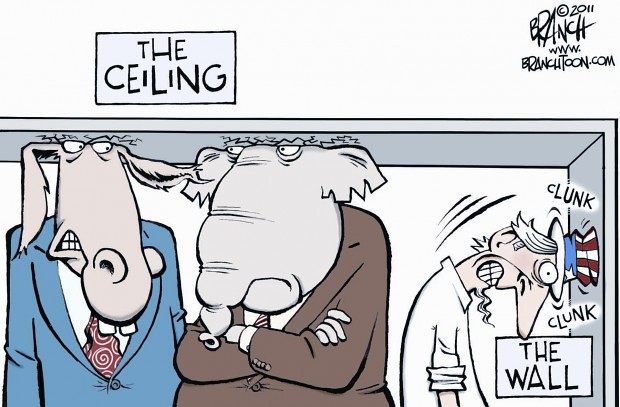
Doug Casey: The situation is completely and irredeemably out of control. It’s a farce. Quite laughable, except for the fact it’s so deadly serious.
Can they reduce the debt ceiling or the amount of debt? Or even slow down its growth at this point? No.
The situation is beyond redemption because most US government expenditures go to pay entitlements—Social Security, Medicare, Medicaid, food stamps, and numerous other types of welfare.
Those things will be very hard to cut at this point; breaking the doggy dishes of millions of corrupted Americans would cause unrest. Plus, the so-called “defense” budget, which mostly supports the military/industrial complex while fomenting conflict. It’s actually much larger than disclosed because it should include $50 billion of foreign aid, the cost of running outrageously large embassies over the world, the CIA, and black budgets of all types.
Meanwhile, all US government agencies are bent on expanding themselves. The bureaucrats who run them realize that if they don’t grow the budget every year, they reduce their chances of going from one GS level to the next. Their success is based upon managing more people and spending more money. Naturally, all these agencies grow like cancers.
As a result, the “debt ceiling” is a fiction. It will stay out of control unless there is a total reorganization of the government—which itself would be risky. And that’s not going to happen until we have a financial catastrophe that leaves absolutely no alternative.
International Man: You have previously stated the US government should default on the national debt.
What are the reasons for that?
Doug Casey: I know it sounds outrageous to propose the US government default on its national debt. Of course, they don’t think it will ever be necessary because, as several high-level government officials have pointed out, they can just print money to pay off the debt.
However, I disagree. What are the reasons for doing something as seemingly catastrophic as defaulting on the debt? I’ll give you at least five. Stick with me. Let’s conduct an outrageous but not unreasonable thought experiment.
First, barring default, future generations of Americans will be turned into serfs to pay off the debt. Profligate people have run up the debt, but everybody’s children and grandchildren are stuck with having to pay it off. That’s simply immoral. If you have any care for the future at all, future generations should be saved from becoming serfs to pay it off.
Therefore, the most important step in the liberty movement now is convincing more people to apply the same moral code to theft and murder committed by government as they apply to those same crimes by private citizens. The government, at the very least, should be held to the same moral codes as the people it governs.
Ensuring that government follows the same nonaggression principle as law-abiding citizens is the key to a society of freedom, peace, and prosperity.
Political Cartoon by Joe Wolf in the Rapid City Journal
Last week the House passed legislation increasing the debt ceiling. The bill was supported by all but four Republicans. For some Republicans, this was the first time they had ever voted for a debt ceiling increase. Perhaps the reason they did so this time was because the legislation also promised to reduce federal spending by $4.5 trillion over the next decade. Most of those spending reductions are achieved by rolling back Fiscal Year spending to 2022 levels and then limiting increases in spending to one percent for the next ten years. The bill also returns unspent COVID relief money to the U.S. Treasury and eliminates President Biden’s student loan forgiveness programs.
Perhaps the most significant part of the bill is the REINS Act. This legislation requires congressional approval of any new federal regulation that will have an impact of more than $100 million, will have significant harmful impact on the economy, or will increase consumer prices. Even though the bill increases spending and debt, there are reasons a supporter of limited government might vote for it.
However even in the unlikely event that this bill is passed in the Senate and signed into law by President Biden, it is unlikely that the one percent spending cap would remain in force for the full ten years.
Printing and raising taxes are not social policies. It is profoundly anti-social, as it destroys the middle class and makes the economy weaker. Raising the debt ceiling is also extremely negative for the middle class because it means more taxes, lower purchasing power of the currency, and stagnation in the future.
Every time the United States reaches its debt limit, we read that it is important to reach an agreement to lift it. The narrative is that the debt ceiling must be raised, or the US economy will suffer a severe contraction. There is even an episode of a TV series, “Designated Survivor”, where the character played by Kiefer Sutherland places lifting the debt ceiling as the priority to get the U.S. economy on track. The debt ceiling is viewed as an evil and anachronistic burden on growth. It is not.
Analysts all over the world consider the debt ceiling a non-event because Congress always agrees to increase it. As such, markets do not even care. Congress has raised the debt ceiling on time on over eighty occasions since 1960, according to S&P Global. The rating agency points out that Congress has passed legislation to raise or suspend the debt ceiling seven times in the last twelve years (in 2011, 2013, 2017, 2018, 2019, and twice in 2021).
The U.S. Treasury has announced it will start implementing “extraordinary measures” to fulfill its legal obligations. These extraordinary measures would give the government the possibility of extending the deadline until early June. Analysts and commentators say that Congress faces two options: either raise the debt ceiling or suspend it. Really? No one seems to think of the urgent need to cut spending.
The problem of the United States’ debt is not one of receipts. It is created by the constant increase in mandatory spending. Governments continue to raise taxes, and when the economy grows, they spend more. However, when the economy stalls or declines, they spend even more. In fiscal year 2022, the government spent $6.27 trillion. In 2015, it was $4.7 trillion. There is no revenue measure that would cover an increase of such magnitude and maintain it every year. Blaming the deficit on tax cuts makes no mathematical sense and assumes a confiscatory and extractive view of the economy, where the private sector must always provide rising revenues to a government that always spends more.
It is interesting to see how the debate has shifted to tax cuts, which did not reduce receipts, instead of spending that never generates the announced fiscal multiplier or reduces the deficit.
Those who say that the deficit would have been solved by eliminating the last tax cuts have a problem with mathematics. There is no way that any form of revenue measure could have covered a $1.6 trillion spending increase. Even if you believe in the idea that the government will always collect higher receipts from massive tax increases, which is false, only one year of mild recession would balloon the deficit and debt again.
The solution to the United States budget deficit is not more taxes. Even in the most optimistic receipt scenario, there is no tax hike program that would even start to address the structural deficit, estimated at one trillion dollars a year. Expenses are annual and consolidated, but receipts are cyclical and depend on the health of the economy. Therefore, revenue measures never reduce debt.
When governments say they will only tax the rich, they are treating citizens as if they were children. There is simply no way in which the government would collect every year between half a trillion to a trillion more only from a handful of rich people whose wealth is mostly in shares.
Deficits are always a spending problem. However, none of the parties want to address the ballooning levels of US debt by reducing expenditure. Therefore, they always agree on increasing public debt, which makes the economy weaker.
The solution for many is printing money and raising taxes. More taxes hurt the recovery, damage the job improvement potential, and reduce investment in the economy. More taxes mean less growth and no deficit improvement. More taxes and more printing mean that, added to those negatives, real wages decline, deposit savings evaporate, and the inflationary tax destroys the middle class.
Those that say deficits are reserves that the government creates for the private sector and that deficit spending is good for growth because a monetary sovereign country like the United States can spend and borrow as it pleases are simply lying. If deficit spending were a source of reserves that benefited the private sector, the United States’ productivity, growth, investment, and consumption in real terms would be off the charts, not sluggish, and real wages would be rising, not falling. The United Kingdom and Japan have proven that pushing the limit on debt, taxes, and spending only brings stagnation and declining real wages.
Consequently, Dimon’s position is essentially this: “Abandon all checks and balances if it threatens Wall Street portfolios!” What Wall street wants is to know for sure that the regime will keep the money flowing. That leaves no room for meaningful opposition.
Dimon was echoing the words—nearly verbatim—of Biden’s Treasury secretary Janet Yellen in using the most extreme language possible, with words such as “complete catastrophe.” Dimon also repeated Yellen’s lie that the US has never defaulted, claiming a default “would be unprecedented.” Dimon then went on to demand that the debt ceiling be abolished altogether so that the US government would no longer be encumbered by inconvenient impediments to endless amounts of federal debt and spending.
This sort of thing, of course, is precisely what we’ve come to expect from billionaires and other captains of the financial sector who have made a living out of turning inflationary monetary policy into big profits for themselves and their fellow corporate cronies.
Wall Street and the financial sector have become increasingly dependent on inflationary monetary policy to prop up their portfolios, and huge amounts of deficit spending have been key to this equation.
After all, as federal deficits (and the debt overall) have ballooned, the regime in Washington has relied more and more on deficit spending to keep paying the bills. Yet with more than $25 trillion in debt on the books, debt service would prove to be crippling to the regime were it not for the central bank’s monetization of debt.
In other words, the federal government would have to pay double or triple the amount of interest it now pays—thus forcing big cuts to popular government programs—were it not for the fact that the central bank is buying up enormous amounts of government debt. Indeed, the Fed’s holdings of Treasury debt have multiplied many times over during the past decade, rising from “only” a half trillion dollars in 2008 to $4.6 trillion today, more than half of the Fed’s total portfolio in 2021.
These assets have been purchased using newly created money, which when spent on Treasurys enters the economy through the financial sector. That means fat fees and a huge advantages for the financial sector, as it is able to spend newly created cash on assets and goods before prices adjust to reflect the realities of an increasingly inflated currency.
Moreover, this need for low interest rates on federal debt drives an overall dovish monetary policy committed to ultralow interest rates. This, as shown by Karen Petrou in her book Engine of Inequality, has disproportionately benefited the financial sector and the ultrarich.
So we shouldn’t be surprised when representatives of the ultrawealthy Wall Street class like Dimon apparently don’t see much downside to having federal deficits continue to spiral upward. The deficit-spending game has been great for them.
“Number one is really a morality point: We all teach our children that we are supposed to meet obligations and I don’t think the nation should be any different. Number two, we should never even get this close—there are huge economic costs already being borne … [and] it’s already affecting the stock market,” Dimon said, and “number three, we should get rid of this debt ceiling—we don’t need to have this kind of brinksmanship every couple of years.”
The first point, of course, is laughable coming from any representative of corporate America. Corporate leaders in America hardly eschew bankruptcy as a method of avoiding paying one’s debts—when it helps the bottom line. It’s standard practice, and one never witnesses much hand-wringing about whether or not we’re sending a good message to “the children” when a business declares bankruptcy. Dimon’s attempt to put a patina of moralism on paying debts should be regarded as cynical in the extreme. Moreover, by engaging in policies that lead to price inflation—whether in assets prices or goods prices—the regime is already embracing the schemes of a deadbeat. It’s paying off its debts in deliberately devalued dollars.
The second point merely illustrates the tunnel vision with which Wall Street operates. Ever since the early days of the Greenspan Put in the late 1980s, central bankers and Wall Street have increasingly all agreed that asset price inflation in the stock markets is somehow synonymous with American prosperity overall. Yet, as repeatedly shown by David Stockman in his book The Great Deformation, Wall Street and Main Street are absolutely not the same thing, and we ought not treat them as such. Moreover, a disproportionate amount of these “huge economic costs” that would be borne in case of default would be largely felt by the regime itself and by the investor class. While default would finally rein in government runaway spending—while freeing up much of the budget for things other than debt service—holders of government debt would no doubt suffer. But, as Rothbard notes, these people took that risk willfully. The taxpayers, on the other hand, have no say in the matter and ought not be forced to endlessly pay the bills which they have never consented to.
And finally, there is Dimon’s condemnation of “brinksmanship.” Yet, what Dimon here calls brinkmanship is what opponents of monarchical tyranny once called “dissent” or “freedom.” After all, parliamentary government—so far as it was a check on executive power—was created in practice for purposes of brinkmanship. That is, the legislative’s body control over government spending was there precisely to hold the executive—usually a monarch—accountable by withholding tax revenues until the monarch agreed to concessions of various types. Usually, the executive would attempt to force some sort of crisis—often a war-related crisis—to frighten the legislators into caving to his or her demands. It’s a time-honored political tactic. Much of the time, however, only by refusing to blink during periods of ”brinkmanship” do opponents of executive power succeed. The fact that the current crop of legislators is largely motivated by goals of partisan advantage is immaterial. Thus has it always been. That’s not a reason to straighten the regime’s path to yet another round of ripping off the taxpayers.
Consequently, Dimon’s position is essentially this: “Abandon all checks and balances if it threatens Wall Street portfolios!” What Wall street wants is to know for sure that the regime will keep the money flowing. That leaves no room for meaningful opposition.
Also an Ideological Problem
It is unlikely, however, that Dimon is motivated strictly by the prospects of a bigger payday. Supporting runaway spending is simply the dominant ideology today in financial sector boardrooms and in business schools. While conservatives were shortsightedly obsessing over “electing the right people” or winning the next election, interventionist ideologues were taking over business schools and university faculty offices. They ensured that the next generation of business leaders and economists would embrace the ideas of endless spending, large-scale government intervention, and inflationist monetary policy. So, when the Jamie Dimons of the world push for abolishing the debt ceiling—or having the central bank monetize another trillion in government debt—its likely not just a cynical ploy. This is especially unsurprising for someone like Dimon, who sat on the board of the New York Fed from 2008 to 2013. The thinking here is likely far more nuanced than a mere scramble for profits. In other words, these people are probably true believers. This is, after all, what they learned from their economics professors. Author:
Ryan McMaken is a senior editor at the Mises Institute. Send him your article submissions for the Mises Wire and Power and Market, but read article guidelines first.
Of course, reducing the debt ceiling would force the government to stop borrowing so much money from credit markets. This would leave significantly more credit available for the private sector. The shortage of capital is one of the most often cited reasons for the failure of the economy to recover.
Lowering the debt ceiling would force federal-government budget cutting on a large scale, and this would free up resources (labor, land, and capital) and force a cutback in the federal government’s regulatory apparatus. This would put Americans back to work producing consumer-valued goods.
The Biden administration’s rhetoric on the debt ceiling has become nothing short of apocalyptic. The Treasury Department has announced that a failure to increase the debt ceiling “would have catastrophic economic consequences” and would, as NBC news claims, constitute a “doomsday scenario” that would “spark a financial crisis and plunge the economy into recession.”
Apparently, the memo went out to the debt peddlers that they are not to hold back when sowing maximum fear over the thought that the US might government might pause its incessant debt accumulation even for a few days.
The reality, however, is quite something else. While a failure to raise the debt ceiling would no doubt cause short-term disruptions, the fact is the medium- and long-term effects would prove beneficial by reining in the regime’s chokehold on the American economy and financial system.
This is explained in a recent column by Peter St. Onge in which he examines just how much of a problem default really is:
In 2021 the US government plans to spend $6.8 trillion. Of which about half is borrowed — $3 trillion. So if they can’t raise the ceiling, they’d have to cut that $3 trillion.
Mainstream media, naturally, claims this is the end of the world. CBS estimates it would cost 6 million jobs and $15 trillion in lost wealth—comparable to the 2008 crisis, which was also caused by the federal government. CNN, more colorfully, claims cascading job losses and “a near-freeze in credit markets.” They conclude, falsely, that “No one would be spared.”
Considering the source, we can guess these predictions are overblown. So what would happen?
Well, $3 trillion is a lot of money—roughly 15% of America’s GDP. But we have to remember where that $3 trillion came from. The government, after all, doesn’t actually create anything, every dollar it spends came out of somebody else’s pocket. Whose pocket? Part of the $3 trillion was bid away from private borrowers like businesses, and the rest was siphoned from peoples’ savings by the Federal Reserve creating new money.
This means that, yes, GDP would decline sharply. But wealth would actually grow, perhaps substantially. The businesses would be able to buy things they need, while the savers keep their money that was doing useful things like paying their retirement.
Ryan McMaken is a senior editor at the Mises Institute. Send him your article submissions for the Mises Wire and Power and Market, but read article guidelines first.
The reality, however, is quite something else. While a failure to raise the debt ceiling would no doubt cause short-term disruptions, the fact is the medium- and long-term effects would prove beneficial by reining in the regime’s chokehold on the American economy and financial system.
Ultimately, when a media pundit or Janet Yellen predicts the end of the world if debt doesn’t continue to skyrocket ever upward, they are simply calling for a continuation of the status quo.
The Biden administration’s rhetoric on the debt ceiling has become nothing short of apocalyptic. The Treasury Department has announced that a failure to increase the debt ceiling “would have catastrophic economic consequences” and would, as NBC news claims, constitute a “doomsday scenario” that would “spark a financial crisis and plunge the economy into recession.”
Apparently, the memo went out to the debt peddlers that they are not to hold back when sowing maximum fear over the thought that the U.S. might government might pause its incessant debt accumulation even for a few days.
The reality, however, is quite something else. While a failure to raise the debt ceiling would no doubt cause short-term disruptions, the fact is the medium- and long-term effects would prove beneficial by reining in the regime’s chokehold on the American economy and financial system.
This is explained in a recent column by Peter St. Onge in which he examines just how much of a problem default really is:
In 2021 the U.S. government plans to spend $6.8 trillion. Of which about half is borrowed—$3 trillion. So if they can’t raise the ceiling, they’d have to cut that $3 trillion.
Mainstream media, naturally, claims this is the end of the world. CBS estimates it would cost 6 million jobs and $15 trillion in lost wealth—comparable to the 2008 crisis, which was also caused by the federal government. CNN, more colorfully, claims cascading job losses and “a near-freeze in credit markets.” They conclude, falsely, that “No one would be spared.”
Considering the source, we can guess these predictions are overblown. So what would happen?
Well, $3 trillion is a lot of money—roughly 15% of America’s GDP. But we have to remember where that $3 trillion came from. The government, after all, doesn’t actually create anything, every dollar it spends came out of somebody else’s pocket. Whose pocket? Part of the $3 trillion was bid away from private borrowers like businesses, and the rest was siphoned from peoples’ savings by the Federal Reserve creating new money.
This means that, yes, GDP would decline sharply. But wealth would actually grow, perhaps substantially. The businesses would be able to buy things they need, while the savers keep their money that was doing useful things like paying their retirement.
So GDP drops, wealth soars.
Now, there will be near-term pain, simply because the GDP drop comes before the private borrowing ramps up, while those retirement savings are no longer being siphoned to pay for parties at strip clubs or, say, another trillion for farting cows.
So, yes, it will be a sharp drop in GDP. But so long as government stays out of the way, choosing the prudent 1920 response of doing nothing, the recovery will be very rapid. Why would they do nothing? After all, governments don’t like staying out of the way these days. Because a government that suddenly loses half it’s budget is going to find a lot of things not worth doing. Given a choice between defunding government workers’ pensions or defunding economy-crushing Green New Deals, governments will choose their own.
So that’s short-term: pain, but less than it seems. And that’s where the magic begins. Because ending deficits fundamentally reduces governments’ long-term ability to prey on the people’s wealth.
This is because debt and money printers are much less obvious than taxes, which are painful and make more enemies. So a default becomes a “back door” to move government back towards its traditional “parasite” role rather than the “predator” role it’s taken on since Nixon unleashed the money printers. Especially since COVID-19, when lockdowns were bought with fresh money and deficits. I wrote about this predatory evolution a few months ago, but the bottom line is government default is a tremendous investment in our future prosperity.
Ultimately, when a media pundit or Janet Yellen predicts the end of the world if debt doesn’t continue to skyrocket ever upward, they are simply calling for a continuation of the status quo.
And what does the status quo mean? It means a world in which the U.S. government continues to spent trillions of dollars it doesn’t have, made possible through monetizing massive amounts of debt and forcing taxpayers to devote ever more of their own wealth and income to paying off an ever-more-huge chunk of interest.
It also means more government spending, which—regardless of whether it’s funded by debt or by taxes—causes malinvestment and, through the redistribution of wealth, rewards the politically powerful at the expense of everyone else. In other words, its keeps Pentagon generals and Big Pharma executives living in luxury while the taxpayers are lectured about the need to “pay America’s bills.”
Rather, as Mark Thornton noted in 2011, the right thing to do is lower the debt ceiling. Thornton explains the many benefits, ranging from effective deregulation to freeing up capital for the private sector:
If Congress passed legislation that systematically reduced the debt ceiling over time, the economy could be rebuilt on a solid foundation. Entrepreneurs in the productive sectors would realize that an ever-increasing proportion of resources (land, labor, and capital) would be at their disposal, while companies that capitalized on the federal budget would have an ever-declining share of such resources.
Congress would have to cut the pay and benefits of its employees (FDR cut them by 25 percent in the depths of the Great Depression) as well as the number of such employees. Real wage rates would decline, allowing entrepreneurs to hire more employees to produce consumer-valued goods.
Congress would have to cut back on its far-flung regulatory operations, which are in fact one of the biggest drags on the economy due to the burden and uncertainty that Obama and Congress have created in terms of healthcare, financial-market, and environmental regulations. A recent study by the Phoenix Center found that even a small reduction of 5 percent, or $2.8 billion, in the federal regulatory budget would result in about $75 billion in increased private-sector GDP each year and the addition of 1.2 million jobs annually. Eliminating the job of even a single regulator grows the American economy by $6.2 million and creates nearly 100 private-sector jobs annually.
Under a reduced debt ceiling, the federal government would also have to sell off some of its resources. It has tens of thousands of buildings that are no longer in use and tens of thousands of buildings that are significantly underused—about 75,000 buildings in total. It also controls over 400 million acres of land, or over 20 percent of all land outside of Alaska, which is almost wholly owned by the government. There is also the Strategic Petroleum Reserve and many other assets that could be sold off to cover short-term budget shortfalls.
Of course, reducing the debt ceiling would force the government to stop borrowing so much money from credit markets. This would leave significantly more credit available for the private sector. The shortage of capital is one of the most often cited reasons for the failure of the economy to recover.
Lowering the debt ceiling would force federal-government budget cutting on a large scale, and this would free up resources (labor, land, and capital) and force a cutback in the federal government’s regulatory apparatus. This would put Americans back to work producing consumer-valued goods.
Unfortunately, the public has been fed a steady diet of rhetoric in which any reduction in government spending will bring economic Armageddon. But it’s all based on economic myths, and Thornton concludes:
Passing an increase in the debt ceiling merely perpetuates the myth that there is any ceiling or control or limit on the government’s ability to waste resources in the short run and its willingness to pass the burden of this squander onto future generations.
The usual “debt ceiling” theatrics have reappeared. We’re again greeted with the propaganda that if the most indebted government in the history of th
e world doesn’t continue to go deeper into debt, the world would grind to a halt. But economic “crisis,” which is really a painful return to economic reality, is inevitable. The real “crisis” is continuing to dig a deeper hole. So it’s certainly time to think about getting one’s own person financial house in order.
The default is already happening via devaluation of money.





 MCViewPoint