


https://www.oftwominds.com/blogmar19/services-inflation3-19.html?fullweb=1
Charles Hughes Smith
The soaring cost of services is driven by a number of factors.
What will the future bring: fire (inflation) or ice (deflation)? The short answer: both, but in very different doses. Goods that are tradeable and exposed to technologically driven commodification will decline in price (deflation) while untradeable services that are difficult to commoditize will increase in price (inflation), generating a self-reinforcing feedback loop of wage-price inflation.
Gordon Long and I discuss these trends in our latest program The Supply-Demand Services Problem (YouTube).
The big difference between goods that drop in price (TVs, etc.) and services that are exploding higher (healthcare, childcare, elderly care, higher education, local taxes and fees, etc.) is the relative size each occupies in the household budget: a new TV is a couple hundred bucks and a once-every-few-years purchase, while all the services cost thousands of dollars annually– or even tens of thousands of dollars.
A new TV or electronic gew-gaw is signal noise in the household budget while services consume the most of what’s left after paying for housing and transport.
A 10% decline in the cost of a new TV is $25, while a 10% increase in annual tuition and college fees is $2,500. Add in thousands more for childcare, elderly care, local taxes and fees and healthcare, and the deflationary impact of tradeable goods is trivial compared to the increases in untradeable services.
Not all goods are declining in sticker price. vehicles are rising sharply in price, a fact that’s erased by hedonic adjustments in official inflation (the new car is supposedly so much better than the previous model that the “price” actually declines-heh).
Then there’s the inexorable shrinkage of quantity and quality. The package that once held 16 ounces now contains 13.4 ounces, and the appliance that once lasted for years now lasts a few months as the quality of components is reduced.
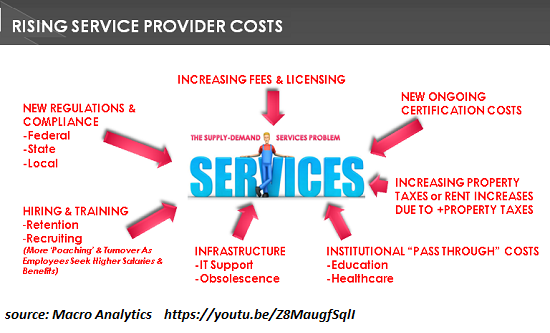
The soaring cost of services is driven by a number of factors:
1. The cost of staying in business is rising: wages are going up, overhead is going up, rent is going up, regulatory burdens are increasing, compliance costs more and local taxes, fees and licensing are skyrocketing.
This drives the costs of local small services ever higher: childcare, haircuts, elderly care, educational enrichment programs, and so on.
2. Competition that would suppress price increases has been destroyed by cartels and monopolies and regulatory capture. Big Pharma has eliminated foreign competition, higher education is a rapacious cartel, healthcare is nothing more than a collection of cartels, Internet and telephony providers are either local monopolies or cartels, and so on.
3. In the endless quest for higher quarterly profits, Corporate America has stripped out on-the-job education, preferring to poach high-value workers from competitors rather than invest in in-house training. This has reduced the pool of workers with up-to-date real-world skills, as a college diploma even in the sciences doesn’t translate to marketable skills.
This dynamic pushes wages higher via poaching while reducing the supply of qualified workers.
4. Service-sector infrastructure is often obsolete, kludgy and costly. Insiders are loathe to invest in technologies that might reduce headcount, and even when funds are made available the integration of legacy systems often yields extremely poor results.
5. The cartel-monopoly structure of service sectors has inhibited the spread of cost-cutting technologies; online education that leads to a diploma should be nearly free and universally accessible, (see my book The Nearly Free University), but instead the higher education cartel continues to exact its pound of flesh for a diploma, a scrap of paper with rapidly diminishing returns in an economy over-supplied with college graduates and workers with advanced degrees.
6. The demands on workers’ time and energy continually increases, leaving many unable to provide the services that were once performed in the home–childcare, elderly care, food prepared at home, and so on.
7. The cultural focus on academic achievement and entertainment has stripped away basic skills that were once common, forcing households to pay for pricey services: changing the oil in a car, basic plumbing and home repairs, etc. are now uncommon skills.
8. These social and demographic trends are reducing the supply of service expertise: small business owners (Baby Boomers) are retiring and the skills of starting and operating a service business in a costly regulatory thicket are not being taught or nurtured.
As a result, there is a widening gap between demand and supply of essential services. This asymmetry is not easily remedied and as a result it will generate self-reinforcing inflation that the economy is ill-prepared to pay.
There is much more in our program:
 (39:52)
 MCViewPoint