The design of our constitutional republic, for better or worse, was to protect individual liberties and private property by limiting the power of government. That’s why leftists hate it.
Late-night political hack and former comedian Stephen Colbert doesn’t usually warrant any notice, but he stumbled onto an important truth recently. Lamenting the possibility that the Supreme Court may overturn Roe v. Wade, he whined that if only 27 percent of Americans (according to a Washington Post/ABC News poll) support such a move, and the court doesn’t vote the way he and a majority of Americans prefer, “We don’t live in a democracy.”Democracy or a republic? I say: Let’s restore our founding system — a republic — to our land. That would be something to celebrate. [Click to Tweet]
But we weren’t supposed to live in a democracy. We were supposed to live in a republic.
A story, probably apocryphal, is told that upon exiting the Pennsylvania statehouse at the conclusion of the Constitutional Convention in 1787, Ben Franklin was approached by a passerby. “What have you given us,” the woman asked him. “A republic, if you can keep it,” he replied. While the word “republic” to a Democrat is like a cross to a vampire, it is unquestionably the type of government the Founders created in our Constitution. The design of our constitutional republic, for better or worse, was to protect individual liberties and private property by limiting the power of government. That’s why leftists hate it.
The word “democracy” does not even appear in the Constitution, nor does it appear in that document’s philosophical antecedent, the Declaration of Independence, which stated boldly the revolutionary idea that everyone is “endowed” with unalienable rights – to life, liberty, and the pursuit of happiness. This assertion upended the idea that individuals were mere “subjects” beholden to their betters, cogs in a machine worthy of consideration only insofar as they served the purposes of the elite. The Framers wanted regular elections, but that was simply a peaceful means to eject recalcitrant politicians acting against the interests of the people.
Anti-democratic mechanisms were consciously built into the Constitution. Inspired by an eighteenth-century French political philosopher named Baron de Montesquieu, a system of checks and balances was established. The executive, legislative, and judicial branches were created, each with the ability to stymie the others. Members of the U.S. House of Representatives, elected directly by the people, could pass legislation, but it could die in the Senate; a bill passed through both chambers faces a potential veto from the president, chosen via an Electoral College, not popular vote, and a super majority is required to override that veto. Finally, despite overwhelming support, courts can strike down any law that violates the Constitution.
Interestingly, in a recent report that could easily have been written by a member of the Democratic Party, the Chinese Foreign Ministry specifically highlighted this as proof of our system’s alleged failure. It read in part, “The U.S. political system has far too many checks and balances, raising the cost of collective action and in some cases making it impossible altogether. . . . There is an entrenched political paralysis in the U.S.” [Emphasis added]
This analysis, meant as a criticism, is actually very revealing. Afterall, when Communists are upset about something, it’s likely good for individual freedom! Leftists get misty-eyed when talking about “democracy,” claiming they simply want to “empower” the “common people,” but the truth is they despise voters and are happy with the electoral process only when things go their way. Witness their reaction to the recent election in Virginia, which leftwing commentators denounced as “racist” – despite the victory of a female black immigrant (!) in her run for lieutenant governor. The long-serving president of the state senate in New Jersey was defeated by a truck driver, in his first bid for public office. The left-wing Atlantic smeared his victory as “populist moonshine.” Arch-“progressive” Hillary Clinton claims – oblivious to the irony – that a Trump victory in the 2024 election will spell “the end of our democracy.”
The Framers wanted it to be difficult to pass laws. They also wanted the sphere in which government acted to be quite small, enumerating the limited powers of Congress in Article I, Section 8, of the Constitution. Further protections are found in the Bill of Rights—the 10 amendments to the Constitution forbidding government from infringing the rights of Americans -– even with majority approval. For example, the First Amendment shields unpopular speech from criminal prosecution – no matter what; the Sixth Amendment guarantees that a criminal defendant will be tried by an impartial jury – not by popular opinion or by vengeful government officials; the Eighth Amendment protects the worst offender against “cruel and unusual punishment,” even if the mob wants his head on a pike.
Democracy or a republic? I say: Let’s restore our founding system — a republic — to our land. That would be something to celebrate.
“Australia is not a free country. Westerners are trained to believe that that’s what you call any wealthy English-speaking nation with liberal cultural values, but really it’s just a continent-sized US military base with kangaroos. Human rights are only allowed where they are convenient, which is why they are continually disintegrating.”
The Australian government has been on the receiving end of more and more criticism for its Covid response lately, not just domestically but from overseas.
And there are other aspects of this trend which have nothing to do with Covid. One of the most controversial recent developments in Australia’s escalating government overreach (and potentially the most consequential in the long term) has been the hasty passing of a new law greatly expanding government surveillance powers which allows law enforcement to hack into people’s devices and collect, delete, or even add to and alter the data therein, as well as take control of their social media accounts, supposedly “in order to frustrate the commission of serious offences online.”
Critics tend to lump this sweeping surveillance state escalation in with authoritarian policies related to the pandemic, but the bill makes no mention of Covid; its proponents cite its utility in fighting terrorism and child exploitation. Indeed this bill, which will certainly lead to myriad abuses, is just the latest in a continuing expansion of government surveillance powers in Australia that has been going on for years. This video from The Juice for example was made in 2018 criticizing Canberra’s assault on encryption:https://www.youtube-nocookie.com/embed/eW-OMR-iWOE?rel=0&autoplay=0&showinfo=0&enablejsapi=0
In reality, while the pandemic has certainly been a major factor in exacerbating civil rights erosion, Australia’s Covid response has simply added to a problem that had already existed and was already getting worse. The 2019 CIVICUS Monitor, a global research group that tracks fundamental freedoms in 196 countries, downgraded Australia from an “open” country to one where civil space has “narrowed”, citing new laws to expand government surveillance, prosecution of whistleblowers, and raids on media organizations.
Australia is now the only democratic nation in the world without a national bill of rights. Some comprehensive form of legal protection for basic rights is otherwise seen as an essential check and balance in democratic governance around the world. Indeed, I can find no example of a democratic nation that has gained a new Constitution or legal system in recent decades that has not included some form of a bill of rights, nor am I aware of any such nation that has done away with a bill of rights once it has been put in place.
Why then is Australia the exception? The answer lies in our history. Although many think of Australia as a young country, constitutionally speaking, it is one of the oldest in the world. The Australian Constitution remains almost completely as it was when enacted in 1901, while the Constitutions of the Australian states can go back as far as the 1850s. The legal systems and Constitutions of the nation and the Australian colonies (and then states) were conceived at a time when human rights, with the prominent exception of the 1791 United States Bill of Rights, tended not to be protected through a single legal instrument. Certainly, there was then no such law in the United Kingdom, upon whose legal system ours is substantially based. This has changed, especially after World War II and the passage of the Universal Declaration of Human Rights, but by then Australia’s system of government had been operating for decades.
Officials have been rewarded for these drastic actions with thunderous public support, and until a few months ago the Australian government enjoyed soaring levels of approval from a very collectivist-minded population who overwhelmingly desired the elimination of the virus even if it meant trading some freedoms. Approval of those strict measures has dipped significantly since the Delta outbreak, but a majority of Australians still believe lockdowns and other restrictions are at appropriate levels for the time being. The absence of any federal restrictions on state governments’ ability to limit personal freedoms has allowed premiers to chase this public support regardless of potential long-term consequences.
Australia is not a free country. Westerners are trained to believe that that’s what you call any wealthy English-speaking nation with liberal cultural values, but really it’s just a continent-sized US military base with kangaroos. Human rights are only allowed where they are convenient, which is why they are continually disintegrating.
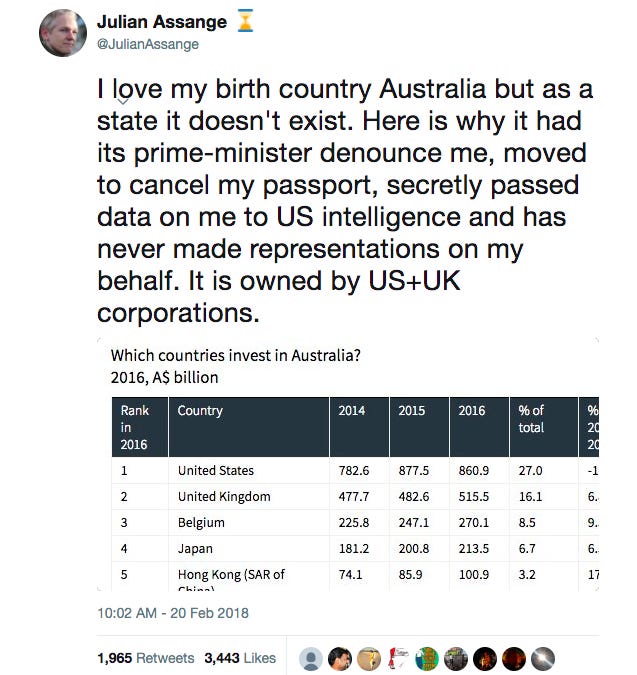
The first mistake in believing that Australia is a free country is believing that it is free. The second is believing that it’s an actual country. As Julian Assange put it shortly before the Australian government allowed him to be silenced and then imprisoned for journalism exposing US war crimes:
“I love my birth country Australia but as a state it doesn’t exist. Here is why it had its prime-minister denounce me, moved to cancel my passport, secretly passed data on me to US intelligence and has never made representations on my behalf. It is owned by US+UK corporations. Before WWII Australia was dominated by the UK–of which it was a colony. After the war it subordinated itself U.S. hegemony. A brief attempt at an independent Australian foreign policy in 1975 resulted in a US+UK backed constitutional coup.”
Anyway, it’s a mess.
So what to do about all this? If you listen to social media comments from people in the northern hemisphere the answer is that Australians should wage a civil war against their government, which from where I’m standing is hilarious partly because they’re talking about a populace whose entire cultural values system is built around being laid back and unbothered, and partly because most of those commenters are Americans living directly under the single most tyrannical regime on earth who have yet to put their much-touted Second Amendment toward practicing what they preach.
There’s a lot that’s going to have to shift before Australians gain stable protections for their civil liberties, which will necessarily have to include not just some kind of bill of rights but becoming an actual republic and finally getting that ugly old woman off our coins and ending the illegitimate US military occupation here once and for all. This will not happen until there’s an expansion in public consciousness of the need to do this, which may or may not be born out of conditions getting a lot worse before they get better. It may also be born out of a critical mass of Australians deciding they’re fed up and beginning a real push toward becoming a free country.
Bottom line the answer to the question of what needs to happen for Australia to move toward health is the same as the answer everywhere else: we’re just going to have to wake up. Human consciousness wants to awaken, and it will shake us in whatever ways we need to be shaken in order to make that happen. This is a hell of a time to be alive.
_________________________
My work is entirely reader-supported, so if you enjoyed this piece please consider sharing it around, following me on Facebook, Twitter, Soundcloud or YouTube, or throwing some money into my tip jar on Ko-fi, Patreon or Paypal. If you want to read more you can buy my books. The best way to make sure you see the stuff I publish is to subscribe to the mailing list for at my website or on Substack, which will get you an email notification for everything I publish. Everyone, racist platforms excluded, has my permission to republish, use or translate any part of this work (or anything else I’ve written) in any way they like free of charge. For more info on who I am, where I stand, and what I’m trying to do with this platform, click here.
In the end, the fact that the notion of a people not needing a government to have their freedom of religion and speech seems absurd represents the devastating extent to which the statist mentality has been cemented in the minds of the men, women, and children of this country.
“You gather the idea that Mauritius was made first, and then heaven; and that heaven was copied after Mauritius.” – Mark Twain
Since its rebirth as an independent state in 1968, this paradisaic island has been touted as a paragon of democratic political institutions promoting rapid economic growth and motivating its citizens to overcome divisions of religion, language, ethnicity, and region of origin. It is looked up to as an example of thriving democracy and constitutionalism in the aftermath, most recently, of Dutch, French, and British colonization.
One benefits greatly from venturing beyond a cursory look at this small island republic’s admirable history and digging into the respect for institutions borrowed from its Western overseers. In doing so, it becomes painfully transparent that proselytizing about the virtuous and egalitarian character of a representative democracy has been little more than another shrewd but effective tactic of the state to maintain its essentially illiberal nature with the end goal of enthralling the ancestors of present-day Mauritians and ensuring that their descendants are born under its yoke.
The Lack of Preexisting Cultural and Societal Institutions
Unlike a select few of its fellow African entities, such as Botswana or Madagascar, Mauritius has not had the advantage of precolonial institutions or cultural frameworks to promote resistance against the state’s encroachment on property rights or to provide guidance for development following the departure of the colonizers. With regard to Madagascar, several Malagasy tribes, specifically the Merina, had such institutions. This society, descended from Southeast Asian settlers, adhered to a legal code instituted by its Hindu aristocracy, which l’Estrac describes in Mauritians: Children of a Thousand Races, his 2004 work, as outlining a basic social order, the organization of justice, the status of the family, property rights, moral values, and territory. However, this lack of precolonial institutions or frameworks did not prevent the spark for an anarchic society from coming forth.
Beginning in the late seventeenth century, the incumbent Dutch colonial administrators witnessed not only the ruthlessness and violence they could inspire in rebels and runaway slaves, but also how this diverse group, comprising Malagasy and Indian slaves, could achieve peaceful coexistence. Taking refuge in the uncharted Mauritian wilderness upon their escape, this seemingly disparate group of former slaves, miles away from their respective motherlands, established a society in which each individual’s land was demarcated and neighbors’ property and individual rights, as well as their freedom to practice whichever faith they belonged to, were respected. The commonalities that transcended their differences were their love of freedom and willingness to take any measures necessary to defend their liberty. No measure was so drastic or immortalized as their arsonist massacres of the Dutch establishment in 1677 and their escape to Bourbon Island (present-day Réunion).
Thus, if we are to lament the loss of a truly voluntarist spirit among the island’s modern-day citizens, as well as its diaspora, we can pinpoint the departure of its anarchic ancestors, in the pursuit of their own freedom, as the downward turning point in the fight against the state. The fight for freedom by any means necessary did not end here; uprisings and revolts became increasingly frequent over the following years, manifested by Malagasy and Indian slaves who saw slow, excruciating deaths as free men and women as preferable to lifetimes spent chained and shackled.
The State Wises Up
Under no colonial administration were the state’s attempts to keep disenfranchised groups pitted against one another more beautifully executed than under the French (1715–1810). The legal codes and governmental practices that their bureaucracy left behind were fundamental to keeping the freedoms and aspirations of the island’s inhabitants in check.
However, to understand how these manifestations of statism in their colonial incarnations function, it is crucial to gain an accurate picture of who stood where in the social hierarchy of the day. At the dawn of French rule, the elite consisted of French-born inhabitants who had arrived in service to the East India Company. Whites born on the island were directly beneath them. Then the Creoles, foreigners (Englishmen and Dutchmen), and, finally, the slaves, the latter of which were separately categorized as black, Indian, or Malagasy. At the turn of the century, this hierarchy had remained more or less unchanged, perhaps with greater diversity in the middle class (the “people of color”), which at this point consisted of free Indians and Creoles.
With specific regard to the Indians, a singularly ingenious strategy by the French colonial government to gain better control over them was the creation of the “chief of the Malabars” (chefs de Malabars) office1 in 1784. The position was created in response to frequent intracommunal feuds.
The position was filled by Denis Pitchen, a wealthy Tamilian Catholic born to free Indian parents. At a superficial level, Pitchen’s elevation to a position of authority as a nonwhite resident would be lauded as a milestone for the representation of nonwhites, particularly by apologists of colonialism or advocates of reform through bureaucratic channels. However, l’Estrac provides us with two wrinkles that undermine this milestone’s glorious sheen:
Pitchen was a slave owner, and among his possessions were other fellow Indian Christians. This drew the ire of the Catholic Church, which expressed its indignation at the enslavement of Christians.
Rather than serving any meaningful diplomatic position, the office of the chief simply served as a conduit for the Franco-Mauritian plantocracy to infiltrate the Indian camp and ensure that their internal troubles would not affect the administration’s hold over them.
Pitchen’s performative elevation was a crippling blow to the self-determination of the inhabitants. This tactic was a common one for rulers: elect an elite or a committee of them from the disenfranchised classes and grant them a few privileges to convince them of the benefits of retaining the present system of governance. The efficacy of this strategy is evident in the resignation of the future generations to the legislative and executive tools of the French and, later, the British as the best pathways to improve their condition and environment.
The state’s decisive blow to freedom and liberty came in 1886, when the revered reformist Sir William Newton began the electoral tradition of the Council of Government. Newton was very careful to restrict the franchise to those who met the criteria of earning a certain income and owning a certain amount of wealth in the form of assets or land. Despite this discriminatory restriction of the franchise, the masses’ adoration of democracy would soon grow into a general culture of leaving the responsibility of governance in the hands of “elected” officials. This contract, however, is merely symbolic, as their own constitution only recognizes three groups (Hindus, Muslims, and Chinese), with the remaining communities being lumped together under “general population.”
Conclusion
As the politicians and lawmakers of the Mauritian political structure have become more diverse (only with regard to ethnicity and religion, as opposed to diversity of thought and philosophy), the Mauritian population has convinced themselves that their fight for liberty and self-respect as a nation is behind them, remaining ignorant of the pyrrhic nature of their “victory.” In the end, the fact that the notion of a people not needing a government to have their freedom of religion and speech seems absurd represents the devastating extent to which the statist mentality has been cemented in the minds of the men, women, and children of this country.
1. In the colonial context, “malabar” was a generic term used to describe Indians brought to the island, some as slaves and some as indentured laborers. The term refers to the Malabar Coast of the Tamilnadu state in south India.
There is, in fact, only either just or unjust discrimination. Yet, egalitarian democracy remains adamant in its totalitarian policy. The popular pastime of modern democracies of punishing the diligent and thrifty, while rewarding the lazy, improvident, and unthrifty, is cultivated via the State, fulfilling a demo-egalitarian program based on a demo-totalitarian ideology.
Democratic tyranny, evolving on the sly as a slow and subtle corruption leading to total State control, is thus the third and by no means rarest road to the most modern form of slavery.
Plato, in his Republic, tells us that tyranny arises, as a rule, from democracy. Historically, this process has occurred in three quite different ways. Before describing these several patterns of social change, let us state precisely what we mean by “democracy.”
Pondering the question of “Who should rule,” the democrat gives his answer: “the majority of politically equal citizens, either in person or through their representatives.” In other words, equality and majority rule are the two fundamental principles of democracy. A democracy may be either liberal or illiberal.
Genuine liberalism is the answer to an entirely different question: How should government be exercised? The answer it provides is: regardless of who rules, government must be carried out in such a way that each person enjoys the greatest amount of freedom, compatible with the common good. This means that an absolute monarchy could be liberal (but hardly democratic) and a democracy could be totalitarian, illiberal, and tyrannical, with a majority brutally persecuting minorities. (We are, of course, using the term “liberal” in the globally accepted version and not in the American sense, which since the New Deal has been totally perverted.)
How could a democracy, even an initially liberal one, develop into a totalitarian tyranny? As we said in the beginning, there are three avenues of approach, and in each case the evolution would be of an “organic” nature. The tyranny would evolve from the very character of even a liberal democracy because there is, from the beginning on, a worm in the apple: freedom and equality do not mix, they practically exclude each other. Equality doesn’t exist in nature and therefore can be established only by force. He who wants geographic equality has to dynamite mountains and fill up the valleys. To get a hedge of even height one has to apply pruning shears. To achieve equal scholastic levels in a school one would have to pressure certain students into extra hard work while holding back others.
The first road to totalitarian tyranny (though by no means the most frequently used) is the overthrow by force of a liberal democracy through a revolutionary movement, as a rule a party advocating tyranny but unable to win the necessary support in free elections. The stage for such violence is set if the parties represent philosophies so different as to make dialogue and compromise impossible. Clausewitz said that wars are the continuation of diplomacy by other means, and in ideologically divided nations revolutions are truly the continuation of parliamentarism with other means. The result is the absolute rule of one “party” which, having finally achieved complete control, might still call itself a party, referring to its parliamentary past, when it still was merely a part of the diet.
Erik von Kuehnelt-Leddihn (1909-1999) was an Austrian nobleman and socio-political theorist who described himself as an enemy of all forms of totalitarianism and as an “extreme conservative arch-liberal” or “liberal of the extreme right.” Described as “A Walking Book of Knowledge,” Kuehnelt-Leddihn had an encyclopedic knowledge of the humanities and was a polyglot, able to speak eight languages and read seventeen others.
3 The system will stop at nothing to hold on to its power and, if possible, increase its levels of control and exploitation. It has no scruples. No lie is too outrageous, no hypocrisy too nauseating, no human sacrifice too great.
One potential positive from the whole Covid-19 debacle is that we have learned an incredible amount about the society in which we live. This will be crucial if we manage to stave off a descent into a nightmare future of techno-fascist slavery.
We will have a new understanding of what our world has become and what we would like it to be in the decades and centuries to come. And “we” means we. While the majority have, apparently, learnt nothing at all from what has happened, they will eventually catch up.
There is no way that knowledge gained by a wide-awake 15% or 20% of the population will not end up being shared by almost everyone. Once the truth is out, it tends to stay out. As H.R. Haldeman so wisely put it, “you can’t put the toothpaste back in the tube”.
Here are Ten Things We Have Learned During the Covid Coup.
*
1 Our political system is hopelessly corrupt. Virtually all politicians are hopelessly corrupt. No political party can be trusted. They all can be, and have been, bought.
*
2 Democracy is a sham. It has been a sham for a very long time. There will never be any real democracy when money and power amount to the same thing.
*
3 The system will stop at nothing to hold on to its power and, if possible, increase its levels of control and exploitation. It has no scruples. No lie is too outrageous, no hypocrisy too nauseating, no human sacrifice too great.
*
4 So-called radical movements are usually nothing of the sort. From whatever direction they claim to attack the system, they are just pretending to do so, and serve to channel discontent in directions which are harmless to the power clique and even useful to its agendas.
*
5 Any “dissident” voice you have ever heard of through corporate media is probably a fake. The system does not hand out free publicity to its actual enemies.
*
6 Most people in our society are cowards. They will jettison all the fine values and principles which they have been loudly boasting about all their lives merely to avoid the slightest chance of public criticism, inconvenience or even minor financial loss.
*
7 The mainstream media is nothing but a propaganda machine for the system and those journalists who work for it have sold their sorry souls, placing their (often minimal) writing skills entirely at the disposition of Power.
*
8 Police are not servants of the public but servants of a powerful and extremely wealthy minority which seeks to control and exploit the public for its own narrow and greedy interests.
*
9 Scientists cannot be trusted. They will use the hypnotic power of their white coats and authoritative status for the benefit of whoever funds their work and lifestyle. He who pays the piper calls the tune.
Democracy is useful for the peaceful transfer of power. However, in an of itself, Democracy does not equal “Freedom.” In fact, neither the Declaration of Independence, nor The U.S. Constitution mention the word “Democracy” anywhere. Is it a coincidence that the U.S. Constitution is almost completely ignored at the same time that America is considered a “Democracy”?
Omidyar, whose Omidyar Network funds AELP, also funds the Democracy Fund which is now part of Omidyar Group (1). The Democracy Fund, in turn, together with the Knight Foundation, Quadrivium, the McArthur Foundation and Luminate (also funded by Omidyar) fund Democracy Works (2). Omidyar also funds Democracy Fund Voice, which in turn contributes to Defending Democracy Together (3). Then there is Healthy Democracy which is funded by the Democracy Fund, Silicon Valley Community Foundation (which also receives money from Democracy Fund) (4) and the Ford Family Foundation. The Omidyar Network also co-funds New Public by Civic Signals, along with the Knight Foundation, One Project, the National Conference on Citizenship and the University of Texas at Austin, Centre for Media Engagement. Of course, the University of Texas at Austin, Centre for Media Engagement is also funded by the Omidyar Network, the Democracy Fund (funded by Omidyar), the Knight Foundation, Robert McCormick Foundation, and Google. To name just a few others, the Ada Lovelace Institute also receives funding from Luminate, the Wellcome Trust and Nuffield Foundation, while TicTec, a MySociety event about ‘civic tech’, is funded by Facebook, Luminate and Google, among others.
As the founder and operator of a pro-democracy civil-society organisation, I’ve often been astounded at calls to give NGOs a greater say in rule-making, more visibility during negotiations and privileged access to decision-makers. Because I know what few people do – that small, member-driven, self-funded NGOs are relatively rare.
Instead, the kind of organisation that tends to drive the political agenda is generally billionaire (or at least multimillionaire) funded. The most well-known examples here are groups funded by conservatives like the Koch brothers and large companies like ExxonMobil. I had naively assumed that others criticised these organisations for the same reasons I did – because their actions undermined the principle of democratic equality by giving the impression that their ideas enjoyed far more backing than they did.
However, I stand corrected.
A few months ago, I suffered a rare relapse into naivety and decided that it was about time I got on to the NGO ‘funding’ gravy train. Apparently, floods of money were out there waiting for me in the democracy world. Meanwhile, for incomprehensible reasons, I was stubbornly insisting on behaving like some old-fashioned grandmother, cackling things like, ‘In my day, we used to go around with a tin can collecting for Amnesty International at Christmas! We met in the basement of a pub and everyone paid for their own beer!’
People were so baffled at this attitude that I began to doubt myself and look into how to get funding for projects in the democracy space. And because I thought it would be a good idea to be organised about it, I made a database.
That turned out to be a good idea, because it revealed the influence exerted by a wealthy few over civil society. To illustrate this, I am going to show how just a tiny fraction of a small slice of one funding network starts, but definitely does not end, with eBay billionaire Pierre Omidyar.
I should stress that I have no particular axe to grind against Omidyar, who has supported things I whole-heartedly approve of, like the Intercept under Glenn Greenwald. I also don’t believe that Omidyar is the source of any kind of unique evil or that he is up to anything other wealthy people aren’t. I merely picked him as my starting point to illustrate the generalities of the modern NGO-industrial complex, which includes an end-to-end web of political financing, of which Omidyar is merely a part.
Omidyar provides funding for, among many other things, the American Economic Liberties Project. AELP views itself as a check on the influence of big business on politics. According to its website: ‘All across society, monopolistic corporations govern much of our economic lives and exert extraordinary influence over our democracy.’
According to a typically fawning article about the AELP, during one meeting:
‘the conversation turned to a report the group was producing: a series of graphics showing that different brands of a certain product – or coffee – were, in fact, owned by a small number of conglomerates. The graphics represented the group’s hope that people will understand how concentration affects their lives – and be moved to do something about it. [To which AELP’s executive director Sarah Miller said:] “Let’s just wonder at it for a minute.”’
And that is exactly what we’re going to do here: just wonder at the concentration of power behind a bazillion different brand names and hope people understand how it affects their lives.
Despite all the lip service about democracy, justice, human rights, freedom, equality and so forth—the entire Washington establishment exists for the sole purpose of perpetuating the empire.
How do I know?
Because the media response to the January 6th attack at the Capitol reveals the Washington establishment’s true nature.
The political class has commenced Operation Destroy Trump. The Washington machine will stop at nothing to expose every character flaw, every incompetency, and every authoritarian tendency of Trump.
Except one thing; if I wanted to prove that Trump was a dangerous racist dictator with no regard for human decency I could do it pretty easily, and I wouldn’t even have to search for subliminal messages in his bumbling speeches.
Trump has been complicit in a genocidal war waged by Saudi Arabia that has killed over 200,000 Yemeni civilians.
Trump illegally assassinated a high ranking member of the Iranian government—a sovereign government that the United States is not at war with—risking a conflict that would certainly produce more casualties than any other war this century!
Trump has dropped more drone strikes on Somalian civilians in 2020 than Bush and Obama did in 10 years combined! He also killed more Afghan civilians via airstrikes in 2019 than any other year in that war!
Where was mainstream media? Where was Congress? they must have been combing through speeches and tweets for racist dog whistles and subliminal calls to violence because they certainly weren’t monitoring the American drones dropping bombs on the heads of black children in Somalia.
Trying to prove Trump is the most dangerous president in U.S. history, while not attacking him on the worst atrocities he has committed is criminal, maybe even slanderous in a morbid way.
Why are the media and congress silent on these war crimes, especially at a time when they will stop at nothing to destroy President Trump?
Because the media is complicit—they exist to serve the empire.
Nothing that substantially challenges the presumption of U.S. global hegemony ever makes the airwaves. Yes, every once in a while the media will toss a low ranking soldier under the bus for war crimes, but those crimes are never presented in a way that challenges the policy. And to their credit, the media did create a hoopla over the assassination of Iranian General Qassam Soleimani, but again, they never asked the critical questions that would challenge U.S. policy in the region.
The mainstream media is state media in all but name. Journalists enjoy relationships with various anonymous sources within the intelligence community who leak cherry-picked intelligence for news rooms to gobble up in exchange for writing news stories that parrot the regime’s official lines.
After the lines are repeated enough times to satisfy Joseph Goebbels, a litany of retired generals who sit on the boards of defense contractors (which is never disclosed) make their rounds on cable news networks as they pass the ready-made sermons of the empire along to the people without a bit of skepticism from the host. In other words, the American people are exclusively inundated with the opinions of so-called experts who all stand to financially or professionally benefit from war.
The formula is rather simple. The think tanks create the policy; congress implements the policy; the network news manufactures your thirst for war; and the defense contractors fasten the weapons and buys everyone else off. Ultimately, money is moved from your pocket and is used to line the pockets of the whole cabal.
That’s why no one on network news, despite their real hatred of him, will ever dunk on Trump with the phrase “Trump is a war criminal.” Because even taking out Trump is not worth the American people wondering for even a second what exactly they mean by war criminal.
The mainstream media is not just complicit with the empire, in fact, their sole job is to protect the empire against any threat to it, such as Trump. Trump was the first candidate in recent history to make it into the Oval Office without the approval of the Washington establishment. He cracked the code of American politics by circumventing the filters of the corporate media and spoke directly to the American people through social media. The recent social media purges against Trump and his inner circle was not spontaneous, it was premeditated. The Washington machine was merely waiting for a catalyst event to occur so it could reassert its stranglehold on American political discourse.
Before Trump broke the system, the presidential primary elections were designed specifically for the corporate media to weed out unacceptable candidates. What constitutes unacceptable? Anyone who opposes the American global empire. The media gatekeepers successfully scuttled every campaign that advocated radical foreign policy change. Tulsi Gabbard spent her 2020 primary season getting ridiculed on TV for allegedly being a friend of dictators, which is an impressive way to spin her anti-war platform. Gabbard was simply getting the Ron Paul treatment, who was also lambasted by the elites during his presidential runs (2008, 2012) for having the gall to point out the evil hypocrisies of American foreign policy. The Washington machine conspired to steal the democratic nomination from Bernie Sanders twice – not because of his democratic socialism – but because he wasn’t an empire zealot either. The message is clear: anything goes in American politics except questioning the empire.
In 2016, on a Republican debate stage Trump openly called the Iraq war a mistake, criticized our wars in Afghanistan and Syria, and questioned our role in NATO. The media worked overtime to ensure a Trump defeat, but Trump proved to be bulletproof because of his cult-like following on social media. Of course, Trump never quite lived up to his promises of an America First foreign policy as he perpetuated the criminal wars of his predecessors. However, it was clear that the Washington establishment was terrified of what he might do, which is why most of his administration was plagued with a ridiculous investigation of a Russian collusion hoax that nobody believed, followed by an impeachment based on the flimsiest of pretexts. They were grasping at straws to get rid of Trump.
Trump’s improbable victory caused a panic in 2016 until the establishment realized that Trump had very little understanding of his own America First ideology. A Trump presidency could be managed by the Washington machine as long as Trump didn’t appoint anyone who could implement his campaign promises. For the most part, the Washington establishment was able to control the Trump administration with well placed neocons such as Mike Pompeo, John Bolton, and Jim Jeffrey who worked tirelessly to undermine Trump’s vision at every foreign policy turn. The only redeeming quality the Washington establishment saw in Trump was his hawkishness on China, which the media has been happy to help propagandize the American people into supporting a trade war and military posturing in the South China Sea.
As the Trump movement comes to an end the chickens are coming home to roost. Washington was so worried about controlling and eliminating Trump that they neglected his base, which has become increasingly radicalized due to the media’s deranged hostility towards them.
The anger of Trump’s base came to head on January 6th when protesters stormed the Capitol building because they believed the election had been stolen from Trump. Of course the violence at the Capitol was inexcusable, but why was the Washington outrage machine cranked up to level 11?
Washington is panicking because they see the unfolding events as an existential threat to their stranglehold on the American people and their global empire. The Washington machine was unable to stop Trump’s 2016 insurgent campaign, and Washington’s damage control strategy only worked to contain Trump’s policies but failed to control his growing popular base. Here’s three reasons why panic is suddenly setting in in the Imperial city.
First, the ruling class recognizes that their power is waning. George Bush’s Global War on Terror was truly a global war fought on two fronts, international and domestic. The national security state was given a shot in the arm with the Patriot Act, and Americans have been taking their shoes off at airports ever since. After twenty years of war, it’s undeniable that the war abroad has been a miserable failure (Afghanistan, Iraq, Somalia, Libya, Syria). But despite the empire’s failures abroad, the American people could always be counted on to stay in line. Now it seems the population is spiraling out of control of the Washington handlers.
Second, the violence is finding its target. The ruling elite has always tolerated violence as long as it stays on the peripheral and is directed at factions within the population, such as the Black Lives Matter protests this past summer. Although their cause may be misguided and their legitimate anger has been manipulated, the Capitol protesters have at least identified the proper source of all their frustrations, Congress. Congress has robbed all of us blind in pursuit of their maniacal vision of global dominance, and now—to their surprise—the war has come home.
Finally, whether the claims of the protesters are true or not, this event exposes American democracy for the sham that it is. The assumption of U.S. global hegemony is derived from the belief that America has a uniquely exceptional system of government. When an angry mob storms the Capitol building because 34% of voters believe the election was fraudulent, America’s exceptional system appears to be a myth. Therefore, the foundation of America’s global empire is nothing but a house of cards on display for the world to see.
To the empire zealots, this wasn’t just an attack on a government building, this was an attack on a religious structure, which should raise red flags. Chuck Schumer and Nancy Pelosi both referred to the Capitol as a “temple to democracy.” Joe Biden called the process of ratifying the election “sacred.” The Capitol is their vatican, their religion is American democracy, and their salvation is fighting evangelical wars to spread their religion far and wide. To these true believers, only America’s government is sacred. No one was referring to Muammar Gadhafi’s government buildings as sacred when Schumer, Pelosi, and Biden all supported Obama bombing those buildings to spread the blessings of American democracy to Libya. Trump and his supporters have exposed America’s favorite export, democracy, as a rotten product. For Washington’s empire lackeys, such as Republican Liz Cheney, this attack on America’s religion can not be tolerated.
In response, the domestic War on Terror, which previously relied on spying and government psyops, is now being fought in plain sight. Congress immediately moved to impeach Trump with just days to go in his administration to make sure that he never gets near the strings of power again. The Capitol protestors are labeled as “domestic terrorists” to clear the road for a new domestic terrorism bill in the upcoming Biden Administration. Big tech has been co-opted to do the government’s bidding by removing anyone deemed a dangerous subversive from the internet. Take out their leaders, label them terrorists, and disrupt their lines of communication. Sound familiar?
The Republican base, which has always been loyal to the Empire, has lost its faith in American Exceptionalism. The Past 12 months of impeachments, lockdowns, corporate bailouts, left-wing riots, mandatory white privilege training, and censorship has pushed a large segment of Republicans into a corner where they feel like they have nothing to lose. Despite all the nonsense rhetoric about right wing militias, the reason the Capitol police was so unprepared for this moment was because the right doesn’t normally act like this. Now Washington realizes they have a full on insurgency on their hands that isn’t going away no matter how bad they want to wish it out of existence.
It’s tempting to interpret the empire’s employment of its awesome powers against the American people as a sign of its overwhelming strength. But that’s false. This is a sign of weakness. This is how empires die, like a wounded beast lashing out as it takes its last gasps. The war on the home front is failing. The people are rejecting the government which increasingly feels as if it’s being forced upon them. The government response is merely the domestic surge (like Iraq’s in 2007, and Afghanistan’s in 2009) that puts a bandaid over an infection that will continue to spread underneath. That infection is our lack of consent. Washington is now recognized for what it is, an occupying force that hardly anyone consents to anymore. After the last 4 years of the left declaring “not my president,” the right will share that same sentiment for the next 4 years.
People are finally waking up and realizing that the federal government stopped caring about its citizens long ago. The beginning of the end was when President Truman stood up the national security state after World War II and declared that the U.S. government would counter the Soviet Union in every country on the map, including our own. After 70 years, the United States has morphed into a rogue military state hiding behind a facade of democracy that exists only to feed its own lust to dominate the globe at the expense of the American people. While the empire spoiled over $6.4 Trillion in the last 20 years looking for other countries to fix, America was slowly crumbling and stood woefully unprepared to respond to domestic emergencies, such as a pandemic or a fedup American population that has begun to reject government legitimacy.
There is no putting the genie back in the bottle. The system is exposed. The empire can not be reigned in, it’s a cancer that has metastasized to engulf the entirety of the beltway. The only solution is secession and a peaceful dissolution of the federal government. If that sounds crazy to you, consider the alternative: a perpetual cycle of hatred and violence that may end in a bloody civil war.
Kenny MacDonald is a former Navy SEAL and veteran of the war in Afghanistan. He is currently pursuing a bachelor’s degree in history. Follow his Youtube channel here.
I would point to the roots of it in the political strategy of Antonio Gramsci, who knew that communism would not come to the West via a division between the workers and the owners/capitalists, but only through the creation from below of a new culture – one that by design would crush Christianity. And this would be true enough; we are living it.
Paul VanderKlay commented: “The underclass knows the overclass better than the overclass knows the underclass.” I replied, in the comments to the video (modified slightly for clarity):
Something really worth considering in understanding the political and world events (and the media that has covered these) that have played out over the last years.
This, in the context of events at the capitol, etc.
I have been thinking about when the political division in this country took such a toxic turn – not just toxic between and amongst politicians, but toxic toward and between some multiple number of tens-of-millions of people.
I would point to the roots of it in the political strategy of Antonio Gramsci, who knew that communism would not come to the West via a division between the workers and the owners/capitalists, but only through the creation from below of a new culture – one that by design would crush Christianity. And this would be true enough; we are living it.
I would also consider the manifestation of this strategy in the 1960s and the cultural revolution that was plainly visible at the time. Certainly, by the 1990s, the toxic ideas of critical theory would begin to permeate academia to the point where today the various disciplines of the liberal arts are all lost to corruption (with STEM now being dragged through the wreckage of their wake).
Yet, throughout this time – and for the most part – the debates and discussions were on policy matters; we didn’t turn the issues into ones where the other side was seen as totally corrupt and unpardonable.
Sure, there was a small minority of us who saw as totally corrupt some of the institutions and objectives: The Federal Reserve and the military adventurism and empire, as two examples. But, given the overwhelming support that these received (either actively or passively, whether considered or ignored), the national personal animus was limited to something like everyone ganging up on Ron Paul (the most courageous politician of my lifetime) during a presidential debate.
I think that there were a couple of events that marked the divide – where the political debate turned into personal animosity, division, derision, disgust and disdain. The first event marked it economically, and that was the bailouts in 2008. Calls to congress were running as high as 95% against the bailouts, as I recall. But we know how the rest of the story played out. This made clear the purpose of the financial system. But while it has contributed to the divide (or helped accelerate it), this is a separate issue to my point here.
The event that marked the first formal notice that the cultural divide was going to be forced upon us was back in April, 2008. Sure, the seeds were planted long before: once Gramsci’s strategy was put in place – especially in higher education – the deck was stacked. But in April, 2008, we were put on notice:
“And it’s not surprising then that they get bitter, they cling to guns or religion or antipathy to people who aren’t like them or anti-immigrant sentiment or anti-trade sentiment as a way to explain their frustrations.”
So said presidential hopeful Barack Obama, when speaking about those who are frustrated with their economic conditions – said frustration, of course, quite warranted given the aforementioned financial crisis (and the economic divide that has been growing wider since Nixon closed the gold window).
Obama was speaking of the underclass – and it is the underclass clings to religion and guns. Or, more properly: if you cling to religion and guns, you are underclass. Religion and guns: two targets to be eliminated, as we know, by the overclass.
Further, the underclass was labeled by Obama as being against others not like them – yet, this same underclass helped elect Obama to the office of president a few months later.
Hillary Clinton would reply:
“The people of faith I know don’t ‘cling to’ religion because they’re bitter. People embrace faith not because they are materially poor, but because they are spiritually rich.”
Of course, her reply was based solely on the possibility that this would bring her more votes, as she was running against Obama at the time. To say it was a cynical statement would be redundant, as this could be said about virtually every statement made by virtually every politician.
As if to demonstrate the point of cynicism, and to further the seeds sown that have resulted in the divide, Clinton offered eight years later (and four years ago):
“You know, to just be grossly generalistic, you could put half of Trump’s supporters into what I call the basket of deplorables. Right?
“The racist, sexist, homophobic, xenophobic, Islamaphobic — you name it. And unfortunately, there are people like that. And he has lifted them up. He has given voice to their websites that used to only have 11,000 people — now how 11 million. He tweets and retweets their offensive hateful mean-spirited rhetoric. Now, some of those folks — they are irredeemable, but thankfully they are not America.”
These folks are deplorable and irredeemable. If you believe there is something in your culture, tradition, and Western Civilization worth saving, you are deplorable and irredeemable.
Between these two comments – first Obama’s, then Clinton’s – it seems to me that we find the lines of hate drawn. And it is during the last twelve years that the seeds planted by Gramsci have turned into the culture war of today – one driving the country to a totalitarian dystopia.
Conclusion
When Nietzsche wrote of the death of God, he wasn’t making a prophetic statement, nor was he offering a clarion call to action. He was describing the reality of the time, capturing, in that phrase, what has transpired from the time Enlightenment ideas took root until that moment and the inevitability of what was to come and where this road would lead.
Take the following in the same light:
The day after the events of January 6, I heard someone on sports talk radio reliving his feelings from the day before, while he sat glued to the television news coverage. “We didn’t know if they would start dragging congressmen out of their offices.”
Yet, if you are deemed irredeemable, why wouldn’t you? What do you have to lose?
Two women were kicked off of a Delta Airlines flight for having a private conversation about Trump. There are at least 70 million other adults who fall into this category.
As I wrote the other day, this is the lesson that the irredeemable deplorables are being taught:
No matter what, you will lose. We are going to beat this so far into you that you will never forget it. Even when you win, you will lose; even when you are peaceful (or especially because we count on you being peaceful), you will lose.
Dragging congressmen out of their offices might be the most peaceful event on the road ahead of us.
When there are at least 70 million irredeemable adults, where else does this road lead? Posted by bionic mosquito



 MCViewPoint