MCViewPoint

Opinion from a Libertarian ViewPoint

Posts Tagged ‘Denuclearization’

Why Trump is right about North Korea

Posted by M. C. on December 21, 2023

At least he is interested in breaking with the past and facing reality about nukes

Doug Bandow

Donald Trump’s foreign policy mistakes were many, but on the North’s nuclear challenge he has been farsighted compared to most foreign policy analysts. That continues with his reported willingness to deal with the DPRK as it is, not how everyone wishes it were. North Korea is a nuclear state. It is time to confront that reality.

https://responsiblestatecraft.org/donald-trump-north-korea/

With opinion polls showing Donald Trump ahead of Joe Biden in the 2024 race, Washington policymakers are contemplating the possibility of another Trump administration.

No doubt there would be dramatic changes in U.S. foreign policy. Including, it appears, in Washington’s approach to North Korea.

As Politico reported: “Donald Trump is considering a plan to let the Democratic People’s Republic of Korea keep its nuclear weapons and offer its regime financial incentives to stop making new bombs, according to three people briefed on his thinking.”

This would overturn decades of international insistence that the North eschew nuclear weapons, commonly called CVID: complete, verifiable, irreversible dismantlement/denuclearization. Until now, questioning this policy triggered wild wailing, gnashing of teeth, and rending of garments among Korea-watchers.

The conventional wisdom is that Washington must stand firm — until the end of time, or beyond, if necessary — despite the growing North Korean nuclear arsenal. Pyongyang has enough fissile material to make at least 45-55 weapons, and perhaps twice that number, though estimates vary widely.

Moreover, the DPRK continues to add nukes. One controversial study warned that the North could amass as many as 242 weapons in the next few years, which would place it ahead of Israel, Pakistan, India, and the United Kingdom.

Virtually no one believes that Pyongyang will denuclearize. Only South Africa, with just six weapons (and another being constructed), has eliminated an existing arsenal. Almost certainly disarming the DPRK would require either defeat or collapse of the Kim dynasty. Regarding North Korea, fantasy has seemingly become policy.

However, it appears that Trump is prepared to overturn conventional wisdom when it comes to Pyongyang — again. After threatening war in 2017, he turned to summitry with Kim Jong-un, a switch widely denounced in Washington. Distrust of Trump as a negotiator was pervasive, with the greatest fear that he would succeed and agree to something other than CVID. After the 2019 Hanoi summit collapsed without a deal, Kim appears to have decided that Trump was unwilling to agree to sanctions relief without a commitment to full denuclearization. The former then ended his dialogue with the US (and South Korea).

Biden continues to insist on CVID, instructing the DPRK not to conduct another nuclear test. Despite his proposals for contact, which at times came perilously close to begging, Kim has refused to talk. Rather, the latter is expanding North Korea’s nuclear capability, testing ballistic missiles, launching satellites, developing submarine-launched and tactical weapons, and threatening first use of nukes.

These efforts may now be aided by Russia, which is relying on the North to provide artillery shells and perhaps more for the Ukraine war.

The future looks no better. Last year after the Supreme People’s Assembly enshrined the North’s nuclear status in law, Kim declared that “As long as nuclear weapons exist on Earth, and imperialism and the anti-North Korean maneuvers of the US and its followers remain, our road to strengthening our nuclear force will never end.”

This policy, he added, is “irreversible.” He is likely strengthening his nuclear deterrent to prepare for talks with Washington — presumably offering to trade nuclear limits for sanctions relief.

Policymakers almost uniformly reject this course since arms control won’t deliver denuclearization, Washington’s preferred outcome. However, the result still would be better, likely far better, than Pyongyang continuing to augment its stockpile and replacing Pakistan as a global Nukes ‘R Us. However, that doesn’t matter to critics.

Some simply insist that the North cannot have nuclear weapons. Of course, it shouldn’t have them, but successive U.S. presidents repeating that point have left North Korea as an undisputed nuclear state.

Another argument is that dropping CVID would undermine the nonproliferation regime. However, the DPRK’s possession of nuclear weapons, not America’s recognition of that reality, poses the real nonproliferation challenge.

See the rest here

Be seeing you

Posted in Uncategorized | Tagged: , , , | Leave a Comment »

What Trump and Biden get wrong about North Korea – Responsible Statecraft

Posted by M. C. on October 27, 2020

The good news is that there are growing voices in Congress that recognize the importance of peace with North Korea as a crucial step towards denuclearization. There are now 50 members of Congress who have co-sponsored House Resolution 152,

https://responsiblestatecraft.org/2020/10/26/what-trump-and-biden-get-wrong-about-north-korea/

Written by
Christine Ahn

At last week’s presidential debate, the American people were presented with two widely divergent points of view on how to address North Korea’s growing nuclear arsenal: Either engage with its leader (and thereby “legitimize” a “thug”) or apply more sanctions and pressure in order to “control” North Korea. 

But this is a false dichotomy. Meeting or not meeting with the North Korean leader hasn’t been the failure of U.S. policy. And more pressure and sanctions will not convince North Korea to give up its nuclear weapons arsenal.

To make any substantial progress, the next administration must take a wholly new approach to achieve a nuclear-free Korean Peninsula. 

Most urgently, the next administration should officially end the Korean War with a peace agreement. Contrary to the belief held by most Americans, the 70-year-old war never officially ended and was only halted by a fragile ceasefire signed in 1953. That means that the risk of an escalation (intentional or accidental) that triggers a full-scale — potentially nuclear — war remains, endangering us all. 

Both the Trump and Obama administrations depended on a mixture of sanctions, political isolation, and the threat of military force to try to compel North Korea to abandon its nuclear weapons program. But both “maximum pressure” (Trump) and “strategic patience” (Obama) failed to make progress toward that goal. A positive step was the 2018 Singapore Agreement in which the United States and North Korea agreed to establish new relations toward a peace regime and a nuclear-free Korean Peninsula. While North Korea has improved its military capability, it has not tested any long-range missiles or new nuclear weapons since then. 

But since last year’s Hanoi Summit, talks between North Korea and the United States have stalled. That’s because engagement with North Korea was not accompanied by a fundamental change in U.S. policy. The United States keeps expecting that pressure will convince North Korea to unilaterally disarm without providing any sanctions relief or security guarantees.

What actually put the prospect of denuclearization on the table was the possibility of peace that began with the 2018 Olympics diplomacy between North Korea and South Korea. It manifested in the Panmunjom Declaration, in which President Moon Jae-in and Chairman Kim Jong Un declared “that there will be no more war and a new era of peace has begun on the Korean peninsula.” The Declaration calls for inter-Korean economic and civic projects and replacing the Armistice Agreement with a peace agreement. But the United States has impeded these reconciliation efforts.

Instead of further militarizing the region and applying more sanctions and pressure, which are harming innocent North Korean civilians, the next administration should engage in the hard work of sustained diplomacy based on specific, concrete next steps. Diplomacy isn’t a “gift” to North Korea; it’s what needs to happen to get to peace. Talking with North Korea should not be viewed differently from what Washington does with any authoritarian power. Ignoring North Korea only kicks the can down the road in addressing Pyongyang’s growing nuclear capabilities and arms proliferation. Furthermore, a majority of Americans support the United States negotiating with adversaries like North Korea to avoid a military confrontation.  

Specifically, the next administration should replace the “all or nothing” stance with step-by-step, reciprocal, verifiable actions to advance denuclearization and peace. That could mean building confidence through opening liaison offices, easing sanctions, facilitating reunions between Korean-American families and their loved ones in North Korea, and formalizing a moratorium on North Korean long-range missile and nuclear testing and U.S.-South Korea military exercises. 

But most crucially, we must end the Korean War. This continued state of war is not a mere technicality; it’s the root cause of militarism and tensions that must be resolved if there is to be real progress with North Korea. 

The good news is that there are growing voices in Congress that recognize the importance of peace with North Korea as a crucial step towards denuclearization. There are now 50 members of Congress who have co-sponsored House Resolution 152, which calls for an end to the Korean War and a peace agreement. Notably, all of the Democratic contenders for the next chair of the House Foreign Affairs Committee — Reps. Brad Sherman, Joaquin Castro, and Gregory Meeks — are co-sponsors of this important resolution.

The status quo means more nuclear weapons, more human rights violations, more separated families, more suffering from sanctions, and the ongoing risk of nuclear war. It’s in everyone’s interest to change course with a realistic, concrete plan toward peace and denuclearization, but this is ultimately in the hands of the next U.S. president. Americans must urge him to choose wisely.

Be seeing you

Posted in Uncategorized | Tagged: , , , | Leave a Comment »

An Elite Coalition Emerges Against a Trump-Kim Agreement – Antiwar.com Original

Posted by M. C. on June 22, 2018

How do these countries expect an empire to survive by asking to be left alone and live their own lives?

They just want to be free to live life as they please like any US citizen…err…ahh…I would like to retract that comment but it is already in NSA’s giant Utah data center.

https://original.antiwar.com/porter/2018/06/21/an-elite-coalition-emerges-against-a-trump-kim-agreement/

by 

…But media coverage of the Singapore summit shows that something much bigger and more sinister is now in play: a consensus among foreign policy and national security elites and their media allies that Trump’s pursuit of an agreement with Kim on denuclearization threatens to undo seventy years of U.S. military dominance in Northeast Asia…

The real concern of the opposition to Trump’s diplomacy, therefore, is no longer that he cannot succeed in getting an agreement with Kim on denuclearization but that he will succeed… Read the rest of this entry »

Posted in Uncategorized | Tagged: , , , | Leave a Comment »

South Korean Intel Services Say North Korea Strongly Committed to Denuclearization – News From Antiwar.com

Posted by M. C. on March 28, 2018

Not if John Bolton has his way.

One might think SK would know what it is talking about but then we in the US are not used to that.

https://news.antiwar.com/2018/03/27/south-korean-intel-services-say-north-korea-strongly-committed-to-denuclearization/

Jason Ditz

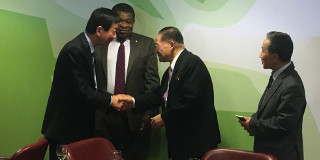
South Korean MP Young Chin and North Korean official Ri Jong Hyuk meet in Geneva

The bigger news was in South Korea, however, where the National Intelligence Service (NIS) offered a report to the National Assembly on the peace process, saying they believe “North Korea is strongly committed to dialogue and also committed to denuclearization.”

Posted in Uncategorized | Tagged: , , | Leave a Comment »