MCViewPoint

Opinion from a Libertarian ViewPoint

Posts Tagged ‘Dwight D. Eisenhower’

The “Acid Rain” Scare and the Science-Industrial Complex | Mises Wire

Posted by M. C. on December 17, 2021

Moreover, science as much as possible was to be a meritocracy in which education, ability, insight, and perseverance determined the success of a scientist. Today, success depends more upon one’s ability to promote progressive narratives, and entry into the research fields themselves are now increasingly determined by one’s sex, ethnicity, and other characteristics that have nothing to do with one’s ability to conduct scientific inquiry.

https://mises.org/wire/acid-rain-scare-and-science-industrial-complex

William L. Anderson

People who can recall or who are aware of President Dwight D. Eisenhower’s farewell speech to the nation in January 1961 usually remember it for his use of the phrase “military-industrial complex.” Eisenhower wrote:

This conjunction of an immense military establishment and a large arms industry is new in the American experience. The total influence—economic, political, even spiritual—is felt in every city, every State house, every office of the Federal government. We recognize the imperative need for this development. Yet we must not fail to comprehend its grave implications. Our toil, resources and livelihood are all involved; so is the very structure of our society.

In the councils of government, we must guard against the acquisition of unwarranted influence, whether sought or unsought, by the military-industrial complex. The potential for the disastrous rise of misplaced power exists and will persist.

It is not an understatement to say that Eisenhower’s warning not only was unheeded but also was prophetic, and the endless military involvement of US armed forces around the world for the past half century is proof that the president was right. However, the speech contained another warning about the role of science and scientists in our society that also went unheeded:

Akin to, and largely responsible for the sweeping changes in our industrial-military posture, has been the technological revolution during recent decades.

In this revolution, research has become central; it also becomes more formalized, complex, and costly. A steadily increasing share is conducted for, by, or at the direction of, the Federal government.

Today, the solitary inventor, tinkering in his shop, has been overshadowed by task forces of scientists in laboratories and testing fields. In the same fashion, the free university, historically the fountainhead of free ideas and scientific discovery, has experienced a revolution in the conduct of research. Partly because of the huge costs involved, a government contract becomes virtually a substitute for intellectual curiosity. For every old blackboard there are now hundreds of new electronic computers.

The prospect of domination of the nation’s scholars by Federal employment, project allocations, and the power of money is ever present and is gravely to be regarded. Yet, in holding scientific research and discovery in respect, as we should, we must also be alert to the equal and opposite danger that public policy could itself become the captive of a scientific-technological elite. (emphasis mine)

See the rest here

Be seeing you

Posted in Uncategorized | Tagged: , , | Leave a Comment »

From Marshall to Milley – The American Conservative

Posted by M. C. on September 24, 2021

Four star generals and the process of their promotion, then and now, are worlds apart.

Four stars now automatically become part of a mutual general officer admiration society, that cheers even mediocre performance in general officers chosen for high command, because, like “made men” in the Mafia, senior leaders agree not to turn on their peers.

https://www.theamericanconservative.com/articles/from-marshall-to-milley/

Politics
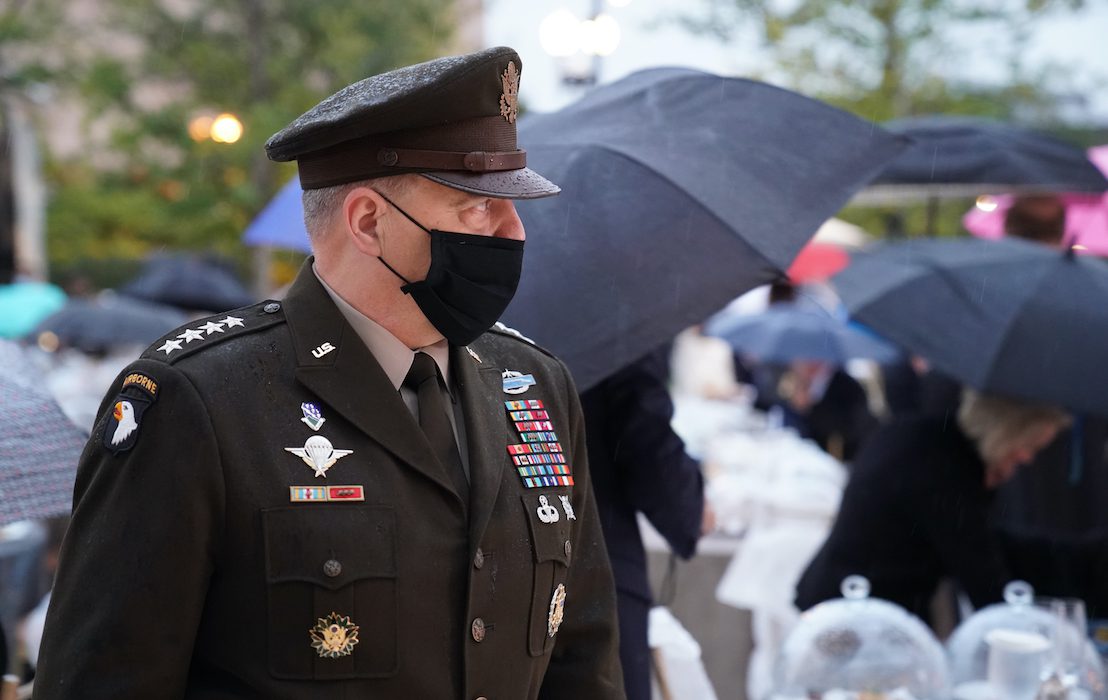
(By Phil Pasquini/Shutterstock)

Douglas Macgregor

On September 1, 1939, Brigadier George C. Marshall took the oath of office as the 15th U.S. Army chief of staff, a post he held until November 1945. When the ceremony ended, General Marshall confided to his aide de camp, “There is enough dead wood in the Army’s officer corps to light several forest fires.”

Marshall was more right than he knew. If the U.S. Army and Army Air Corps fought shoulder to shoulder with the French Army in 1940, American arms would have suffered the same fate as the French and British Armies—total defeat at the hands of the German Wehrmacht. This fact was made painfully obvious 14 months after the Second World War broke out.

In February 1943, 11,000 German troops smashed through the 30,000 soldiers of the U.S. Army’s II Corps at Kasserine Pass. The U.S. commander, Major Gen. Lloyd Fredendall, a swaggering blowhard, was relieved and sent home. It was not the last time that a cigar-chewing imitation of a real general would fail in action against the German onslaught, but the experience strengthened Marshall’s intolerance of general officer failure in action.

Dwight D. Eisenhower thought Marshall had picked Fredendall—an officer with no combat experience despite serving in the First World War—but Fredendall was actually chosen for command by Lieutenant Gen. Lesley McNair for the energy he demonstrated in training. Though Fredendall had not gone ashore to join his troops until the fighting was over, Eisenhower decorated Fredendall for the II Corps’ successful landing in North Africa. Sadly, once Fredendall was selected for the wrong reasons, only disaster in combat with a capable opponent could reveal Fredendall’s deficiencies as a battlefield commander.

Unfortunately, the practice of tolerating mediocre officers with friends and sponsors in the four star ranks persists today.

Today, the task of finding senior military leaders with character, competence and intelligence is immeasurably harder than it was in Marshall’s day. Under the Bush and Obama administrations, the American media’s adulation for four stars transformed general officers such as Petraeus, McChrystal, Mattis, Allen, and Austin into instant celebrities.

Four stars now automatically become part of a mutual general officer admiration society, that cheers even mediocre performance in general officers chosen for high command, because, like “made men” in the Mafia, senior leaders agree not to turn on their peers. Eliminating failed general officers, even when failure is found out the hard way in action, is deemed dangerous to a promotion system based on nepotism that presents itself as infallible.

Political leaders are of no help. Almost no one in the Senate asked relevant questions of nominees for four stars after 9/11—questions like: Is this mission really achievable? Will the proposed operations have a decisive impact and accomplish the mission? What do Americans gain if this the proposed operation actually works? And what do the American People lose if the mission fails? Should Americans really expect the Army and Marine Corps to impose a Western system of government on Iraq or Afghanistan? Are cultures really congruent?

Consequently for aspiring four stars, advocating the commitment of more soldiers, more cash, and more time in Afghanistan and Iraq became customary. Carrying on the failed policies of the military and political leaders who nominated them for four stars ensured that the future four stars would have a chair when the music stopped. Senators and Congressmen either could not evaluate the nominees or they were reluctant to admit that the system had gotten things wrong from the beginning.

Rather than address the hard issues, political oversight of the armed forces focuses more on policies designed to please constituents or create jobs in their states and districts, policies that neuter the military’s ability to punish substandard performers or to link promotion to merit. The end result justifies the divisive practice of advancing individuals—frequently women and minorities—who are less qualified or not otherwise “selectable” by reducing the numbers of qualified individuals from selection to create spaces.

Clearly, officers who express concern about these policies do not go unnoticed in political circles. These officers are frequently viewed as politically unreliable and are eliminated from promotion to the senior ranks. However, those officers who strongly identify with these policies make themselves known not only to their superiors in uniform, but to members of the House and Senate with an interest in promoting their ideological fellow travelers in uniform to flag rank in the armed forces.

The point is that General Mark Milley is not an isolated example. He’s the product of an environment that has existed for nearly 30 years, if not longer. Behind Mark Milley stand another two dozen four stars ready to take his job that are indistinguishable from him in their attitudes and career patterns.

Is the situation hopeless? History answers with an emphatic “No.”

After the defeat of the U.S. Army’s II Corps, General Sir Harold Alexander, Eisenhower’s British deputy, commented on Fredendall to his American allies, “I’m sure you must have better men than that.” Eisenhower agreed. Major Gen. Patton, a man who but for the outbreak of WWII would have retired as an obscure cavalry colonel, replaced Fredendall.

Will the abysmal outcome in Afghanistan, or the revelations that four stars actively conspired with President Trump’s opponents to undermine his authority, make any difference to how we select the brass? Time will solve the mystery.

Douglas Macgregor, Col. (ret.) is a senior fellow with The American Conservative, the former advisor to the Secretary of Defense in the Trump administration, a decorated combat veteran, and the author of five books.

Be seeing you

Posted in Uncategorized | Tagged: , , , | Leave a Comment »

The Atomic Bombing of Japan, Reconsidered | Mises Wire

Posted by M. C. on January 2, 2019

Russia’s move, in fact, compelled the Japanese to consider unconditional surrender

japan was ready for conditional surrender for months, the country was starving.

Stalin declared against Japan to have an excuse to ransack China. There is a school of thought that the real reason we dropped the bomb was to send Russia a message.

https://mises.org/wire/atomic-bombing-japan-reconsidered

In the summer of 1945, President Harry Truman found himself searching for a decisive blow against the Empire of Japan. Despite the many Allied victories during 1944 and 1945, Truman believed Emperor Hirohito would urge his generals to fight on. America suffered 76,000 casualties at the battles of Iwo Jima and Okinawa, and the Truman administration anticipated that a prolonged invasion of mainland Japan would bring even more devastating numbers. Even so, plans were drawn up to invade Japan under the name Operation Downfall.

The estimates for the potential carnage were sobering; the Joint Chiefs of Staff pegged the expected casualties at 1.2 million. Staff for Admiral Chester Nimitz and General Douglas MacArthur both expected over 1,000 casualties per day, while the personnel at the Department of the Navy thought the totals would run as high as 4 million, with the Japanese incurring up to 10 million of their own. The Los Angeles Times was a bit more optimistic, projecting 1 million casualties.

With those numbers, it’s no wonder the US opted to (literally) take the nuclear option by dropping Little Boy on Hiroshima on August 6, and then Fat Man on Nagasaki on August 9. Japan formally surrendered 24 days later, sparing potentially millions of U.S. servicemen, and vindicating the horrifying-yet-necessary bombings.

At least this is the common narrative that we’re all taught in grade school. But like so many historical narratives, it’s an oversimplification and historically obtuse. Read the rest of this entry »

Posted in Uncategorized | Tagged: , , , , | 1 Comment »

Tomgram: Andrew Bacevich, How We Learned Not To Care About America’s Wars | TomDispatch

Posted by M. C. on October 10, 2017

In short, a country of sheeple.

http://www.tomdispatch.com/post/176335/tomgram%3A_andrew_bacevich%2C_how_we_learned_not_to_care_about_america%27s_wars/#more

Americans don’t attend all that much to ongoing American wars because: 

1. U.S. casualty rates are low. By using proxies and contractors, and relying heavily on airpower, America’s war managers have been able to keep a tight lid on the number of U.S. troops being killed and wounded.

2. The true costs of Washington’s wars go untabulated.  In a famous speech, dating from early in his presidency, Dwight D. Eisenhower said that “Every gun that is made, every warship launched, every rocket fired signifies, in the final sense, a theft from those who hunger and are not fed, those who are cold and are not clothed.” Read the rest of this entry »

Posted in Uncategorized | Tagged: , , | Leave a Comment »