
MCViewPoint

Opinion from a Libertarian ViewPoint

Posts Tagged ‘egalitarian’

My Corner by Boyd Cathey-Liberty or Equality: You Cannot Have Both

Posted by M. C. on March 12, 2021

Over the past half century and more we have witnessed a different kind of revolution; it does not employ as weapons of choice the tank and bayonet, nor the Gulag as the final destination for unrepentant opponents. It leaves nothing of substance behind in its wake. It is an unfolding, all-encompassing cultural movement, subverting and then incorporating in its service diverse extreme revolutionary elements injected into our educational system, into our entertainment industry, into our politics, even into the very language we use to communicate with each other. The “violence” it metes out is mostly of a cerebral nature, not of the physical kind, but rather predicated on shame, humiliation, and the fear of the loss of a job or reputation.

http://boydcatheyreviewofbooks.blogspot.com/

Friends,

Occasionally I will write and publish longer, more detailed articles and essays for The New English Review. These essays are normally about classical music, philosophy, even a short story and a poem or two. They are not keyed necessarily or directly to specific current events. They usually differ from the shorter pieces of political and social commentary that a reader will find here at My Corner by Boyd Cathey.

Last night I went back and reread one of those longer essays. And I thought—given the Harris/Biden administration’s insane emphasis on what they call “equity,” and the dogmatic imposition of “equality” (which is whatever the progressivist Left currently defines it as)—that I might dust it off and offer it here. I think it gets into and explores the rickety structure, the utter egalitarian fakery that is being imposed on us and on our society, and, in fact, the slogan behind which all sorts of unnatural and devastating—and Satanic—evil is shoved down our throats and pounded into the malleable brains of our captive children.

I pass it on here:

Facing the Egalitarian Heresy of the 21st Century

by Boyd Cathey (March 2020)

Poet Henry Wadsworth Longfellow, in The Masque of Pandora, writes, “Whom the gods would destroy, they first make mad.” He was not the first to use a version of the phrase, which is found in Sophocles’ play, Antigone. But the meaning has been fairly consistent for over two millennia.

Aren’t we witnessing this today?

A large number of our fellow citizens seem possessed by a kind of madness. They seem to exist in a kind of parallel universe, with its own set of beliefs, its own standards of truth and particular narrative of facts. In almost every respect this universe represents the contrary, the negation, of the inherited, rooted foundation on which our historic Western and Christian civilization is based.

This contrary reality did not all of a sudden spring up, it has existed and been cultivated and nurtured for centuries. Its founding ideologues understood that their premises and desired objectives ran up full force against the ingrained traditions and historic legacy of a culture and civilization that traced its origins not only to the beliefs of the ancient Hebrews, but also to the highest art, philosophy and statecraft of the Greeks and Romans.

Encouraged by the Emperor Constantine at the First Council of Nicaea (325 A.D.) and two centuries later by the Emperor Justinian the Great, the empire both East and West recognized the primacy of Divine Positive Law—the laws and revealed teachings of God and His Church. But not only that: this transformation signaled the explicit foundation of Europe based not only on Revelation, but also upon the reality of Natural Law, those rules inscribed in nature and integral to it that also have as their Author, God Himself. The Christian civilization that came about was built securely and firmly not only on Holy Scripture but also the traditions and the legacy of those ancient cultures that were not destroyed by the Faith, but fulfilled and completed by it.

In the incredibly rich inheritance of ancient philosophy there was a recognition that there were discernible “laws” which govern the orderly operation and functioning of the social order and make possible a harmonious communal existence within society. What the Christian church did was to confirm the existence of those laws while adding a capstone, a divine sanction and specificity derived from Revelation and the teachings of Jesus Christ and the Church. Thus, this transformation of ancient society was prescriptive, conservative in the best sense of that word.

Is this template not the exact opposite of the modernist, progressivist revolution which seeks to cut society off from its inheritance, depriving it of the accumulated wealth of that heritage?

No doubt, change and reform, in some degree, always must occur in society. But these changes do not affect the necessity of our acceptance of the unaltered and unalterable higher laws given by God or the laws inscribed in nature. Rather, they occur on a practical level in any well-functioning society. There is a quote from Prince Giuseppe di Lampedusa’s famous novel describing the revolutionary turmoil of mid-19th century Italy, The Leopard (Il Gattopardo): “Things will have to change in order that they remain the same.” In 1963 director Luchino Visconti directed an exquisite film of the same name based on that novel, starring, quite improbably, Burt Lancaster. The film vividly portrays the tensions between the immemorial past and the circumstances created by political and social change.

What Lampedusa’s principle character, the Prince of Salina is saying is that no society—no culture—can completely denude itself of its inheritance and its history and actually survive. And more, a denial of natural law and the Divine Positive Law ends catastrophically. Such experiments in total revolutionary transformation have inevitably ended in violent bloodshed and incredible destructiveness—in the massacres of the French Revolution, and more recently, in the Gulag and the concentration camp, or in blood-soaked Maoism.

Over the past half century and more we have witnessed a different kind of revolution; it does not employ as weapons of choice the tank and bayonet, nor the Gulag as the final destination for unrepentant opponents. It leaves nothing of substance behind in its wake. It is an unfolding, all-encompassing cultural movement, subverting and then incorporating in its service diverse extreme revolutionary elements injected into our educational system, into our entertainment industry, into our politics, even into the very language we use to communicate with each other. The “violence” it metes out is mostly of a cerebral nature, not of the physical kind, but rather predicated on shame, humiliation, and the fear of the loss of a job or reputation. It plays on the natural human desire for conformity, while steadily upping the ante in our laws—constantly moving the goalposts of what is acceptable and unacceptable. It is the kind of intellectual “violence” now writ large that once impelled people to look the other way when their neighbors were hauled off to Siberia under Comrade Stalin, or to Dachau under Hitler. But, arguably, it is worse, for it denies the very existence of those immutable laws that govern the universe.

It has been highly effective, utilizing as its major weaponry the terrifying twins, the inexpungable accusations of “racism” and “sexism,” and a whole panoply of sub-terms that accompany such charges: “white supremacy,” “historic white oppression,” “colonialist imperialism,” “misogyny,” “toxic masculinity,” and increasingly expanded to incorporate terms like “anti-migrant” or “anti-transgender” bigotry.

The overarching desire of this progressivist revolution is, in fact, not reform—not what Lampedusa’s Prince of Salina says consolingly about some things changing so that other things can remain the same. No, it is incredibly “post-Marxian,” making the older Communist and Marxist revolutionary dreams seem tame in comparison. It invokes and demands a total transformation in which nearly all, if not all, of those institutions, those traditions, and that inheritance vouchsafed to us from our ancestors is rudely discarded, rejected, and condemned as racist, sexist, fascist—in other words, our remembered past is cut off from us.

This progressive revolution is predicated on the idea of equality. Yet, in fact, the equality as envisaged does not exist and has never existed in nature. For revolutionary “equality” is a slogan, in reality an exercise in guile and subterfuge employed to shame and cajole a weak-willed and gullible citizenry into eventually dissolving the traditional social bonds and inherited natural (and moral) laws that have governed our culture for two millennia. Its true objective is domination over and power in society.

As an increasingly independent outgrowth of an historic cultural Marxism formulated decades ago and insinuated into our educational systems and entertainment industry, this assault on our historic culture makes the template of the old Soviet Communists appear conservative. Josef Stalin would never have, and never did, put up with same sex marriage, transgenderism, or the kind of feminist extremism we see around us today. True, the Soviets talked of equality, and women occupied some professional positions, but for the Reds a strong family and observance of supposedly “outdated” traditional morality were still important.

Revolutionary equality, in the form of egalitarianism, is not only a rebellion against the Divine Positive Law, but also against Nature, that is, against the way things are and function naturally in our world, those workings and that usual consistency observed as prescriptive laws for thousands of years.

There is a parable in the Gospel of St. Matthew, the Parable of the Talents (Mt. 25:14-30; The Parable of the Bags of Gold/NIV), which both mirrors and confirms those laws. The three servants of the Master are given unequal amounts and told to be faithful stewards and invest the talents wisely. The first two, those with the largest amounts, comply and double their accounts; but the servant with the least amount fails to use his one Talent, and thus is condemned: “You wicked and lazy slave! You knew, did you, that I reap where I did not sow, and gather where I did not scatter? . . . So take the talent from him, and give it to the one with the ten talents . . . As for this worthless slave, throw him into the outer darkness, where there will be weeping and gnashing of teeth.”

See the rest here

Boyd D. Cathey was educated at the University of Virginia (MA, Thomas Jefferson Fellow) and the Universidad de Navarra, Pamplona, Spain (PhD, Richard M. Weaver Fellow). He is a former assistant to the late author, Dr. Russell Kirk, taught on the college level, and is retired State Registrar of the North Carolina State Archives. Has published widely and in various languages. He resides in North Carolina.

Be seeing you
Posted in Uncategorized | Tagged: , , , , , | Leave a Comment »

Why There’s a Left-Right Divide among Libertarians | Mises Wire

Posted by M. C. on September 6, 2020

So while thin libertarians are primarily concerned with limiting state power and protecting private property, it is thick libertarians who often seek to infuse their political philosophy with leftist social justice exhortations and calls to fight injustice and racism everywhere, even if the state must eventually be invoked as an intervening power (e.g., Gary Johnson’s “bake the cake” fiasco, or Jo Jorgensen’s recent Tweet). As Rockwell has noted, this has happened before, with what he sees as the degradation of classical liberalism into today’s American “liberalism.”

https://mises.org/wire/why-theres-left-right-divide-among-libertarians?utm_source=Mises+Institute+Subscriptions&utm_campaign=a777ee7200-EMAIL_CAMPAIGN_9_21_2018_9_59_COPY_01&utm_medium=email&utm_term=0_8b52b2e1c0-a777ee7200-228343965

Amid the sociocultural convulsions and boutique displays of urban anarcho-tyranny that have taken place in America in recent months, there has been renewed discussion within certain circles of the liberty movement about how appropriate it is for libertarians and their intellectual brethren to self-identify as “right-wing” or “left-wing.” While libertarianism itself, which merely requires adherence to the nonaggression principle (NAP) and a desire to minimize or abolish state power, need not be considered a “right-wing” or “left-wing” political philosophy, I contend (from a decidedly right-wing perspective) that individual libertarians are almost certainly on the right or on the left.

All too often, libertarian infighting and internecine squabbles come across as mere navel gazing, with many mainstream libertarians—especially Libertarian Inc.—insisting that they have heroically transcended the old left-right spectrum. (Strangely enough, some libertarians seem to believe that this spectrum primarily pertains to red/blue politics.) Nevertheless, in recent months there have been some important conversations touching upon rights, human nature, the left-right spectrum, and what being a libertarian actually means. These conversations have taken place on podcasts such as Dave Smith’s Part of the Problem, Free Man Beyond the Wall, and The Tom Woods Show, among others.

I believe that these conversations are quite useful, as they might help convince some libertarians to abandon the hackneyed idiocy of defining and summing up the movement as “economically conservative but socially liberal.” It is a cheap cop-out, and individual libertarians should not shy away from accepting a “right-wing” or “left-wing” label; in fact, attempting to do so is an exercise in futility.

Stripped down to its very core, being right-wing entails a defense of natural hierarchies and a recognition that human beings are not all the same. This is consonant with thinkers from Aristotle all the way through the “revolutionary” leaders of the American War for Independence. Thomas Jefferson—admittedly not typically cited as a right-winger—voiced this sentiment in a letter to John Adams:

I agree with you that there is a natural aristocracy among men. The grounds of this are virtue and talents….The natural aristocracy I consider as the most precious gift of nature, for the instruction, the trusts, and government of society.

Many on the right augment their worldview by noting that there is an objective moral order in the universe—and that it is knowable to us. Imperfect human beings are capable of great evil but also incredible acts of love, mercy, courage, and creativity. The embrace of an objective moral order (i.e., natural law) can be traced back to Catholic scholastics such as Thomas Aquinas and, later on, the Jesuit thinkers of the School of Salamanca (whom Murray Rothbard considered to be proto-Austrians in their approach to economics).

The very understanding that we are born with inherent natural rights is a sine qua non for civil society that is embraced by most anarcho-capitalists, propertarians, “paleolibertarian” minarchists, Ron Paul supporters, and true conservatives on the right. They recognize that the sacrosanct rights to private property and free association do not come from any government or collective entity.

Critics of the Right toss around (what they believe to be) slurs such as “reactionary” and “counterrevolutionary.” Yet, as Jeff Deist and others have argued, when considering the twentieth century’s long and disastrous litany of egalitarian and statist experiments here in the United States (e.g., the institution of the federal income tax, the Federal Reserve, the popular/democratic election of US senators, the New Deal, the Great Society), it is almost impossible for a libertarian NOT to take up a reactionary stance against these statist usurpations. After all, right-wingers contend that not all changes to civil society are desirable and that not all novelty serves the good. There might even be a modicum of wisdom from past generations that should be retained and imparted to future generations.

The Left, on the other hand, is defined by a devotion to egalitarianism, fighting for what they define as “oppressed” groups, and working for what they see as social and economic justice. They typically promote radical social change and keeping the ancien regime in a state of upheaval, believing that “inclusion” and tolerance are more appropriate for a progressive polity than reactionary morality and societal mores.

It is a leftist view that human beings are not born with intrinsic natural or God-given rights; rather, they are granted and assured those rights by the state or the collective. Any differences that might exist between human beings—whether disparities in wealth, innate abilities, health, intelligence, or even biological sex—could be unjustly exploited, so it follows that there might be a much bigger role for the state.

There are a variety of different economic views among left libertarians. Some adhere to anarcho-socialism and mutualism as described by Pierre-Joseph Proudhon. Others on the left practice countereconomics and agorism as promulgated by Samuel Konkin. All left libertarians are against economic and military imperialism; many of them recognize the labor theory of value, along with the rejection of private ownership of natural resources and the means of production, as fundamental economic principles.

In many instances, the line between left libertarians and right libertarians roughly approximates the delineation between “thick” and “thin” libertarianism. Thin libertarians merely believe in the NAP, the inviolability of private property, and the illegitimacy of state violence. Under subsidiarity principles, any government that is allowed to exist has its relatively small, distinct sphere of influence, and it must not intrude upon local communities—and especially not the family. Thick libertarians usually go much further, though. As Lew Rockwell has argued:

Proponents of a “thick” libertarianism suggest that libertarians are bound to defend something more than the nonaggression principle, and that libertarianism involves commitments beyond just this. One such proponent recently said, “I continue to have trouble believing that the libertarian philosophy is concerned only with the proper and improper uses of force.”

So while thin libertarians are primarily concerned with limiting state power and protecting private property, it is thick libertarians who often seek to infuse their political philosophy with leftist social justice exhortations and calls to fight injustice and racism everywhere, even if the state must eventually be invoked as an intervening power (e.g., Gary Johnson’s “bake the cake” fiasco, or Jo Jorgensen’s recent Tweet). As Rockwell has noted, this has happened before, with what he sees as the degradation of classical liberalism into today’s American “liberalism.”

Certainly, it is possible for left libertarians and those with “thick” tendencies to avoid the siren song of authoritarian power and live according to the NAP, but it could very well represent a constant internal ideological struggle. After all, who would enforce the far left’s desired ban on privately held land and factories? Who would step in and prevent workers from being exploited? What entity will outlaw discrimination, curtail racism, and punish rogue bakers?

The differences in economics, ethics, and worldview among libertarians are plainly evident. When libertarians approach political and societal questions—and when they define the scope of their own libertarianism—they clearly do so from the left or from the right.

Author:

Gregory Gordon

Gregory Gordon (Twitter: @gregorysgordon) earned his Ph.D. from the Colorado School of Mines. He currently works as a geoscientist in the energy industry, and he is a lecturer in the California State University system. He resides in California with his wife and four children.

Be seeing you


Posted in Uncategorized | Tagged: , , , , | Leave a Comment »

USA: The slippery slope of egalitarian racism, by Thierry Meyssan

Posted by M. C. on July 21, 2020

The 35 Pilgrim Fathers set out from Leiden, stopped in England, and then crossed the ocean on the Mayflower. They arrived in North America in 1620 to practice their religion freely.

Freedom of religion as long as it was THEIR religion.

In the 2016 election campaign, I asked the question, “Will the United States reform or tear itself apart? » [5] In my view, only Donald Trump could allow the USA to continue as a nation, while Hillary Clinton would provoke a civil war and probably the dissolution of the country on the model of the end of the USSR. What has happened since the death of George Flyod shows that I was not mistaken.

https://www.voltairenet.org/article210521.html

by Thierry Meyssan

The reactions to the murder of black George Flyod by a white policeman do not refer to the history of slavery in the United States, but – like the systemic opposition to President Trump- to a profound problem in Anglo-Saxon culture: Puritan fanaticism. The domestic violence that rocked this country during the two civil wars of Independence and Secession must be remembered in order to understand current events and prevent their resurgence. Beware: in the United States, the political class now preaches egalitarian racism. All equal, but separate.

The Anglo-Saxon Puritans

About four hundred members of the Church of England fled their country where they were considered fanatics. They took refuge in Leiden, Holland, where they were able to live according to the Calvinist tradition, or more precisely the Puritan interpretation of Christianity. Probably at the request of King James I, they sent two groups to the Americas to fight against the Spanish Empire. The first founded what was to become the United States, the second was lost in Central America.

Later, the Puritans took power in England with Lord Cromwell. They beheaded the Papist King Charles I, established an egalitarian Commonwealth and colonized Ireland, massacring Catholics en masse. This bloodthirsty experiment was short-lived and discredited for a long time the idea of a General Interest (Res Publica) in the eyes of the English.

The 35 Pilgrim Fathers set out from Leiden, stopped in England, and then crossed the ocean on the Mayflower. They arrived in North America in 1620 to practice their religion freely. During their voyage, they signed a Covenant in which they vowed to establish a model society (strict observance of the Calvinist faith and cult, intense community life, and unfailing social and moral discipline). By creating the Colony of Plymouth, they hoped to build the “New Jerusalem” after fleeing from the “Pharaoh” (James I) and crossing the “Red Sea” (the Atlantic). After a year, they thanked God for their epic, which is commemorated each year as Thanksgiving. [1] They established their capital city 60 kilometers north, in Boston. Their community veiled its women, practiced public confessions and corporal punishment.

JPEG - 34 kb
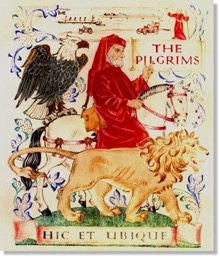
The logo of the very powerful Pilgrim’s Society: the Pilgrim Father is depicted alongside the British lion and the American eagle.

These events are not only myths that every American should know, they shape the political system of the USA. Eight out of 45 presidents (including the Bushes) are direct descendants of the 35 “Pilgrim Fathers”. Despite the arrival of tens of millions of immigrants and institutional appearances, their ideology remained in power for four centuries, until the election of Donald Trump. A very closed club, Pilgrim’s Sociey, brought together, under the authority of the English monarch, very high British and American personalities. It set up the “Special Relationship” between London and Washington and, among other things, provided many secretaries and advisers to President Obama.

Many ceremonies planned this year for the 400th anniversary of the Mayflower have been cancelled due to the fight against the coronavirus epidemic, in particular the conference that the former British National Security Advisor was to give at Pilgrim’s Society. Bad tongues assure that the epidemic will end the day after the US presidential election, if Donald Trump loses it, and that the festivities can then take place.

There are two cultures that have always been opposed in the United States among Christians: Calvinists or Puritans on the one hand, and Catholics, Anglicans and Lutherans on the other. While some “denominations” among the eight hundred US churches resolutely line up on one side, most are crossed by both because Puritanism has no defined theological corpus. It is rather a way of thinking.

The War of Independence began in 1773 with the Boston Tea Party. Its first actor was John Adams, another direct descendant of one of the 35 “Pilgrim Fathers” and second president of the United States. While the call for independence was made by the political journalist Thomas Paine based on religious arguments although he himself did not believe in anything.

In a way, the War of Independence was a continuation in the Americas of Lord Cromwell’s British Civil War (the “Great Rebellion”). This conflict would resurface a third time with the Civil War, which, it should be remembered, had nothing to do with slavery (both sides practised it at the beginning of the war and both sides repealed it during the war to hire former slaves into their armies).

The Puritans lost in England with Cromwell’s Republic, but won the next two times in the United States. Historian Kevin Phillips, who was Republican electoral adviser to Republican Richard Nixon (descendant of a brother of one of the 35 “Pilgrim Fathers”), has studied this conflict at length over the centuries. [2] It is on the basis of this data that he imagined the strategy of “Law and Order” in the face of the segregationist Democrat George Wallace in the 1968 presidential election; a strategy that Donald Trump has taken up again for the 2020 election.

All this to say that appearances are deceiving. The dividing lines are not where the rest of the world thinks they are.

- The Puritans have always supported absolute equality, but only among Christians. They long forbade Jews from entering the civil service and massacred the Indians they claimed to love. During the American Civil War, they extended their egalitarianism to blacks (unlike the Puritans in southern Africa, who defended apartheid to the end), giving rise to the false myth of a war against slavery. Today, they defend the idea that humanity is divided between equal and, if possible, separate races. They are still reluctant to call them interracial marriages.

- The Puritans place lying at the bottom of their scale of values. It cannot be for them a ruse, but always the worst of crimes, far more serious than robbery and murder. In the seventeenth century, they punished with the whip for lying to a pastor for any reason. They established laws that still punish lying to a federal official for any reason.

US Evangelism

With time, and particularly in the 19th century, another current of thought arose within American Christianity: evangelism. These are Christians of all denominations who try to get closer to the original Christianity of which they know little. So they rely on the sacred texts. Like the Puritans, the Evangelicals are fundamentalists, i.e. they give the Scriptures the role of a divine word and interpret them while refusing any contextualization of the texts. But they are much more pragmatic. On everything, they have a position of principle, but when faced with a problem, they act in conscience and not according to the rules of their community.

It is very easy to make fun of the grotesque convictions of the Evangelicals against the theory of evolution, but this is of little importance and they abandon it when necessary. It is much more significant, but unfortunately rarer, to denounce the puritanical vision of a humanity divided into distinct, equal, but separate races. Yet this has serious consequences on a daily basis.

The Puritans remained the masters of U.S. politics until 1997, when Libertine President Bill Clinton issued an executive order banning all expressions of religious faith in federal institutions. The result was a shift in religion from the Administration to the private sector. All major corporations accepted prayer groups in their workplaces. This shift favored the public emergence of Evangelicals at the expense of Puritans.

JPEG - 29.7 kb
During the riots outside the White House, President Trump went to St. John’s Episcopal Church to present himself, Bible in hand, as the defender of the religious beliefs of all Christians in the face of Puritan fanaticism.

The Return of Puritan Fanaticism

The conflict between the Puritans and the rest of society is today taking a radical and religious turn. It opposes two mentalities, one idealist, egalitarian within their community and fanatical, the other sometimes even more extravagant, agreeing on inequalities, but realistic.

Puritan Hillary Clinton hesitated to become a Methodist pastor after her failure in the presidential election [3]. She sinned a lot (her affair with Vince Foster), was punished by God (her husband’s affair with Monica Lewinsky) repented (within the Pentagon Family [4]) and was saved. She is sure that she was chosen by God and takes pride in her violence against non-Christian peoples. She supports all wars against the “enemies of America” and hopes to see the return of Christ.

On the contrary, Donald Trump shows no interest in theology, has only an approximate knowledge of the Bible and a summary faith. He has sinned as much as anyone else, but boasts of what he has achieved rather than repenting of his sins in public. He doubts himself and compensates for his feeling of inferiority with excessive egotism. He loves to compete with his enemies, but does not want to destroy them. In any case, he embodies the will to restore the greatness of their country (“Make America Great Again!”) rather than to pursue wars always and everywhere, which makes him the champion of the Evangelicals against the Puritans. He offers the opportunity for Christians to reform themselves rather than convert the world.

In the 2016 election campaign, I asked the question, “Will the United States reform or tear itself apart? » [5] In my view, only Donald Trump could allow the USA to continue as a nation, while Hillary Clinton would provoke a civil war and probably the dissolution of the country on the model of the end of the USSR. What has happened since the death of George Flyod shows that I was not mistaken.

JPEG - 46.3 kb
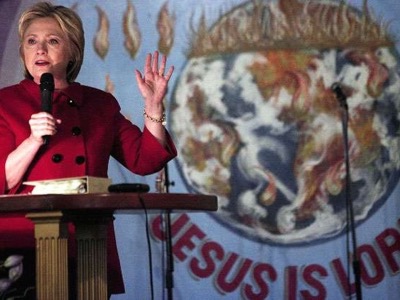
Hillary Clinton during the 2016 election campaign.

Hillary Clinton and Democratic Party supporters are imposing their ideology. They fight against lies and destroy statues like their Puritan ancestors burned the Salem witches. They develop an absurd reading of their own society, denying social conflicts and interpreting inequalities only in terms of so-called distinct human races. They disarm the local police and force “white” personalities to apologize in public for enjoying an invisible privilege.

In the Russian case, the discontinuation of the prosecution of former National Security Advisor Michael Flynn and the presidential pardon granted to Donald Trump’s former advisor, Roger Stone, sparked angry protests from Puritans. Neither man harmed anyone, but they dared to lie to the FBI to keep him out of the White House.

The mayor of Minneapolis (the town of George Flyod) was publicly humiliated for refusing to disband the “racist” city police. While Seattle City Council has just cut its city police budget in half. This does not bother the upper social classes living in private residences, but deprives those who cannot afford private security guards.

The Associated Press, then the New Yok Times, the Los Angeles Times and soon almost all US media, decided to write Black with a capital letter when referring to “race” [6], but not White in the same way. Indeed, the fact of writing White with a capital letter is a distinctive sign of the white supremacists [7].

The Pentagon considered renaming its military bases with the names of southern personalities accused of being “racist” and sent an e-mail to all civilian and military personnel of the US Army denouncing as “extreme right” the claim that there is only one human race. Although these initiatives have provoked a strong reaction from the trumped-up GIs and have failed, they mark a very dangerous escalation [8].

All these decisions demonstrate a loss of collective rationality.

Translation
Roger Lagassé
Be seeing you


Posted in Uncategorized | Tagged: , , , , , | Leave a Comment »