
The Federal Reserve. A Rothschild tool.
“Permit me to issue and control a nation’s currency , and I care not who writes it’s laws”
Mayer Amshel Rothschild

Enemy of the State-Read the Book-Know the Man
This is not a Safe Space but Baby, I don't care.

"I am not a number, I am a Free Man" - No. 6
 Information Liberation Alex Jones’ Prison Planet Gary North Specific Answers Antiwar The Daily Bell Tenth Amendment Center Economics Policy Journal The American Thinker The New American Lew Rockwell
Posted by M. C. on May 21, 2025
The Federal Reserve. A Rothschild tool.
“Permit me to issue and control a nation’s currency , and I care not who writes it’s laws”
Mayer Amshel Rothschild
Posted in Uncategorized | Tagged: Bankster, Currency, Federal Reserve, Rothschild | Leave a Comment »
Posted by M. C. on May 18, 2024
The Federal Reserve is the root of all evil.
Abolishing the thing that enables the war machine and finances the MIC and it’s election contributions is a tough sell.

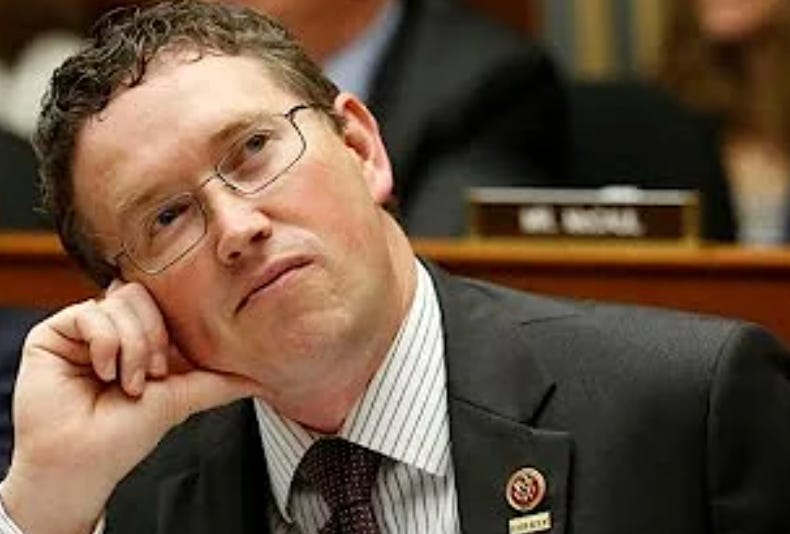
On May 15, 2024, Kentucky Congressman Thomas Massie posted on X a poll on whether he should put forward a bill to abolish the United States Federal Reserve. The poll was able to pick up 115,000 votes when it concluded on May 16.
The poll featured three options: “end the Fed,” “keep the Fed,” and “just show poll results.”
Of those votes, an overwhelming 86% majority chose to “end the Fed.”
This eventually prompted Massie to introduce, H.R. 8421, the Federal Reserve Board Abolition Act, which abolishes the Board of Governors of the Fed and its network of banks. On top of that, it repeals the Federal Reserve Act, the 1913 law that established the Federal Reserve System
“Americans are suffering under crippling inflation and the Federal Reserve is to blame,” Massie declared in a May 16 statement announcing the introduction of the bill.
“During COVID, the Federal Reserve created trillions of dollars out of thin air and loaned it to the Treasury Department to enable unprecedented deficit spending. By monetizing the debt, the Federal Reserve devalued the dollar and enabled free money policies that caused the high inflation we see today, “ Massie observed.
Massie is following in the footsteps of the legendary Congressman Ron Paul, who introduced the “Audit the Fed” bill (H.R. 1207) during the 111th Congress, which placed the microscope on the Fed’s monetary policy moves. For his part, Massie introduced his own“Audit the Fed” bill during the 114th Congress.
Through its control of the monetary supply and its ability to expand it, the Fed is one of the entities most responsible for generating inflation. This entire process results in the devaluation of the dollar, destruction of the purchasing power of money individuals hold, and the imposition of a hidden tax on working class individuals’ income and savings.
The Fed’s interventions when it comes to fixing interest rates and tinkering with the money supply, generates the dreaded economic boom and bust cycle. It also fosters bad incentives through the creation of a “moral hazard” in how it enables banks to execute speculative and high-risk lending practices based on the assumption that the Fed will bail out embattled banks for their irrational decisions.
The Fed is not only an economic cancer but also a great enabler of economic growth. It’s not a coincidence that after the creation of the Fed in 1913 it has facilitated the largest expansion of government in American history in the last 100 years.
Thankfully, Massie recognizes this and has introduced this legislation to correct over a century’s worth of bad economic decision-making. Let’s hope that other Republicans follow suit in backing Massie’s legislation.
Be seeing you
Posted in Uncategorized | Tagged: end the Fed, Federal Reserve, Federal Reserve Board Abolition Act, Thomas Massie | Leave a Comment »
Posted by M. C. on April 2, 2024
Congress should also pass legislation requiring any new spending to be offset by cuts in other federal spending and forbidding the Federal Reserve from purchasing federal debt instruments.
by Ron Paul
Last month, the US Senate passed a resolution saying the over 34 trillion dollars (and growing) national debt threatens national security. A few days later, a bipartisan majority of the Senate voted for a 1.2 trillion dollars spending bill. In addition to the usual increases in war and welfare spending, the bill funds gender transitioning for minors without parental consent and red flag laws, which allow law enforcement to seize an individual’s firearms without due process.
Before passage of the latest spending bill, the Congressional Budget Orifice (CBO) released a report predicting that the national debt would exceed the prior record of 106.4 percent of gross domestic product (GDP) by 2028. Interest payments on the national debt are estimated to reach 870 billion dollars this year, more than the government will spend on the military. The CBO estimates that, unless Congress cuts spending (which is highly unlikely), by 2051 interest on the debt will exceed not just military spending but spending on the two biggest items in the federal budget — Social Security and Medicare.
As Eric Boehm of Reason magazine points out, the CBO report understates how much federal spending will grow in the next several decades since it cannot predict what “crises” future congresses and presidents will exploit to ramp up federal spending. As Boehm suggests, someone projecting 30 years ago how much government would spend in the future would not have included the increase in spending due to 9/11, the subsequent creation of a homeland security-industrial complex, the “forever” wars in Afghanistan and Iraqi, the housing meltdown, or the covid lockdown. The hypothetical budget projection would also not have predicted legislation like the Medicare prescription drug benefit or Obamacare.
The large and growing interest on the national debt puts pressure on the Federal Reserve to keep interest rates low. The Federal Reserve’s rate increases, though relatively small, are one reason national debt payments rose by 32 percent since last year.
Be seeing you
Posted in Uncategorized | Tagged: Federal Reserve, Security Threat, Senate, Spending | Leave a Comment »
Posted by M. C. on March 5, 2024
The economic crisis will be worsened by the moral crisis caused by the belief among too many Americans at all levels of society that they have a right to government-provided economic security at the expense of their fellow citizens. This will result in violence and the growth of authoritarian political movements.
by Ron Paul
https://ronpaulinstitute.org/federal-reserve-responsibility-for-consumer-and-government-debt-crises
According to the Federal Reserve, credit card delinquencies increased by 50 percent in 2023, while consumer debt grew to 17.5 trillion dollars. A recent survey by Clever Real Estate found that three in five Americans have credit card debt and that 23 percent of Americans increase their credit card debt every month. The survey also found that 48 percent of Americans (including 59 percent of millennials) use credit cards for essential living expenses.
The overreliance on credit cards and the accompanying increase in consumer debt are consequences of our fiat money system. Since Richard Nixon severed the last link between the dollar and gold in August of 1971, the dollar’s value has declined by 87 percent based on the government’s understated Consumer Price Index numbers. This means that even though Americans’ nominal wages have increased, their real wages have declined as their dollars buy less.
The continuing erosion of the dollar’s value makes it impossible for many Americans to accumulate meaningful savings. Those Americans who can save may actually lose money by doing so thanks to the Federal Reserve’s inflation tax that erodes the value of savings. This is why Congress has felt it necessary to provide tax incentives to encourage saving for things like retirement, education, and health care.
Be seeing you
Posted in Uncategorized | Tagged: Debt Crises, Federal Reserve, Government Debt | Leave a Comment »
Posted by M. C. on February 23, 2024
Of all the government or quasi-government institutions, there is perhaps none as openly opaque in its operations and unaccountable for its failures as the Federal Reserve…
Translated: the Fed intends to “buy and then sell back at a set date and price any qualifying security from any qualifying corporation or institution,” essentially, a futures contract meant to help operations that are either illiquid or overleveraged stay in business;
Further translated: giving money to failed businesses that ought to stay failed.
https://libertarianinstitute.org/articles/and-the-winner-is-not-you
Of all the government or quasi-government institutions, there is perhaps none as openly opaque in its operations and unaccountable for its failures as the Federal Reserve. For, unlike its top rivals for this most dubious of distinctions, like the CIA, NSA, or DOD, which do their law bending and money wasting largely of sight and out of mind, the nation’s money supply is so ubiquitous, so ever-present in the lives of the ordinary person that its activities must of necessity take place before the public eye. Hence, the gradual development of Fed Speak; that is, the art of speaking so technocratically that none but the most arcanely initiated have any hope of understanding what is being said or done.
Consider a few commonplace examples, which one can find in the regularly published minutes of the Federal Reserve’s meetings:
The Fed will “conduct overnight reverse repurchase agreement operations at an offering rate of 0.8 percent and with a per-counterparty limit of $160 billion per day,” and further “engage in dollar roll and coupon swap transactions as necessary to facilitate settlement of the Federal Reserve’s agency MBS transactions.”
Mm-hm. Yes. Indeed—perfectly clear.
Translated: the Fed intends to “buy and then sell back at a set date and price any qualifying security from any qualifying corporation or institution,” essentially, a futures contract meant to help operations that are either illiquid or overleveraged stay in business; and, further towards that end, the Fed intends to “continue to sell short various portions of its now nearly $3 trillion in mortgage backed security holdings,” again in an effort to help illiquid or highly levered dealers and traders of these securities stay liquid.
That Fed Speak elides more than it illuminates is, of course, intentional and operates on a number of levels: first, no ordinary person understands any of this; second, those who do understand benefit from these arrangements, i.e. the major banks, and consequently love it and have lobbied for it; and, lastly, the above combination along with their desire to pass the buck to anyone else means your congressional reps have no interest in intervening with the Fed’s activities, even when it blatantly violates the rules Congress put in place when it set the Federal Reserve up—all Fed purchases having been statutorily mandated to occur in the “open market,” that is at market prices (i.e. not executed as futures contracts).
Lev Menand’s latest book, which I reviewed last year, for all its sympathy for the Federal Reserve’s activities (having been himself an employee), could not avoid deeming the Fed completely out of control, acting since 2008 and through COVID without any bounds at all: an exploding balance sheet, unlimited credit facilities for troubled banks—this is not “Free Market Capitalism,” but rank corporatism, and a major reason young people increasingly view socialism or populist conservatism as preferable alternatives.
For, much like the national security establishment, it isn’t as though these gross violations of the principles of liberal, capitalist government have even produced any notable successes: quite to the contrary, they have produced little but abject failure.
Consider, first, its primary mandate, price stability. Even if you buy the argument for the Fed’s inflation targeting (macroeconomic voodoo), as should be clear by the Fed’s own tracking of its expansion of the money supply and concurrent inflation measures, including not just consumer and producer price indexes but also asset price inflation, it has been running the money printer at a far higher clip than the 2% they claim to be the annual target (see graphs below—and note that the Nasdaq, the index most heavily skewed toward non-dividend paying, high-growth potential technology companies grew the fastest and the most since 2008, a consequence of the lower discount rate the Fed’s looser monetary policy preferences required).
Further, even assuming the Fed hits their 2% annual target, everyone who has seen the infamous graph illustrating the loss of the dollar’s purchasing power since the Fed’s inception will no doubt be aware that by the turn of the next century the value of a dollar in the intervening seventy-plus years would have been further halved.
As far as its second mandate, full employment (yet more macroeconomic voodoo), unless you want a McJob or other insecure work in the so-called “gig economy,” the Federal Reserve’s market distortions have played a central role in undermining investment in the real, rather than the financial, economy.
Whether like Friedrich Hayek you believe currency of choice, the denationalization of money, is the answer, or like Ron Paul believe it is time to simply End the Fed, it is beyond time for public debate to pull back the curtain on the Fed’s language games and call a stop to the inflationists’ game.
Be seeing you
Posted in Uncategorized | Tagged: Denationalization, Federal Reserve, gig economy, inflationist, macroeconomic, Voodoo | Leave a Comment »
Posted by M. C. on September 1, 2023
Whatever comes from states pursuing their own monetary interests, we should not get our hopes up that the states will provide sound money to the people. If states monopolize money production, they will use it predominantly to serve their own needs.
https://mises.org/library/what-central-bank-cartel-has-planned-you
The Austrian(TA): What is the global currency plot, and who benefits most from the success of this effort?
Thorsten Polleit (TP): The global currency plot denotes a rather inconvenient truth: the existence of states (as we know them today) sets into motion a dynamic process toward creating a single world fiat money controlled by a world central bank, and most likely a central world government. The beneficiaries will be the very few—the “elite”—in charge of running the state and those few privileged by the state, such as big business, big banking, Big Pharma, and Big Tech. However, the great majority of the people will suffer a very great disadvantage. In fact, a single world fiat currency would most likely entail tyranny.
TA: The first half of the book is largely focused on economic theory and method. Why is economics so important to understanding the global fiat currency threat?
TP: I would argue that thinking about the method of economic science is actually the most important part of all of this. You know, economics is not an empirical science but must be conceptualized as a science of the logic of human action—or “praxeology,” as Ludwig von Mises called it. The logic of human action allows us to understand that there are regularities in human reality to which we must adapt our actions to succeed. It also makes us understand what will happen if— under certain conditions—actions that are contrary to the logic of human action are taken. For instance, we can know in advance (without having to resort to any kind of testing) that a state—defined as a coercive territorial monopoly—will (other things being equal) continue to expand no matter what; that it will seek control of money, replacing commodity money with its own fiat currency; and that states will form a cartel and strive to eventually establish a world government with its own world fiat currency. The logic of human action reveals these dynamics that many people are most likely unaware of.
TA: What role do central banks such as the Federal Reserve play?
TP: It may be hard to swallow, but central banks were not created for the greater good but to support the state and special interest groups. After World War II, the US became the dominant economic and military power in the world, and the Federal Reserve (the Fed), founded in 1913, became the world’s most powerful central bank, issuing the US dollar, the world’s leading reserve currency. It is fair to say that the Fed does indeed call the shots in the international financial and economic system. The Fed acts as the unofficial world central bank. Central banks play a crucial role in making a fiat currency system possible, and if they form a cartel, they can basically create a single world fiat currency.
TA: The dollar has played a central role in the global economy for decades. Does the dollar’s global hegemony help or hinder efforts to create a single global currency?
TP: The dominance of the US dollar is certainly helping to push the world toward a single fiat currency. Just imagine a major crisis that will eventually hit us. When the worldwide fiat currency regime starts to unravel, the US dollar will likely be the last man standing. In such a situation, it is also very likely that many countries will try to peg their currency to the US dollar (i.e., effectively adopt the US dollar as base money). It may not sound realistic right now, but imagine a scenario in which the United States and China join forces and endorse exchange rate fixing through the International Monetary Fund’s special drawing rights, later declaring the exchange rates irrevocably fixed. The world would be closer to a single world fiat currency than ever.
TA: What would it look like if the dollar were replaced by some sort of new international currency?
Be seeing you
Posted in Uncategorized | Tagged: Bank Cartel, central bank, Federal Reserve, fiat currency, global currency | Leave a Comment »
Posted by M. C. on August 10, 2023
Consider how the IRS recently pried open PayPal, Venmo, and Cash App accounts with transactions over $600. Consider also that the Supreme Court just ruled that the IRS can investigate your bank accounts without notification in some circumstances, including if you are a friend, family member, or associate of someone who owes the IRS.

https://mises.org/wire/cbdcs-ultimate-tool-financial-intrusion
“Experts” at the Federal Reserve and other central banks proudly broadcast the potential “financial inclusion” that could be achieved with a central bank digital currency (CBDC). In the Fed’s main CBDC paper, “Money and Payments: The U.S. Dollar in the Age of Digital Transformation,” they make it clear: “Promoting financial inclusion—particularly for economically vulnerable households and communities—is a high priority for the Federal Reserve . . . a CBDC could reduce common barriers to financial inclusion.”
The term has a ring to it that signals support for progressive goals. “Inclusion” is part of the Orwellian trio of terms “diversity, inclusion, and equity,” which, as Dr. Michael Rectenwald writes, means “surveillance, punishment of the ‘privileged,’ sacrifice of national citizens to global interests, and the labeling as ‘dangerous’ and marking for (virtual) elimination those supposed members or leaders of ‘hate groups’ who oppose such measures.” The central banks’ use of “financial inclusion” involves the same reversal of meanings.
Consider that a retail CBDC would be like having a bank account with the Federal Reserve, even if it is intermediated by another bank. There is a lot of guesswork about how a CBDC will be implemented, but some say that it will not just be like having a bank account with the Fed, but that it could be exactly that.
Either way, if a CBDC were genuinely aimed at financial inclusion, it would offer something to those who have chosen to forgo a bank account entirely. This “unbanked” population constitutes about 5.4 percent of US households according to a 2021 Federal Deposit Insurance Corporation (FDIC) survey. The survey asked each household why they do not have a bank account, and the responses indicate that minimum balance requirements, privacy, trust, and fees are the most significant factors.
Figure 1: Unbanked households’ reasons for not having a bank account, 2021 (percent)

The critical question, then, is this: what does a CBDC offer these households that physical cash and other nonbank financial services (e.g., check cashing, money orders, prepaid cards) do not?
A CBDC undermines privacy. Whatever a central bank might say about privacy protection with a CBDC can be safely dismissed. The Fed paper, for example, says, “Protecting consumer privacy is critical. Any CBDC would need to strike an appropriate balance, however, between safeguarding the privacy rights of consumers and affording the transparency necessary to deter criminal activity.” We should not conflate the characteristics of a CBDC with those of cryptocurrencies in general, which offer anonymity and pseudonymity to their users.
Be seeing you
Posted in Uncategorized | Tagged: CBDC, Federal Reserve, Financial Intrusion, IRS, Privacy, Unbanked | Leave a Comment »
Posted by M. C. on May 5, 2023
Perhaps the most recent—and alarming—demonstration of the Fed’s disconnect from reality comes from the Fed’s repeated failures to foresee or address mounting bank failures.
2023 has already seen three major banks failures. As The New York Post reported on Monday:
Still wonder why Ron Paul wants to end the Fed?
https://mises.org/wire/jay-powell-said-banking-system-sound-and-resilient-now-more-banks-are-trouble
The Federal Reserve’s Federal Open Market Committee (FOMC) on Wednesday raised the target policy interest rate (the federal funds rate) to 5.25 percent, an increase of 25 basis points. With this latest increase, the target has increased 5 percent since February 2022. This is the highest rate reached since August 2007, shortly before a recession began in December of that year.
With an increase of only 25 basis points, the May meeting is the third month in a row during which the Fed has pulled back from its more substantial rate hikes of 2022. After four 75-basis-point increases in 2022, the committee approved a 50-point increase in December, followed by 25-point increases in February and March, and another on Wednesday.

Although CPI inflation has remained at or above five percent in recent months the FOMC has slowed down in its monetary tightening over the past four months. This is spite of the fact Powell today characterized price inflation as “well above” the two-percent target while concluding the Fed “has a long way to go” in terms of getting price inflation under control. Nonetheless, indications continue to mount that the Fed is maintaining its drift toward more dovish policy.
This was apparent in Powell’s comments on the state of the economy on Wednesday. The Fed uses most indications of economic weakness as excuses to embrace monetary easing, and the Fed now increasingly points to weakening growth. In his remarks, Powell said “the US economy slowed significantly last year” while noting the pace of growth “continued to be modest” into the spring. Although Powell, as usual, pointed to “strong” job growth numbers, he did not present this as a clear indicator of the overall economy. Instead, the discussion turned toward the Fed’s economic forecasts which, according to Powell, point to a “mild recession.” Sticking to the usual script however, Powell emphasized the word “mild” and predicted employment losses as a result of a coming recession would be “smaller than is typical in recessions.” Given that the Fed has demonstrated no prescience whatsoever in terms of forecasting inflation rates or economic growth in recent years, it’s unclear as to what gives Powell the confidence to make such a precise prediction.
The FOMC’s press release text also points toward a policy turn away from monetary tightening. For example, in March’s press release, the FOMC noted:
Be seeing you
Posted in Uncategorized | Tagged: bank failures, Banking System, Federal Reserve, FOMC, Jay Powell | Leave a Comment »
Posted by M. C. on March 21, 2023
“A Central Bank Digital Currency is the cornerstone of a federal government that could track each and every transaction that happens in the world,” Florida Chief Financial Officer Jimmy Patronis said in the press release. “There would be no privacy, and if there is no privacy, there are no rights. In the same way Florida is fighting back against the IRS, we need to fight back against this program.
Fighting “free” money and “legal” surveillance will be tough.
I am sure PA gov Josh Shapiro will be the first to join DeSantis in this fight as individual liberty has been the first priority of PA governors of late…joke.
By Ben Zeisloft
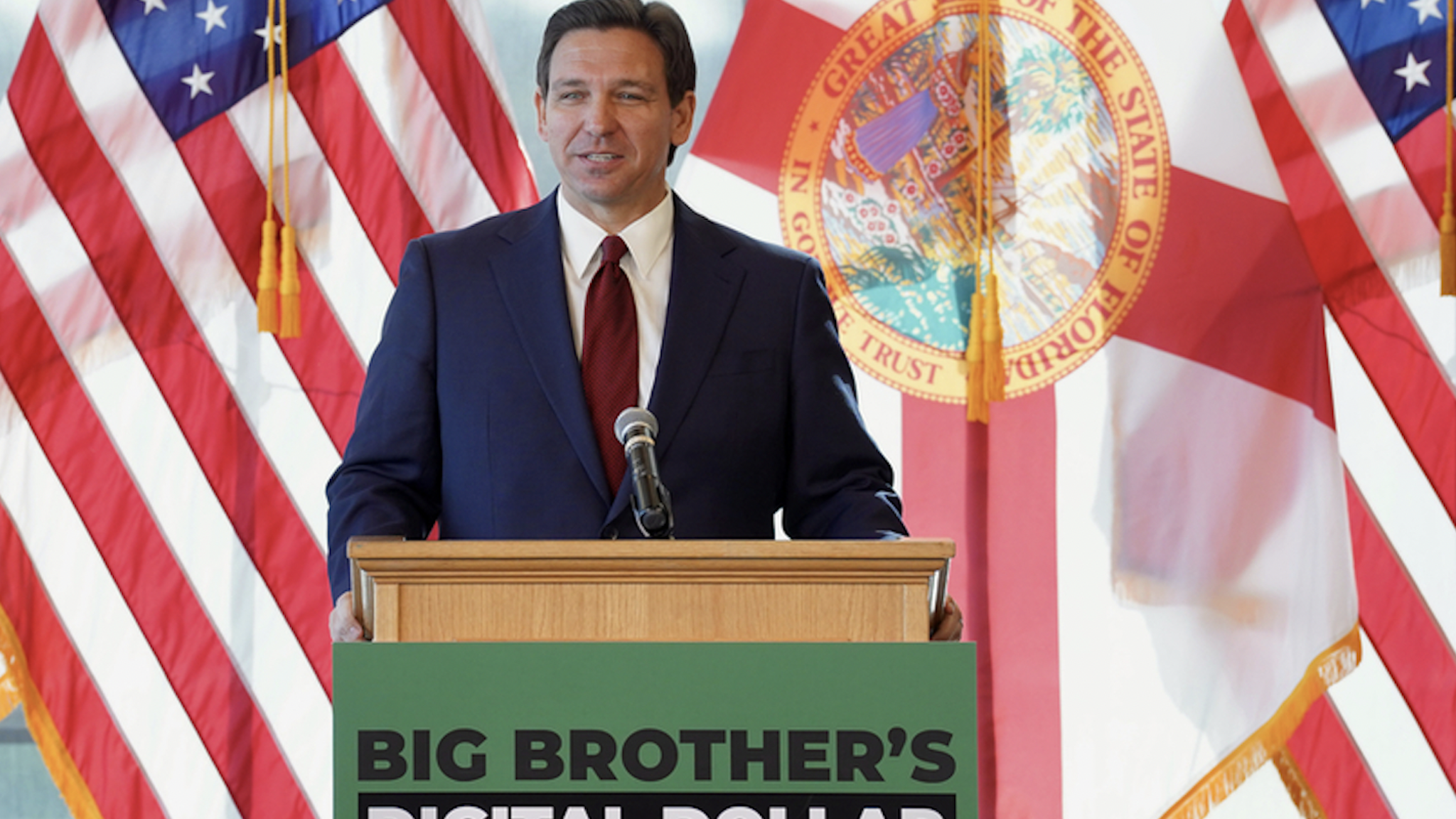
Governor Ron DeSantis (R-FL) revealed a proposal on Monday meant to combat the possible implementation of a central bank digital currency by the Federal Reserve and the Biden administration.
Critics of a potential central bank digital currency note that the asset, which would be managed by the Federal Reserve and tethered to the value of the dollar, would create opportunities for government surveillance and control of private citizens. DeSantis proposed legislation that would ban the recognition of central bank digital currencies, whether from the federal government or an overseas central bank, as money under Florida’s Uniform Commercial Code.
“The Biden administration’s efforts to inject a Centralized Bank Digital Currency is about surveillance and control,” DeSantis said in a press release. “Today’s announcement will protect Florida consumers and businesses from the reckless adoption of a ‘centralized digital dollar’ which will stifle innovation and promote government-sanctioned surveillance. Florida will not side with economic central planners; we will not adopt policies that threaten personal economic freedom and security.”
Nations such as China, Australia, Japan, India, Russia, and South Korea are presently exploring central bank digital currencies, which have already been established in the Bahamas, Nigeria, and Jamaica, according to a report from the Atlantic Council.
Skeptics of central bank digital currencies have noted the many instances in which the financial system has been leveraged by public and private actors to oppose certain political perspectives, including those often held by conservatives. Canadian Prime Minister Justin Trudeau invoked emergency powers last year to freeze the personal and corporate bank accounts of people involved with demonstrations against vaccine mandates, while PayPal announced that the firm would withdraw funds from accounts deemed to be promoting racism or misinformation, a policy that the company later claimed was published by mistake.
Gov. Kristi Noem (R-SD) recently vetoed legislation that would have classified a potential central bank digital currency as money in South Dakota’s Uniform Commercial Code. DeSantis called on other states to adopt similar prohibitions on the digital assets.
Be seeing you
Posted in Uncategorized | Tagged: Centralized Bank Digital Currency, control, Federal Reserve, Josh Shapiro, Ron DeSantis, Surveillance | Leave a Comment »
Posted by M. C. on March 18, 2023
Eventually these excesses will have to be unwound, gradually or suddenly. When they are, you can bet that all the people who have made fortunes from cheap cash for the last 15 years will be reaching into someone else’s pockets to save themselves – just as they did over the weekend.And the only pockets left will be the federal government’s.
In other words, yours.

Back to the banks.
For a few hours on Sunday, they fooled me.
At 6:15 p.m. Sunday, the government and Federal Reserve announced they would guarantee all deposits at the two big banks they’d closed, Silicon Valley Bank and Signature Bank – removing the $250,000 limit on insured accounts to help prevent a bank run.
Taxpayers would not be on the hook for any losses, they said. The banking industry would pay for the extra insurance.
I didn’t think the deposit insurance should be extended at all.
When banks failed in 2008, we didn’t have unlimited deposit insurance, and we didn’t have widespread bank runs on healthy or unhealthy institutions. Very few individuals have more than $250,000 in their plain vanilla bank accounts (as opposed to brokerage accounts where they are saving for retirement).
So extending the limits at taxpayer expense to protect very wealthy depositors and – in the case of Silicon Valley Bank – venture-capital backed companies didn’t seem fair.
And we have limits on government backed deposit insurance for good reason. Without it, large depositors have every reason to chase the highest possible interest rates on their money, even at badly managed banks. Why? They know that even if the bank squanders their deposits on bad loans, they’ll get their money back.
—
(BAIL ME OUT! SUBSCRIBE NOW!)Subscribe
—
This risk is not theoretical. In the 1980s, many savings and loans crashed after offering high-yielding deposits. As financial historian and journalist Roger Lowenstein explained yesterday in the New York Times:
When the Federal Reserve, under pressure of rising inflation, began to jack up rates, S.&L.’s had to pay higher rates to attract deposits…
Many switched to riskier assets to juice their returns, but as these investments soured, their problems worsened. Roughly a third, or about 1,000, S.&.L.’s failed.
—
But venture capitalists – led by David Sacks, a good friend of Elon Musk – spent the weekend screaming that bank runs would be inevitable if the government didn’t guarantee all depositors.
Many if not most of these folks had not-at-all hidden conflicts-of-interest – either personal deposits at Silicon Valley Bank or investments in companies that had deposits there. Nonetheless, they insisted that they were warning about bank runs solely because they wanted to save ‘Merica from bank runs!
Whether or not they were trying to worsen the crisis, their warnings certainly did. They essentially forced the government’s hand.
My old friend and colleague Jesse Eisinger (I guess he’s now a ex-friend, thanks to my reporting on Covid and the mRNAs, but that’s a story for another day) captured the dynamic nicely:
Be seeing you
Posted in Uncategorized | Tagged: capitalism, capitalists, deposit insurance, Federal Reserve, par value, Silicon Valley Bank | Leave a Comment »
 MCViewPoint