MCViewPoint

Opinion from a Libertarian ViewPoint

Posts Tagged ‘Foreign Policy’

Transcript: The Foundations of a Libertarian Foreign Policy

Posted by M. C. on July 29, 2025

By The Savvy Street Show

July 18, 2025

Controversies in Libertarianism, Podcast 3

Date of recording: June 3, 2025, The Savvy Street Show

Host: Roger Bissell. Guests: Walter Block, Vinay Kolhatkar

For those who prefer to watch the video, it is here.

Editor’s Note: The Savvy Street Show’s AI-generated transcripts are edited for removal of repetitions and pause terms, and for grammar and clarity. Explanatory references are added in parentheses. Material edits are advised to the reader as edits [in square brackets].

Roger Bissell

Good evening, everyone, and welcome to The Savvy Street Show. My name is Roger Bissell, and I’m your host for this third installment of our series on controversies in libertarianism. Tonight’s topic is libertarian foreign policy. Is there even such a thing? And if there is more than one candidate, are any of them correct in their basics or, if not, can they be fixed? So again, here to explore this topic are my two guests, the eminent economist and libertarian theorist and author of the series, Defending the Undefendable, Walter Block. Welcome to the show, Walter.

Walter Block

Thanks for having me. It’s always a pleasure.

Roger Bissell

Pleasure for us, too, Walter, good to have you. And second, we have my friend and frequent co-host, a novelist and screenwriter, chief editor of The Savvy Street, and co-author with me of Modernizing Aristotle’s Ethics, Vinay Kolhatkar. Welcome to the show, Vinay.

Vinay Kolhatkar

Thank you for having me.

Roger Bissell

Well, we’re going to just plunge right in. The first question is rather open-ended, just to kind of warm up with. Does a nation-state, such as the United States, have rights or obligations or any kind of moral principles that it needs to act according to? Walter, let’s have you begin, if you would.

Walter Block

On the one hand, I wear an anarcho-capitalist hat. And on the other hand, I wear a moderate libertarian hat; call it classical liberalism.

I guess I’m torn on this because I wear two hats. On the one hand, I wear an anarcho-capitalist hat. And on the other hand, I wear a moderate libertarian hat; call it minarchism or classical liberalism or something like that. Now, with the anarcho-capitalist hat, paradoxically, we’re not against government. We just want everyone to have one. So, from the anarcho-capitalist point of view, the optimal number of governments is about 8 billion, because there are 8 billion people here, and everyone should have one. You know, be the first on your block to have a government, and everyone should get one. And then my government should be nice to your government, Roger, and nice to your government, Vinay, and we should all follow the non-aggression principle, and we should all cooperate with each other. We don’t have to like each other, but we’ve got to keep our mitts off each other—unless we agree to put our mitts on each other, like in a voluntary boxing match or something like that. So, the foreign policy of me should be the same as the foreign policy of you guys, and that is to adhere to the non-aggression principle and uphold private property rights based on homesteading—and as Robert Nozick would then say, on anything subsequent like voluntary trade. So, if I homestead some land and you homestead a cow, and I produce corn and you produce milk, and now we trade, I now have the righteous ownership of the milk even though I didn’t produce it, because I can trace it back to homestead and voluntary trade.

Now for the tough part. Now we’re minarchists for the moment, or classical liberals, and what should the government do? Well, it’s going to collect taxes, which is a no-no, but now I’m not an anarcho-capitalist anymore. I’m schizophrenic. I’m now a limited-government libertarian. And yes, we’re going to have taxes, and the taxes are mainly for armies to protect us from foreign invaders; police to protect us from local invaders, rapists, murderers; and courts to determine, what should be the statutory rape age, or is my music too loud at three in the morning? Things like that. Or Vinay and I had a contract, and I say he broke it, he says he didn’t, so I’ll appoint you, Roger, as the court. You would decide, based on the evidence that Vinay and I give to you.

I don’t see anything in the bowels of libertarianism that says you can’t have any allies.

So, what should the foreign policy be? The foreign policy should be to protect the country. Don’t let any invaders come in and get us. Now, this leads to an issue. Should we have allies? Well, I don’t see why we shouldn’t have allies. I don’t favor an alliance with everybody from our country, let’s say that our country is the United States, but I don’t see anything in the bowels of libertarianism that says you can’t have any allies. So, I would say that if we’re the ally of Israel, and Israel is under attack, we help them; and on the other hand, if we’re under attack, we would expect Israel to help us. This leads to a whole can of worms. Who should be our allies? NATO? How about China? Better yet, Taiwan. Should the Taiwanese be our allies? That would be my opening answer to the question.

Roger Bissell

Okay. Well, Vinay, do you see it that way or do you have a different slant on it?

Vinay Kolhatkar

Governments only have rights that are delegated to them by their citizens.

Well, a little different slant. First of all, I’ve held this view, I think, for many decades, which is a view that we do have allies [naturally]. So, for instance, if the three of us are walking down Central Park, let’s say somebody attacks Walter Block. He doesn’t have a gun, he doesn’t have a knife, and Roger being a big strong guy, I’m going to encourage him to intervene. [Laughter]. I will intervene as well, especially if it’s a physical fight, and poor Walter could be beaten to death, but three against one, we might have a better chance. And it’s an implicit contract because we’re friends or colleagues, we help each other out. But the critical question was, do nation-states have rights and obligations? And I found out that my answer is identical to [Ayn] Rand’s. She explores that in an essay called “Collectivized Rights” in the book The Virtue of Selfishness. She divides the world into black and white, no gray in that hypothetical, which is typical of Rand. So, let’s say there are nations that are fundamentally secular, democratic, and respect the rule of law, have a wall between religion and the state, and, most importantly, they respect the rights of their citizens. Now, she’s a little bit uncertain where to draw the line, and she’s drawn the line where the US, the UK, in her time—the 60s, would clearly fall on the good side. And her favorite villain, Soviet Russia, would fall on the bad side, as would Cuba, because they’re completely communist, and they respected no rights, it was a kangaroo court system out there. So, in those, she says firstly, that the governments only have rights that are delegated to them by their citizens. So, the right to protect them from internal strife [requires that] we have the police, the courts. But in this situation, [the government also has] the right, clearly, and an obligation to protect the citizens from outside threats.

But what if the threat isn’t imminent to the United States itself, taking the US as an example? And this is a statement I completely agree with. Then the government has the right to intervene, but not an obligation. That’s a statement that is absolutely right in one sense. If you’re going by the beach and you see somebody drowning, [and] it’s a complete stranger, not your own son or daughter or somebody that you love, then you do have the right to jump in the water and save him or her; but you may not be so confident of your swimming, you might drift away and you might drown yourself and such things have happened, and so you don’t have the obligation. You’ve got to make a split[-second] decision, a quick decision; but in foreign policy, we don’t have to make that quick a decision.

Governments like Iran’s, that abrogate the rights of their own citizens, have no right to exist, and any country has the right (but not the obligation) to help topple that kind of government.

Essentially, these kinds of governments, like the government of Iran, that abrogate the rights of their own citizens, have no right to exist, and we, or the US or any country, according to Rand, and I agree, has the right to help topple that kind of government, especially if the end result is going to be a better one.

Even Murray Rothbard, about as anti-war [an intellectual] as you can get, said that the Indo-Pakistan War in 1971 was a just war.

Even Murray Rothbard, about as anti-war [an intellectual] as you can get, said that the Indo-Pakistan War in 1971 was a just war, because you had East Pakistan on the east of the Indian subcontinent and on the west, you had Pakistan. It was a funny kind of unified country [the old Pakistan] with a large area in the middle that belonged to India. Apparently, Pakistan was raping, pillaging, and looting out in East Pakistan, and there were refugees coming in hordes crossing over the Indian border. To cut a long story short, the Indian army went into what is now Bangladesh. They repelled the Pakistani army, freed the people, and then they just came back, and they [people there] had a new election and called it a new state: Bangladesh. That was, even according to Rothbard, a just cause. Now, I don’t know how many Indian soldiers died in that, and somebody might argue, wait a minute, you’re still using taxpayers’ money to intervene, and even if one soldier died, what right did you have to put him into an external conflict? But there was a danger in the future to the Indian subcontinent from Pakistan winning against East Pakistan. So, I rest my case there. The principle is there. The particulars get very complicated.

Roger Bissell

They sure do. I like your example of our pal Walter [being] out there in Central Park, and he’s being set upon by some violent person. Now, let’s expand it a little bit to a situation where the guy has not attacked Walter yet, but we’re strolling along, the two of us, and we know Walter is not far away. Maybe he’s over at the food wagon getting a hot dog or something, and we hear this guy over in the bushes, and he says, “I’m going to get that blasted Walter Block,” and he’s loading up his pistol. Now, by the NAP [non-aggression principle] and the right to self-defense and the right to help your friend by defending them—this gets into preemptive stuff, right? —if there’s no policeman nearby, and our phones don’t have any charge in the batteries, then it’s up to us. Do we have the right to apprehend, subdue, disarm this guy, to initiate force against him? Or, in fact, is he initiating force already, even though he hasn’t laid a hand on Walter yet? He’s planning, and he’s loading up his gun. Maybe he’s mentally deranged, and he’s not really going to do anything, he’s just hallucinating. But what kind of chance do you take in a situation like that? Do you go after the crazy person? Vinay, go ahead and comment.

Vinay Kolhatkar

If the threat is absolutely imminent, we do have the right to intervene.

If the threat is absolutely imminent, we do have the right to intervene. I’ll give you a couple of other examples. Even in a libertarian society, you would probably take away the firearms from a person who is a paranoid schizophrenic, has a history of violence, has been in and out of jail, has been warned plenty of times but can’t help himself, and has already shot at a few people. He’s not in jail because fortunately his aim was pretty bad, and he ended up injuring people in the leg or the arm, hasn’t killed anyone simply because he’s not as good a shot, but he keeps doing this, and even a libertarian society would take away his firearms. And in cases otherwise, even this person may have made many threats to Walter, he has mailed him [threats], has shouted from his soapbox that “I don’t like Walter’s existence, he should be eradicated from the earth.” And suppose in this case, Roger and I are policemen, so it makes it a little bit easier than us unarmed taking on an armed, deranged person. We are policemen, we sight him, and he is right behind Walter, about to draw his gun. Yes, we have every right at least to use the taser guns on him to disarm him and disable him. And if nothing succeeds, and he lunges at Walter with a knife, and there’s only five feet between them, at that stage we have the right to shoot [the assailant] in the chest or the head area.

Roger Bissell

So, you’re going to wait till you see the whites of his eyes or something? You wouldn’t preempt him if he’s just off in the bushes loading his gun and muttering ominously?

See the rest here

Be seeing you

Posted in Uncategorized | Tagged: , , , , | Leave a Comment »

They Don’t Just Tell Us What To Think, They Train Us HOW To Think

Posted by M. C. on January 31, 2025

Before we come up with a single thought of our own about government, we are trained to assume as our starting point that the people running things in our country are known to us and occupy official positions in our capitol. We are trained to assume that if we have a problem with the way things are going, there are official channels through which the powerful can be held to account and real changes can be advanced. The fact that we are actually ruled by unelected plutocrats and empire managers who often have no position in the official government is never seriously entertained.

https://www.caitlinjohnst.one/p/they-dont-just-tell-us-what-to-think

Caitlin Johnstone

It’s not just that they tell us what to think, it’s that they train us how to think.

From grade school on we are fed a framework for thinking about the world whose premises are completely fraudulent. Any analysis which does not take place within that framework is portrayed as ignorant at best and dangerous extremism at worst.

Before we come up with a single thought of our own about politics, we are trained to assume as our starting point that elections are real and that the official democratically elected government is the only power structure calling the shots in our country. We are trained to assume that decisions get made in our government based on how people vote in elections between two parties who oppose each other and promote the most organically popular positions on important issues in order to win votes. This is all complete bullshit, but it’s the foundation we’re taught to premise all our ideas and opinions about political matters upon.

Before we come up with a single thought of our own about government, we are trained to assume as our starting point that the people running things in our country are known to us and occupy official positions in our capitol. We are trained to assume that if we have a problem with the way things are going, there are official channels through which the powerful can be held to account and real changes can be advanced. The fact that we are actually ruled by unelected plutocrats and empire managers who often have no position in the official government is never seriously entertained.

Before we come up with a single thought of our own about the media, we are trained to assume as our starting point that we live in a free country with a free press instead of a dystopian civilization where the news media function as the propaganda services of our rulers. We are trained to assume that while some parts of the media may have obvious biases regarding which mainstream political faction they favor, it’s still possible to get a more or less accurate read on what’s happening in the world by listening to both sides of that ideological divide. None of this is true, but it’s the framework in which all mainstream analysis of the western media occurs.

Before we come up with a single thought of our own about foreign policy, we are trained to assume as our starting point that the US and its allies are more or less a force for good in this world, and that all the stories we hear about the governments and groups it works to destroy are more or less true. We are trained to assume that while the western power structure is imperfect and might make mistakes here and there, it must never stop killing and tyrannizing foreigners, because if it does, the bad guys might win. The easily quantifiable fact that the US-centralized empire is by far the most tyrannical and abusive power structure on earth never enters into the discussion.

This is the conceptual framework for thinking about the world that people are trained to espouse, first in school, and then throughout the rest of their lives by the mass media. If they go to university, as the most powerful people in our society typically do, then this framework is hammered home far more aggressively — especially in the most esteemed universities that the so-called “elite” tend to come from.

See the rest here

Be seeing you

Posted in Uncategorized | Tagged: , , , , | Leave a Comment »

Arming Ukrainian Neo-Nazi’s? — U.S. Foreign Policy Is Just One Terrible Idea Followed By Another

Posted by M. C. on June 21, 2024

The Ron Paul Liberty Report

Recall 9/11 and was the ultimate result of funding the Mujaheddin.

Be seeing you

Posted in Uncategorized | Tagged: , , | Leave a Comment »

Are All The Foreign Policy ‘Experts’ Secretly Putin Puppets?

Posted by M. C. on March 1, 2024

The Ron Paul Liberty Report

Be seeing you

Posted in Uncategorized | Tagged: , | Leave a Comment »

“US Foreign Policy Is a Scam Built on Corruption”

Posted by M. C. on January 8, 2024

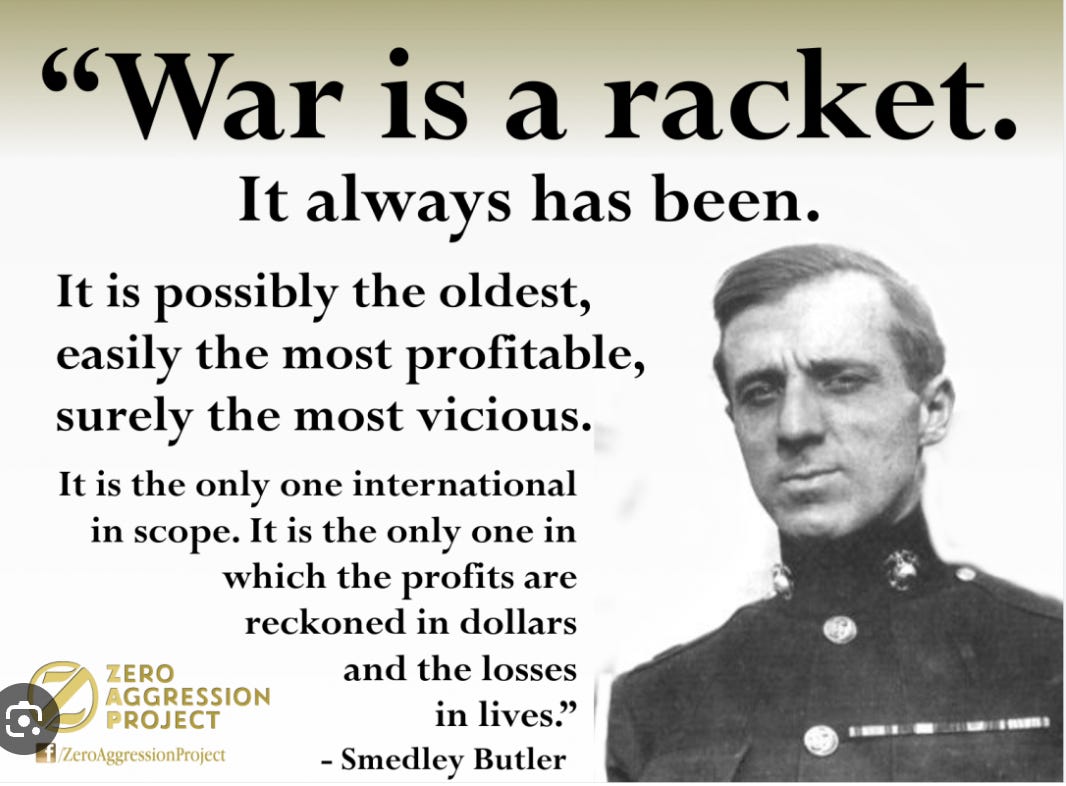
Professor Jeffrey D. Sachs reminds us that war is a racket.

Major General Smedley Darlington Butler was, at the time of his death in 1940, the most decorated Marine in U.S. history. During his 34-year career, he fought in the Philippine–American War, the Boxer Rebellion, the Mexican Revolution, and World War I.

However, at some point after World War I, he began to have grave doubts about his profession. Over time, with study and reflection, he concluded that he had NOT spent his life fighting and killing for the American people, but for special interests in New York City and Washington.

As he memorably stated it in his 1935 book, War is a Racket:

I helped make Mexico, especially Tampico, safe for American oil interests in 1914. I helped make Haiti and Cuba a decent place for the National City Bank boys to collect revenues in. I helped in the raping of half a dozen Central American republics for the benefits of Wall Street. The record of racketeering is long. I helped purify Nicaragua for the international banking house of Brown Brothers in 1909-1912. I brought light to the Dominican Republic for American sugar interests in 1916. In China I helped to see to it that Standard Oil went its way unmolested.

Though war is indeed profitable for the financiers and industrialists who champion it, it is invariably a disaster for a free citizenry. As James Madison remarked in a 1795 pamphlet:

Of all the evils to public liberty, war is perhaps the most to be dreaded, because it comprises and develops every other. War is the patent of armies; from these proceed debts and taxes. And armies, and debts, and taxes, are the known instruments for bringing the many under the dominion of the few. In war, too, the discretionary power of the executive is extended; its influence in dealing out offices, honors, and emoluments is multiplied; and all the means of seducing the minds are added to those of subduing the force of the people! No nation could preserve its freedom in the midst of continual warfare.

I thought of Butler and Madison this morning when a friend in Boston sent me an essay by Columbia University Professor Jeffrey Sachs that begins as follows:

US Foreign Policy Is a Scam Built on Corruption

See the rest here

Be seeing you

Posted in Uncategorized | Tagged: , , , | Leave a Comment »

The Real Problem With Our Foreign Policy…

Posted by M. C. on December 5, 2023

by Ron Paul

According to Secretary Austin, non-interventionists who advocate “an American retreat from responsibility” are the ones destabilizing the world, not endless neocon wars.

https://ronpaulinstitute.org/the-real-problem-with-our-foreign-policy/

Over the weekend Defense Secretary Lloyd Austin explained to the American people what’s really wrong with US foreign policy. Some might find his conclusions surprising.

The US standing in the world is damaged not because we spent 20 years fighting an Afghan government that had nothing to do with the attacks on 9/11. The problem has nothing to do with neocon lies about Iraq’s WMDs that led untold civilian deaths in another failed “democratization” mission. It’s not because over the past nearly two years Washington has taken more than $150 billion from the American people to fight a proxy war with Russia through Ukraine.

It’s not the military-industrial complex or its massive lobbying power that extends throughout Congress, the think tanks, and the media.

Speaking at the Reagan National Defense Forum in California’s Simi Valley, Austin finally explained the real danger to the US global military empire.

It’s us.

See the rest here

Be seeing you

Posted in Uncategorized | Tagged: , , | Leave a Comment »

America’s Founders Were Right — Don’t Tie U.S. Foreign Policy To Any Other Nation

Posted by M. C. on November 8, 2023

Entanglements

The Ron Paul Liberty Report

Be seeing you

Posted in Uncategorized | Tagged: , , | Leave a Comment »

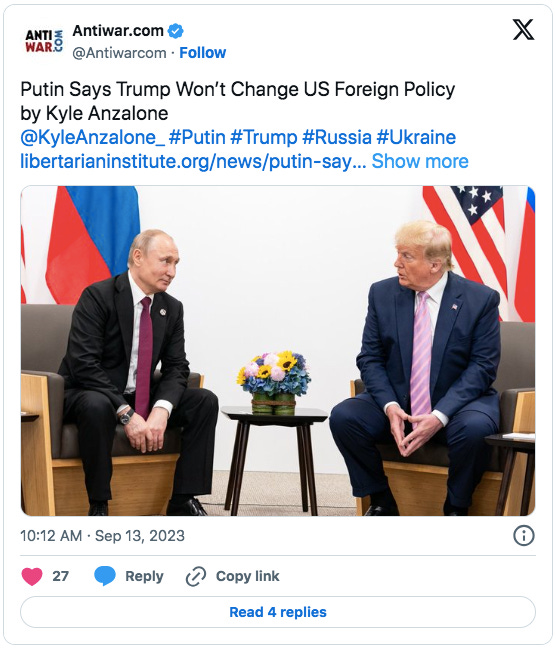
Putin Doesn’t Think US Foreign Policy Will Change If Trump Is Re-Elected (And He’s Probably Right)

Posted by M. C. on September 14, 2023

The claim that Trump was a secret agent of the Kremlin has always been a ridiculous conspiracy theory made possible by mass-scale journalistic malpractice and intervention by the US intelligence cartel,

https://www.caitlinjohnst.one/p/putin-doesnt-think-us-foreign-policy?utm_campaign=email-post&r=iw8dv&utm_source=substack&utm_medium=email

Caitlin Johnstone

Vladimir Putin said at the Eastern Economic Forum on Tuesday that he wouldn’t expect any meaningful changes in US policy toward Russia if former president Donald Trump secures re-election next year.

TASS reports the following on the Russian president’s comments:

“I think there will be no fundamental changes regarding Russia in US foreign policy, no matter who is elected president,” Putin said. “Mr. [Donald] Trump (ex-president and Republican Party candidate — TASS) says he will solve acute problems, including the Ukrainian crisis, in a few days, this can only please. Nevertheless, he too imposed sanctions on Russia during his presidency,” Putin recalled.

The US, according to the Russian president, “views Russia as a permanent adversary, or even an enemy, and has hammered this into the heads of ordinary Americans.” “The current authorities have tuned American society into an anti-Russian vein and spirit — that’s what it’s all about. They have done it, and now it will be very difficult to somehow turn this ship in the other direction,” Putin said.

This is not the first time Putin has made such comments. When Oliver Stone asked him in an interview during Trump’s presidency what has changed from administration to administration in the four US presidents he’d gone through during his leadership, Putin replied, “Almost nothing. Your bureaucracy is very strong and it is that bureaucracy that rules the world.”

And he’s right; from Bush to Obama to Trump to Biden there has been a consistent pattern of escalation which has now culminated in a terrible proxy war — provoked by western actions — which has the potential to go nuclear at any time. Trump has been campaigning on the claim that he can end the Ukraine war in a day if re-elected, but there is no actual reason to believe that’s true.

Neither mainstream American party likes to admit to this fact because of the implications for their respective political agendas, but in terms of concrete policy decisions Trump actually governed as a virulent Russia hawk who spent his entire term ramping up cold war aggressions against Russia on multiple fronts. He arguably played as much of a role in paving the way toward the war in Ukraine as any other president — it was Trump after all who first began pouring American weapons into Ukraine, an incendiary move that his predecessor Obama had actually resisted for fear of provoking Moscow.

The claim that Trump was a secret agent of the Kremlin has always been a ridiculous conspiracy theory made possible by mass-scale journalistic malpractice

See the rest here

Be seeing you

Posted in Uncategorized | Tagged: , , | Leave a Comment »

Elliott Abrams Has Left Bloody Footprints Across the Globe

Posted by M. C. on September 9, 2023

Justice is long overdue for Romero, the other Salvadorian faith leaders who were murdered in the 1980s, the children murdered in El Mazote, the Ixil Mayan women raped by death squads in Guatemala, and the people of Haiti, Iraq, Palestine, and elsewhere.

https://jacobin.com/2023/07/elliott-abrams-war-criminal-human-rights-abuse-el-salvador-biden-reagan

By Rev. Graylan Scott Hagler Ariel Gold

From Latin America to the Middle East, Elliott Abrams has advocated foreign policy responsible for untold violence and destabilization. Victims of those policies deserve justice. Instead, Joe Biden has rewarded Abrams with a top appointment.

One bright sunny March morning in 1980, Archbishop Oscar Arnulfo Romero was saying mass at a church hospital in San Salvador when a bullet from a sniper rifle ripped through his heart.

Romero started life and ministry as a conservative. But after his friend Father Rutilio Grande was assassinated to discourage other faith leaders from supporting Salvadoran peasants, Romero underwent a political and theological conversion. Picking up where Grande left off, Romero embraced a “theology of liberation,” a perspective that espouses God’s preference for the poor and oppressed. His visibility as archbishop elevated his voice and the credibility of his critique of the conditions faced by peasants in El Salvador.

A month before his assassination, Archbishop Romero wrote President Jimmy Carter requesting a halt to US military assistance to the right-wing Salvadoran government and its allied paramilitary death squads. Over 250,000 people attended Romero’s funeral, echoing his demands for justice. Tragically, they were swimming against the historical current. A campaign of terror and murder, often orchestrated or at the very least condoned by the United States, continued across the country.

In the wake of Romero’s murder, Elliott Abrams, the newly appointed assistant secretary of state for human rights and humanitarian affairs, said, “Anybody who thinks you’re going to find a cable that says that Roberto D’Aubuisson murdered the archbishop is a fool.” In fact, two US embassy cables said precisely that, naming D’Aubuisson as the one who ordered his personal bodyguard to carry out Romero’s assassination. In denying the evidence, Abrams helped him get away with murder. With Abrams’s support, US military assistance to the Salvadoran government was dramatically increased that year.

This month, President Biden nominated Elliott Abrams to join the State Department Advisory Commission on Public Diplomacy. Abrams’s history is not secret: in 2019, Representative Ilhan Omar grilled him before Congress. Abrams served for twelve years as part of the Ronald Reagan and George H. W. Bush  administrations. During that time, seventy-five thousand Salvadorians were killed. Abrams called US policy in El Salvador a “fabulous achievement.” Recounting the 1981 massacre at El Mozote, Omar asked, ‘“Do you think that massacre was a ‘fabulous achievement’ that happened under our watch?”

In the village of El Mozote, the army’s Atlácatl Battalion herded women and children into a church convent and opened fire with US-supplied M16 automatic rifles before burning the building down. They committed other atrocities as well, and by the end over nine hundred people were murdered. Of them, 140 were children, their average age six. One survivor recalled seeing a dead mother and her dead baby lying in bed. On the walls, scrawled in blood, were the words: “Un nino muerto, un guerrillero menos”: “One dead child is one less guerrilla.”

Elliott Abrams’s Global Footprint

See the rest here

Be seeing you

Posted in Uncategorized | Tagged: , , , | Leave a Comment »

Exchanging the Rust Belt for Military Bases: Foreign Policy and Deindustrialization

Posted by M. C. on August 12, 2023

in the words of Henry Kissinger’s assistant for international economic affairs Fred Bergsten: “Foreign economic policy” has been the abettor of “overall U.S. foreign policy,” and that “foreign policy considerations have dictated the U.S. position on virtually all issues of foreign economic policy.”

https://libertarianinstitute.org/articles/exchanging-the-rust-belt-for-military-bases-foreign-policy-and-deindustrialization/

by Joseph Solis-Mullen

depositphotos 11874193 s

While the benefits of trade liberalization in the postwar period have been abundant, readers may be surprised to learn how secondary (or even nonexistent) consideration of such possible benefits were to U.S. policymakers. Rather, trade liberalization following World War II was primarily conceived in terms of political and security priorities. As an April 1950 report by the Bureau of the Budget put it: “Foreign economic policies should not be formulated in terms primarily of economic objectives. They must be subordinated to our politico-security objectives and the priorities which the latter involve.”

As will be shown, because trade as a percentage of GDP would not rise above ten percent until the 1970s, trade policy was seldom front and center in Washington and could therefore be quietly used by policymakers as a bargaining chip to get their way with Western Europe, Japan, and other allies on non-economic matters. As Harry Truman’s Assistant Secretary of State for Economic Affairs put it: “The great question is whether the country is willing to decide in the broader national self-interest to reduce tariffs and increase United States imports even though some domestic industry may suffer serious injury.”

An early example was in 1953, following the “loss of China,” when the National Security Council advised opening the American market to Japanese goods on the grounds that failure to do so might slow Japan’s economy and create an opening for the (non-existent) Japanese communists to exploit. From Harry Truman to Richard Nixon, such necessary strategic interests as the employment of shoemakers in Italy and Spain, farmers in France, or synthetic textile producers in Japan were given priority by officials in the Executive Branch and State Department. Despite occasional attempts by Congress to intervene, the wisdom of those like George Ball, John F. Kennedy’s Undersecretary of State for Economic Affairs, and previously a lobbyist for the newly formed European Economic Community (EEC), triumphed. “Americans,” he said, could “afford to pay some economic price for a strong Europe.”

Indeed, the pursuit of strategic objectives over domestic economic interests would continue into the 1960s, with the Trade Expansion Act of 1962 authorizing the president to make huge discretionary cuts in U.S. tariffs. Ardently advocated for by the Kennedy administration, whose representatives testified before Congress regarding the windfall benefits sure to follow, former FDR administration economist Oscar Gass noted that such further trade liberalization was such a “holy cause” that “decent people were prepared to lie for it.” The act was followed by the so-called Kennedy Round of trade talks (1964-67), which resulted in further such cuts to U.S. tariffs, subsidies, and quotas.

These were decidedly one-sided trade concessions. And so it is important to make clear, particularly as an advocate of actually free trade, that what Washington was creating was deliberately not free trade; it was a policy of asymmetric concessions in the name of maintaining the easy cooperation of allied governments. As one of Nixon’s State Department trade specialists Philip Trezise put it later: “We did make some big tariff cuts and didn’t get any reciprocity. It was quite deliberate.”

But what started as using the American market as an incentive and destination of last resort for anything allies wanted to offload, quickly cut into the American current account once these states had been rebuilt (with U.S. aid and corporate transfers) and Washington’s spending on war and welfare reached unsustainable levels. Indeed, by 1970 Nixon had begun to feel uneasy about the domestic political implications of the policy, cautioning his NSC to “take greater cognizance of the problems of U.S. businessmen and their concerns abroad, even when ultimately they may have to be overridden by foreign policy considerations.”

Unsurprisingly, no real change in policy followed.

See the rest here

Be seeing you

Posted in Uncategorized | Tagged: , , , | Leave a Comment »