MCViewPoint

Opinion from a Libertarian ViewPoint

Posts Tagged ‘G. K. Chesterton’

Eugenics – LewRockwell LewRockwell.com

Posted by M. C. on October 29, 2021

Thus, Corbett and Barnes have both pointed out that the meta narrative to explain what is going on in the Covid crazed world is a continuation of the Eugenics movement that was discredited after the horrors of Nazi Germany during WWII. That is, there is a group of sociopathic billionaires, like Gates and the Rockefellers, working to impose eugenics solutions on the world population in the name of Covid. On the strategic level of the Rockefellers, the ultimate goal is (1:38:20 in the Big Oil documentary) scientific dictatorship. My hope is that the Covid scam has demystified millions of people around the world to the true nature of how public policy is conjured up to institute population control.

https://www.lewrockwell.com/2021/10/ira-katz/eugenics/

By Ira Katz

Two quite different personalities who are observers of the world scene that I follow are James Corbett of the CorbettReport.com and the populist lawyer Robert Barnes of VivaBarnesLaw.Locals.com.

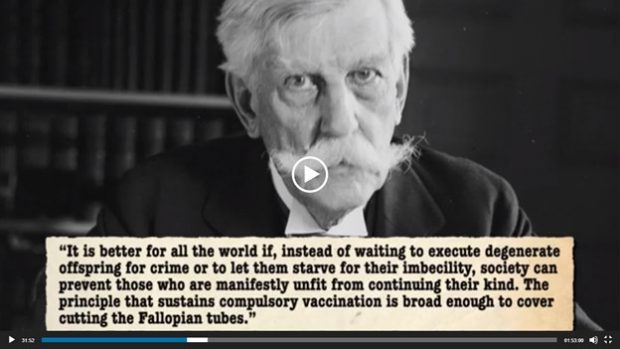
Barnes is involved in many lawsuits to counter vaccine mandates. In his public explanations he has noted Jacobson v. Massachusetts, the Supreme Court case enshrining forced vaccinations into American jurisprudence. It is the key precedent for Buck v. Bell that upheld forced sterilization for the “unfit.” Barnes has explicitly pointed to the eugenics decisions as the legal basis for the Covid mandates.

Corbett has produced detailed and perfectly sourced documentaries, including Why Big Oil Conquered the World (also see the related How Big Oil Conquered the World), that explain the history of the Eugenics movement. At 31:52 read the quote from Oliver Wendell Holmes, Jr in his Buck v; Bell majority decision (8-1). Note the key connection to compulsory vaccination. During the height of the Covid scare Corbett released his must see documentary Who Is Bill Gates? See especially Part IV,( at 1:28:30) Meet Bill Gates in which the Gates family orthodoxy of eugenics is exposed.
Thus, Corbett and Barnes have both pointed out that the meta narrative to explain what is going on in the Covid crazed world is a continuation of the Eugenics movement that was discredited after the horrors of Nazi Germany during WWII. That is, there is a group of sociopathic billionaires, like Gates and the Rockefellers, working to impose eugenics solutions on the world population in the name of Covid. On the strategic level of the Rockefellers, the ultimate goal is (1:38:20 in the Big Oil documentary) scientific dictatorship. My hope is that the Covid scam has demystified millions of people around the world to the true nature of how public policy is conjured up to institute population control.

A commentator on one of Barnes’ open live streams altered him to the book Eugenics and other Evils by G. K. Chesterton published in 1922.The continuity of the eugenics philosophy and modus operandi in the Covid response are evident in Chesterton’s treatment of the subject. I list below several of my highlighted passages from the book.

But the criticism of Eugenics soon expanded of itself into a more general criticism of a modern craze for scientific officialism and strict social organisation.

People talk about the impatience of the populace; but sound historians know that most tyrannies have been possible because men moved too late. It is often essential to resist a tyranny before it exists. It is no answer to say, with a distant optimism, that the scheme is only in the air.

I know that it means very different things to different people; but that is only because evil always takes advantage of ambiguity.

…know that it numbers many disciples whose intentions are entirely innocent and humane; and who would be sincerely astonished at my describing it as I do. But that is only because evil always wins through the strength of its splendid dupes; and there has in all ages been a disastrous alliance between abnormal innocence and abnormal sin.

Dr. S.R. Steinmetz, with that creepy simplicity of mind with which the Eugenists chill the blood, remarks that “we do not yet know quite certainly” what were “the motives for the horror of” that horrible thing which is the agony of Œdipus.

This lucid politician finds an old law, let us say, about keeping lepers in quarantine. He simply alters the word “lepers” to “long-nosed people,” and says blandly that the principle is the same.

The prize specimen of them was another M.P. who defended the same Bill [to sterilize the feeble minded] as “an honest attempt” to deal with a great evil: as if one had a right to dragoon and enslave one’s fellow citizens as a kind of chemical experiment; in a state of reverent agnosticism about what would come of it. But with this fatuous notion that one can deliberately establish the Inquisition or the Terror, and then faintly trust the larger hope, I shall have to deal more seriously in a subsequent chapter.

The Eugenic State has begun. The first of the Eugenic Laws has already been adopted by the Government of this country [England]; and passed with the applause of both parties through the dominant House of Parliament. This first Eugenic Law clears the ground and may be said to proclaim negative Eugenics; but it cannot be defended, and nobody has attempted to defend it, except on the Eugenic theory. I will call it the Feeble-Minded Bill both for brevity and because the description is strictly accurate.

The same can be expressed with even more point and simplicity in the proverb that prevention is better than cure. Commenting on this, I said that it amounted to treating all people who are well as if they were ill.

The thing that really is trying to tyrannise through government is Science. The thing that really does use the secular arm is Science. And the creed that really is levying tithes and capturing schools, the creed that really is enforced by fine and imprisonment, the creed that really is proclaimed not in sermons but in statutes, and spread not by pilgrims but by policemen—that creed is the great but disputed system of thought which began with Evolution and has ended in Eugenics. Materialism is really our established Church; for the Government will really help it to persecute its heretics. Vaccination, in its hundred years of experiment, has been disputed almost as much as baptism in its approximate two thousand. But it seems quite natural to our politicians to enforce vaccination; and it would seem to them madness to enforce baptism.

They mean that the public is to be given up, not as a heathen land for conversion, but simply as a pabulum for experiment. That is the real, rude, barbaric sense behind this Eugenic legislation. The Eugenist doctors are not such fools as they look in the light of any logical inquiry about what they want. They do not know what they want, except that they want your soul and body and mine in order to find out. They are quite seriously, as they themselves might say, the first religion to be experimental instead of doctrinal. All other established Churches have been based on somebody having found the truth. This is the first Church that was ever based on not having found it.

And while I reiterate that many of its more eloquent agents are probably quite innocent instruments, there are some, even among Eugenists, who by this time know what they are doing.

I do not mean, of course, that no scientific men have rigidly tackled these, though I do not recall any cases. But I am not talking of the merits of individual men of science, but of the push and power behind this movement, the thing that is able to make it fashionable and politically important.

People can certainly spoil their health with tea or with tobacco or with twenty other things. And there is no escape for the hygienic logician except to restrain and regulate them all. If he is to control the health of the community, he must necessarily control all the habits of all the citizens, and among the rest their habits in the matter of sex.

It is inevitable that the most private matters should be most under public coercion. This inverse variation is very important, though very little realised. If a man’s personal health is a public concern, his most private acts are more public than his most public acts. The official must deal more directly with his cleaning his teeth in the morning than with his using his tongue in the market-place. The inspector must interfere more with how he sleeps in the middle of the night than with how he works in the course of the day. The private citizen must have much less to say about his bath or his bedroom window than about his vote or his banking account.

And when health and the humours of daily life have passed into the domain of this social discipline, when it is admitted that the community must primarily control the primary habits, when all law begins, so to speak, next to the skin or nearest the vitals—then indeed it will appear absurd that marriage and maternity should not be similarly ordered. Then indeed it will seem to be illogical, and it will be illogical, that love should be free when life has lost its freedom.

As a man can find one jailer more lax than another, so he could find one employer more kind than another; he has at least a choice of tyrants. In the other case he finds the same tyrant at every turn. Mr. Shaw and other rational Socialists have agreed that the State would be in practice government by a small group. Any independent man who disliked that group would find his foe waiting for him at the end of every road.

Another form of the intervention, and one already mentioned, is the kidnapping of children upon the most fantastic excuses of sham psychology

Ira Katz [send him mail] lives in Paris and works as a research engineer for a French company. He is the co-author of Handling Mr. Hyde: Questions and Answers about Manic Depression and Introduction to Fluid Mechanics.

Be seeing you

Posted in Uncategorized | Tagged: , , , | Leave a Comment »

Why Chesterton Despised Thanksgiving Day | Intellectual Takeout

Posted by M. C. on November 30, 2020

Chesterton, to put it mildly, was not a fan of Puritanism in any of its guises. Theologically, Puritanism is rooted in Calvinism, and the determinism of Calvinistic predestination was anathema to Chesterton. But at issue here is another aspect of Puritanism, namely the temptation of Puritans, then and now, to promote—and enforce—prohibitions.

Oh well, you say, those prohibition-minded Puritans are long gone. Not so, countered Chesterton, who could point to the brief success of the movement to prohibit the sale of alcohol in America.

https://www.intellectualtakeout.org/article/why-chesterton-despised-thanksgiving-day/

By Chuck Chalberg

Did you know that England also has a Thanksgiving Day?  Well, actually it doesn’t. But G. K. Chesterton did propose such a day for his England. And therein lies a tale, or at least a few thoughts for a Thanksgiving Day conversation. 

Chesterton’s thoughts on thanksgiving with a small “t” are not at issue here. But they are important. He thought that a sense of gratitude was crucial for human happiness. For him, that sense should begin with thanks for this world and one’s very existence in it. Even in his darkest days, days of unbelief that were touched with thoughts of suicide, Chesterton always held on to some sense of belief—and his life—by “one thin thread of thanks.”

But his thoughts about an official Thanksgiving Day for England were more directly tied to the origins of the first thanksgiving feast in the New World and its perpetrators, the American Puritans. 

Chesterton, to put it mildly, was not a fan of Puritanism in any of its guises. Theologically, Puritanism is rooted in Calvinism, and the determinism of Calvinistic predestination was anathema to Chesterton. But at issue here is another aspect of Puritanism, namely the temptation of Puritans, then and now, to promote—and enforce—prohibitions.

Oh well, you say, those prohibition-minded Puritans are long gone. Not so, countered Chesterton, who could point to the brief success of the movement to prohibit the sale of alcohol in America.

Oh well, you respond, that foray into prohibitionism has been thoroughly discredited and is now nearly a century behind us. Maybe so. But during the heyday of the 18th amendment Chesterton was on hand to point to the follies—and dangers—of the prohibitionist mind set. He was also on hand to ask us to remember to thank God for “beer and burgundy by not drinking too much of them.”

Today Chesterton’s words remain on hand to remind us that there are links between the Puritan mind of the 17th century and what he has termed the “Modern Mind.” It is a cast of mind that still “cries aloud with a voice of thunder” that there are always things that must be “forbidden.”

This cry could come from prohibitionists declaring that “there must be no wine.” Or it could come from pacifists who insist that “there must be no war.” Or from communists who stipulate that “there must be no private property.” Or from the “secularist” who decrees that “there must be no religious worship.”

All of these prohibitionists, and more besides, remain determined to ride roughshod over Chesterton’s “ordinary man.” That would be the “ordinary man” who had a right to live—and order—his own life as he saw fit. Those rights included the right to “judge about his own health,” the right to “bring up children to the best of his ability,” and the right to “rule other animals within reason” among many other ordinary rights.

In sum, G. K. Chesterton was far from convinced that Puritanism was dead and gone. In fact, it was all too alive in the “Modern Mind.” That was the mind that could not accept what Chesterton regarded as the “Catholic doctrine that human life is a battle.” More often than not, these are the battles that one fights with oneself, which is to say battles that should be fought without benefit of official—and officious—prohibitions.

Having come to the United States twice while the 18th amendment held legal sway, Chesterton experienced a direct encounter with this version of prohibitionism. Teetotaler that he wasn’t, G. K. Chesterton had reason to object to the powers of prohibitionist thinking over the modern American mind (even if he occasionally benefited from home brew in professors’ homes while lecturing at Notre Dame in the fall of 1930).

When back home in England, Chesterton’s objections gave way to thanks. That would be thankfulness that his country had not taken a similar step. In fact, it was this very sense of thankfulness that led him to propose a Thanksgiving Day for England. It would be a day to “celebrate the departure of those dour Puritans, the Pilgrim fathers.” Once here, they gave thanks and feasted (probably without beer or burgundy).

But if Chesterton is right, they also left their mark on America and the modern American mind, a mark that had lingered here long after their departure not just from England, but from this world.

Dear Readers,

Big Tech is suppressing our reach, refusing to let us advertise and squelching our ability to serve up a steady diet of truth and ideas. Help us fight back by becoming a member for just $5 a month and then join the discussion on Parler @CharlemagneInstitute!

Chuck Chalberg

Dr. John C. “Chuck” Chalberg writes from Bloomington, Minnesota.

Be seeing you

Posted in Uncategorized | Tagged: , , , , | Leave a Comment »

Dread the Future? Here’s What Helped Me – LewRockwell

Posted by M. C. on June 16, 2020

The campus had changed very much physically and psychologically. In my
early years at Duke a beer keg was available friday afternoons at the
engineering building for faculty, grad and undergrad students to help
them mingle. That would be impossible to even imagine today.

In Texas I was the loser in a tenure battle that was more ridiculous
than dramatic. This failure was largely due to my refusal to play the
game, in part the manipulation of students.

Yes, this is all nostalgia, how much dark reality have I omitted? But nothing can be more real than the happiness these people and places have given me then and even now as I contemplate the darkness that is rising.

https://www.lewrockwell.com/2020/06/ira-katz/nostalgia/

By

I must admit that the mounting number of ominous events have given me a sense of dread for the future. But recently I had a pleasant moment when I drank a biere blanche at a cafe for the first time in several months.  G. K. Chesterton remarked in his comments about his trip to America that “there are people whom I met for a few hours or a few moments, whom I none the less sincerely admire and honour because I cannot but smile as I think of them.”   In these terrible times I thought of the many bars and pubs where I spent so much of my life and enjoyed being with so many different kinds of people; it makes me smile.  One of the most memorable (pun intended) passages in all of literature is the moment in Proust’s À la recherche du temps perdu when Marcel tastes the tea and crumbs of his madeleine cake that sparks a shudder of pleasure throughout his body and memories of his past life. One tool to combat my dread is nostalgia. I realize modern progressive types (e.g., Pinker) always pooh pooh nostalgia. But of course they are wrong about most things. As I grow older I certainly think many things were better before and are getting worse now. What sane person would contradict that sentiment today? In the spirit nostalgia and Proust I recount below highlights from my pub life.

Park Place, Knoxville, TN

Just after graduating from the University of Florida engineering school I found a job at the Y-12 Plant in Oak Ridge, TN. This is a very interesting site with a special history beginning with the Manhattan Project.. I must say that I had 5 job offers, but took this one, the lowest in salary because of some intuition that I cannot explain. I rented an apartment in a complex in West Knoxville near the Pellissippi Parkway that is the direct route to Oak Ridge. I knew nothing about Knoxville or East Tennessee, I knew nobody. Yet, within a few months time I learned the locations of backroom gambling joints (though I never went to the back rooms themselves). This happened because East Tennessee is a special place, but even more it is because there was a clubhouse bar in the Brendon Park Apartment called Park Place. It was a simple bar with about 5 stools and canned beer owned by a couple of the residents. I recall a typical moment sitting at the bar between a Jewish physicist who did his PhD at Cornell and an unemployed hillbilly from West Virginia who’s prized possession was a magnum pistol that he often carried with him. “What shall we do tonight guys?” … miniature golf! I learned so much about life, especially about generosity, friendship, and how to enjoy life. Park Place was the wellspring of so much fun: group meals, all night poker games, road trips, fishing trips, and on and on. My friends were from Waterbury, CT; Buffalo, NY, Redondo Beach, CA, Atlantic City, NJ, etc., and of course from East Tennessee. Park Place ceased to exist long ago. My friends moved away decades ago. And I can only remember a tiny fraction of the stories and experiences that so enriched my life with so many smiles.

The Hideaway Bar, Duke University, Durham, NC

After three fun and transformative years in Knoxville I realized that if I stayed at Y-12 I would be doing the same kind of projects for years with very little vacation. So I decided to go to graduate school at Duke University (another intuitive decision). I needed to work very hard to get back in the education groove so I did not find a replacement for Park Place for at least a couple of years. Eventually I found The Hideaway Bar. Tucked in the basement of administration buildings on Duke’s gothic West Campus, this simple beer bar was organized by a business school professor with a committee of graduate student co-owners.I was usually there just after my graduate student workday with other grad students and university staff. I became friends with the manager of the computer store, the head of the bus service, and parking, and food service managers. Many were graduates of Duke, others were locals. We all loved sports, playing golf, tailgate parties and road trips. The bar sponsored a softball team (the special version called modified) that was the center of activity during the hot slow days of summer along with Durham Bulls minor league baseball. It was also the best place outside of Cameron Indoor Stadium to watch the basketball games as the crowd would also pass by before and after the game. At the end of my PhD my funding ran out so I worked there for a few months. The undergrads would show up after 10 as they finished studying. I strictly required at least a fake ID when I checked people at the door. But I was quick to note that I was not a bouncer. I would not think of “bouncing” anybody as half the bar was under age including the basketball stars. During the warm days near the end of the spring term we would sell every single beer we could store in the small bar. In particular I loved walking up from the engineering building as the weather was warming through the copse of trees (long gone) behind Duke Chapel with a quick stop to smell the breath of spring, (a fragrant bush like honeysuckle). The tiny green outside the bar had a picnic table where I would read in the sun just as the carillon of the chapel played at five o’clock. I even wrote a very bad sonnet about this experience,

A warm winters day at Duke I remember clear,
Not for the gardens, grounds or Gothic towers,
It is that something special in the air,
T’is when strolling past the Chapel’s flowers,
At four or five when I care not about a thing,
Just pausing for a moment’s thought,
On the beautiful fragrance of the breath of spring,
Yea I say, this can’t be bought,
Could I enjoy this sweet scented memory from now until eternity?
Employing this sonnet is my chosen course,
Hoping to recall the things I Love especially,
I complete this Devilish reminiscence with no remorse,
Leaving you now with one last thought to share
Life was sweeter still, continuing up to the Hideaway for an ice cold beer.

I forget much more than I list here about the old Hideaway. It closed in 2001 but it had lost its charm many years previously. The campus had changed very much physically and psychologically. In my early years at Duke a beer keg was available friday afternoons at the engineering building for faculty, grad and undergrad students to help them mingle. That would be impossible to even imagine today.

The Bombay Bicycle Club, San Antonio, TX

After some years as a postdoc I took a tenure track teaching position in San Antonio, TX. Same story, I knew nothing and nobody about San Antonio or Texas. Will Rogers once characterized San Antonio as one of the four unique cities in the United States.

In those days life in the city of San Antonio still was reflected in the mix of cultures that had enriched its history.  Life in the city was also enriched by the Bombay Bicycle Club.  Located in Brackenridge Park, just down the street from the zoo, the BBC reflected all that was good and unique about San Antonio and exhibited all the ingredients of a great saloon. In our modern, alienated society there are very few places where one can meet a stranger and strike up a conversation.  Even less where one can meet a stranger who will become a friend.  A great bar is one of those places and the BBC is a great bar.  In my day there a typical happy hour crowd included blue collar workers fresh from the delivery truck, white collar workers (many of them were lawyers), 09’ers (wealthy people who live within zip code 78209 which is made up of the fashionable enclaves of Olmos Park and Alamo Heights), a family of tourists who are visiting the park, and in August, members of the old Houston Oilers who trained at the nearby university.  The happy customers were Anglo, Hispanic, African-American, German, Croatian, . . .  You could meet a person from every race, religion, and ethnicity at Bombays.  One Sunday afternoon, in the almost empty bar, I watched a Celtics playoff game with the great Dave Cowens who was a coach for the Spurs. Not only was it possible to meet all of these people, but it was possible to get to know them, and to come to like them. A special place in my heart is for the Phone Man, who should be the character out of a novel he was so original and funny, the girls highschool basketball coach who was old and wise, the ex-CIA University of Chicago PhD who was too intelligent for his real estate business, but most of all for the owners. They were a true Texas couple (sadly apart now) with histories going back into the mists of Texas history. They were so generous and so much fun.  On my last visit to the BBC the owner handed me a reference letter  In part he wrote, “Ira is the absolute ideal customer.  He always shows up, speaks when spoken to, always pays, expects and asks for nothing for free and never causes fights.  Aside from being a fountain of information on an amazing number of topics, Ira appreciates the beauty of life, which includes having membership in a great local pub (I’d probably use the word joint)….  Please take care of my friend Dr. Katz, you’ll find him the most remarkable companion.” This letter is a prized possession that I had framed and put on the wall (my wife only allows me to decorate the toilet so it is there). I should say I never felt totally comfortable in Texas; that is, I never felt like a Texan. But I felt totally at home at the BBC. It still exists and it certainly must still be great as it is run by the same wonderful owner. To find a great bar, and to make it your bar, is one of the great pleasures in life.  One of the great pleasures I have had in life was finding the Bombay Bicycle Club.

Sydney, Australia Read the rest of this entry »

Posted in Uncategorized | Tagged: , , , , , , , , | Leave a Comment »

G.K. Chesterton and Old Dixie | Abbeville Institute

Posted by M. C. on August 16, 2019

G.K.Chesterton is a another lost literary treasure. Much like another of his era Garet Garrett.

Among other things he came out against progressive eugenics.

He is also the creator of the Father Brown mysteries.

https://www.abbevilleinstitute.org/blog/g-k-chesterton-and-old-dixie/

By

Before there was any New England in the North, there was something very like Old England in the South. Relatively speaking, there is still – G. K. Chesterton

Within Christian and conservative circles, the great English writer Gilbert Keith Chesterton (1874-1936) is widely considered one of the most important authors of the Twentieth Century. As a poet, novelist, mystery writer, journalist and Christian apologist Chesterton excelled; presenting a formidable challenge to the encroaching progressivism and secularism to which the greater part of the English speaking world has succumb. In many ways Chesterton embodies the best of the conservatism of Edmund Burke together with the classical liberal democratic ideals of the old English Whigs. Among the pillars of the edifice constructed by Chesterton’s thought are: an emphasis on the classical Natural Law tradition, a tremendous respect for the old Roman Republic and civilization, and a devotion to orthodox/creedal Christianity.

Many people know that Chesterton’s writings were a prominent influence in C.S. Lewis’ conversion to Christian faith, and I will go so far as to affectionately classify Lewis’ writings as – G. K. Chesterton for dummies. In this respect many people who are not acquainted with Chesterton’s works have been influenced by other writers who were themselves students of that giant of a man oft hailed as the Apostle of Common Sense; to name but a few: Dorothy Sayers, Russell Kirk, T. S. Eliot, William F. Buckley, Flannery O’Connor and J.R.R. Tolkien.

As an advocate for Tradition with a capital “T” and the family as the fundamental building block of society, Chesterton is credited with one of the most penetrating definitions of that sometimes misused and misunderstood idea we regularly refer to as “conservatism.” Russell Kirk elaborated on principle six of his ten point 1952 essay What is Conservatism?: “The conservative appeals beyond the rash opinion of the hour to what Chesterton called the democracy of the dead —that is, the considered opinions of the wise men and women who died before our time, the experience of the race. The conservative, in short, knows he was not born yesterday.”  Chesterton wrote in his masterpiece Orthodoxy:

Tradition means giving a vote to that most obscure of all classes, our ancestors. It is the democracy of the dead. Tradition refuses to submit to the small and arrogant oligarchy of those who merely happen to be walking about. All democrats object to men being disqualified by the accident of birth; tradition objects to their being disqualified by the accident of death. Democracy tells us not to neglect a good man’s opinion, even if he is our groom; tradition asks us not to neglect a good man’s opinion, even if he is our father. (Orthodoxy; Chapter 4; 1908)

This brings us squarely where we need to be to understand Chesterton’s thoughts concerning the American South. While Chesterton may have gone through a self-conscious phase of knee jerk British Imperialism, his reading of British antiquity steered him rather in the direction of federalism and home rule. So for example, Chesterton as an historian agreed that the British American Colonies could and should secede and self-govern, and in his own day he had strong sympathies with the Southern Irish cause…

Fascinatingly, Chesterton turns his critique to the cult like status of Abraham Lincoln humorously observing: “Lincoln was quite un-English, was indeed the very reverse of English; and can be understood better if we think of him as a Frenchman…” And interestingly when it comes to Lincoln’s role as the great emancipator Chesterton casually and correctly comments that at best Old Abe held a certain “moderation in face of the problem of slavery.” When considering R. E. Lee, Chesterton imagines him as Hector defending Troy:

Long ago I wrote a protest in which I asked why Englishmen had forgotten the great state of Virginia, the first in foundation and long the first in leadership; and why a few crabbed Nonconformists should have the right to erase a record that begins with Raleigh and ends with Lee, and incidentally includes Washington. The great state of Virginia was the backbone of America until it was broken in the Civil War. From Virginia came the first great Presidents and most of the Fathers of the Republic. Its adherence to the Southern side in the war made it a great war, and for a long time a doubtful war. And in the leader of the Southern armies it produced what is perhaps the one modern figure that may come to shine like St. Louis in the lost battle, or Hector dying before holy Troy. …Old England can still be faintly traced in Old Dixie. It contains some of the best things that England herself has had, and therefore (of course) the things that England herself has lost, or is trying to lose. But above all, as I have said, there are people in these places whose historic memories and family traditions really hold them to us, not by alliance but by affection… England once sympathised with the South. The South still sympathises with England. (What I Saw In America; Chapter 13)

Chesterton wrote in Chapter 36 of his book Come to think of It that “the American Civil War was a war between two civilizations” and that “it will affect the whole history of the world.” He seemed to conceive that just as Lincoln loosened the “lightning of His terrible swift sword” in America, scarcely a Continental European Duchy or Fiefdom would be safe from the expansion of the new European Mega States marking a trajectory to our modern age…

Be seeing you

The Complete Father Brown Mysteries (Illustrated) - Kindle ...


Posted in Uncategorized | Tagged: , , , , | Leave a Comment »

The Risen Christ walks with us

Posted by M. C. on March 31, 2018

http://fgfbooks.com/Pilon/2018/Pilon180328.html

by Rev. Mark A. Pilon
fitzgerald griffin foundation

With that their eyes were opened and they recognized Him,
but He vanished from their sight.

LittlemoreTracts classic, 4/30/17 — The great English writer G. K. Chesterton was asked once by a reporter what he would do if the Risen Christ were now standing right behind him. The questioner knew of Chesterton’s firm belief in the bodily resurrection of Christ, but he was not prepared for the answer he got from Mr. Chesterton, who simply replied “but He is.”

Unfortunately, not many Christians today have this clear insight and deep faith when it comes to the Resurrection of Christ. For too many Christians, His Resurrection is simply something they profess their faith in, that is, an astounding event that happened two thousand years ago. Read the rest of this entry »

Posted in Uncategorized | Tagged: , , | Leave a Comment »