
MCViewPoint

Opinion from a Libertarian ViewPoint

Posts Tagged ‘green’

3 Reasons There’s Something Sinister With the Big Push for Electric Vehicles

Posted by M. C. on September 9, 2023

The current and future grid in most places will not be able to support each home running 25 refrigerators—not even close. Just look at California, where the grid is already buckling under the existing load.

EVs are spying machines. They collect an unimaginable amount of data on you, which governments can access easily.
by Nick Giambruno

Electric Vehicles

25 refrigerators.

That’s how much the additional electricity consumption per household would be if the average US home adopted electric vehicles (EVs).

Congressman Thomas Massie—an electrical engineer—revealed this information while discussing with Pete Buttigieg, the Secretary of Transportation, President Biden’s plan to have 50% of cars sold in the US be electric by 2030.

The current and future grid in most places will not be able to support each home running 25 refrigerators—not even close. Just look at California, where the grid is already buckling under the existing load.

Massie claims, correctly, in my view, that the notion of widespread adoption of electric vehicles anytime soon is a dangerous fantasy based on political science, not sound engineering.

Nonetheless, governments, the media, academia, large corporations, and celebrities tout an imminent “transition” to EVs as if it’s preordained from above.

It’s not.

They’re trying to manufacture your consent for a scam of almost unimaginable proportions.

Below are three reasons why something sinister is going on with the big push for EVs.

But first, a necessary clarification.

You no doubt have heard of the term “fossil fuels” before.

When the average person hears “fossil fuels,” they think of a dirty technology that belongs in the 1800s. Many believe they are burning dead dinosaurs to power their cars.

They also think “fossil fuels” will destroy the planet within a decade and run out soon—despite the fact that, after water, oil is the second most abundant liquid on this planet.

None of these ridiculous notions are true, but many people believe them. Using propaganda terms like “fossil fuels” plays a large role.

Orwell was correct when he said that corrupting the language can corrupt people’s thoughts.

I suggest expunging “fossil fuels” from your vocabulary in favor of hydrocarbons—a much better and more precise word.

A hydrocarbon is a molecule made up of carbon and hydrogen atoms. These molecules are the building blocks of many different substances, including energy sources like coal, oil, and gas. These energy sources have been the backbone of the global economy for decades, providing power for industries, transportation, and homes.

Now, on to the three reasons EVs are a giant scam at best and possibly something much worse.

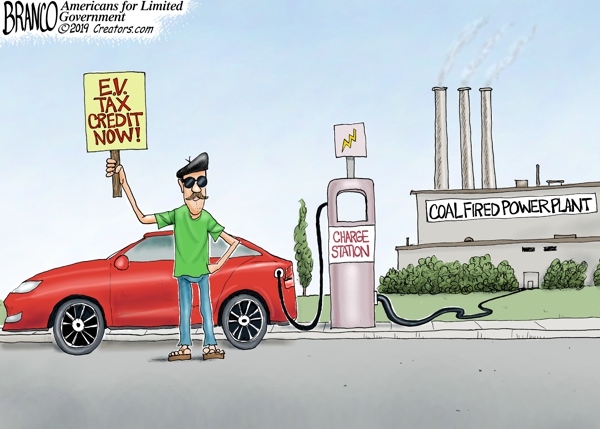
Reason #1: EVs Are Not Green

The central premise for EVs is they help to save the planet from carbon because they use electricity instead of gas.

It’s astounding so few think to ask, what generates the electricity that powers EVs?

Hydrocarbons generate over 60% of the electricity in the US. That means there’s an excellent chance that oil, coal, or gas is behind the electricity charging an EV.

It’s important to emphasize carbon is an essential element for life on this planet. It’s what humans exhale and what plants need to survive.

After decades of propaganda, Malthusian hysterics have created a twisted perception in many people’s minds that carbon is a dangerous substance that must be reduced to save the planet.

Let’s entertain this bogus premise momentarily and assume carbon is bad.

Even by this logic, EVs do not really reduce carbon emissions; they just rearrange them.

Further, extracting and processing the exotic materials needed to make EVs requires tremendous power in remote locations, which only hydrocarbons can provide.

Additionally, EVs require an enormous amount of rare elements and metals—like lithium and cobalt—that companies mine in conditions that couldn’t remotely be considered friendly to the environment.

Analysts estimate that each EV requires around one kilogram of rare earth elements. Extracting and processing these rare elements produces a massive amount of toxic waste. That’s why it mainly occurs in China, which doesn’t care much about environmental concerns.

In short, the notion that EVs are green is laughable.

It’s simply the thin patina of propaganda that governments need as a pretext to justify the astronomical taxpayer subsidies for EVs.

Reason #2: EVs Can’t Compete Without Government Support

See the rest here

Be seeing you

Posted in Uncategorized | Tagged: , , , , , , | Leave a Comment »

Erie Times E-Edition Article-Go green on housing with no additional cost

Posted by M. C. on June 4, 2021

“Go green on housing with no additional cost”

The point here is “no additional cost” really means “free government money” pays the tab. This person, vice president of the Environment Program at the JPB Foundation, is delusional.

Free government money comes from 3 places. Taxes (not free to the taxpayer), loans from other countries and entities (the resultant interest is not free) and printing money which generates the hidden tax that is inflation which is now again rearing it’s ugly head (paid for by everyone).

The sad part is the author and most of the unwashed masses may actually believe free government money is really a free lunch.

The real housing crisis is sky high home prices. And that is courtesy of free government money supplied by the Fed.

https://erietimes-pa-app.newsmemory.com/?publink=276b95073_1345dd0

Go green on housing with no additional cost

Your Turn Dana Bourland | Guest columnist Two of the biggest problems we face today — a shortage of decent, affordable housing and climate change — are connected. Fortunately, the solutions are connected as well. That’s why we must not only ‘build back better’ in the wake of pandemic and recession, but build back greener.

Most housing in the United States is inefficient and expensive to heat and cool. That means high utility bills and higher carbon emissions; residential energy use accounts for a fifth of climate-changing greenhouse gases emitted in the United States.

At the same time, the facilities that produce the power to build and operate our homes — like coal-fired power plants — contribute to a changing climate. Because they are often located in communities of color, these facilities also exacerbate environmental injustice. And producing the petrochemicals used in adhesives, cabinets, carpets, insulation and other building materials not only contributes to climate change, but pollutes the air outside and inside our homes.

The good news is that we can address our housing crisis and our climate crisis with green affordable housing at no additional cost.

President Joe Biden’s infrastructure plan includes a large allocation for housing — an important first step. And the much-needed recent expansion of the Weatherization Assistance Program will make homes more comfortable and efficient.

But these investments can accomplish so much more, by ‘greening’ the entire building supply chain. That means going beyond energy consumption in our homes to address energy usage and petrochemicals in the manufacturing and transportation of materials.

In other words, how we build is as important as what we build. We can’t make one home green while polluting other communities in the process.

Biden’s ‘American Jobs Plan’ calls for investing $213 billion in the nation’s housing infrastructure. This includes $40 billion to repair public housing, $45 billion for the national Housing Trust Fund, an expansion of the Housing Choice Voucher program and more.

The administration can ‘green’ this investment by requiring these programs to use holistic green affordable housing criteria. These should go beyond energy efficiency to include the use of sustainably produced, non-toxic building materials. In this way, the infrastructure bill could stabilize the climate and improve public health while expanding access to affordable housing.

Similarly, the Weatherization Assistance Program could be expanded to include health and safety improvements as well as energy-efficiency upgrades, creating well-paying jobs for contractors while reducing triggers for asthma and other health impacts.

To solve our housing and climate crises, we must integrate how we think about both. We do not have the time or the resources to meet our housing crisis without considering how to meet our climate crisis. And if new investments in infrastructure deploy green building practices, we can score a triple win for housing, health and the climate.

Dana Bourland is vice president of the Environment Program at the JPB Foundation and author of ‘Gray to Green Communities: A Call to Action on the Housing and Climate Crises.’

Be seeing you

Posted in Uncategorized | Tagged: , , , | Leave a Comment »