MCViewPoint

Opinion from a Libertarian ViewPoint

Posts Tagged ‘habeas corpus’

Fredrickson: Don’t let constitutional rights be a victim of this virus | Opinion | news-journal.com

Posted by M. C. on March 27, 2020

https://www.news-journal.com/opinion/fredrickson-don-t-let-constitutional-rights-be-a-victim-of/article_ac663588-6d5d-11ea-bd73-6bd78fe4d483.html

Courts across the country are grappling with how to continue operations in the face of the threat posed by the COVID-19 pandemic, in particular how to comply with the requirements of the Speedy Trial Act for criminal defendants. While most of Congress’ attention is focused on how to respond to the looming financial meltdown, the Trump Justice Department is floating language to be included in one of the relief packages to address the burden on the judiciary. Some of the department’s proposal are sensible; others would be dangerous incursions on fundamental constitutional rights.

The department’s draft language, as reported by Politico, seeks modification of the Federal Rules of Criminal Procedure to allow greater use of videoconferencing, even at times without the defendant’s agreement. With COVID-19’s rapid transmission between individuals, and the danger it poses to certain groups of people, such a move might have some merit. Similarly, the Justice Department’s proposal to extend the statute of limitations in criminal and civil cases during an emergency “and for one year following the end of the national emergency” has some merit, though an additional year is excessive. The courts too are facing a significant slowdown as staff works remotely and others are getting sick.

But the Justice Department’s request doesn’t stop there. Instead, the department has also included an idea that should be immediately rejected: letting federal court chief judges halt all court proceedings during an emergency. This provision would apply to “any statutes or rules of procedure otherwise affecting pre-arrest, post-arrest, pre-trial, trial, and post-trial procedures in criminal and juvenile proceedings and all civil process and proceedings.” In its draft language shared with Congress, the Justice Department argues that the new provision would ensure more consistency in the procedures adopted in different courthouses.

What is most chilling about this proposal is what it would do to habeas corpus, the constitutional guarantee that a detained person has the right to appear in court for a determination of whether his or her detention is lawful. The Justice Department language would allow a judge to order someone who had simply been arrested, but not charged or convicted, to be held until the judge determines the emergency is over.

This proposal is chillingly reminiscent of the Bush administration’s overreach in the aftermath of 9/11. In 2001, it moved quickly to send Congress legislation to address the economic impact of the terrorist attack and strengthen national security authorities, all of which Congress passed with little dissent. The USA Patriot Act, one of the most far-reaching proposals, was passed into law less than two months after the attack, granting greatly expanded surveillance and deportation powers to federal law enforcement. The Patriot Act both broadened the definition of immigrants who were deportable and eliminated many procedural protections for such individuals. Any immigrant “certified” a threat to national security could be detained indefinitely.

The American Civil Liberties Union and others challenged that provision, arguing it was unconstitutional to allow the indefinite detention of individuals arrested and not charged with a terrorism offense if they had an immigration status violation — like overstaying a visa — but could not return to their home country.

Though the Supreme Court has not ruled definitively on the constitutionality of indefinite detention, in June 2003, the Justice Department’s inspector general affirmed the arrests and detentions of hundreds of immigrants, mostly Arab, Muslim or South Asian men, had been “indiscriminate” and “haphazard” and the Immigration and Naturalization Service (the predecessor to Immigration and Customs Enforcement) had been regularly detaining individuals not linked to criminal activity or terrorism.

Now, Trump’s Justice Department is seizing on the pandemic as an excuse to push for a major rollback in civil liberties. President Donald Trump has shown an admiration for autocrats around the world, from Russia’s Vladimir Putin to Turkey’s Recep Tayyip Erdogan. It is a classic move of such leaders to use a crisis to advance policies they have long supported. Indeed. Trump has already instituted tighter border restrictions because of covid-19 and further limited asylum applications.

Even if Congress does not agree to the new detention policy, Trump is endowed, as president, with other authorities he can use now that must be closely scrutinized. Even a president admired for his leadership during crisis, Franklin D. Roosevelt, ordered people of Japanese ancestry on the West Coast to be put in internment camps. After 9/11, Congress gave the Bush administration almost everything it asked for, resulting in flawed legislation with vast civil liberties violations. We must demand Congress not forget those lessons.


Be seeing you
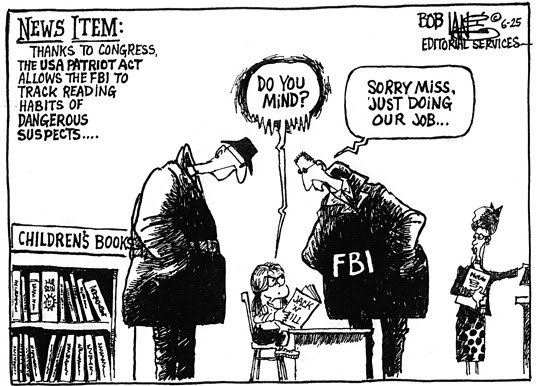
covertress: The USA Patriot Act


Posted in Uncategorized | Tagged: , , , , | Leave a Comment »

Our Free Speech Crisis – LewRockwell

Posted by M. C. on July 10, 2019

We should reject any restriction on free speech. We might ask ourselves, “What’s the true test of one’s commitment to free speech?” It does not come when people permit others to say or publish ideas with which they agree. The true test of one’s commitment to free speech comes when others are permitted to say and publish ideas they deem offensive.

https://www.lewrockwell.com/2019/07/walter-e-williams/our-free-speech-crisis/

By

The First Amendment to our Constitution was proposed by the 1788 Virginia ratification convention during its narrow 89 to 79 vote to ratify the Constitution. Virginia’s resolution held that the free exercise of religion, right to assembly and free speech could not be canceled, abridged or restrained. These Madisonian principles were eventually ratified by the states on March 1, 1792.

Gettysburg College professor Allen C. Guelzo, in his article “Free Speech and Its Present Crisis,” appearing in the autumn 2018 edition of City Journal, explores the trials and tribulations associated with the First Amendment. The early attempts to suppress free speech were signed into law by President John Adams and became known as the Alien and Sedition Acts of 1798. Later attempts to suppress free speech came during the Civil War, when President Abraham Lincoln and his generals attacked newspapers and suspended habeas corpus. It wasn’t until 1919, in the case of Abrams v. United States, when the U.S. Supreme Court finally and unambiguously prohibited any kind of censorship.

Today, there is growing contempt for free speech, most of which is found on the nation’s college and university campuses. Guelzo cites the free speech vision of Princeton University professor Carolyn Rouse, who is chairperson of the department of Anthropology. Rouse shared her vision on speech during last year’s Constitution Day lecture. She called free speech a political illusion, a baseless ruse to enable people to “say whatever they want, in any context, with no social, economic, legal or political repercussions.” As an example, she says that a climate change skeptic has no right to make “claims about climate change, as if all the science discovered over the last X-number of centuries were irrelevant.”…

We should reject any restriction on free speech. We might ask ourselves, “What’s the true test of one’s commitment to free speech?” It does not come when people permit others to say or publish ideas with which they agree. The true test of one’s commitment to free speech comes when others are permitted to say and publish ideas they deem offensive…

I am afraid that too many of my fellow Americans are hostile to the principles of liberty. Most people want liberty for themselves. I differ. I want liberty for me and liberty for my fellow man.

Be seeing you

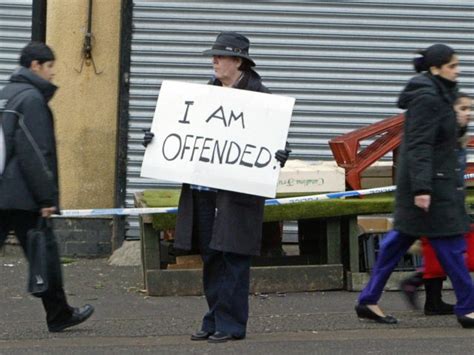
offended

Citizen: “What are you protesting against” Johnny: “What have you got?” The Wild One


Posted in Uncategorized | Tagged: , , , | Leave a Comment »

Lincoln and Trump: Two of a Kind? | Mises Wire

Posted by M. C. on July 4, 2019

Did you learn this in government school? Me neither.

https://mises.org/wire/lincoln-and-trump-two-kind

President Trump has outraged legions of political opponents with his plan to give a Fourth of July speech on the steps of the Lincoln Memorial. A Washington Post columnist frets that Trump’s speech will leave a “stain” that “won’t ever completely wash away.” But before any more teeth-gnashing occurs, we should recognize the surprising parallels between Trump and President Lincoln.

Trump sparked an uproar in 2017 by tweeting derisively about the “so-called judge” who blocked his order severely restricting immigration from seven nations. Twitter was not around in the 1860s so Lincoln never took online swipes at the judiciary. However, when Supreme Court Chief Justice Roger Taney ruled in 1861 that Lincoln had no right to suspend habeas corpus along a railroad corridor, Lincoln ignored his decision. The following year, Lincoln greatly expanded the suspension, resulting in the arrest and military trials of people who had done nothing more than insult the president. Up to 15,000 northerners became political prisoners as a result of Lincoln’s orders.

Trump mortifies the press corps and millions of non-ink-stained wretches when he denounces that the media is “the enemy of the American people.” Lincoln refrained from such rude comments during his four years in the White House. However, on May 18, 1864, Lincoln issued an executive order for “arrest and imprisonment of irresponsible newspaper reporters and editors” after the New York World and Journal of Commerce published an incorrect report on a pending expansion of conscription. Lincoln forcibly shut down 300 newspapers in the North that were insufficiently supportive of military policies and hundreds of editors, publishers, and reporters were tossed into prison without charges.

Trump has been widely condemned for canceling the Obama administration mandate compelling every public school to allow transgender students to use the bathrooms and locker rooms of their choice. Transgender rights were not an issue in the 1860s, but Lincoln’s treatment of the most reviled ethnic group of his era was not his finest hour. In 1862, Lincoln approved the largest mass execution in American history — 39 Sioux Indians. In 1863, Lincoln approved brutally expelling Navajos and Apaches from the New Mexico territory. In 1864, John Evans, a personal friend of Lincoln’s and his appointee as Colorado territorial governor, launched a military campaign that culminated in the U.S. cavalry slaughtering more than 100 peaceful Indian women and children at Sand Creek, an unprovoked attack that even Congress labeled a “massacre.”

Trump was denounced for his “tyrannical and despotic” attempt to withhold federal funds from self-proclaimed “sanctuary cities” that refuse to cooperate with federal immigration authorities. Rather than sanctuary cities, Lincoln dealt with border states that threatened to secede and he did not rely on sweet words alone. In September 1861, Lincoln sent federal troops to arrest pro-southern members of the Maryland legislature. In Kentucky, Union commanders targeted Southern sympathizers with roving “execution squads,” as the New York Times noted. Vast swaths of southern Missouri were devastated and depopulated to prevent any support for Confederate forces.

Trump suggested in 2016 that the U.S. government could kill the families of terrorists to dissuade others from launching attacks — and to hell with Geneva Conventions rules protecting non-combatants. Lincoln also relied on a catch-all notion of collective guilt. Shortly before his 1864 march across Georgia, Union Gen. William Sherman telegramed Washington that “there is a class of people — men, women, and children — who must be killed or banished before you can hope for peace and order.” Lincoln congratulated Sherman for a ruthless destructive campaign that made “Georgia howl.” After Union Gen. Phil Sheridan torched much of Virginia, Lincoln sent him a message declaring “my own personal admiration and gratitude for the month’s operation in the Shenandoah Valley.” Historians swept Lincoln’s brutal tactics under the rug long before his memorial was consecrated in 1922.

Trump and Lincoln are soulmates on today’s most contentious economic issue. Trump portrays imports as a pox while his trade wars are ravaging American farmers and many manufacturers. Promising high tariffs helped Lincoln capture the presidency in 1860 and he cheered in February 1861 when congressional Republicans boosted tariffs as high as 216%. The New York Times denounced that bill as a “disastrous measure” that “alienates extensive sections of the country we seek to retain” and will “deal a deadly blow … at the measures now in progress to heal our political differences.” That tariff law helped drive Virginia, North Carolina, and Tennessee out of the Union, thereby making the Civil War far more destructive. Protectionism remains as idiotic now as it was 150 years ago but politicians continue to demagogue the issue…

Be seeing you

'Welcome to 'All Sides of the Issues.' Here's our panel of commentators -- a communist, a socialist, a liberal, and a progressive....'


Posted in Uncategorized | Tagged: , , , , | Leave a Comment »