MCViewPoint

Opinion from a Libertarian ViewPoint

Posts Tagged ‘individual liberty’

Libertarian Party of Pennsylvania-Stamp Act

Posted by M. C. on March 23, 2025

The Stamp Act wasn’t just about taxes—it was about government overreach, economic control, and the denial of individual liberty. The American colonists understood what too many politicians today forget: government will always find excuses to take more from the people unless they are stopped.

Stamp Act

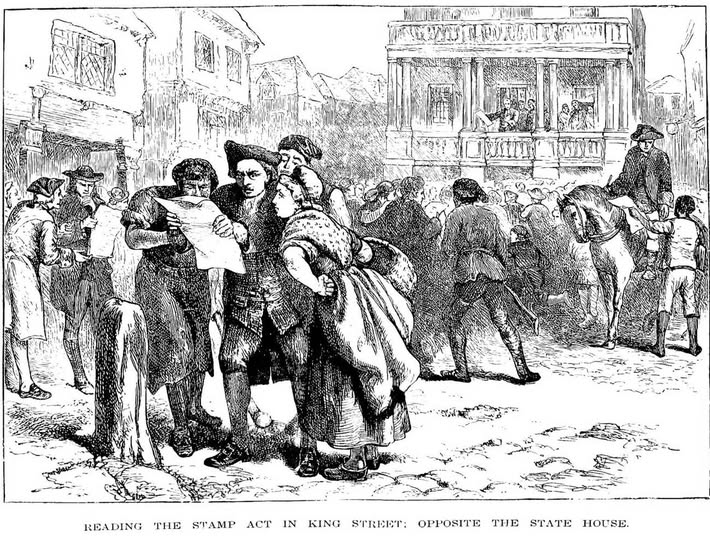
On this day, March 22, 1765, the British Parliament passed the Stamp Act, imposing direct taxes on the American colonies by requiring them to purchase official stamped paper for legal documents, newspapers, and even playing cards. This blatant act of taxation without representation ignited colonial resistance and helped spark the American Revolution.

The Stamp Act wasn’t just about taxes—it was about government overreach, economic control, and the denial of individual liberty. The American colonists understood what too many politicians today forget: government will always find excuses to take more from the people unless they are stopped.

As Libertarians, we continue this tradition of opposing this government overreach. While the common rallying cry was that “taxation without representation” was theft, we take that one step further by declaring that any taxation without consent of the person being taxed is theft. Nobody has the right to the products of your labor and this is true even if many people believe they are. We relentlessly point out that the natural state of government is expansion. Any chance a politician or bureaucrat has to take an inch, they’ll take it, but they will also try for a mile. The tax rates the founding fathers rebelled over are nothing compared to the burdensome tax bill the average American faces every year.

But the founding fathers didn’t just complain about these injustices, they took action. They protested and boycotted and formed groups like the Sons of Liberty to oppose these actions by the British. In less than a year, Britain was forced to repeal the tax.

The Stamp Act may be history, but the fight against government overreach is just as relevant today. Whether it’s taxation, corporate bailouts, or endless regulations, the government continues to take from people while failing at many of their most basic tasks. They would rather spend that money on their pet projects, useless boondoggles, funding ridiculous research, or giving your money to their friends in other countries. The lesson from the Stamp Act is clear, sitting back and complaining won’t make a difference, change comes from action. A small group of dedicated activists took on the most powerful nation of their time and birthed a nation founded on the principles of life, liberty, and property. Are you ready to take action?

Be seeing you

Posted in Uncategorized | Tagged: , , , | Leave a Comment »

The Role of Government Should Be To Protect Individual Liberty

Posted by M. C. on October 2, 2023

The Ron Paul Liberty Report

Be seeing you

Posted in Uncategorized | Tagged: , | Leave a Comment »

TGIF: “America First” Need Not Be Antiwar

Posted by M. C. on July 3, 2023

Right-wing populists, like their left-wing counterparts, seem to oppose the establishment’s foreign policy mostly because it consumes tax money they want the government to spend on domestic projects. That’s hardly comforting to anyone who wants the government to do less and thereby consume far fewer scarce resources, which after all are produced privately.

Much more could be said against America First, for example,  that the term national interest has long been a cover for collectivism and coercion. America First is no guarantee of nonintervention. What we need is a commitment not to America First but to individual liberty first.

https://libertarianinstitute.org/articles/tgif-america-first-not-antiwar/

by Sheldon Richman

drone

Today’s Trump-inspired “America First” faction cannot be counted on to be consistently noninterventionist and antiwar. That it may lean that way because its chief rival faction is so enthusiastic about foreign adventurism is hardly a firm assurance that it will remain antiwar in the future.

We must beware of the assumption that an interventionist foreign policy is, in contrast to America First, by nature “Any Country But America First.” Admittedly, advocates of U.S. foreign adventurism often defend their policy choices in terms of the benefits to another population. But that’s not all they do. They also typically invoke the security interests of the American people. It’s a small world, after all, they say, and what protects others also protects us. How often have you heard interventionists agitate for war solely on behalf of foreigners? Sure, national self-sacrifice might not be good politics, but that doesn’t mean that people of the interventionist mindset don’t mean what they say.

My point is not that they are right, but only that they, or most of them, are sincere (though misguided). I doubt if George W. Bush’s disastrous invasion of Iraq was motivated solely by regard for the Iraqis or Israelis.  Not was Barack Obama’s bombing and regime change in Libya carried out on behalf of the Libyan people only. In both cases the key policymakers and their supporters believed that these actions were also good for the American people, who had been told for decades that Saddam Hussein and Muammar Qaddafi threatened them. The same can be said about the people who gave us the war in Vietnam. This is not to dismiss the malign influence of dishonest people who simply enjoy exercising power or who will profit from selling weapons to the government.  But I am suspicious of such single-factor explanations.

If I’m right about this, we must ask what today’s America Firsterism is defined in contrast to.

See the rest here

Be seeing you

Posted in Uncategorized | Tagged: , , | Leave a Comment »

TGIF: True Liberals Are Not Conservatives

Posted by M. C. on May 23, 2022

by Sheldon Richman

As he closed his essay Hayek confessed that since the word liberal had been corrupted, thanks to the French Revolution and other forces, by “overrationalis[m], nationalis[m]” and socialis[m],” it had ceased to a good label for his political outlook, which he shared with Tocqueville and Acton: “What I should want is a word which describes the party of life, the party that favors free growth and spontaneous evolution. But I have racked my brain unsuccessfully to find a descriptive term which commends itself.” 

https://libertarianinstitute.org/articles/tgif-true-liberals-not-conservatives/

The relevance of F. A. Hayek’s essay “Why I Am Not a Conservative,” the postscript to his important 1960 book, The Constitution of Liberty, is demonstrated at once by the opening quote from Lord Acton:

At all times sincere friends of freedom have been rare, and its triumphs have been due to minorities, that have prevailed by associating themselves with auxiliaries whose objects often differed from their own; and this association, which is always dangerous, has sometimes been disastrous, by giving to opponents just grounds of opposition. [Emphasis added.]

Who among true liberal advocates of individual liberty and free social evolution — aka libertarians — would deny the truth of that observation?

Hayek had European conservatism in mind when he wrote his essay, and for years, American conservatives, who still had affection for true liberalism, hastened to point this out. As Hayek wrote:

Conservatism proper is a legitimate, probably necessary, and certainly widespread attitude of opposition to drastic change. It has, since the French Revolution, for a century and a half played an important role in European politics. Until the rise of socialism its opposite was liberalism. There is nothing corresponding to this conflict in the history of the United States, because what in Europe was called “liberalism” was here the common tradition on which the American polity had been built: thus the defender of the American tradition was a liberal in the European sense.

Later in his essay, he elaborated that “in the United States it is still possible to defend individual liberty by defending long-established institutions. To the liberal they are valuable not mainly because they are long established or because they are American but because they correspond to the ideals which he cherishes.”

But he noted that “This already existing confusion [over labels] was made worse by the recent attempt to transplant to America the European type of conservatism, which, being alien to the American tradition, has acquired a somewhat odd character.” The confusion was compounded, Hayek wrote, when socialists began to call themselves liberals.

Many still suffer from this confusion today. But change has been afoot because the illiberals of the left and right increasingly want no part of true liberalism or the label — and in a way, that’s good. Those on the left who call themselves progressives or socialists don’t like the label liberal (or neo-liberal) because they associate it with the current permanent bipartisan prowar regime beholden to special corporate interests (so we liberals still have work to do), and virtually all conservatives eschew the label because they don’t want to be mistaken for libertarians. That’s also good.

So Hayek’s essay has new relevance for America. Would Hayek have been surprised? He would have distinguished national conservatism from neoconservatism because of the latter’s cosmopolitanism. But how could he embrace as bonafide allies people who view imperialist war as a way to create “national greatness” and social solidarity, as the neocons do? Hayek would have agreed with Abraham Bishop who said in 1800 that “a nation which makes greatness its polestar can never be free; beneath national greatness sink individual greatness, honor, wealth and freedom.”

Let’s look at Hayek’s problem with conservatism. For him, the “decisive objection” is that “by its nature,” conservatism can do no more than slow down the change that progressives have initiated. That’s not good enough: “What the liberal must ask, first of all, is not how fast or how far we should move, but where we should move.” He acknowledged that although the liberal’s differences with the “collectivist radical” are greater than his differences with the conservative, the latter “generally holds merely a mild and moderate version of the prejudices of his time.” Thus “the liberal today must more positively oppose some of the basic conceptions which most conservatives share with the socialists.”

See the rest here

Be seeing you

Posted in Uncategorized | Tagged: , , , , , | Leave a Comment »

Watch “The Great Infrastructure Rip-Off: Who Gets The Money?” on YouTube

Posted by M. C. on August 14, 2021

When everything (except infrastructure) is considered “infrastructure,” politicians are basically saying that they’re going to take your money, and they can make up any excuse that they want to do so. The role of government must be seriously reconsidered. We have deviated extremely far from the American government’s original role of protecting individual liberty and keeping the peace.

https://youtu.be/EF-StflWzlw

Posted in Uncategorized | Tagged: , , | Leave a Comment »

TGIF: Defend the Enlightenment! | The Libertarian Institute

Posted by M. C. on July 5, 2021

It’s in the nature of ideas, as with all tools, that they can be used for good or ill. Stifling discussion because bad people may capitalize on fact can hardly be grounds for shutting down the intellectual marketplace. One could think of no surer example of the cure being worse than the alleged disease.

https://libertarianinstitute.org/articles/sheldon/tgif-defend-the-enlightenment/

by Sheldon Richman

The libertarian philosophy is embedded in Enlightenment liberalism. This is clearly seen in its commitment to free inquiry (reason) and free speech, the full realization of which, I argue, requires complete respect for individual rights, including property rights.

Unfortunately we live at a time when those values are increasingly under assault from from a variety intellectuals and activists despite political and cultural differences among themselves. We hear prominent people ask–and it’s really an assertion disguised as a question–whether free inquiry and free speech are really all they have been cracked up to be in light of the American condition. This seems to be a change even from the recent past, when question like that would likely come only from the most authoritarian fringes of the left and right.

Advocates of individual liberty and the rich patterns of cooperation that liberty generates have reason worry. Nothing good would be gained from restrictions on those Enlightenment values–regardless of whether the restrictions came from the government or private sources. Nothing good at all.

Whatever one’s fears about the state of American culture, it is difficult to see how stifling inquiry and speech could improve matters. Whether one is a left-collectivist who believes Enlightenment values lock in white male supremacy or a right-collectivist who believes those values have allowed the left to control the culture’s commanding heights, the crushing of true liberalism can only lead to disaster, eventually for everyone.

You need not be a libertarian to see the point, and fortunately we see nonlibertarians all around the political spectrum expressing dismay about the new disparagement of free-wheeling inquiry and uninhibited expression of its findings.

This is not rocket science. Squelching speech does not make alleged bad thoughts go away. On the contrary, it may give them an illusion of legitimacy they would never have achieved in open discussion. When a subject becomes taboo, even good-faith people may reasonably ask, “What are the self-appointed censors so scared of? Does the forbidden claim have merit that I’ve overlooked?” How does that help the censors beat back ideas?

The value of the open competitive marketplace of ideas is so obvious that it ought not require repeating. We learn through the contest among ideas. The way to defeat an assertion is not to suppress it, but to rebut it. No idea is so dangerous that it has to be banned from the marketplace. A free society cannot tolerate thought police, whether political or private.

To cherish the intellectual marketplace, one only need realize that even someone who is thoroughly wrong about a particular matter or event (and perhaps even ill-intentioned) could contribute to our knowledge by stumbling on an overlooked truth. We just never known who might be the one to set the record straight in some way. (The leftist Norman Finkelstein has admirably made this point many times.)

Moreover, it’s important that the intellectual marketplace–like the commercial marketplace and for the same reasons–not be rigged by the state in any way. All intellectual products should have to compete in a just (that is, rights-respecting) arena. Force is to be barred. But that’s all that needs barring. Now may the best ideas win.

This does not mean that the common-sense rules of respect needn’t be observed or that those who violate the rules should never be called to account. But it does mean that toleration is also a virtue when directed at offenders. We are rightly uncomfortable when people lose their livelihoods for saying the “wrong” thing in the “wrong” way. It is difficult to confine this kind of punishment to only the worst offenders. Boomerangs have a way of coming back at you.

Does an open marketplace guarantee that the truth always always wins right away? Of course not. But it’s the best chance we have of rooting out error in the shortest time. The market certainly beats any imaginable alternative, which would have to be one form or another of authoritarianism. No thank you.

It’s in the nature of ideas, as with all tools, that they can be used for good or ill. Stifling discussion because bad people may capitalize on fact can hardly be grounds for shutting down the intellectual marketplace. One could think of no surer example of the cure being worse than the alleged disease.

It’s time for all true liberals, whatever their differences, unite to defend free inquiry and free speech.

About Sheldon Richman

Sheldon Richman is the executive editor of The Libertarian Institute, senior fellow and chair of the trustees of the Center for a Stateless Society, and a contributing editor at Antiwar.com. He is the former senior editor at the Cato Institute and Institute for Humane Studies, former editor of The Freeman, published by the Foundation for Economic Education, and former vice president at the Future of Freedom Foundation. His latest books are Coming to Palestine and What Social Animals Owe to Each Other.

Be seeing you

Posted in Uncategorized | Tagged: , , | Leave a Comment »

No Privacy, No Property: The World in 2030 According to the WEF | Mises Wire

Posted by M. C. on December 8, 2020

https://mises.org/wire/no-privacy-no-property-world-2030-according-wef

Antony P. Mueller

The World Economic Forum (WEF) was founded fifty years ago. It has gained more and more prominence over the decades and has become one of the leading platforms of futuristic thinking and planning. As a meeting place of the global elite, the WEF brings together the leaders in business and politics along with a few selected intellectuals. The main thrust of the forum is global control. Free markets and individual choice do not stand as the top values, but state interventionism and collectivism. Individual liberty and private property are to disappear from this planet by 2030 according to the projections and scenarios coming from the World Economic Forum.

Eight Predictions

Individual liberty is at risk again. What may lie ahead was projected in November 2016 when the WEF published “8 Predictions for the World in 2030.” According to the WEF’s scenario, the world will become quite a different place from now because how people work and live will undergo a profound change. The scenario for the world in 2030 is more than just a forecast. It is a plan whose implementation has accelerated drastically since with the announcement of a pandemic and the consequent lockdowns. 

According to the projections of the WEF’s “Global Future Councils,” private property and privacy will be abolished during the next decade. The coming expropriation would go further than even the communist demand to abolish the property of production goods but leave space for private possessions. The WEF projection says that consumer goods, too, would be no longer private property.

If the WEF projection should come true, people would have to rent and borrow their necessities from the state, which would be the sole proprietor of all goods. The supply of goods would be rationed in line with a social credit points system. Shopping in the traditional sense would disappear along with the private purchases of goods. Every personal move would be tracked electronically, and all production would be subject to the requirements of clean energy and a sustainable environment. 

In order to attain “sustainable agriculture,” the food supply will be mainly vegetarian. In the new totalitarian service economy, the government will provide basic accommodation, food, and transport, while the rest must be lent from the state. The use of natural resources will be brought down to its minimum. In cooperation with the few key countries, a global agency would set the price of CO2 emissions at an extremely high level to disincentivize its use.

In a promotional video, the World Economic Forum summarizes the eight predictions in the following statements:

  1. People will own nothing. Goods are either free of charge or must be lent from the state.
  2. The United States will no longer be the leading superpower, but a handful of countries will dominate.
  3. Organs will not be transplanted but printed.
  4. Meat consumption will be minimized.
  5. Massive displacement of people will take place with billions of refugees.
  6. To limit the emission of carbon dioxide, a global price will be set at an exorbitant level.
  7. People can prepare to go to Mars and start a journey to find alien life.
  8. Western values will be tested to the breaking point..

Beyond Privacy and Property

In a publication for the World Economic Forum, the Danish ecoactivist Ida Auken, who had served as her country’s minister of the environment from 2011 to 2014 and still is a member of the Danish Parliament (the Folketing), has elaborated a scenario of a world without privacy or property. In “Welcome to 2030,” she envisions a world where “I own nothing, have no privacy, and life has never been better.” By 2030, so says her scenario, shopping and owning have become obsolete, because everything that once was a product is now a service.

In this idyllic new world of hers, people have free access to transportation, accommodation, food, “and all the things we need in our daily lives.” As these things will become free of charge, “it ended up not making sense for us to own much.” There would be no private ownership in houses nor would anyone pay rent, “because someone else is using our free space whenever we do not need it.” A person’s living room, for example, will be used for business meetings when one is absent. Concerns like “lifestyle diseases, climate change, the refugee crisis, environmental degradation, completely congested cities, water pollution, air pollution, social unrest and unemployment” are things of the past. The author predicts that people will be happy to enjoy such a good life that is so much better “than the path we were on, where it became so clear that we could not continue with the same model of growth.”

Ecological Paradise

In her 2019 contribution to the Annual Meeting of the Global Future Councils of the World Economic Forum, Ida Auken foretells how the world may look in the future “if we win the war on climate change.” By 2030, when CO2 emissions will be greatly reduced, people will live in a world where meat on the dinner plate “will be a rare sight” while water and the air will be much cleaner than today. Because of the shift from buying goods to using services, the need to have money will vanish, because people will spend less and less on goods. Work time will shrink and leisure time will grow.

For the future, Auken envisions a city where electric cars have substituted conventional combustion vehicles. Most of the roads and parking spaces will have become green parks and walking zones for pedestrians. By 2030, agriculture will offer mainly plant-based alternatives to the food supply instead of meat and dairy products. The use of land to produce animal feed will greatly diminish and nature will be spreading across the globe again.

Fabricating Social Consent

How can people be brought to accept such a system? The bait to entice the masses is the assurances of comprehensive healthcare and a guaranteed basic income. The promoters of the Great Reset promise a world without diseases. Due to biotechnologically produced organs and individualized genetics-based medical treatments, a drastically increased life expectancy and even immortality are said to be possible. Artificial intelligence will eradicate death and eliminate disease and mortality. The race is on among biotechnological companies to find the key to eternal life.

Along with the promise of turning any ordinary person into a godlike superman, the promise of a “universal basic income” is highly attractive, particularly to those who will no longer find a job in the new digital economy. Obtaining a basic income without having to go through the treadmill and disgrace of applying for social assistance is used as a bait to get the support of the poor.

To make it economically viable, the guarantee of a basic income would require the leveling of wage differences. The technical procedures of the money transfer from the state will be used to promote the cashless society. With the digitization of all monetary transactions, each individual purchase will be registered. As a consequence, the governmental authorities would have unrestricted access to supervise in detail how individual persons spend their money. A universal basic income in a cashless society would provide the conditions to impose a social credit system and deliver the mechanism to sanction undesirable behavior and identify the superfluous and unwanted.

Who Will Be the Rulers?

The World Economic Forum is silent about the question of who will rule in this new world.

There is no reason to expect that the new power holders would be benevolent. Yet even if the top decision-makers of the new world government were not mean but just technocrats, what reason would an administrative technocracy have to go on with the undesirables? What sense does it make for a technocratic elite to turn the common man into a superman? Why share the benefits of artificial intelligence with the masses and not keep the wealth for the chosen few?

Not being swayed away by the utopian promises, a sober assessment of the plans must come to the conclusion that in this new world, there would be no place for the average person and that they would be put away along with the “unemployable,” “feeble minded,” and “ill bred.” Behind the preaching of the progressive gospel of social justice by the promoters of the Great Reset and the establishment of a new world order lurks the sinister project of eugenics, which as a technique is now called “genetic engineering” and as a movement is named “transhumanism,” a term  coined by Julian Huxley, the first director of the UNESCO.

The promoters of the project keep silent about who will be the rulers in this new world. The dystopian and collectivist nature of these projections and plans is the result of the rejection of free capitalism. Establishing a better world through a dictatorship is a contradiction in terms. Not less but more economic prosperity is the answer to the current problems. Therefore, we need more free markets and less state planning. The world is getting greener and a fall in the growth rate of the world population is already underway. These trends are the natural consequence of wealth creation through free markets.

Conclusion

The World Economic Forum and its related institutions in combination with a handful of governments and a few high-tech companies want to lead the world into a new era without property or privacy. Values like individualism, liberty, and the pursuit of happiness are at stake, to be repudiated in favor of collectivism and the imposition of a “common good” that is defined by the self-proclaimed elite of technocrats. What is sold to the public as the promise of equality and ecological sustainability is in fact a brutal assault on human dignity and liberty. Instead of using the new technologies as an instrument of betterment, the Great Reset seeks to use the technological possibilities as a tool of enslavement. In this new world order, the state is the single owner of everything. It is left to our imagination to figure out who will program the algorithms that manage the distribution of the goods and services. Author:

Antony P. Mueller

Dr. Antony P. Mueller is a German professor of economics who currently teaches in Brazil. Write an email. See his website and blog.

Be seeing you

Posted in Uncategorized | Tagged: , , , , , , | Leave a Comment »

Here We Go Again – LewRockwell

Posted by M. C. on November 19, 2020

By doing so, they have reignited the age-old debate of individual liberty versus public safety. In this case, the safety they claim to be enhancing is safety from disease. Yet, by their executive orders, they have purported to use state law to interfere with freedoms without due process that are guaranteed by the U.S. Constitution. By doing that, they have set themselves up for criminal prosecutions when normalcy returns.

Let us hope so.

https://www.lewrockwell.com/2020/11/andrew-p-napolitano/here-we-go-again-2/

By Andrew P. Napolitano

“Rightful liberty is unobstructed action according to our will within limits drawn around us by the equal rights of others. I do not add ‘within the limits of the law’ because the law is often but the tyrant’s will, and always so when it violates the right of an individual.” — Thomas Jefferson (1743-1826)

As if nanny state governors had been sleepwalking through the tyrannical shutdowns and their disastrous consequences last spring and summer, as if they were ignorant of the economic destruction of those they barred from going to work or operating their businesses, as if they thought it is lawful to assault natural rights and constitutional guarantees, these same governors are now beginning another wave of interferences with personal liberty.

Slowly, over the past 10 days, while the eyes of the public and the media have been on the counting of votes in the presidential election and the ensuing allegations and litigations, governors in New Jersey, Pennsylvania, Michigan, Connecticut and New York have threatened to impose or have begun to impose their unconstitutional, illegal, immoral and illogical efforts to shut down society in order — they claim — to rid the land of the COVID-19 virus.

By doing so, they have reignited the age-old debate of individual liberty versus public safety. In this case, the safety they claim to be enhancing is safety from disease. Yet, by their executive orders, they have purported to use state law to interfere with freedoms without due process that are guaranteed by the U.S. Constitution. By doing that, they have set themselves up for criminal prosecutions when normalcy returns.

Here is the backstory.

For the past four years, I have been working on a 650-page treatise that explores the origins of human freedom from a natural law perspective. The book traces the recognition by scholars, jurists, theologians and, in the case of America at its founding, radical revolutionaries like Thomas Jefferson and James Madison, who truly believed and passionately argued that human freedom — our individual power to make unobstructed choices — comes from within us, and not from the government. Most of the historical defenders of this truism also believed in God and argued that He made us free by giving us free will.

This understanding of natural rights was wedded to the United States at its birth in 1776 when Jefferson wrote in the Declaration of Independence that we are endowed by our Creator with certain inalienable rights, and again in 1791 when Madison wrote in the Ninth Amendment that because human liberty is so expansive the government must protect even unstated, unenumerated rights.

To protect our rights from whom?

The framers could easily answer that question, yet the folks who run the government today do not want it asked because the answer implicates them. In the revolutionary era, colonists could protect themselves from evildoers attempting to steal their property or take their lives. But the foe they most feared was the government. They fought a bloody war against the government of King George III because it assaulted their economic rights and their right to self-government.

History is repeating itself, without the courageous revolutionaries. It is not my neighbor, or even a thief in the night, who impairs my personal liberty — it is the government. It does so, just as King George did, under the guise of safety. Yet, the Constitution and the Bill of Rights were written precisely to prevent governments in America — state or federal — from interfering with our liberty, absent a jury trial at which they must prove fault.

This jury trial requirement is called due process. It is guaranteed by the Fifth and 14th Amendments, which mandate that the government comply with due process whenever it seeks to impair the life, liberty or property of any person. Of course, a constitutional guarantee is only as reliable as is the fidelity to the Constitution of those in whose hands we repose it for safekeeping.

Now, back to these nanny state governors. They have assumed to themselves the powers to write laws and enforce them. That assumption violates the U.S. Constitution and the constitutions of the states in which they were elected, because the power to write laws and the power to enforce laws is required to be separated in America. We call that the separation of powers. It is, according to my late friend Justice Antonin Scalia, the most unique and freedom-protecting aspect of the Constitution, and it applies to states as well as the federal government.

Add to this the so-called lockdowns — a demeaning word originating in the shutdown of prisons during riots — that directly impair personal liberties that are not only natural to us but are expressly guaranteed by the Constitution as the Supreme Court has interpreted it. These lockdowns interfere with the freedom to speak, travel, worship, assemble, engage in commercial intercourse and use property to its highest and best use.

Under federal law, when a government employee employs government tools to impair these enumerated rights — and does so without due process — that person commits a felony.

Thus, when governors use police powers to interfere with personal liberty — liberty that is expressly guaranteed by the Constitution — and do so without a trial at which the government proves fault, they have violated both state and federal law, no matter their reasoning. Thus, all these executive orders regulating private personal behavior are profoundly unconstitutional and even criminal.

There is no pandemic exception to the Constitution. It is liberty that flows in our veins, not false promises of government safety.

The Best of Andrew P. Napolitano Andrew P. Napolitano [send him mail], a former judge of the Superior Court of New Jersey, is the senior judicial analyst at Fox News Channel. Judge Napolitano has written nine books on the U.S. Constitution. The most recent is Suicide Pact: The Radical Expansion of Presidential Powers and the Lethal Threat to American Liberty. To find out more about Judge Napolitano and to read features by other Creators Syndicate writers and cartoonists, visit creators.com.

Be seeing you

Posted in Uncategorized | Tagged: , , , | 1 Comment »