
MCViewPoint

Opinion from a Libertarian ViewPoint

Posts Tagged ‘industrialization’

Industrialization Is the Antidote to Global Poverty. Global Warming Activists Don’t Care. | Mises Wire

Posted by M. C. on July 18, 2021

To everything I have said, some might retort that the state sector can effectuate the construction and development of a green energy economy better than the private sector can. History has repeatedly demonstrated that this is not the case—the Wright brothers beat the US government to the invention of the aircraft by a long shot, and much of America’s most basic infrastructure was built by competing private sector entities, after the state had made disastrous attempts

https://mises.org/wire/industrialization-antidote-global-poverty-global-warming-activists-dont-care

Eben Macdonald

Having long ago lost the argument that capitalism can’t deliver a higher standard of living, the Left’s current anti-capitalist strategy is to claim capitalism requires environmental destruction. Yet even if one were to assume carbon emissions are the driving factor behind climate change, we must acknowledge the moral and economic necessity of industrialization. Between 1250 and 1800, world GDP per capita barely budged; in 1800, global life expectancy was a mere thirty years, infant mortality was commonplace, and eight in ten humans lived below the poverty line. Since the advent of the Industrial Revolution, that has all changed: despite the environmental impacts, global per capita income has risen fourteenfold and billions have risen from poverty—a phenomenon the economist Deidre McCloskey describes as “the Great Enrichment.” Industry and the establishment of national industrial infrastructure are and have been the keys to economic growth and poverty alleviation. Data indicate that GDP per capita—the amount of goods and services produced per person—is the single best predictor against extreme poverty (graph displayed below):

Poverty to GDP

Moreover, although GDP growth can signal government increases in the money supply rather than true increases in production, poverty reduction has tightly tracked GDP per capita growth in the developing world. A 2010 paper produced a very clear correlation between GDP growth and the poverty rate in Sub-Saharan Africa (graph displayed below):
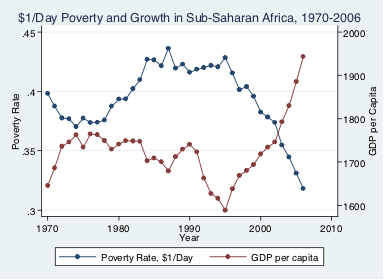
poverty and growth in Africa

It is unfair to use climate change to indict neoliberalism. Industrialization, albeit posing long-term environmental consequences, has lifted the human standard of living by extraordinary amounts. More importantly, the charge makes no sense, considering that the solution to climate change lies in the free market, as recent emissions trends and developments in the energy sector show. The central advantage of capitalism is its capacity for self-rectification and alleviation of the problems it initially creates. That is the miracle of innovation.

Market Development Reduced Greenhouse Gas Emissions

See the rest here

Author:

Eben Macdonald

Eben Macdonald is a 16-year-old student, a keen free-marketeer, and he wants a society which is predicated on liberty.

Be seeing you

Posted in Uncategorized | Tagged: , , , | Leave a Comment »

Greta Thunberg To Poor Countries: Drop Dead | Mises Wire

Posted by M. C. on September 28, 2019

The challenge here arises from the fact that for a middle-income or poor country, cheap energy consumption — made possible overwhelmingly by fossil fuels — is often a proxy for economic growth.

After all, if a country wants to get richer, it has to create things of value. At the lower- and middle- income level, that usually means making things such as vehicles, computers, or other types of machinery. This has certainly been the case in Mexico, Malaysia, and Turkey.

But for countries like these, the only economical way to produce these things is by using fossil fuels.

https://mises.org/wire/greta-thunberg-poor-countries-drop-dead

On Monday, celebrity climate activist Greta Thunberg delivered a speech to the UN Climate Action summit in New York. Thunberg demanded drastic cuts in carbon emissions of more than 50 percent over the next ten years.

It is unclear to whom exactly she was directing her comments, although she also filed a legal complaint with the UN on Monday, demanding five countries (namely Argentina, Brazil, France, Germany and Turkey) more swiftly adopt larger cuts in carbon emissions. The complaint is legally based on a 1989 agreement, the Convention on the Rights of the Child, under which Thunberg claims the human rights of children are being violated by too-high carbon emissions in the named countries.

Thunberg seems unaware, however, that in poor and developing countries, carbon emissions are more a lifeline to children than they are a threat.

Rich Countries and Poor

It’s one thing to criticize France and Germany for their carbon emissions. Those are relatively wealthy countries where few families are reduced to third-world-style grinding poverty when their governments make energy production — and thus most consumer goods and services — more expensive through carbon-reduction mandates and regulations. But even in the rich world, a drastic cut like that demanded by Thunberg would relegate many households now living on the margins to a life of greatly increased hardship.

That’s a price Thunberg is willing to have first-world poor people pay.

But her inclusion of countries like Brazil and Turkey on this list is bizarre and borders on the sadistic — assuming she actually knows about the situation in those places.

While some areas of Brazil and Turkey contain neighborhoods that approach first-world conditions, both countries are still characterized by large populations living in the sorts of poverty that European children could scarcely comprehend.

Winning the War on Poverty with Fossil Fuels

But thanks to industrialization and economic globalization —  countries can, and do, climb  out of poverty.

In recent decades, countries like Turkey, Malaysia, Brazil, Thailand, and Mexico — once poverty-stricken third-world countries — are now middle-income countries. Moreover, in these countries most of the population will in coming decades likely achieve what we considered to be first-world standards of living in the twentieth century.

At least, that’s what will happen if people with Thunberg’s position don’t get their way…

Both, however, also conclude that the challenges posed by climate change do not require the presence of a global climate dictatorship. Moreover, human societies are already motivated to do the sorts of things that will be essential in overcoming climate-change challenges that may arise.

That is, pursuing higher standards of living through technological innovation is the key to dealing with climate change.

But that innovation isn’t fostered by shaking a finger at Brazilian laborers and telling them to forget about a family car or household appliances or travel at vacation time.

That isn’t likely to be a winning strategy outside the world of self-hating first-world suburbanites. It appears many Indians and Brazilians and Chinese are willing to risk the global warming for a chance at experiencing even a small piece of what wealthy first-world climate activists have been enjoying all their lives.

Be seeing you

Poverty In Brazil - The Borgen Project


Posted in Uncategorized | Tagged: , , , , , | Leave a Comment »

Capitalism Didn’t Invent “Keeping Up with the Joneses” | Mises Wire

Posted by M. C. on July 29, 2019

https://mises.org/wire/capitalism-didnt-invent-keeping-joneses

Anti-capitalists long ago lost the argument about whether or not capitalism is the most effective way to increase living standards. Thanks to the spread of a largely-capitalistic marketplace, global poverty rates have fallen precipitously, life expectancy has risen, and standards of living continue to rise. The greatest gains have been in the so-called “developing world.”

But this hasn’t stopped anti-capitalists from coming up with new reasons — reasons unrelated to overcoming poverty — as to why capitalism ought to be abandoned.

One common complaint along these lines is that the capitalist system — mostly through advertising — makes us miserable by convincing us we must continually compete with others to raise our economic and social status within society.

Perhaps the most famous and still-talked-about example of this capitalism-makes-you-miserable narrative is found in 1999’s film Fight Club. The film centers around characters who attempt to escape their dull, depressing lives otherwise ruined by a desire for capitalist excess. At one point, the character named Tyler Durden delivers a monologue concluding that consumers in the capitalist society are

slaves with white collars. Advertising has us chasing cars and clothes. Working jobs we hate so that we can buy sh-t we don’t need.

At the root of this contention is the idea that capitalism causes consumerism, and consumerism drives us to strive ever harder to attain higher levels of material comfort and social status. Rather than enjoying a simple care-free lifestyle, the argument goes, we sacrifice our free time and happiness to working long hours in pursuit of needless consumption and competition.

[RELATED: “Capitalism Doesn’t Cause Consumerism — Governments Do” by Ryan McMaken]

But is capitalism really to blame for this sort of thinking? Is the insatiable quest for higher social status something newly invented by modern market economies?

Hardly.

Unfortunately, the desire to be popular, desirable, and possessing of high levels of social status is not tied to any particular economic system. It is found in all societies, and was certainly not something that suddenly appeared as economies began to industrialize.

What capitalism and industrialization did do was create more options available to people seeking to improve their positions within the social hierarchy. In ages past, status was closely tied to one’s family lineage or to how much favor one enjoyed with the imperial court. In capitalist times, these old criteria have not vanished, but a new  pathway to status was opened up: wealth obtained through success in the marketplace.

Social Status and Wealth Attainment in Pre-Capitalist Times

Prior to indistrialization, social mobility was — with only rare exceptions — open only to people who were already born into a relatively high social strata. Those who were born into the nobility or high-ranking levels of government bureaucracy could perhaps aspire to reach even higher levels of rank within the ruling classes.

The average peasant had no such hopes. For an average person in the pre-capitalist world, the methods of raising one’s status in society were few and exceedingly difficult.

In the ancient world, competition for social status was high-stakes and ever-present. Given the absence of a middle class and the grinding poverty experienced by the overwhelming majority of human beings in these times, those who had managed to rise above the peasantry fought hard to stay there.

The methods of maintaining and increasing status included:

  • Successful military service.
  • Winning favor with government officials through displays of personal loyalty.
  • Marriage into a family of higher social status.
  • Excellence in athletic competitions (most notably in Greece).

Military service was an especially fruitful means of increasing one’s social status. In the Neo-Assyrian empire, to list just one example,

To kill a prominent enemy was a conspicuous way for a soldier to distinguish himself and prove his loyalty to the king … [and this method was] explicitly highlighted as a method of raising a warrior’s profile.1

Material rewards were meted out by rulers to “those who brought in the heads of high-ranking enemy leaders.”2

Military service was a key factor in improving one’s fortunes throughout the ancient world, which is to be expected since warfare — and not commerce — was among the most easily available means to increase one’s wealth in a pre-capitalist world.

Social Status in Socialist Systems

Read the rest of this entry »

Posted in Uncategorized | Tagged: , , , , | Leave a Comment »