


As Albright famously asked Colin Powell in 1992: “What’s the use of having this superb military you’re always talking about if we can’t use it?” To her, American military personnel apparently were but gambit pawns in a global chess game, to be sacrificed for the interest and convenience of those playing.
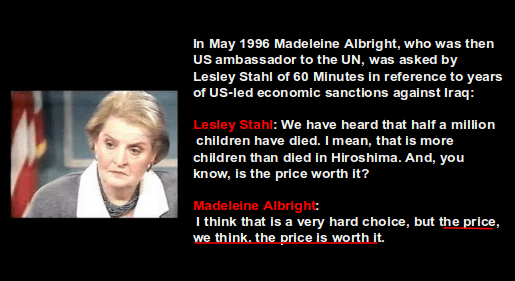
Albright typifies the arrogance and hawkishness of Washington blob.
How to describe U.S. foreign policy over the last couple of decades? Disastrous comes to mind. Arrogant and murderous also seem appropriate.
Since 9/11, Washington has been extraordinarily active militarily—invading two nations, bombing and droning several others, deploying special operations forces in yet more countries, and applying sanctions against many. Tragically, the threat of Islamist violence and terrorism only have metastasized. Although Al Qaeda lost its effectiveness in directly plotting attacks, it continues to inspire national offshoots. Moreover, while losing its physical “caliphate” the Islamic State added further terrorism to its portfolio.
Three successive administrations have ever more deeply ensnared the United States in the Middle East. War with Iran appears to be frighteningly possible. Ever-wealthier allies are ever-more dependent on America. Russia is actively hostile to the United States and Europe. Washington and Beijing appear to be a collision course on far more than trade. Yet the current administration appears convinced that doing more of the same will achieve different results, the best definition of insanity.
Despite his sometimes abusive and incendiary rhetoric, the president has departed little from his predecessors’ policies. For instance, American forces remain deployed in Afghanistan and Syria. Moreover, the Trump administration has increased its military and materiel deployments to Europe. Also, Washington has intensified economic sanctions on Cuba, Iran, North Korea, and Russia, and even penalized additional countries, namely Venezuela.
U.S. foreign policy suffers from systematic flaws in the thinking of the informal policy collective which former Obama aide Ben Rhodes dismissed as “The Blob.” Perhaps no official better articulated The Blob’s defective precepts than Madeleine Albright, United Nations ambassador and Secretary of State.
First is overweening hubris. In 1998 Secretary of State Albright declared that “If we have to use force, it is because we are America: we are the indispensable nation. We stand tall and we see further than other countries into the future, and we see the danger here to all of us.”
Even then her claim was implausible. America blundered into the Korean War and barely achieved a passable outcome. The Johnson administration infused Vietnam with dramatically outsize importance. For decades, Washington foolishly refused to engage the People’s Republic of China. Washington-backed dictators in Cuba, Nicaragua, Iran, and elsewhere fell ingloriously. An economic embargo against Cuba that continues today helped turn Fidel Castro into a global folk hero. Washington veered dangerously close to nuclear war with Moscow during the Cuban Missile Crisis in 1962 and again two decades later during military exercises in Europe.
U.S. officials rarely were prepared for events that occurred in the next week or month, let alone years later. Americans did no better than the French in Vietnam. Americans managed events in Africa no better than the British, French, and Portuguese colonial overlords. Washington made more than its share of bad, even awful decisions in dealing with other nations around the globe.
Perhaps the worst failing of U.S. foreign policy was ignoring the inevitable impact of foreign intervention. Americans would never passively accept another nation bombing, invading, and occupying their nation, or interfering in their political system. Even if outgunned, they would resist. Yet Washington has undertaken all of these practices, with little consideration of the impact on those most affected—hence the rise of terrorism against the United States. Terrorism, horrid and awful though it is, became the weapon of choice of weaker peoples against intervention by the world’s industrialized national states.
The U.S. record since September 11 has been uniquely counterproductive…
Such a philosophy explains a 1997 comment by a cabinet member, likely Albright, to General Hugh Shelton, then Chairman of the Joint Chiefs of Staff: “Hugh, I know I shouldn’t even be asking you this, but what we really need in order to go in and take out Saddam is a precipitous event—something that would make us look good in the eyes of the world. Could you have one of our U-2s fly low enough—and slow enough—so as to guarantee that Saddam could shoot it down?” He responded sure, as soon as she qualified to fly the plane.
For Albright, war is just another foreign policy tool. One could send a diplomatic note, impose economic sanctions, or unleash murder and mayhem. No reason to treat the latter as anything special. Joining the U.S. military means putting your life at the disposal of Albright and her peers in The Blob…
Be seeing you
 MCViewPoint