
MCViewPoint

Opinion from a Libertarian ViewPoint

Posts Tagged ‘interventionists’

Leftists Have It Wrong on Rights

Posted by M. C. on February 7, 2022

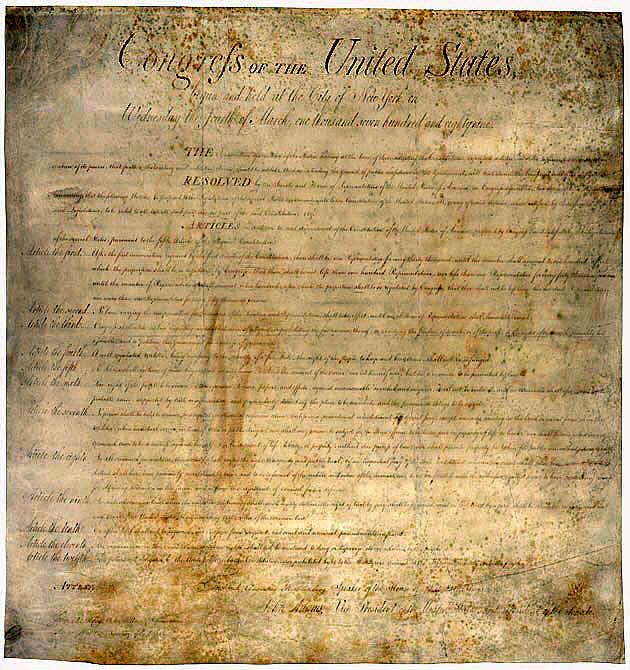
Not even the crafters of the Bill of Rights believed that. A careful reading of the First Amendment reveals that it doesn’t purport to give any rights to anyone. Instead, the wording states that Congress (and implicitly the rest of the federal government) is prohibited from infringing on people’s right of free speech. 

Thus when the government enacts a law or adopts a measure that infringes on freedom of speech, leftists are relegated to saying, “We understand that you have given us this important privilege but please be nice and don’t infringe on it.” Libertarians, on the other hand, say, “You have no legitimate authority to do that and so stop it immediately or else we will alter you or abolish you!”

by Jacob G. Hornberger

One of the central defects among leftists (that is, “liberals,” progressives, socialists, or interventionists) is their wrong-headed view of the nature of people’s rights. Their belief on this issue is one of the distinguishing characteristics between leftists and libertarians.

Leftists believe that people’s rights come from the government or from the Constitution. As such, they view rights not so much as rights but rather more as government-granted privileges.

Libertarians, on the other hand, believe that people’s rights are endowed in them by nature and God and, therefore, that people’s rights preexist government and the Constitution. We hold that the main purpose of government is to serve as our servant whose job is to protect the exercise of our natural, God-given rights. 

A good example of this leftist mindset was recently expressed in a fundraising letter I received from a leftist group called the Daily Kos. The letter stated that freedom of speech is “one of those rights granted to us in Bill of Rights.” It went on to refer to “our First Amendment rights.”

Not even the crafters of the Bill of Rights believed that. A careful reading of the First Amendment reveals that it doesn’t purport to give any rights to anyone. Instead, the wording states that Congress (and implicitly the rest of the federal government) is prohibited from infringing on people’s right of free speech. 

In other words, unlike American leftists today, our American ancestors didn’t believe that people’s rights come from the Constitution, the Bill of Rights, or from the government. They believed in what the Declaration of Independence stated — that man’s rights come from nature and God and that it is the responsibility of government to protect, not destroy, the exercise of such rights.

We are not just talking about a semantical difference here. The difference between how leftists and libertarians view the nature of rights has profound consequences. 
Given that leftists believe that their rights come from the government, they necessarily put themselves in a position of pleading, or perhaps even begging, that government go easy on them — that is, that government officials give them more latitude in exercising their “rights.” 

Thus, leftists view freedom as living on a leash — they just want the government to let them have a longer leash. What happens when the government begins reining in the leash? Leftists have no principled argument to make against what the government is doing. Since people’s rights come from government, leftists believe, then government can legitimately rein in the leash whenever it wants. 

Not so with libertarians. Unlike leftists, we are not relegated to pleading with or begging the government to treat us nicely. That’s because for us our rights don’t come from government. They preexist government. Government officials are nothing more than our servants whose job is to protect our rights. If they fail or refuse to do so — or if they use their power to destroy or infringe our rights — we have the right to alter or even abolish government and restore its rightful responsibility — the responsibility to behave as our servants whose job is to protect the exercise of our preexisting natural, God-given rights.

Thus when the government enacts a law or adopts a measure that infringes on freedom of speech, leftists are relegated to saying, “We understand that you have given us this important privilege but please be nice and don’t infringe on it.” Libertarians, on the other hand, say, “You have no legitimate authority to do that and so stop it immediately or else we will alter you or abolish you!”

The leftist view of the nature of rights is one reason why you can never count on leftists to protect our rights and liberties. Anyone who wants a genuine defense of our rights and liberties needs to join up with us libertarians. 

EMAIL

Be seeing you

Posted in Uncategorized | Tagged: , , , , , , , | Leave a Comment »

The Terrorist Haven Fallacy on Afghanistan – The Future of Freedom Foundation

Posted by M. C. on April 28, 2021

This is what interventionists just don’t get. They want the U.S. to continue intervening in Afghanistan and elsewhere (e.g., Iraq and Syria) to stop anti-American terrorism. They don’t understand that it is the interventionism that they are advocating that produces the anti-American terrorism. They don’t understand that that is what makes their “war on terrorism” a perpetual war, one that continues to expand the power of the national-security establishment and to enrich the pockets of its ever-growing army of contractors and sub-contractors.

https://www.fff.org/2021/04/20/the-terrorist-haven-fallacy-on-afghanistan/

by Jacob G. Hornberger

Interventionists are saying that U.S. forces need to stay in Afghanistan because otherwise that country will, once again, become a “haven” for anti-American terrorists.

They still just don’t get it. It never ceases to amaze me how blind and obtuse interventionists can be.

Anti-American terrorism is not like the flu or like Covid-19. It doesn’t just spread around the world like an infection or a virus.

Moreover, the 9/11 attacks didn’t occur because the terrorists hated America for its “freedom and values.” They weren’t motivated by anger and rage over Elvis Presley or any other rock and roller. They weren’t motivated by hatred for Billy Graham or any other Christian evangelist.

The 9/11 attacks and all the other anti-American terrorist attacks were rooted in anger and hatred over U.S. interventionism abroad, specifically in the Middle East. Interventionism is the cause of anti-American terrorism. That’s what interventionists still just don’t get.

There were terrorist attacks on American targets before 9/11. There was the attack on the World Trade Center in 1993, which was no different in principle than the 9/11 attacks eight years later. There was also the attack on the USS Cole, an imperial warship refueling in Yemen’s Aden harbor when it was attacked. There were the attacks on the U.S. embassies in Kenya and Tanzania.

All of these terrorist attacks, including the 9/11 attacks, had one thing in common: They were motivated by anger and hatred for the U.S. government’s interventionist foreign policy. For that matter, so were other instances of anti-American terrorism, such as the Fort Hood killing and the Detroit would-be bomber.

For more than 30 years, the U.S. national-security establishment had relied on Russia and the rest of the Soviet Union, along with Red China, North Korea, North Vietnam, Cuba, and the threat of “godless communism,” to justify its existence. The last thing the Pentagon, the CIA, and the NSA ever expected was that the Cold War would end and that it would lose its official communist enemies.

Then the Soviet Union suddenly and unexpected declared an end to the Cold War, exited West Germany and Eastern Europe, and dismantled. Suddenly, the justification for having converted the federal government from a limited-government republic to a national-national-security state in 1947 disintegrated.

That’s when U.S. officials decided to go into the Middle East with its interventionist foreign policy. They intervened in the Persian Gulf War, killing countless Iraqis. They intentionally destroyed Iraq’s water and sewage treatment plants with the intent to spread infections and illnesses among the Iraqi populace. They imposed one of the most brutal systems of sanctions in history on the Iraqi people. The sanctions killed hundreds of thousands of Iraqi children. The U.S. ambassador to the UN, Madeleine Albright, declared that the deaths of half-a-million Iraqi children from the sanctions were “worth it.” U.S. troops were stationed near Islamic holy lands, knowing full well how that would be received my Muslims. There was also the unconditional support given to the Israeli government.

All that is what produced the deep anger and rage against the United States that manifested itself in anti-American terrorist attacks. It was interventionism, not hatred for America’s “freedom and values,” that motivated the 9/11 attacks as well as the anti-American terrorist attacks before and after the 9/11 attacks.

Thus, there is a simple solution for anti-American terrorism: Simply end U.S. foreign interventionism. Then the supposed threat of Afghanistan serving as a “haven” for anti-American terrorism disappears.

This is what interventionists just don’t get. They want the U.S. to continue intervening in Afghanistan and elsewhere (e.g., Iraq and Syria) to stop anti-American terrorism. They don’t understand that it is the interventionism that they are advocating that produces the anti-American terrorism. They don’t understand that that is what makes their “war on terrorism” a perpetual war, one that continues to expand the power of the national-security establishment and to enrich the pockets of its ever-growing army of contractors and sub-contractors.

Ending American interventionism would bring an end to anti-American terrorism, which would bring an end to the perpetual “war on terrorism.” But even that’s not enough because it is clear that for the national-security establishment, its Cold War against Russia and China never ended. To finally, once and for all, end the Cold War, it is necessary to dismantle America’s disastrous experiment as a national-security state and restore a limited-government republic to our land. That’s a key to getting our nation back on the right road — the road to liberty, peace, prosperity, and harmony with the people of the world.

This post was written by: Jacob G. Hornberger

Jacob G. Hornberger is founder and president of The Future of Freedom Foundation. He was born and raised in Laredo, Texas, and received his B.A. in economics from Virginia Military Institute and his law degree from the University of Texas. He was a trial attorney for twelve years in Texas. He also was an adjunct professor at the University of Dallas, where he taught law and economics. In 1987, Mr. Hornberger left the practice of law to become director of programs at the Foundation for Economic Education. He has advanced freedom and free markets on talk-radio stations all across the country as well as on Fox News’ Neil Cavuto and Greta van Susteren shows and he appeared as a regular commentator on Judge Andrew Napolitano’s show Freedom Watch. View these interviews at LewRockwell.com and from Full Context. Send him email.

Be seeing you

Posted in Uncategorized | Tagged: , , , | Leave a Comment »

The Foreign Policy We Need | The American Conservative

Posted by M. C. on August 7, 2020

Trump has shown that conservatives aren’t necessarily eager to go to war, even if they remain entirely too trusting of Republican presidents who want to take them there—including the current occupant of the Oval Office under the wrong set of circumstances. That is a good first step, but it is far from sufficient. Conservative restrainers must stop being passive observers in a foreign policy debate Trump and their libertarian allies have already joined. It’s well past time for a conservative foreign policy of peace. 

https://www.theamericanconservative.com/articles/time-for-all-conservatives-to-make-peace-with-the-antiwar-mission/

Restrainers on the right must stop being passive observers in a debate Trump and their libertarian allies have already joined.

Sen. Rand Paul (Gage Skidmore), President Trump (U.S. Coast Guard) and Rep. Matt Gaetz (Gage Skidmore)

Four years after the once unthinkable election of a Republican president who called the Iraq war a “mistake,” America still needs a genuinely conservative foreign policy of realism and restraint.

Hegemonists and hyper-interventionists are being challenged for the first time in two decades, perhaps as never before in the post-Cold War era. The folly of their never-ending, no-win wars is evident to voters, prime-time cable news hosts, diplomats, academics, even the veterans and active-duty soldiers who have fought in them. A new generation of conservative thought leaders is coming of age that turns the thinking that prevailed under George W. Bush on its head, yet the Right is still underrepresented in the fight against the hawkish dead consensus and the GOP’s governing class lags well behind.

There is a progressive critique of U.S. foreign policy that is gaining adherents, even if the Democratic Party nominated a conventional liberal hawk to challenge Donald Trump for president of the United States. Joe Biden represents the death rattle of the fading New Democrat politics of the 1990s, with its ever-present fear of being seen as less ready to go to war than the Republicans, a cry of electoral desperation and a reluctance to go into a competitive general election with an overtly socialist standard-bearer. Biden is himself responsive to trends within his party, including on matters of war and peace, even if he is too likely to appoint to critical national security positions the same set of officials who ruined Barack Obama’s foreign policy. Bernie Sanders’s team of relative realists is more likely to be the party’s future.

But there are millions of Americans for whom the progressivism of 2020 does not even claim to speak. Tulsi Gabbard’s fate—she won some delegates in American Samoa, and was kept off the debate stage as voting drew closer—shows that the modern Democratic Party prioritizes wokeness over war. Left-Right “transpartisan” coalitions can accomplish important things together, as the congressional resolution demanding an end to the war in Yemen shows. They have also become inherently unstable under Trump, who is an asset to making antiwar arguments to conservatives but anathema to liberals.

There has also been considerable resistance to the neoconservative hegemony that dominates Republican foreign policy thinking, making it possible once again to vote in good conscience for a GOP presidential candidate without the reservation that the installation of a center-right commander-in-chief will inevitably lead to a repeat of the Iraq war or worse. But much of this pushback, welcome as it is, comes from libertarians. The American political coalition that is more skeptical of statism, and has been since at least Ronald Reagan if not Barry Goldwater, needs to be reminded that war is as likely to end in failure or produce unintended consequences as any other government program. Too often, Republicans treat the Pentagon as an honorary member of the private sector and exempt its endeavors from the scrutiny they would apply to bureaucrats of any other stripe. But federal employees actually do a better job of delivering the mail than delivering democracy to the Middle East.

Libertarians have done yeoman’s work in turning the neocon foreign policy monologue of the 2000s into a real dialogue. Especially invaluable has been the contributions of two families, the Pauls and the Koch brothers. When the history of early 21st century conservatism is written, their names will be at least as important as the Kristols and Podhoretzs. But at the present time, libertarianism does not appear to be a governing philosophy that can win a national election and therefore seriously contest for control of U.S. foreign policy. The younger generation of conservatives who reject interventionism run amok should not be forced to choose between prudence in immigraton policy or foreign affairs, an endless repetition of a Reagan economic program better suited to the 1980s than 2021, or going abroad in search of monsters to destroy in pursuit of imaginary WMD and equally fictitious democratist fantasies, based on ideas that were terrible then and now, this time covered in a veneer of focus-grouped populism.

Yet the new national conservatism has produced exactly one reliable populist Republican politician who has shown a willingness to vote according to Trump’s foreign policy campaign promises when the going gets tough: Rep. Matt Gaetz of Florida. The foreign policy of Sen. Josh Hawley remains a work in progress, though a potentially promising one; Sens. Tom Cotton and Marco Rubio remain as hawkish as ever, however Trumpian they have become on other issues. Rep. Walter Jones, who arrived at antiwar conservatism from a non-libertarian starting point, is dead. Rep. Jimmy Duncan is retired. This is a smaller group than the handful of libertarian Republicans standing athwart the neocon war machine yelling stop.

♦♦♦

Trump himself bears a great deal of responsibility for this unmet challenge. He has largely delivered the foreign policy of second-term George W. Bush, an improvement only over the first-term variety, though he seems a great deal less pleased about it. He has cycled through defense secretaries and national security advisors, but the endless wars have not yet come to an end. The most important former Trump official and ally who has moved in the right direction on foreign policy is Jeff Sessions; the president is actively campaigning against his return to the Senate. He has not started any new wars, but he has risked escalating some old ones—and, most dangerously, fanned the flames of tension with Iran.

That doesn’t mean Trump’s better instincts on foreign policy have been meaningless. Without them, the Qasem Soleimani killing earlier this year could have easily metastasized into a full-fledged Iraq-style war with Iran. He would not have sacked John Bolton, whom he should never have hired in the first place. He has kept the debate over the U.S. presence in Afghanistan and Syria from fading into the background as falling bombs become ambient noise. He has eroded ISIS’s gains without massive new deployments to the Middle East and has stopped short of fighting every side of the Syrian civil war. Trump has also laid bare many of the leftist assumptions that undergird contemporary neoconservatism and sent prominent neocons, whose muggings by reality had apparently worn off, back to their ancestral homes in the Democratic Party.

What Trump hasn’t done is implement a new foreign policy that differs sufficiently from that which gave us the tragedies of Iraq and Libya or create a new talent pool of qualified federal officials who could help a future Republican president do so. With the possible exception of Gaetz, he has not even put the Republicans most aligned with his preferred foreign policy in the best position to succeed him. What does it profit us to move some troops around in northern Syria only to wind up at war in Iran, or to lose Jennifer Rubin as an intermittently conservative blogger at the Washington Post only to gain a President Nikki Haley?

Trump’s biggest positive contribution, like that of TAC founding editor Pat Buchanan before him, is to demonstrate that there is a real constituency for a different policy within the Republican electorate. To be sure, some of it had to do with their credibility with grassroots conservatives and GOP-aligned demographics. It was difficult to caricature Trump or Buchanan, like Jim Webb across the aisle, as uninterested in American national security or interests. They were not, hysteria about Russia or Iraq notwithstanding, “unpatriotic conservatives” in the eyes of rank-and-file Republicans. They were seen as unimpeachably pro-American.

As antiwar conservative Fox News host Tucker Carlson explained it in another context, the American people do care if the president keeps them safe. “You can regularly say embarrassing things on television,” he said. “You can hire Omarosa to work at the White House. All of that will be forgiven if you protect your people. But if you don’t protect them—or, worse, if you seem like you can’t be bothered to protect them—then you’re done. It’s over. People will not forgive weakness.” Trump in 2016, like Buchanan in 1996, passed that test in Republicans’ eyes in a way that a liberal George McGovern and most libertarians never could. Ergo Trump sits in the Oval Office while McGovern lost 49 states and the Libertarian Party has never won more than 3.3 percent of the national popular vote.

But it wasn’t just the messenger. The message was a fundamentally conservative one, even if not the stereotypical saber-rattling Republican argumentation. The United States is a great country, but not an embryonic United Nations.

Read the rest of this entry »

Posted in Uncategorized | Tagged: , , , , , | Leave a Comment »

Calls for Central Planning in the COVID-19 Panic Are like the Calls for the “War Socialism” of Old | Mises Wire

Posted by M. C. on April 14, 2020

The opposite is true. It is the private economy that wins wars. The private economy is yielding more goods and services to alleviate the corona epidemic. The efficiency of private companies these days is amazing. Uncounted solutions are coming from the private sector, which is switching to the production of masks, medical suits, drugs, ventilators or coming up with safe new ways of delivering goods and services to consumers.

https://mises.org/wire/calls-central-planning-covid-19-panic-are-calls-war-socialism-old?utm_source=Mises+Institute+Subscriptions&utm_campaign=acaee256f8-EMAIL_CAMPAIGN_9_21_2018_9_59_COPY_01&utm_medium=email&utm_term=0_8b52b2e1c0-acaee256f8-228343965

In dark hours, when people fear for their lives, they eagerly deliver their freedom to the state. Many want the government take control of their lives, because they think it will be better for them. Ludwig von Mises has written extensively about the erroneous belief that in an emergency the state must take control of the economy because the market economy supposedly fails. Specifically, Mises dealt with this subject in his writings on war socialism.

In Human Action, he writes about the reasoning in favor of state planning:

The market economy, say the socialists and the interventionists, is at best a system that may be tolerated in peacetime. But when war comes, such indulgence is impermissible. It would jeopardize the vital interests of the nation for the sole benefit of the selfish concerns of capitalists and entrepreneurs. War, and in any case modern total war, peremptorily requires government control of business.” (1998, p. 821).

In Nation, State, and Economy Mises similarly remarks:

So-called war socialism has been regarded as sufficiently argued for and justified with reference mostly to the emergency created by war. In war, the inadequate free economy supposedly cannot be allowed to exist any longer; into its place must step something more perfect, the administered economy. (2006, p. 117).

The similarity between the reasoning in favor of war socialism and the arguments that have been brought forward during the corona emergency is striking. Today war rhetoric abounds. Emanuel Macron explicitly stated, “We’re at war,” and sent, as in Spain, the military to the streets. US president Donald Trump similarly speaks of “Our Big War” and invokes the wartime authority of the Defense Production Act. We hear the slogan “We are in this together” all the time.

Mises discusses German war socialism during the First World War in detail. He points out that Emperor Wilhelm II basically lost all powers to the General Staff. General Ludendorff “became virtually omnipotent dictator,” he explains in Omnipotent Government (1985, p. 42), and subordinated everything to the war effort.

Winning the war was thought to be the outstanding goal, which could only be achieved by centralizing all powers. These powers were given to the military. After all, they were the experts in military matters.

Today, we face a similar tyranny of experts, to borrow a term from William Easterly. In the medical emergency, enormous power lies in the hands of doctors such as Anthony Fauci in the US or Christian Drosten in Germany. These experts advise governments what to do—for instance, which size of gatherings shall be prohibited (events of 1000, 100, or 3 persons), if and for how long economies shall be locked down, and if the wearing of masks shall become mandatory. And politicians follow the advice of the doctors. After all, they are the experts.

The similarities to war socialism do not end there. Indeed, to different degrees we are experiencing war socialism, because the war against the virus involves a massive central invasion of private property. Almost all economic activity has become subordinated to the war effort. In many countries businesses not considered essential to the war effort are forced to close down, such as retail stores, gastronomy businesses, or hotels. Others are forced indirectly to close, as their customers are confined.

In a sense, the whole population has been conscripted in the fight against the virus. Some people are allowed to continue producing, because it is considered worthwhile. Other people have been conscripted and ordered to fight the war on the home front. They are not allowed to leave their homes, as the experts consider this the best way to fight the virus and win the war. Even children are forced to contribute to the war effort by staying home. The central planners also decide when it is worthwhile to leave the home trenches, i.e., to walk the dog or buy groceries.

As in other wars, borders are temporarily closed and the international division of labor is severely hampered. War is financed in three main ways (Mises 2006, pp. 136–42).

First, goods and services are confiscated. In the corona war, medical material is being seized. Companies are closed and individuals confined. They shift their “production” toward the war effort. They produce “social distancing,” which is considered the main “good” necessary to win the war against the virus. Second, taxes are increased. Indeed, war profit taxes are especially popular. We are already hearing the first proposals in that direction. Third, the printing press accelerates, which we are experiencing as well.

In sum, the government interventions in the corona epidemic can be considered as a form of war socialism.

The next question is: is war socialism true socialism?

According to Mises, true socialism exists when there is a “transfer of the means of production out of private ownership of individuals into the ownership of society. That alone and nothing else is socialism. (Mises, 2006, p. 142).

Mises declares: “the measures of war socialism amounted to putting the economy on a socialistic basis. The right of ownership remained formally unimpaired. By the letter of the law the owner still continued to be the owner of the means of production. Yet, the power of disposal over the enterprise was taken away from him” (2006, p. 143).

In socialism, the central authority decides what is produced. In corona socialism, the government indirectly does that also: it decides which businesses are allowed to open and which are not. Thus, it decides what can be produced (masks, ventilators) and what will not be produced (tourism or sporting events).

Mises clarifies: “War socialism was by no means complete socialism, but it was full and true socialization without exception if one had kept on the path that had been taken” (Mises 2006, p. 144). Of course, corona socialism, as an instance of war socialism, is considered to be temporary, as “exceptional provisions for the duration of the war” (Mises 2006, p. 146).

But does war socialism achieve its aim? The defenders of the centralized effort claim that “the organized economy is capable of yielding higher outputs than the free economy” (Mises 2006, p. 117).

The opposite is true. It is the private economy that wins wars. The private economy is yielding more goods and services to alleviate the corona epidemic. The efficiency of private companies these days is amazing. Uncounted solutions are coming from the private sector, which is switching to the production of masks, medical suits, drugs, ventilators or coming up with safe new ways of delivering goods and services to consumers.

Private companies swiftly shift their production efforts due to anticipated profits. In a market economy, it is profits that direct production, quickly taking all human needs into account. In contrast, the medical production czars tend to have only one end or human need in mind. They want to slow down infection rates at all costs. They disregard other human ends, such as creating successful businesses and enjoying a vast array of goods and services such as vacationing or other leisure activities. When these ends cannot be reached, there may be other health problems, such as heart diseases or psychic issues. The forced lockdown brings economic misery. A general fall in living standards ensues with all its consequences.

The central medical planning focuses only on measurable variables such the infection rate. By not taking into account other ends (and not being able to do so), this planning exerts enormous harm from the point of view of voluntarily interacting individuals. In contrast to the central planning approach, which focuses on one end, all ends in human society are taken into account in the market economy through (expected) profits. Production is adjusted swiftly and efficiently toward the changing ends of consumers.

It is entrepreneurial profit seeking that unleashes human creativity and genius and thereby satisfies human needs as efficiently as humanly possible. The right answer to a war, and to the corona war as well, is therefore to eliminate all barriers to entrepreneurship:

For anyone of the opinion that the free economy is the superior form of economic activity, precisely the need created by the war had to be a new reason demanding that all obstacles standing in the way of free competition be set aside. (Mises 2006, p. 117)

In other words, in order to win the corona war, government should cut taxes and regulations vigorously. Unfortunately, governments around the world have opted for the opposite path, namely war socialism. If they do not quickly rectify their responses and end their war, the socialization of our economies will continue. Mises warns: “in the long run war and the preservation of the market economy are incompatible” (1998, p. 824).

Be seeing you


Posted in Uncategorized | Tagged: , , , , | Leave a Comment »