MCViewPoint

Opinion from a Libertarian ViewPoint

Posts Tagged ‘Iran’

Biden’s deal to end the US combat mission in Iraq is just window dressing to give the illusion of an end to that ‘forever war’ — RT Op-ed

Posted by M. C. on July 29, 2021

Anyone pretending that America’s lingering and unwanted presence in Iraq is an act of altruism and benevolence dedicated solely to counter-terrorism is deluded. The 30-year history of its contemporary role in the country which involved two outright wars, the latter an illegal invasion, glaringly suggests otherwise. The existing façade that they are there to “defeat ISIS” is a painfully out-of-date distraction, not least when the rise of ISIS was a consequence of America’s intervention in the country in the first place.

https://www.rt.com/op-ed/530376-us-combat-mission-iraq/

Tom Fowdy

Tom Fowdy

is a British writer and analyst of politics and international relations with a primary focus on East Asia.

Washington’s agreement to cease ‘direct fighting’ is a long way from a troop withdrawal. The reality is, America has no intention of pulling out of Iraq anytime soon as it is far too important to their real aim of containing Iran.

Iraq is a nation steeped in American controversy, epitomising the country’s catastrophic 21st century obsession with ‘regime change’. One wonders when America will cut its losses and leave the Middle East nation alone. Recently, there’s been some hope they might withdraw, with the Biden administration appearing to sympathise with the growing political sentiment against ‘forever wars’. Following a visit by Iraqi Prime Minister Mustafa al-Kadhimi to DC, Washington and Baghdad on Monday signed a deal to “end” the US combat mission in Iraq by the end of this year. But, as ever with American military intervention, many questions still remain.

The devil, of course, is in the details. The headline sounds great, but actually US forces won’t leave the country and don’t commit to either. They simply cease directly “fighting” ISIS and “remain” in an advisory capacity. The White House refused to comment on any potential “troop withdrawals” accordingly. If it wasn’t obvious, the Iraqi government have been wanting America out for a long time and its parliament even passed a motion to do so following the assassination of Iranian General Qassem Soleimani last year, but Washington refused to budge, with Trump pushing threats of sanctions. But it’s not like they were ever invited in the first place. One must question accordingly, does this deal actually mean anything at all? Are we going to keep pretending ISIS is the real reason America is there? And given the US happily uses its own capabilities within Iraq to attack Iranian targets at will, what is changing here?

Anyone pretending that America’s lingering and unwanted presence in Iraq is an act of altruism and benevolence dedicated solely to counter-terrorism is deluded. The 30-year history of its contemporary role in the country which involved two outright wars, the latter an illegal invasion, glaringly suggests otherwise. The existing façade that they are there to “defeat ISIS” is a painfully out-of-date distraction, not least when the rise of ISIS was a consequence of America’s intervention in the country in the first place. The real reason the US is there is simply to contain Iran. Also on rt.com Biden says US ‘combat mission’ in Iraq will be over by year’s end, but won’t say how many troops to remain deployed

The mainstream media have largely reacted to this deal claiming that a US withdrawal could expand “Iranian influence” in the country and over Iraq’s government, as if it is just Tehran that wants the “Americans out” as opposed to it being an authentic sentiment within the country. Yet this is a dishonest interpretation of events. Anyone who knows Middle East politics in detail will see that Iran is not exercising “malign influence” over Iraq, but the two countries have a natural affinity for each other on the fact they are both majority Shi’ia Muslim nations and are linked by history. It is ironic on behalf of the US that when Saddam Hussein was in Baghdad, he led a Sunni minority dictatorship who sought to play down sectarianism through wielding secular Arabist nationalism. He even went to the desperate length of going to war against Iran to thwart the Islamic revolution’s influence on his country after 1979.

This reveals the biggest problem with what America has done to Iraq, underscoring its brainless approach to the rejection and an obsession with getting the best of both worlds. By illegally invading Iraq, dumping Saddam’s Ba’athist regime and striving to build a utopian democratic project in its own image, Washington gifted the Shi’ia majority control of the country. They then naturally choose to pursue a closer sectarian and economic relationship with Iran. This brought about religious conflict, triggering the rise of ISIS out of Al-Qaeda, as disgruntled Sunni resistance forces found traction in the country’s poorer north. Iraq remains a chronically unstable country and America is part of the problem.

Yet despite the sectarian strife and the instability that continues to place Iraq in turmoil, both Sunnis and Shi’ias are united in their wish to simply see the US leave. It is only the Kurds in the North, who see the US presence as a route to securing their autonomy, who want the Americans to remain. The United States has already long overstayed its ‘welcome’. Its presence in Iraq is an occupation, one which the sovereign government has no leverage to reverse. It lingers there not because there is a mission to defeat terrorism, but because the US wants to maintain an unlimited right to bomb Iranian targets and militias as part of its regional proxy conflict against Tehran. Also on rt.com Washington denies its top envoy discussed withdrawal of troops from Iraq with Prime Minister Kadhimi

This is an unjust arrangement, with Washington believing it has more of a right to be an intruding presence in Baghdad than Tehran itself does. What we see here is a face-saving deal to supplement an Iraqi prime minister who is suffering under widespread anti-American pressure and frequent social unrest. But there is no substance to the deal, the US doesn’t really commit to anything, only saying it will stop fighting a terrorist force long since defeated. It’s not an exit, it’s simply window dressing and doesn’t alter the reality that the United States maintains an unwanted presence in Iraq and will continue to use it how it sees fit.

Biden talks the talk on withdrawing from various Middle East conflicts, but there are serious questions concerning whether he will ever actually live up to it in practice.

Think your friends would be interested? Share this story!

Be seeing you

Posted in Uncategorized | Tagged: , , , , , | Leave a Comment »

Oh So True, Not So Funny

Posted by M. C. on May 23, 2021

https://babylonbee.com/news/israel-to-buy-weapons-from-america-with-money-given-to-them-by-america-to-shoot-down-iranian-rockets-paid-for-by-america

JERUSALEM—Biden has approved a $735 million weapons sale to Israel. Israel will be paying for the weapons using money from foreign aid given to them by America. According to experts, Israel needs these weapons so they can shoot down Hamas rockets that were given to them by Iran, who paid for them using money given to them by America. 

“Yeah, it’s all pretty straightforward,” said one Middle East expert. “Not confusing in the least.”

According to sources, Iran bought weapons technology with $1.8 billion in cash given to them by the Obama administration. They then provided those weapons to Hamas terrorists in Gaza in order to kill Jews. 

Israel is responding with weapons systems purchased with American foreign aid dollars from the Trump administration.

“Yeah,” said the expert, “the entire conflict is pretty much a proxy war between Democrats and Republicans at this point.” 

Some in America have started a petition to bring those dollars back to America so Democrats and Republicans can just shoot rockets at each other here at home.

Be seeing you

Posted in Uncategorized | Tagged: , , , | Leave a Comment »

Two Front War? Three Fronts? What’s Biden’s Game in Taiwan, Iran, and Ukraine?

Posted by M. C. on April 13, 2021

The Biden Administration is becoming even more bellicose toward Russia and China over “crises” in Taiwan and Ukraine. Meanwhile US-backed Israel is attacking Iranian nuclear facilities. During the Cold War the hawks always pushed for the ability to fight a two-front war. Can a US military already bogged down for 20 years fight a THREE front war? Will someone in Washington display some common sense?

Be seeing you

Posted in Uncategorized | Tagged: , , , , | Leave a Comment »

Advocates of Economic Sanctions Mirror the Morality of al Qaeda – Stark Realities

Posted by M. C. on March 18, 2021

Like Terrorists, Sanctioning Governments Intentionally Harm Civilians

https://starkrealities.substack.com/p/advocates-of-economic-sanctions-mirror

Brian McGlinchey

Efforts to restore American and Iranian compliance with the 2015 nuclear deal—formally called the Joint Comprehensive Plan of Action (JCPOA)—are at an impasse.

President Biden has declared there will be no relaxing of smothering economic sanctions on Iran unless the country first returns to full compliance with the deal. Iran, which began exceeding nuclear enrichment thresholds in response to America’s total withdrawal from the deal under President Trump, wants the United States to begin easing sanctions first.

As that chess game continues, there’s something missing from op-ed pages, network news studios and the House and Senate chambers: a fundamental debate about the morality of economic sanctions.

If we reduce economic sanctions to a general characterization that encompasses both ends and means, we arrive at a truth that is as damning as it is incontrovertible:

Economic sanctions intentionally inflict suffering on civilian populations to force a change in their governments’ policies

If that has a familiar ring, perhaps it’s because “the intentional use of violence against civilians in order to obtain political aims” is one definition of terrorism.

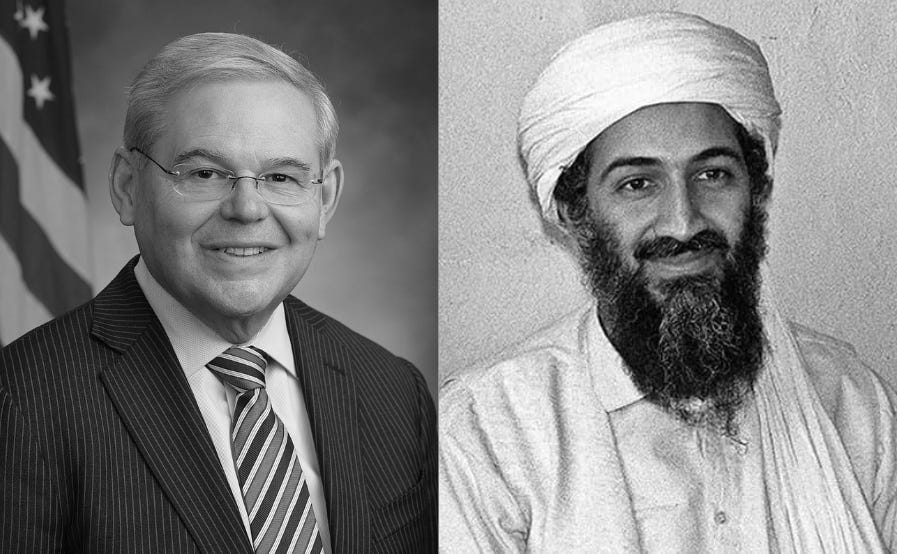
Sanction Architect Bob Menendez, Terrorism Architect Osama bin Laden

That’s not to say “sanctions” and “terrorism” are interchangeable terms. However, both practices center on willfully harming civilians to accomplish political goals.

Like Sanctioning Governments, Terrorists Have Political Objectives

Some resist the fact that al Qaeda and other terrorist groups are principally motivated by political goals. That’s understandable, given establishment media grossly underreports terrorist motivations.

The resulting vacuum is filled with reflexive and false assumptions—for example, that Muslim terrorists are principally motivated by religion—or deliberately misleading government claims, like President George W. Bush’s baseless assertion that al Qaeda terrorists “hate our freedoms.”

Through various written and recorded pronouncements, Osama bin Laden made al Qaeda’s political motivations clear. His aims included the withdrawal of U.S. forces from the Middle East, and termination of U.S. support of the region’s dictators and the government of Israel.

The political nature of terrorism was particularly apparent in the 2004 Madrid train bombings. The attacks came three days before Spain’s general election, and a video received by Spanish authorities said the attacks were punishment for the country’s participation in the occupation of Iraq.

On election day, the shaken Spanish population gave an upset victory to the Socialist party, and the newly elected prime minister immediately pledged to withdrawal Spanish troops from Iraq.

Those examples focus on al Qaeda and its kin, but terrorists of all religions, ethnicities and nationalities have political aims. An exhaustive study of worldwide suicide bombing by University of Chicago Professor Robert Pape found nearly all such attacks seek “to compel modern democracies to withdraw military forces from territory that the terrorists consider to be their homeland.”

Like Terrorists, Sanctioning Governments Intentionally Harm Civilians

In a hearing earlier this month, Senate foreign relations committee chairman Bob Menendez (D-NJ), who has been one of Capitol Hill’s most prolific authors of Iran sanction legislation, praised sanctions as part of “our arsenal of peaceful diplomacy.”

Perhaps it was a Freudian slip that led him to oxymoronically place his supposedly “peaceful” sanctions inside an “arsenal”—in their effect, there’s little difference between imposing economic sanctions and mining Iranian harbors.

Of course, “peaceful” isn’t the favorite adjective of sanction advocates. When boasting about their handiwork, Menendez and others invariably use a far more appropriate descriptor: “crippling.” Barack Obama @BarackObamaVP Biden on Iran: “These are the most crippling sanctions in the history of sanctions. Period.”October 12th 2012758 Retweets220 Likes

Officials assure us that sanctions are meant to cripple governments, but any honest observer understands that’s achieved by first crippling the country’s economy.

Since the concept of economic harm is somewhat abstract, it’s easy for Americans to limit their visualization of that harm to a downward slope on a gross domestic product chart, failing to appreciate what economic warfare means to the everyday lives of individual humans.

Occasionally, though, American media provides a window on the harms being visited upon the Iranian people.

Consider a 2019 Los Angeles Times story, “Middle-Class Iranians Resort to Buying Rotting Produce as U.S. Sanctions Take Toll.” Reading the title alone would give most Americans a far better appreciation of sanctions’ real-world impact. The article provides other examples, such as a single mother forced by skyrocketing prices into abandoning her apartment and moving into her mother’s one-bedroom dwelling.

While the U.S. sanctions regime provides exceptions for Iran’s import of food and medicine, other limitations on the flow of Iranian money—and vendors’ and bankers’ fears of accidentally running afoul of U.S. restrictions—often render those exceptions meaningless.

As a result, sanctions can have profound consequences for Iran’s sick. Among other observations, a 2019 report by Human Rights Watch found:

  • Iranian patients with rare diseases were finding it increasingly difficult to access essential, imported medicines
  • A pediatric cancer treatment center was unable to acquire medications deemed essential by the World Health Organization
  • Patients with epidermolysis bullosa—a rare disease that causes blistering— had their supply of a special kind of foam dressing cut off when a European producer ceased business in Iran due to U.S. sanctions. The domestic alternative dressing “often gets attached to the blisters, causing excruciating pain for the patients,” according to an attorney representing a health NGO.

The report also noted Iranians were finding it harder to acquire imported eye drops, “causing suffering for the large number of patients affected by chemical weapons during the Iran-Iraq war.”

Exasperatingly, many of those eye patients are being victimized by the U.S. government for a second time: During the Iran-Iraq War, American intelligence officials provided targeting information to the Iraqi military, fully aware Saddam Hussein’s forces would attack with chemical weapons.

See the rest here

Be seeing you

Posted in Uncategorized | Tagged: , , , , , | Leave a Comment »

International Relations according to Antony Blinken, by Thierry Meyssan

Posted by M. C. on March 6, 2021

Washington has little choice: its interests have not changed, but those of its ruling class have. Antony Blinken therefore intends to pursue the line adopted since President Reagan hired Trotskyists to create the NED: to make human rights an imperial weapon, without ever respecting them himself. For the rest, one will avoid getting angry with the Chinese and will try to exclude Russia from the wider Middle East so that the war can continue without end.

https://www.voltairenet.org/article212370.html

by Thierry Meyssan

The Biden Administration performs its first acts of International Relations.

First, Secretary of State Antony Blinken participates in numerous international meetings by video conference, assuring his interlocutors that “America is back. Indeed, the United States is taking up its position in all intergovernmental organisations, starting with the United Nations.

The United Nations

As soon as he took office, President Biden cancelled the US withdrawal from the Paris Agreement and the World Health Organization. Shortly afterwards, Blinken announced that his country was joining the Human Rights Council and was running for president. What’s more, he is campaigning to ensure that only those states that he considers to be respectful of human rights can sit on the Council.

These decisions call for several remarks:

Paris Agreements

- The US withdrawal from the Paris Accords was based on the fact that the IPCC’s work was not scientific, but political, since it is in fact an assembly of senior officials with scientific advisors. They led to, admittedly a lot of promises, but in reality to only one concrete result: the adoption of an international right to pollute managed by the Chicago Stock Exchange. The Chicago Stock Exchange was created by Vice-President Al Gore and its statutes were drafted by the future President Barack Obama. The Trump administration never contested climate change, but argued that other explanations were possible rather than industrial greenhouse gas emissions, for example the geophysical theory formulated in the 19th century by Milutin Milanković.
- The return of the United States to the Paris agreements has caused fear among US shale oil and gas personnel and companies. The Biden Administration is determined to quickly ban petrol-powered cars, for example. This decision will not only have an impact on employment in the US, but also on its foreign policy since it had become the world’s largest oil exporter.

WHO

- The US withdrawal from the WHO was motivated by China’s leading role in the WHO. The current Director-General, Dr. Tedros Adhanom Ghebreyesus, is a member of the pro-Chinese Tigray People’s Liberation Front. In addition to his UN function, he has also played a central role in supplying arms to the Tigray rebellion.
- The WHO delegation that went to Wuhan to investigate the possible Chinese origin of the Covid-19 included Dr. Peter Daszak, president of the NGO EcoHealth Alliance, as the only US member. This expert funded work on coronaviruses and bats at the P4 laboratory in Wuhan. He is therefore clearly judge and jury.

Human Rights Council

- The US withdrawal from the Human Rights Council was the consequence of the Trump administration’s denunciation of its hypocrisy. In fact, the Council had been used in 2011 by the US itself to hear false witnesses and to accuse the “Gaddafi regime” of having bombed an eastern district of Tripoli; an event that never happened. This memorable staging had been transmitted to the Security Council, which had adopted a resolution authorising the West to “protect” the Libyan population from its infamous dictator. Given the success of this propaganda operation, various states and alleged NGOs have tried to use the Council in turn, particularly against Israel.
- The United Nations does not understand the term “human rights” as does the United States. For the latter, Human Rights are simply protection from the Reason of State, which implies the prohibition of torture. On the contrary, for the United Nations, the term also includes the right to life, education and the right to work, etc. From this point of view, China has important progress to make in terms of justice, but has an exceptional record in terms of education. It therefore has its rightful place in the Council, although Washington disputes this.
- Antony Blinken has just enunciated the “Khashoggi jurisprudence”. It is a question of no longer granting visas to foreign political leaders who do not respect the human rights of their opponents. But what value does this doctrine have when the United States has a gigantic targeted assassination service and sometimes uses it against its own nationals?

Iran and the future of the Greater Middle East

The Biden Administration is also negotiating a return to the 5+2 nuclear agreement with Iran. The aim is to resume the negotiations that William Burns, Jake Sullivan and Wendy Sherman began 9 years ago in Oman with the emissaries of Ayatollah Ali Khamenei. Today they have become respectively Director of the CIA, National Security Advisor and Deputy Secretary of State.

At the time, Washington’s aim was to eliminate President Mahmoud Ahmadinejad and relaunch the Shia/Sunni confrontation in the context of the “war without end” (Rumsfeld/Cebrowski strategy). For the Khamenei Guide, it was to get rid of Ahmadinejad who had dared to strike against him and to extend his power over all the Shiites in the region.

These negotiations led to the manipulation of the Iranian presidential election of 2013 and the victory of the pro-Israeli Sheikh Hassan Rohani. As soon as he took office, he sent his foreign minister, Mohammad Djavad Zarif, to negotiate in Switzerland with Secretary of State John Kerry and his adviser Robert Malley. This time it was a question of closing the Iranian military nuclear file before witnesses, which everyone knew had long since been completed. Then came a year of secret bilateral negotiations on Iran’s regional role, called to resume the role of Middle East policeman under Shah Reza Pahlevi. Finally, the nuclear agreement was signed with great pomp and circumstance.

But in January 2017, the Americans elected Donald Trump, who questioned the agreement. President Rohani then published his project for the Shiite and allied states (Lebanon, Syria, Iraq and Azerbaijan): to federate them into a great empire under the authority of the Guide of the Revolution, Ayatollah Ali Khamenei. It is on this new basis that the Biden Administration must henceforth negotiate.

But the United States can only position itself in the broader Middle East once it has decided what it is going to do with its two rivals: Russia and China. The Department of Defense has appointed a Commission that is working on the subject and will issue its recommendations in June. In the meantime the Pentagon intends to continue what it has been doing for 20 years: the “war without end”. The aim of the war being to destroy any possibility of resistance in the region, and thus to destroy all state structures, whether friendly or enemy, there was no a priori question of accepting the Rohani project.

Washington began contacts in November, three months before President Biden took office. This is exactly what the Trump administration had done with Russia, which led to legal action under the Logan Act. This time it is different. There will be no lawsuits because the Biden administration is unanimously supported by everything that matters in Washington.

Moreover, the Iranian-US negotiations are taking place in the East. Tehran and Washington are holding hostages to keep pressure on each other. Each one arrests spies, or if they are not tourists, and imprisons them for the duration of an investigation that is dragging on for a long time. It has to be said that they are better treated in the West than in Iran where they are subjected to constant psychological pressure.

To begin with, Washington maintained its sanctions against Iran, but lifted those it had taken against the Houthis in Yemen. It has also turned a blind eye to the South Korean channel that allows Iran to circumvent its embargo. But that wasn’t enough.

From February 15 to 22, Iran launched – through its Iraqi affiliates – commando actions against US forces and companies in Iraq; a way of showing that it is more legitimate in that country than Uncle Sam is. For their part, the Israelis accused Iran of having caused an explosion in a tanker belonging to one of their companies in the Gulf of Oman on February 25.

The Secretary of State responded by sending the Pentagon to bomb installations used by Shiite militias in Syria, a way of showing that the United States is illegally occupying this country whose authorities are suffering from Iranian sectarian aid – today Iran is not helping the Syrians, but those of them who are Shiites – and that they will have to come to terms with it.

China

See the rest here

Article licensed under Creative Commons

The articles on Voltaire Network may be freely reproduced provided the source is cited, their integrity is respected and they are not used for commercial purposes (license CC BY-NC-ND).

Be seeing you

Posted in Uncategorized | Tagged: , , , , | Leave a Comment »

From Taiwan To Iran, US Aggression Overtakes Biden’s Promises

Posted by M. C. on March 2, 2021

The Biden Administration’s promise to embrace diplomacy over Trump’s perceived unilateralism took a blow last week with the US attack on Syria. That is not the only hot spot where diplomacy as we understand it seems to have been abandoned. Today we have a look at the three hot spots. And finally today…Dr. Seuss cancelled???

Be seeing you

Posted in Uncategorized | Tagged: , , , | Leave a Comment »

Erie Times E-Edition Article-Airstrikes test US role as world police

Posted by M. C. on February 27, 2021

Lloyd Austin appears to be the new Bolton.

“Biden wanted to respond to the incident in Iraq,” said Max Abrahms, a professor of political science and public policy at Northeastern University, “but he wanted to do it in a way that didn’t seem too heavy-handed …

Being a bomb’s ground zero for having the shovel you are carrying being mistaken for a rifle is far from heavy handed in the Pentagram’s mind. Every day stuff.

The world’s policeman…someone has to do it. Why not McDonnell Douglas?

https://erietimes-pa-app.newsmemory.com/?publink=16a354c79

Kim Hjelmgaard

USA TODAY

Pentagon airstrikes against Iranbacked militias in Syria are not only the first military action taken by President Joe Biden. They are a test of his broad pledge to pursue a foreign policy that is more cooperative and mindful of international partners than his predecessor’s but still eschews the U.S. role as the world’s police to focus on making life better for Americans, some experts and lawmakers say.

Biden on Thursday night ordered the airstrikes on multiple facilities at a Syrian- Iraqi border control point in southeastern Syria in retaliation for rocket attacks on U.S. targets in neighboring Iraq. The Pentagon identified the targets as a “number of Iranian-backed militant groups including Kataib Hezbollah and Kataib Sayyid al-Shuhada.” It called the airstrikes “proportionate” and “defensive” and said the airstrikes were taken after consultation with coalition partners and unspecified “diplomatic measures.”

The military action comes as Washington and Tehran are locked in apparent stalemate over who should take the first step to revitalize a nuclear deal exited by the Trump administration; as Biden has vowed to recalibrate national security actions to favor the middle class; and as reporting from USA TODAY has revealed the scale of U.S. overseas military bases and counterterror operations two decades after 9/11.

“We are concerned that President Biden’s first instinct when it comes to regional security in the Middle East appears to be to reach for military options instead of diplomacy,” said Ryan Costello, director of The National Iranian American Council, an organization that seeks improved relations between Washington and Tehran.

“Biden wanted to respond to the incident in Iraq,” said Max Abrahms, a professor of political science and public policy at Northeastern University, “but he wanted to do it in a way that didn’t seem too heavy-handed … the more fundamental question that needs to be asked, and isn’t, is what are Iranian militias doing in Iraq? The answer is they are there partly because the U.S. toppled (Iraq’s former president) Saddam Hussein.”

Abrahms said that the Biden administration is trying to balance the instincts of veteran national security officials and diplomats such as Secretary of State Antony Blinken – Obama administration-era officials who have long gravitated toward military interventions and regime change – with “the zeitgeist of the American citizenry, which has moved over the course of the Trump administration.”

He described this “zeitgeist,” which is backed up by polling that shows many Americans are most concerned about economic and security threats closer to home, as “a more limited role for the United States in the world, a greater delineation of where our vital interests lie.”

Defense Secretary Lloyd Austin told reporters he was “confident in the target we went after. We know what we hit.”

The Syrian Observatory for Human Rights, a London-based monitoring group, said the airstrikes killed at least 22 pro-Iranian fighters, wounded many more and destroyed several trucks carrying munitions.

Defense Secretary Lloyd Austin, on facilities the U.S. struck, said he was “confident in the target we went after. We know what we hit.” ALEX BRANDON/AP

Be seeing you

Posted in Uncategorized | Tagged: , , , | Leave a Comment »

“Weapons of Mass Destruction”: The Last Refuge of the Global Interventionist | Mises Wire

Posted by M. C. on February 25, 2021

https://mises.org/wire/weapons-mass-destruction-last-refuge-global-interventionist

Ryan McMaken

The threat of “nuclear proliferation” remains one of the great catch-all reasons—the other being “humanitarian” intervention—given for why the US regime and its allies ought to be given unlimited power to invade foreign states and impose sanctions at any given time.

We saw this at work during the run-up to the 2003 invasion of Iraq. It was said that nuclear weapons were among the “weapons of mass destruction” being developed or harbored by Saddam Hussein’s regime. Thus, it was “necessary” that the United States invade Iraq and enact regime change.

It is now very clear, of course, that the Bush-Cheney administration was lying and there was no credible evidence that Iraq’s long-defunct nuclear program had been revived.

But let’s say for the sake of argument that Iraq was well on its way to developing a nuclear weapon in early 2003. Would it have become “necessary” for the US to invade Iraq and install a de facto puppet regime that would agree to not develop nuclear weapons?

The question is relevant, of course, because interventionists are now making the same claims about Iran as were made about Iraq in 2003.

The conventional thinking among neoconservatives and other interventionists in Washington is that yes, the United States is always justified in invading foreign states if it prevents nuclear proliferation. If this is not done, we are told, the new nuclear state will surely use its new weapons, or at least threaten to use them for purposes of blackmail. 

Unfortunately for the interventionists, history has repeatedly shown this claim to be tenuous at best. Since 1945, as more and more states have become part of the “nuclear club,” each new member has failed to live up to the predictions that proliferation will quickly lead to geopolitical destabilization and war.

This has become more important in recent years, as humanitarian interventions have apparently lost their cache with the American public. In recent years, Washington has tried to drum up support for regime change invasions in both Venezuela and Syria, yet those efforts failed to catch on.

Threat of nuclear proliferation, then, likely offers the last hope for the interventionists when it comes to regime change in Iran.

Those Guys Are Crazy!

Perhaps the most-used argument made against tolerating proliferation often rests on the idea that most regimes are too insane, irrational, or incompetent to manage nuclear weapons responsibly—however one might define “responsible” stewardship of weapons that exist to destroy entire metropolitan populations.

The claim is thus made that regimes in Iran, Iraq, and North Korea—to name just three examples—are likely to be unrestrained by the instinct of self-preservation and that thus we cannot apply traditional theories of nuclear deterrence to these regimes.

Yet, this theory has yet to amass any evidence to support it. Are we to believe that the Soviet and Chinese regimes have always been headed by eminently sane people? After all, as John Mueller notes,

the weapons have proliferated to large, important countries run by unchallenged monsters who, at the time they acquired the bombs, were certifiably deranged: Josef Stalin, who in 1949 was planning to change the climate of the Soviet Union by planting a lot of trees, and Mao Zedong, who in 1964 had just carried out a bizarre social experiment that resulted in an artificial famine in which tens of millions of Chinese perished.

Mueller suggests that it is incumbent on the opponents of an Iranian bomb to show that Iran’s leaders are less sane than Stalin.

Some might nevertheless claim (however implausibly) that Muslims are somehow more naturally murderous than Stalin. Yet we might note that this doesn’t explain how the Islamic Republic of Pakistan—an occasional military dictatorship—has somehow refrained from using its nuclear arms against its hated rival India.

In actual experience, regimes that acquire a bomb tend to moderate their behavior. As Kenneth Waltz points out:

every new nuclear state has behaved exactly the way the old nuclear states have behaved. One can describe the way all nuclear states have behaved in one word: responsibly. When the United States contemplated the Soviet Union one day having its own nuclear weapons, we were horrified by the prospect. How could we live? How could the world live with such a country as the Soviet Union—which we saw as bent on world domination—having nuclear weapons? And when China developed its own nuclear weapons, we repeated the same way of thinking—“My God! China? China is crazy!”

But in fact, if you think of the Cultural Revolution, China took very good care of its nuclear weapons. They ensured that they would not fall under the hands of the revolutionaries and came through that horrible ten-year period. The fact is that people worry that a new nuclear country, once it gets a nuclear shield, would then begin to behave immoderately or irresponsibly under the cover of its own nuclear weapons. Well, that has never happened. Every country that has had nuclear weapons has behaved moderately.

(Of course, by “moderately” he only means in terms of provoking full-scale war with rivals.)

In any case, the notion that regimes that acquire nuclear warheads then go off the deep end has yet to be observed in real life.

This is why, in a 2012 forum for PBS, John Mearsheimer noted that if Iran were to acquire nuclear weapons, this would likely stabilize the region rather than destabilize it:

I think there’s no question that a nuclear-armed Iran would bring stability to the region, because nuclear weapons are weapons of peace. They’re weapons of deterrence.

And because nuclear weapons are useful only for deterring attacks, they cannot be used for so-called nuclear blackmail:

We have created this myth in this country over the past few years in talking about Iran that any country that acquires nuclear weapons can blackmail other countries or use those nuclear weapons for offensive purposes. We have a lot of theory and a huge amount of empirical evidence, 67 years now, which show that no country with nuclear weapons can blackmail another country, as long as somebody is protecting that country or it has its own nuclear weapons.

Rather, in the case of Iran, according to Waltz, if the goal is stability in the region, that answer lies in ending Israel’s nuclear monopoly in the region—which has been a source of enduring instability. In the July/August 2012 issue of Foreign Affairs, Waltz observed:

Israel’s regional nuclear monopoly, which has proved remarkably durable for the past four decades, has long fueled instability in the Middle East. In no other region of the world does a lone, unchecked nuclear state exist.

Of course, it is easy to understand why Israel wants to remain the sole nuclear power in the region and why it is willing to use force to secure that status. In 1981, Israel bombed Iraq to prevent a challenge to its nuclear monopoly. It did the same to Syria in 2007 and is now considering similar action against Iran. But the very acts that have allowed Israel to maintain its nuclear edge in the short term have prolonged an imbalance that is unsustainable in the long term. Israel’s proven ability to strike potential nuclear rivals with impunity has inevitably made its enemies anxious to develop the means to prevent Israel from doing so again. In this way, the current tensions are best viewed not as the early stages of a relatively recent Iranian nuclear crisis but rather as the final stages of a decades-long Middle East nuclear crisis that will end only when a balance of military power is restored.

Nuclear Arms Offer a Solution to Threats of Regime Change

Indeed, the case of Israel is not unique in the sense that the United States provokes the same sort of instability worldwide.

The United States has either carried out regime change or threatened to do so in a number of cases. This means those countries targeted by the US are highly motivated to acquire arms, which these regimes correctly see as the only reliable deterrent against US invasion. Waltz continues

There is only one way that a country can reliably deter a dominant power, and that is by developing its own nuclear force. When president Bush identified the countries that he said constituted an “axis of evil”—namely, Iraq, Iran, and North Korea—and then proceeded to invade one of them—namely, Iraq—that was certainly a lesson quickly learned by both Iran and North Korea. That is to say, that if a country wants to deter the United States it has to equip itself with nuclear force. I think we all have seen that demonstrated very clearly.

In other words, it is the United States, and to a lesser extent the State of Israel, which have created situations in which states become highly motivated to acquire nuclear arms for defensive reasons.

If the US really wanted to reduce the likelihood of regimes like Iran and North Korea seeking and expanding nuclear capabilities, the US would disavow its doctrine of regime change explicitly. It would also renounce the notion of an “axis of evil” and cut back the US’s nuclear arsenal to a force designed for minimum deterrence.

Until that happens, the United States itself remains a primary motivation for nuclear armament among regimes that have run afoul of the Washington establishment.

This, however, is unlikely to happen, because a perpetual stance of antiproliferation and regime change pays many dividends in Washington. It keeps the Pentagon’s budget sky-high, and it allows the regime to claim it is enforcing worldwide peace, even while it remains a source of instability.

In the sloppy world of public debates over foreign policy, this appears to many voters to make sense. As Mueller has suggested, it’s easy to just keep pushing the panic button and then taking the credit for the fact that World War III has yet to break out:

Alarmists have one great advantage. If their alarm proves to be justified, they will look like prophets. If nothing happens, they can claim that this desirable condition has been the result of efforts their alarmism has inspired. Thus, when New York Police Department Commissioner David Cohen is asked how he knows whether his extensive counterterrorism programs (which have had an almost perfect record of not finding any terrorists) have been successful, he curtly responds, “They haven’t attacked us.” Reporting this comment, reporters Matt Apuzzo and Adam Goldman note that “the absence of a terrorist attack has been the silver‐bullet argument for national security pro‐fessionals.” Although it is a “flawed argument” logically, they continue, it has been “nearly irrefutable” politically. The dodge, then, is, (1) we are trying to keep them from attacking; (2) they haven’t attacked; therefore (3) it must be our efforts that have kept them from doing so.

The question we must ask ourselves, however, is: At what cost?

How many more countries will the United States bomb or invade in the name of wiping out weapons of mass destruction? We’ve already seen the side effects of these efforts. Not only are hundreds of thousands of human beings killed in these wars—as was the case in Iraq—but these conflicts also create immense refugee and immigration crises while creating power vacuums. ISIS, for example, would have never gained much success at all had the US not destroyed Saddam’s secularist Ba’athist regime in Iraq.

These costs are sure to be studiously ignored. Whether we’re talking about global warming or covid-19, or “weapons of mass destruction,” the strategy today is that we must trust the regime to take whatever drastic steps it wishes or else we face an existential threat. We must adopt environmental regulations that would force billions of Africans and Asians back into poverty “or else.” We must destroy civil liberties and impose lockdowns on countless millions “or else.” We must carry out regime change in yet another country “or else.”

This narrative has worked wonders for regimes seeking ever more power. They won’t abandon this strategy any time soon. Author:

Contact Ryan McMaken

Ryan McMaken (@ryanmcmaken) is a senior editor at the Mises Institute. Send him your article submissions for the Mises Wire and The Austrian, but read article guidelines first. Ryan has degrees in economics and political science from the University of Colorado and was a housing economist for the State of Colorado. He is the author of Commie Cowboys: The Bourgeoisie and the Nation-State in the Western Genre.

Be seeing you

Posted in Uncategorized | Tagged: , , , , , | Leave a Comment »

War with Iran was planned in 1996

Posted by M. C. on February 9, 2021

https://mailchi.mp/e64b770ac913/the-us-celebrates-30-years-of-bombing-iraq-4196737?e=de2d0eded6

What you need to know when your friends think war with Iran is a good idea:
Neoconservatives wrote a policy paper for Israeli prime minister Benjamin Netanyahu back in 1996, to overthrow Saddam and eventually conquer Iran.Seven years later, at Benjamin Netanyahu’s behest, the United States invaded Iraq and overthrew Saddam.That 1996 neocon plan became the blueprint for U.S. foreign policy. The crown jewel of the plan has always been a war with Iran.Media corporations—which are little more than the broadcast system of the military industrial complex—always have fresh reasons to advertise war with Iran. But it is all based on an old plan written decades ago that serves the interests of a foreign power at the expense the American people.In Chapter 6 of Gus Cantavero’s video adaptation of Scott’s new book Enough Already: Time to End the War on Terrorism, Scott delves into the neoconservative policy paper “A Clean Break,” and explores the personal incentives each man in the Bush administration had for toppling Saddam.
https://youtu.be/3Wx-8VLtQ0c
Arm yourself with knowledge so you can fight for peace. Buy Scott’s new book, Enough Already: Time to End the War on Terrorism

Be seeing you

Posted in Uncategorized | Tagged: , , | Leave a Comment »

Facing up to Israel’s destabilizing behavior – Responsible Statecraft

Posted by M. C. on December 17, 2020

The contrast with the state that killed Fakhrizadeh is stark. Israel, which is not a party to the NPT, is generally believed to possess a sizable arsenal of nuclear weapons. It has acquired that stockpile clandestinely, closed off from any international scrutiny or regulatory regime, and with Israel never admitting what it has.

Don’t look to any of our Middle Eastern “friends” for peace and tranquility.

https://responsiblestatecraft.org/2020/12/02/facing-up-to-israels-destabilizing-behavior/

Written by
Paul R. Pillar

Responsibility for the assassination of Iranian nuclear scientist Mohsen Fakhrizadeh is still officially a matter of speculation, but it is highly likely that Israel did it. Israel has the motive, the methods, and the moxie. It also has the record, including not only a string of murders of other Iranian nuclear scientists some eight years ago but also a more widely used killing machine that has made Israel the world’s leader in targeted assassinations.

The killing of Fakhrizadeh was not a blow for nuclear non-proliferation. The demise of no one individual will make a significant dent in Iran’s nuclear program. Fakhrizadeh’s work on a possible nuclear weapon took place in the past, before Tehran suspended that work some 17 years ago. The knowledge on a shelf remains, even if this man does not.

The killing did not pre-empt an Iranian attack or any other untoward Iranian action, and instead is more likely to stimulate such an attack. Iran, which has no nuclear weapons and as a party to the Nuclear Non-Proliferation Treaty is committed never to acquire any, closed all possible paths to a bomb several years ago through the Joint Comprehensive Plan of Action, the multilateral agreement that gutted Iran’s nuclear program and opened what remained of it to intrusive international monitoring.

The contrast with the state that killed Fakhrizadeh is stark. Israel, which is not a party to the NPT, is generally believed to possess a sizable arsenal of nuclear weapons. It has acquired that stockpile clandestinely, closed off from any international scrutiny or regulatory regime, and with Israel never admitting what it has.

The recent assassination did not even serve a purpose comparable to, say, the extraterritorial rubout of a terrorist who will never see the inside of a courtroom and, it might be argued, can be eliminated as a threat in no other way. Instead, the assassination itself was an act of terrorism. It certainly meets the official definition that the State Department uses in compiling statistics on international terrorism, which is “premeditated, politically motivated violence perpetrated against non-combatant targets by sub-national groups or clandestine agents, usually intended to influence an audience”.

Failure to acknowledge that reality while fulminating about terrorism in other contexts or at the hands of other actors represents a double standard. The double standard becomes all the clearer by imagining what the reaction would be if Iran or someone else had assassinated an Israeli nuclear scientist — or an American one.

The Netanyahu government’s evident objective — probably pursued with the encouragement of the lame duck Trump administration, as part of its salting of the earth on its way out the door — is to subvert the Biden administration’s diplomacy with Iran and efforts to return to compliance with the JCPOA. The timing of the Fakhrizadeh assassination is too much of a coincidence to have merely reflected when an operational opportunity happened to arise.

A dangerous road ahead

The next phase in this story depends on the Iranian reaction. If the leadership in Tehran can resist Iranians’ understandable anger and desire for revenge, Netanyahu will at least have humiliated Iran and shown it to be weak. But his favored scenario would be for Iran to do something in retaliation that in turn could become the rationale for escalated military action against Iran by Israel and especially by the United States. The fact that President Trump has already looked into a possible attack on Iran must lead Netanyahu to conclude that he has a good chance of instigating just such a military confrontation, which would be his most effective way yet of pre-emptively trashing the incoming U.S. administration’s diplomacy.

Instigation and provocation of Iran already were part of an Israeli campaign before the Fakhrizadeh killing and before the U.S. election. A probable facet of that campaign was a series of unclaimed explosions in Iran this summer, which hit not only military-related and nuclear facilities but also other targets such as power plants and oil pipelines.

Netanyahu’s government has consistently promoted unending, unqualified hostility toward Iran aimed at keeping it forever ostracized, sanctioned, and loathed. This campaign of permanent confrontation keeps a potential regional rival weak and aims to keep Israel’s U.S. patron away from doing any diplomatic or other business with Tehran. Keeping Iran as a perpetual bête noire to be blamed for everything wrong in the Middle East helps to deflect blame for those wrongs from others, especially Israel. The value to Netanyahu’s government of the bête noire as an all-purpose distraction is reflected in how often that government responds to unwelcome attention to its own conduct by proclaiming, “But the real problem in our region is Iran…”

Partly, but by no means wholly, because of this Israeli demonization campaign, Iran’s conduct routinely gets discussed in the United States in shorthand terms that refer to Tehran’s “malign” or “destabilizing” behavior and support for terrorism. The shorthand obscures inattention to exactly what Iran has been doing and why it does it. It leaves unsaid that most of what Iran does in the region is reaction to what others do — including in response to what Israel has done with terrorism or other destructive action.

By any objective measure of destabilizing behavior, Israel in recent times has been doing at least as much as Iran to destabilize the Middle East, and probably more. This is true of terrorism, sabotage, and other clandestine operations, as illustrated most recently by the assassination of Fakhrizadeh.

It is true of the use of violent proxies, which in Israel’s case has included an Iranian cult/terrorist group that has American blood on its hands. It is true of aggressive military action across international borders — including Israel’s current sustained campaign of aerial assaults in Syria — which is much different from a consensual relationship in which military assistance is given in support of, and in alliance with, an incumbent government.

And it certainly is true when looking at who is urging a return to diplomacy to settle differences, and who instead is subverting diplomacy and promoting confrontation, even to the point of trying to trigger a new war.

A policy challenge for the new administration

All this is grim reality for the incoming Biden administration as it shapes its relationship with Israel. The smart money in Washington is betting against Biden spending much of his precious political capital in trying to make progress in resolving the decades-old Israeli-Palestinian conflict. That’s too bad for the Palestinians and for justice and human rights, but it also is too bad for regional stability, especially given how Israel’s subjugation of the Palestinians has long been a prime motivator for extremism and terrorism.

The destabilization goes well beyond the Palestinian conflict, however, and includes the Israeli terrorism, sabotage, and provocations aimed at Iran. The grimmest of the grim realities is that the current government of Israel is not only actively trying to subvert the new administration’s foreign policy but also is trying to drag the United States into a new Middle East war.

That is an unfriendly act. The Biden administration somehow will have to take that into account in shaping a bilateral relationship that has been characterized — even before the extreme obeisance toward Israel of the Trump administration — by protective vetoes in the U.N. Security Council and $3.8 billion annually in unrestricted aid. The Biden people can start by being honest — consistent with the president-elect’s pledge of truthfulness — about the sources of instability in the Middle East.

Be seeing you

Posted in Uncategorized | Tagged: , , , , | Leave a Comment »