Is there any evidence outside of the Bible that the Resurrection of Jesus was a real historical event rather than a myth or an allegory?
Unfortunately, there is no time machine to go back in history and confirm this event that is memorialized in the way the western world divides modern from ancient history, B.C and A.D.
However there is, surprisingly, evidence revealed from celestial, geophysical and historical accounts outside of the Bible that confirm this event.
According to Wikipedia, Easter (aka Resurrection Sunday) is a remembrance of the resurrection of Jesus from the dead (~30 A.D.) as described in the New Testament. Jesus was crucified, that is, hung on a wooden cross, nailed through his hands and feet and hung on a wooden cross. The historical leaders in place at the time, Pontius Pilate the prefect (governor) of Judea at the time, and King Herod the Roman king, are established historical figures in the same time period and place as the Bible describes. They were responsible for assigning and delivering punishment to Jesus for blasphemy (claims He was God’s Son).
In the Biblical account of the crucifixion, an earthquake and a darkness came over the land between 12 noon and 3 PM that coincided with Jesus’ crucifixion as explained in the Gospel of Matthew. (Matthew 27: 45-54)
Historian Eusebius of Caesarea cites Phlegon who wrote that in the year 32-33 AD: “A great eclipse occurred at the sixth hour that excelled every other before it, turning the day into such darkness of night that the stars could be seen in heaven and the earth moved, toppling many buildings.”
“Dionysius, a pagan philosopher at the time, was present in Heliopolis (modern Cairo), Egypt, when the catastrophe occurred, in the company of a philosopher friend, Apollophanes. His account reads as follows: ‘We [Apollophanes and himself] were both present, standing together in Heliopolis, when we saw the moon falling into alignment with the sun in an abnormal way. For it was not the right time for a conjunction. Then again, we saw it [the moon] from the ninth hour [around 3 pm] till sundown, restored naturally to its place [in the sky] opposite the sun’.”
By the way, Dionysius was converted to Christianity during the Apostle Paul’s Areopagus sermon in Athens. Dionysius heard the Apostle Paul talk about the earthquake and eclipse of the sun that occurred during Jesus’ crucifixion. He personally knew the scriptures were accurate on that account.
Of additional interest, it was 800 years prior that the prophetic Book of Isaiah (chapter 13) foretold when “the sun shall be darkened in his going forth, and the moon shall not cause her light to shine (an eclipse).” What are the odds that would happen?
Did Jesus die on the cross? Or was His death faked? Because Roman soldiers in this instance departed from their practice of breaking a criminal’s legs on the cross to ensure He was dead, probably not wanting to enrage his mother, brothers and other followers who were in attendance to the point of a riot, a Roman centurion thrust a spear in Jesus’ side to confirm He was dead, and the Bible account says water the blood came out. (John 19:34) This meant blood circulation had ceased and the clear blood serum had separated from the heavier red blood cells. Jesus was certainly dead.
There is another Biblical account of an event that surrounded the crucifixion. This story is from the 5th chapter of the book of Mark and the 8th chapter of the book of Luke.
Jesus Himself was the fulfillment of over 300 prophecies, which included His place of birth (Bethlehem), His birth order (firstborn), His family line (from the line of David), the method of His death (crucifixion), even the amount of money he would be betrayed for (30 pieces of silver).
It says in the 27th chapter of the book of Matthew that in remorse, Judas Iscariot, the betrayer of Jesus, returned those 30 pieces of silver to the priests and elders who had accused Jesus of blasphemy. They refused his offer to return the silver coins so it says Judas threw the money into the temple and left.
As the Bible account goes, the chief priests considered it blood money and used it to purchase a field as a burial place for foreigners. It was called the FIELD OF BLOOD. In the Aramaic language that Jesus spoke, that field, called the Akeldama (HAKL-ED-DAMM), today is a large square sepulcher. The land was used as a burial place for non-Jews into the 19th century. The Christian Crusaders buried their dead there. This part of the crucifixion story is also partly confirmed.
Some skeptics say Jesus never existed. The story of His life and death were fables.
Is there any astronomical evidence for the Christmas star in the east the Magi followed to find the baby Jesus and bring Him gold, frankincense and myrrh?
Astronomer Ernest L. Martin, as explained in his text THE START THAT ASTONISHED THE WORLD, ran computer simulations of the stars that shone in the sky over Palestine in 3 B. C. From his initial work astronomers came up with the date of September 11, 3 BC as the date for Jesus’ birth that correlates with astronomical alignments explained in the 12th chapter of the Book of Revelation.
Martin explains that Christmas star was the planet Jupiter aligned in conjunction with Venus and other stars to produce an ultra-bright star that would have appeared in the east. Martin’s explanation of the Star of Bethlehem is now the accepted explanation by modern astronomers.
Regarding the veracity of the Biblical resurrection story, some of the most implausible facts (an earthquake and solar eclipse) and other medical facts confirm the Biblical account.
We don’t have a time machine. There is no way of knowing conclusively the crucifixion and resurrection occurred. The Apostle Paul said we “only know in part,” not the whole. (I Corinthians 13: 12)
Jesus said: “…all things must be fulfilled, which were written in the law of Moses, and in the prophets, and in the psalms, concerning me.” (Luke 24:44)
This article was first published on March 28, 2018.
Can you imagine what Jesus’ life would have been like if, instead of being born into the Roman police state, he had been born and raised in the American police state?
Consider the following if you will.
Had Jesus been born in the era of the America police state, rather than traveling to Bethlehem for a census, Jesus’ parents would have been mailed a 28-page American Community Survey, a mandatory government questionnaire documenting their habits, household inhabitants, work schedule, how many toilets are in your home, etc. The penalty for not responding to this invasive survey can go as high as $5,000.
Instead of being born in a manger, Jesus might have been born at home. Rather than wise men and shepherds bringing gifts, however, the baby’s parents might have been forced to ward off visits from state social workers intent on prosecuting them for the home birth. One couple in Washington had all three of their children removed after social services objected to the two youngest being birthed in an unassisted home delivery.
“When the song of the angels is stilled, when the star in the sky is gone, when the kings and princes are home, when the shepherds are back with their flocks, the work of Christmas begins: to find the lost, to heal the broken, to feed the hungry, to release the prisoner, to rebuild the nations, to bring peace among the people, to make music in the heart.”
– Howard Thurman
The Christmas story of a baby born in a manger is a familiar one.
The Roman Empire, a police state in its own right, had ordered that a census be conducted. Joseph and his pregnant wife Mary traveled to the little town of Bethlehem so that they could be counted. There being no room for the couple at any of the inns, they stayed in a stable (a barn), where Mary gave birth to a baby boy, Jesus. Warned that the government planned to kill the baby, Jesus’ family fled with him to Egypt until it was safe to return to their native land.
Yet what if Jesus had been born 2,000 years later?
What if, instead of being born into the Roman police state, Jesus had been born at this moment in time? What kind of reception would Jesus and his family be given? Would we recognize the Christ child’s humanity, let alone his divinity? Would we treat him any differently than he was treated by the Roman Empire? If his family were forced to flee violence in their native country and sought refuge and asylum within our borders, what sanctuary would we offer them?
Those nativity scenes were a pointed attempt to remind the modern world that the narrative about the birth of Jesus is one that speaks on multiple fronts to a world that has allowed the life, teachings and crucifixion of Jesus to be drowned out by partisan politics, secularism, materialism and war, all driven by a manipulative shadow government called the Deep State.
The modern-day church has largely shied away from applying Jesus’ teachings to modern problems such as war, poverty, immigration, etc., but thankfully there have been individuals throughout history who ask themselves and the world: what would Jesus do?
What would Jesus—the baby born in Bethlehem who grew into an itinerant preacher and revolutionary activist, who not only died challenging the police state of his day (namely, the Roman Empire) but spent his adult life speaking truth to power, challenging the status quo of his day, and pushing back against the abuses of the Roman Empire—do about the injustices of our modern age?
Dietrich Bonhoeffer asked himself what Jesus would have done about the horrors perpetrated by Hitler and his assassins. The answer: Bonhoeffer was executed by Hitler for attempting to undermine the tyranny at the heart of Nazi Germany.
Martin Luther King Jr. asked himself what Jesus would have done about America’s warmongering. The answer: declaring “my conscience leaves me no other choice,” King risked widespread condemnation when he publicly opposed the Vietnam War on moral and economic grounds.
Even now, despite the popularity of the phrase “What Would Jesus Do?” (WWJD) in Christian circles, there remains a disconnect in the modern church between the teachings of Christ and the suffering of what Jesus in Matthew 25 refers to as the “least of these.”
Yet this is not a theological gray area: Jesus was unequivocal about his views on many things, not the least of which was charity, compassion, war, tyranny and love.
After all, Jesus—the revered preacher, teacher, radical and prophet—was born into a police state not unlike the growing menace of the American police state. When he grew up, he had powerful, profound things to say, things that would change how we view people, alter government policies and change the world. “Blessed are the merciful,” “Blessed are the peacemakers,” and “Love your enemies” are just a few examples of his most profound and revolutionary teachings.
When confronted by those in authority, Jesus did not shy away from speaking truth to power. Indeed, his teachings undermined the political and religious establishment of his day. It cost him his life. He was eventually crucified as a warning to others not to challenge the powers-that-be.
Can you imagine what Jesus’ life would have been like if, instead of being born into the Roman police state, he had been born and raised in the American police state?
Consider the following if you will.
Had Jesus been born in the era of the America police state, rather than traveling to Bethlehem for a census, Jesus’ parents would have been mailed a 28-page American Community Survey, a mandatory government questionnaire documenting their habits, household inhabitants, work schedule, how many toilets are in your home, etc. The penalty for not responding to this invasive survey can go as high as $5,000.
Instead of being born in a manger, Jesus might have been born at home. Rather than wise men and shepherds bringing gifts, however, the baby’s parents might have been forced to ward off visits from state social workers intent on prosecuting them for the home birth. One couple in Washington had all three of their children removed after social services objected to the two youngest being birthed in an unassisted home delivery.
Then again, had Jesus’ parents been undocumented immigrants, they and the newborn baby might have been shuffled to a profit-driven, private prison for illegals where they first would have been separated from each other, the children detained in make-shift cages, and the parents eventually turned into cheap, forced laborers for corporations such as Starbucks, Microsoft, Walmart, and Victoria’s Secret. There’s quite a lot of money to be made from imprisoning immigrants, especially when taxpayers are footing the bill.
From the time he was old enough to attend school, Jesus would have been drilled in lessons of compliance and obedience to government authorities, while learning little about his own rights. Had he been daring enough to speak out against injustice while still in school, he might have found himself tasered or beaten by a school resource officer, or at the very least suspended under a school zero tolerance policy that punishes minor infractions as harshly as more serious offenses.
Had Jesus disappeared for a few hours let alone days as a 12-year-old, his parents would have been handcuffed, arrested and jailed for parental negligence. Parents across the country have been arrested for far less “offenses” such as allowing their children to walk to the park unaccompanied and play in their front yard alone.
Rather than disappearing from the history books from his early teenaged years to adulthood, Jesus’ movements and personal data—including his biometrics—would have been documented, tracked, monitored and filed by governmental agencies and corporations such as Google and Microsoft. Incredibly, 95 percent of school districts share their student records with outside companies that are contracted to manage data, which they then use to market products to us.
Jesus’ anti-government views would certainly have resulted in him being labeled a domestic extremist. Law enforcement agencies are being trained to recognize signs of anti-government extremism during interactions with potential extremists who share a “belief in the approaching collapse of government and the economy.”
While traveling from community to community, Jesus might have been reported to government officials as “suspicious” under the Department of Homeland Security’s “See Something, Say Something” programs. Many states, including New York, are providing individuals with phone apps that allow them to take photos of suspicious activity and report them to their state Intelligence Center, where they are reviewed and forwarded to law-enforcement agencies.
Viewed by the government as a dissident and a potential threat to its power, Jesus might have had government spies planted among his followers to monitor his activities, report on his movements, and entrap him into breaking the law. Such Judases today—called informants—often receive hefty paychecks from the government for their treachery.
Had Jesus used the internet to spread his radical message of peace and love, he might have found his blog posts infiltrated by government spies attempting to undermine his integrity, discredit him or plant incriminating information online about him. At the very least, he would have had his website hacked and his email monitored.
Had Jesus attempted to feed large crowds of people, he would have been threatened with arrest for violating various ordinances prohibiting the distribution of food without a permit. Florida officials arrested a 90-year-old man for feeding the homeless on a public beach.
Had Jesus spoken publicly about his 40 days in the desert and his conversations with the devil, he might have been labeled mentally ill and detained in a psych ward against his will for a mandatory involuntary psychiatric hold with no access to family or friends. One Virginia man was arrested, strip searched, handcuffed to a table, diagnosed as having “mental health issues,” and locked up for five days in a mental health facility against his will apparently because of his slurred speech and unsteady gait.
Without a doubt, had Jesus attempted to overturn tables in a Jewish temple and rage against the materialism of religious institutions, he would have been charged with a hate crime. Currently, 45 states and the federal government have hate crime laws on the books.
Had anyone reported Jesus to the police as being potentially dangerous, he might have found himself confronted—and killed—by police officers for whom any perceived act of non-compliance (a twitch, a question, a frown) can result in them shooting first and asking questions later.
Rather than having armed guards capture Jesus in a public place, government officials would have ordered that a SWAT team carry out a raid on Jesus and his followers, complete with flash-bang grenades and military equipment. There are upwards of 80,000 such SWAT team raids carried out every year, many on unsuspecting Americans who have no defense against such government invaders, even when such raids are done in error.
Instead of being detained by Roman guards, Jesus might have been made to “disappear” into a secret government detention center where he would have been interrogated, tortured and subjected to all manner of abuses. Chicago police have “disappeared” more than 7,000 people into a secret, off-the-books interrogation warehouse at Homan Square.
Indeed, as I show in my book Battlefield America: The War on the American People, given the nature of government then and now, it is painfully evident that whether Jesus had been born in our modern age or his own, he still would have died at the hands of a police state.
Thus, as we draw near to Christmas with its celebrations and gift-giving, we would do well to remember that what happened on that starry night in Bethlehem is only part of the story. That baby in the manger grew up to be a man who did not turn away from evil but instead spoke out against it, and we must do no less.
Protecting our lives and our liberty is a responsibility that is not simply delegated to the government—we still retain it. It is important to remind people of the benefits of a free society during and after this pandemic.
On Friday, Pope Francis delivered a special sermon to pray for an end to the COVID-19 pandemic. Indeed, the depressing scenery of the deserted St. Peter’s Square on the rainy night matched the words of the Holy Father:
Thick darkness has gathered over our squares, our streets and our cities; it has taken over our lives, filling everything with a deafening silence and a distressing void, that stops everything as it passes by; we feel it in the air, we notice in people’s gestures, their glances give them away. We find ourselves afraid and lost.
The image of the “plague” crucifix added a special gravity to this prayer, as the unusually high mortality rates in Italy and especially Lombardy have made the disease seem like a modern plague. Some of my friends there intentionally did not travel to their home cities in fear of infecting their elderly parents and have spent the last four weeks isolated in their rooms. Regardless of our political views, all of us wish for a quick end to this situation. However, as a lot of us devote most of our attention to the “defeat” of the coronavirus, we pave the way for the unrestrained authoritarian measures of our governments.
There’s Little Public Resistance
Most of our government officials have not enforced these measures on their own initiative against a people that completely rejects the curbing of their civil liberties. On the contrary, some politicians feared that they might be seen as as too weak for not supporting lockdowns enough. Make no mistake, there is widespread public acceptance of the restrictions imposed by government, as, for example, the surging approval ratings of the Bavarian minister president, the first in Germany to impose strict measures, show.
This panic policymaking could easily be the basis for a modern form of unlimited government. As Lord Acton remarked:
Whenever a single definite object is made the supreme end of the State…the State becomes for the time inevitably absolute.
Right now, public health, which has already been a popular topic among the modern absolutists, is that single definite object. Politicians and wannabe politicians in the affected Western countries complain about how the health system is not capable of handling this exceptional situation because the government has not spent enough money, and they call for more spending, more taxes, and more debt to fund it. There are more contagious diseases than the novel coronavirus, so why not use the emergency powers to protect against them? The public will be susceptible to these points. COVID-19 might prove to be a similar catchword to “9/11” or “Bataclan,” that can always be invoked to expand the power of the state over the lives of its citizens.
It is important to be aware that the current government interventions are legitimated by the voters. Fear and the desire to abdicate some individual responsibility, which comes with the choice whether to change my lifestyle or not, have been important fuels for this havoc.
Pope Francis framed his sermon around Mark 4:37–41:
And there arose a great storm of wind, and the waves beat into the ship, so that it was now full. And he was in the hinder part of the ship, asleep on a pillow: and they awake him, and say unto him, Master, carest thou not that we perish? And he arose, and rebuked the wind, and said unto the sea, Peace, be still. And the wind ceased, and there was a great calm. And he said unto them, Why are ye so fearful? How is it that ye have no faith? And they feared exceedingly, and said one to another, What manner of man is this, that even the wind and the sea obey him?
The Holy Father notes that we find ourselves in the situation of the disciples, caught off guard by a disaster. And, naturally, in times of crisis, people look to their leaders. The leader of the disciples was Jesus, whom the wind and the sea obeyed. However, our leaders do not have his divine powers, and forgetting that there are limits to what single men and governments can achieve might create a modern absolutism of governments whose powers are assumed to be godlike. Only individual adaption to this new situation will be able to create a sustainable solution. For that, we need our civil liberties and the freedom to make choices for ourselves. Protecting our lives and our liberty is a responsibility that is not simply delegated to the government—we still retain it. It is important to remind people of the benefits of a free society during and after this pandemic.
Rendering Unto Caesar: Was Jesus a Socialist? tackles head-on a persistent myth that has stymied individual freedom in many parts of the world. That myth takes many forms, but reduces to this: “You can’t be for capitalism or free markets and be a follower of Jesus at the same time.”
For the first time in a short and readable form, Foundation for Economic Education (FEE) president Lawrence W. Reed debunks these misconceptions in powerful, convincing ways. Though he frequently references Scripture, Reed makes it plain at the start that one doesn’t have to be a Christian to understand the importance of proper interpretation of Scripture, as well as history and economics. People who simply want sound analysis or good history will appreciate it.
By examining the words of Jesus in the context of their time and place, Reed shows Jesus never called for the political process to rearrange wealth. He denounced envy. He stressed choice, accountability and private property. He endorsed keeping one’s word and honoring contracts. He emphasized principles of personal character and the Golden Rule. These things are all difficult to reconcile with political force.
Now, when anyone suggests that the teachings of Jesus are in any way incompatible with free markets or capitalism, defenders of free markets can provide concise and conclusive responses. There is no other publication that does the job as fully or is as accessible as Rendering Unto Caesar.
Thus, as we draw near to Christmas with its celebrations and gift-giving, we would do well to remember that what happened on that starry night in Bethlehem is only part of the story. That baby in the manger grew up to be a man who did not turn away from evil but instead spoke out against it, and we must do no less.
…The Christmas story of a baby born in a manger is a familiar one.
The Roman Empire, a police state in its own right, had ordered that a census be conducted. Joseph and his pregnant wife Mary traveled to the little town of Bethlehem so that they could be counted. There being no room for the couple at any of the inns, they stayed in a stable (a barn), where Mary gave birth to a baby boy, Jesus. Warned that the government planned to kill the baby, Jesus’ family fled with him to Egypt until it was safe to return to their native land.
Yet what if Jesus had been born 2,000 years later?
What if, instead of being born into the Roman police state, Jesus had been born at this moment in time? What kind of reception would Jesus and his family be given? Would we recognize the Christ child’s humanity, let alone his divinity? Would we treat him any differently than he was treated by the Roman Empire? If his family were forced to flee violence in their native country and sought refuge and asylum within our borders, what sanctuary would we offer them?
These nativity scenes are a pointed attempt to remind the modern world that the narrative about the birth of Jesus is one that speaks on multiple fronts to a world that has allowed the life, teachings and crucifixion of Jesus to be drowned out by partisan politics, secularism, materialism and war.
The modern-day church has largely shied away from applying Jesus’ teachings to modern problems such as war, poverty, immigration, etc., but thankfully there have been individuals throughout history who ask themselves and the world: what would Jesus do?
What would Jesus—the baby born in Bethlehem who grew into an itinerant preacher and revolutionary activist, who not only died challenging the police state of his day (namely, the Roman Empire) but spent his adult life speaking truth to power, challenging the status quo of his day, and pushing back against the abuses of the Roman Empire—do?…
Consider the following if you will.
Had Jesus been born in the era of the America police state, rather than traveling to Bethlehem for a census, Jesus’ parents would have been mailed a 28-page American Community Survey, a mandatory government questionnaire documenting their habits, household inhabitants, work schedule, how many toilets are in your home, etc. The penalty for not responding to this invasive survey can go as high as $5,000.
Instead of being born in a manger, Jesus might have been born at home. Rather than wise men and shepherds bringing gifts, however, the baby’s parents might have been forced to ward off visits from state social workers intent on prosecuting them for the home birth. One couple in Washington had all three of their children removed after social services objected to the two youngest being birthed in an unassisted home delivery.
Then again, had Jesus’ parents been undocumented immigrants, they and the newborn baby might have been shuffled to a profit-driven, private prison for illegals where they first would have been separated from each other, the children detained in make-shift cages, and the parents eventually turned into cheap, forced laborers for corporations such as Starbucks, Microsoft, Walmart, and Victoria’s Secret. There’s quite a lot of money to be made from imprisoning immigrants, especially when taxpayers are footing the bill.
From the time he was old enough to attend school, Jesus would have been drilled in lessons of compliance and obedience to government authorities, while learning little about his own rights. Had he been daring enough to speak out against injustice while still in school, he might have found himself tasered or beaten by a school resource officer, or at the very least suspended under a school zero tolerance policy that punishes minor infractions as harshly as more serious offenses.
Had Jesus disappeared for a few hours let alone days as a 12-year-old, his parents would have been handcuffed, arrested and jailed for parental negligence. Parents across the country have been arrested for far less “offenses” such as allowing their children to walk to the park unaccompanied and play in their front yard alone.
Rather than disappearing from the history books from his early teenaged years to adulthood, Jesus’ movements and personal data—including his biometrics—would have been documented, tracked, monitored and filed by governmental agencies and corporations such as Google and Microsoft. Incredibly, 95 percent of school districts share their student records with outside companies that are contracted to manage data, which they then use to market products to us.
Jesus’ anti-government views would certainly have resulted in him being labeled a domestic extremist. Law enforcement agencies are being trained to recognize signs of anti-government extremism during interactions with potential extremists who share a “belief in the approaching collapse of government and the economy.”
While traveling from community to community, Jesus might have been reported to government officials as “suspicious” under the Department of Homeland Security’s “See Something, Say Something” programs. Many states, including New York, are providing individuals with phone apps that allow them to take photos of suspicious activity and report them to their state Intelligence Center, where they are reviewed and forwarded to law-enforcement agencies.
Viewed by the government as a dissident and a potential threat to its power, Jesus might have had government spies planted among his followers to monitor his activities, report on his movements, and entrap him into breaking the law. Such Judases today—called informants—often receive hefty paychecks from the government for their treachery.
Had Jesus used the internet to spread his radical message of peace and love, he might have found his blog posts infiltrated by government spies attempting to undermine his integrity, discredit him or plant incriminating information online about him. At the very least, he would have had his website hacked and his email monitored.
Had Jesus attempted to feed large crowds of people, he would have been threatened with arrest for violating various ordinances prohibiting the distribution of food without a permit. Florida officials arrested a 90-year-old man for feeding the homeless on a public beach.
Had Jesus spoken publicly about his 40 days in the desert and his conversations with the devil, he might have been labeled mentally ill and detained in a psych ward against his will for a mandatory involuntary psychiatric hold with no access to family or friends. One Virginia man was arrested, strip searched, handcuffed to a table, diagnosed as having “mental health issues,” and locked up for five days in a mental health facility against his will apparently because of his slurred speech and unsteady gait.
Without a doubt, had Jesus attempted to overturn tables in a Jewish temple and rage against the materialism of religious institutions, he would have been charged with a hate crime. Currently, 45 states and the federal government have hate crime laws on the books.
Had anyone reported Jesus to the police as being potentially dangerous, he might have found himself confronted—and killed—by police officers for whom any perceived act of non-compliance (a twitch, a question, a frown) can result in them shooting first and asking questions later.
Rather than having armed guards capture Jesus in a public place, government officials would have ordered that a SWAT team carry out a raid on Jesus and his followers, complete with flash-bang grenades and military equipment. There are upwards of 80,000 such SWAT team raids carried out every year, many on unsuspecting Americans who have no defense against such government invaders, even when such raids are done in error.
Instead of being detained by Roman guards, Jesus might have been made to “disappear” into a secret government detention center where he would have been interrogated, tortured and subjected to all manner of abuses. Chicago police have “disappeared” more than 7,000 people into a secret, off-the-books interrogation warehouse at Homan Square.
Indeed, as I show in my book Battlefield America: The War on the American People, given the nature of government then and now, it is painfully evident that whether Jesus had been born in our modern age or his own, he still would have died at the hands of a police state.
Thus, as we draw near to Christmas with its celebrations and gift-giving, we would do well to remember that what happened on that starry night in Bethlehem is only part of the story. That baby in the manger grew up to be a man who did not turn away from evil but instead spoke out against it, and we must do no less.



 by Tyler Durden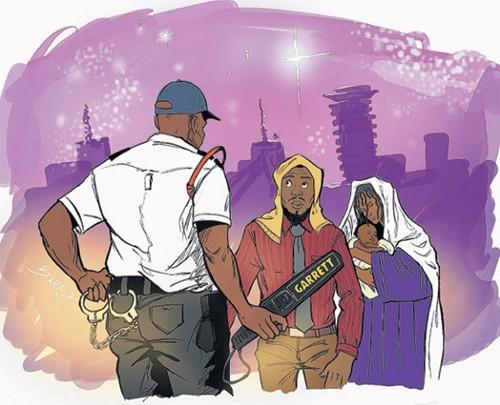


 MCViewPoint