


YOU!
A $30,000 new car with $1,500 headlights eventually becomes a $10,000 used car . . . with $1,500 headlights. After another few years, it will be a $3,500 used car . . . with $1,500 headlights.
Car makers love regulation. Mandatory options save them from the effort of selling options.
https://www.ericpetersautos.com/2020/01/04/the-1500-headlight/
Your next fender-bender could cost you thousands – and not because of the cost of unbending the fenders.
The price of headlights is skyrocketing – because they are no longer just headlights. They are headlight systems, many of them with dozens of individual LED lights – each of them costing more than a single sealed beam halogen headlight – all of them mounted in an ornate, fragile and rapidly yellowing plastic housing.
They are not merely plugged in. They are tied-in. To sensors and computers.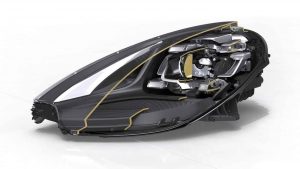
Some of them to GPS.
The latest systems – such as those found in higher-end cars like Audis, Porsches and BMWs – can set you back $1,500 or more for the pair.
Used.
And it’s not just Porsches, BMWs and Audis. Fords and Chevys are getting similar systems. You can’t get a new car without one of these systems, more or less elaborate.
What do you get for your money?
Well, you no longer have to remember to pull back on a steering wheel stalk to dim your high beams – that onerous chore of the medieval era. Like having to apply the brakes in an emergency – or keep the car in its lane.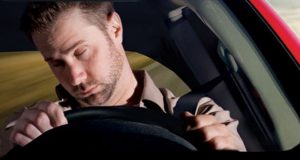
The headlight system will dim the brights automatically. But often more clumsily – and not as quickly as quickly as an attentive human driver.
Who has “sensors” superior in range, nuance and interpretive powers to those built into a headlight. A thinking brain that can assess, process and respond correctly to the almost infinitely variable conditions one finds out in the world – as opposed to programmed software that mindlessly reacts according to limited parameters.
It’s why the brights sometimes blind before they finally dim. Or they don’t come on when they should. Or they toggle spastically in between.
Very much of a piece with emergency brake “assistance” that comes on when there is no emergency – and Lane Keep “assist” that tries to force you back into your lane when you’re trying to make a turn.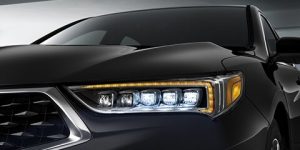
Progress!
Another thing you get is “selective” and “dynamic” illumination. Some of the LEDs go bright; others do not. The computer deciding which – and when. In some of the very latest systems, the light can be sliced. Some of the LEDs individually focus on a specific part of the road – or to spotlight something in the road, such as a deer.
GPS-enabled headlight systems don’t just turn with the car, they anticipate the turn. The headlights know where you’re headed before you get there.
It’s all very elaborate.
Which is why it’s all so expensive.
It’s also why cars have become so disposable.
And so soon.
A $30,000 new car with $1,500 headlights eventually becomes a $10,000 used car . . . with $1,500 headlights. After another few years, it will be a $3,500 used car . . . with $1,500 headlights.
It makes perfect sense to spend $25 on a replacement sealed beam headlight (which never yellow) for a $1,500 used car. You throw away the $3,000 car that needs $1,500 headlights.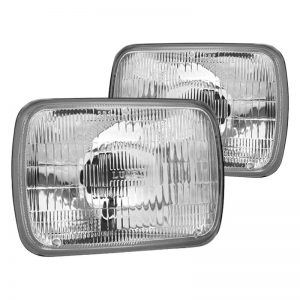
It’s true, of course, that the price of headlights – of the electronics – and of the plastics – will come down over time. Kind of like the cost of electric car batteries. The problem – assuming you dislike being broke or in debt all the time – is that they will probably never come down enough.
In the case of these headlight systems, it’s not just the electronics. It’s also the specificity. A given system – not just the parts you see – is increasingly specific to that specific make/model and even year of car. Which may only be made for three or four years before a new car replaces it. And its headlight system is superseded by a new system. With different electronics as well as plastics.
Once the supply of new replacement plastics and electronics is exhausted, your options are reduced to finding used plastics and electronics – or a new car.
This accelerated disposability is reflected in the cost of insurance – and not just for new cars with $1,500 headlight systems.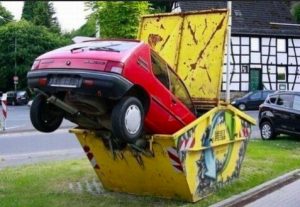
Everyone else is paying more.
You may have already noticed this.
Your bill went up – even though you haven’t filed a claim – or even received a traffic ticket. It is because the cost of repairing – and replacing – new cars is increasing. And that cost is being spread out. You may not own a new car, but you’re helping to pay for one – even if you haven’t damaged one.
Because more and more people are driving haltingly expensive-to-fix new cars . . . and not-worth-fixing not-so-new cars.
It’s interesting to note that cars with $1,500 headlights – and eight air bags, while we’re at it – probably couldn’t be sold if the people buying them had to bear the full potential cost of repairing – and prematurely replacing – them.
But because the car insurance business is a loathsome mafia whose “services” one cannot refuse, the escalating cost-to-fix and cost-to-throw away of new cars is distributed to everyone, very much in the manner of health insurance you’re also not allowed to refuse. The young and healthy – who incur few if any costs themselves – are forced to pay the costs imposed by the old and not-healthy.
What ought to happen is that people who buy cars with GPS-enabled “dynamic” headlight systems – and eight air bags and emergency braking “assist,” et al – pay full freight for their car. Both to buy it and to replace when it’s no longer worth fixing.
This might re-instill some common sense in a business that seems to believe cost is no object. Which, of course, it isn’t.
So long as others can be forced to “help” pay the bill.
Be seeing you

 MCViewPoint