It is only libertarians who are asking these questions and getting to the real issues. It is only libertarians because libertarianism is based on the timeless principles of individual liberty, economic freedom, private property, and a government limited to the protection of these things. Libertarians don’t just hold to these principles when it is expedient or popular to do so. This is what sets them apart from the proponents of every other political philosophy.
Although on the surface, Democrats, liberals, socialists, and progressives seem to be ideological opposites of Republicans, conservatives, nationalists, and constitutionalists, and although both groups are often contrasted with moderates, populists, centrists, and independents, in reality, every one of these groups has something in common: their opposition to libertarianism.
Libertarianism
Libertarianism is the philosophy that says people should be free from individual, societal, or government interference to live their lives any way they desire, pursue their own happiness, accumulate wealth, assess their own risks, make their own choices, participate in any economic activity for their profit, engage in commerce with anyone who is willing to reciprocate, and spend the fruits of their labor as they see fit — as long as their actions are peaceful, their associations are voluntary, their interactions are consensual, and they don’t violate the personal or property rights of others.
Libertarians maintain that as long as people don’t infringe upon the liberty of others by committing, or threatening to commit, acts of fraud, theft, aggression, or violence against their person or property, the government should leave them alone and not interfere with their pursuit of happiness, commerce, personal decisions, economic enterprises, or what they do with their body or on their property.
Libertarians thus believe that —
Individuals, not society or the government, should be the ones to decide what risks they are willing to take and hat behaviors they want to practice.
Everyone should be free to pursue happiness in his own way — even if his choices are deemed by others to be harmful, unhealthy, unsafe, immoral, unwise, stupid, destructive, or irresponsible.
Every crime needs a tangible and identifiable victim who has suffered measurable harm to his person or measurable damages to his property.
Markets should be completely free of government regulation, licensing, restriction, and interference.
No industry or individual should ever receive government grants, subsidies, loans, or bailouts.
The functions of government should be limited to prosecuting and exacting restitution from those individuals who initiate violence against, commit fraud against, or violate the property rights of others.
Contrary to Democrats, liberals, socialists, progressives, Republicans, conservatives, nationalists, constitutionalists, moderates, populists, centrists, and independents — who all may claim to believe some of these things — libertarians believe these things consistently and without exception.
Milei also chose Santiago Bausili as the new central bank head. (I thought there was to be no central bank?) Bausili also worked for JP Morgan and Deutsche Bank in debt, capital markets, and of course, derivatives, in markets covering Argentina, Chile, and Peru. This looks like old home week for Argentina, as the same guys responsible for the past destruction of the economy will be back in the saddle along with Milei,
I warned just after the recent Argentina election, that Javier Milei was not as advertised, and in fact, that he was no different than other politicians. Many condemned my criticism of their new political ‘hero,’ as latching on to any chance for ‘change’ by ignorant and duped voters, is always the imbecilic response by those voluntarily seeking a master to rule them. As I write this just two weeks later, and before he has even taken office, much has already changed, exposing corruption, and political reality that is eternally present. But given the circumstances surrounding all the hype of this self-described new ‘libertarian’ and ‘anarcho-capitalist,’ it seems prudent to expose all the contradiction that surrounds Milei, his Cabinet appointments, his immediate back-tracking, and his connections and supporting cast worldwide, even before he is inaugurated. I think this very important because of so much interest and support coming from the U.S., especially the ‘libertarian’ crowd, and much of the alternative media, whose feigned passion for the people, while at the same time promoting the advancement of freedom through the ballot box, creates a false dichotomy of epoch proportion.
I am not writing this specifically as a hit piece against Javier Milei, but against all ruling class types who claim to be the saviors of the people, by seeking and accepting State power to wield over them. I am only pointing out the gross double-speak, contradiction, and hypocrisy that is so common with all in the political class, government, and any who desire to rule over others, as they can never be trusted. So to be fooled into their trap of propaganda, only requires giving trust without scrutiny, and expecting (hoping for) a desired outcome before it is proven, based only on extreme rhetoric, false promises, political pledges, and bombastic and pompous displays of theatre. All these things are useless, and an assault on the intellect of any able to think for themselves, but given that the ability to think critically is now a very minority position, one can see why those choosing to rule have such an easy time fooling the crowd. Milei’s campaign was little more than a circus-like psychological takeover of the empty minds of those looking for a savior in a crowd of fraudulent criminals.
History shows that smaller polities mean more decentralized governance and greater human liberty. As people can effectively vote with their feet, they can indirectly affect societal change. This is not to say that small governing bodies have no ability to coerce or become corrupt, but people living in those communities are able to more easily choose a new government right next door.
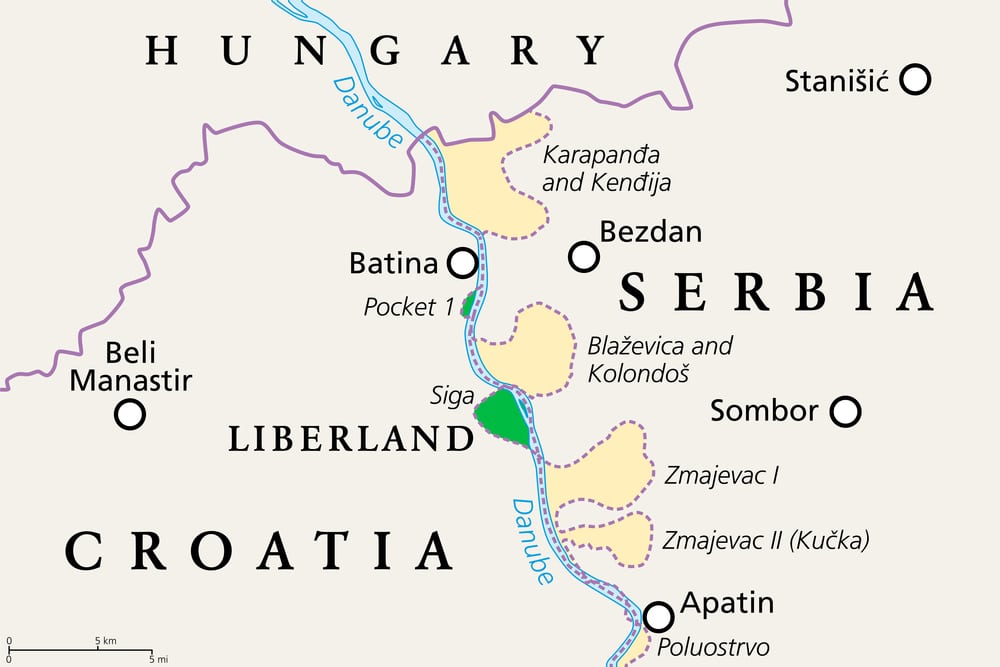
Along the Danube River in South-Central Europe rests a unique parcel of land. This roughly 2.7 square mile piece of land is sandwiched between Croatia and Serbia. Before the breakup of Yugoslavia, the autonomous regions within the federal republic established their borders following the Danube. However, after decades, the river has slightly changed its course, leaving this piece of land outside of both borders. After the breakup of Yugoslavia, neither nation claimed the land, and in fact it remained terra nullius, or no man’s land, until 2015.
Vit Jedlička and a few others proclaimed the territory as the Free Republic of Liberland on April 13, 2015. Upon international recognition, Liberland would be the third smallest sovereign state, after the Vatican City and Monaco. There are four criteria required to be considered a state according to the Montevideo Convention on Rights and Duties of States. They are as follows:
A permanent population;
A permanent territory;
Government;
Capacity to enter into relations with other states;
Liberland has met all of the requirements, meaning that it should be recognized as sovereign by the international community.
Some libertarians have questions as to the necessity of a new state. Aren’t there enough countries already? Why couldn’t Vit and the others be grateful in their original home countries? Could Liberland even be a real country anyways? All of these questions are valid but have equally valid responses.
History shows that smaller polities mean more decentralized governance and greater human liberty. As people can effectively vote with their feet, they can indirectly affect societal change. This is not to say that small governing bodies have no ability to coerce or become corrupt, but people living in those communities are able to more easily choose a new government right next door. Modern nation states are relatively new creations anyways. Thousands of smaller polities existed both inside and outside of competing empires for generations. There is no reason why groups should not be able to secede or claim uninhabited land as new self governing communities.
For Americans, one of the most important stories is that of the separatists and pilgrims who left the Old World searching for religious freedom and commercial success. Not only did they live in the New World as British citizens, but they would also eventually proclaim their own autonomy.
This sense of agency is celebrated by Americans, as well as many post-colonial states around the globe. Why shouldn’t this value be celebrated by everyone? Self-determination as an inalienable right, given by a Creator is crucial to the human experience. Without it, humans lack dignity. The idea that a human adult has no choice but to be subject to the authority of another human adult without explicit consent is dangerous, even tantamount to enslavement.
Property rights also come into play here. Famous empiricist John Locke proclaimed that a natural right to property existed because, “God gave (the world) to mankind in common” for the purpose of stewardship and survival. He argues that individuals can only survive by laboring, and appropriating parcels of land. Thus, property is a natural right to those who contribute their labor to its sustainment.
For it is not the function of any state, including the United States, to right the sins of the Decalogue, to spread fire and devastation in order to bring freedom around the globe—as we murdered countless Vietnamese in the name of their “freedom.” And, above all, we must realize that nuclear war is a far bigger threat to liberty than Communism. How’s that for libertarian “realism”?
In short, libertarians must realize that just as, for them, liberty must be the highest political end, in the same way, peace and the avoidance of mass murder must be the highest end of foreign policy.
[Philosopher] Eric Mack [in his article “Permissible Defense”] uses a device employed by all too many libertarians—of holding the ideal free-market anarchist system or a limited government as virtually equivalent to the current State-ridden system. Thus, he points out quite correctly that isolationism makes no sense as a principle for a free-market protective agency; he leaps from there to the conclusion that, at least for an anarchist, it cannot be a binding principle for the State either. But for an anarchist, the existing State is not a benign if a bit overly cumbersome surrogate for a free-market protection agency. The State is organized crime, murder, theft, and enslavement incarnate. And even for laissez-faire liberals the existing State should be tarred with the same dire labels.
Isolationism is not a principle for free-market defense agencies because there would be no nation-state and therefore no foreign policy for anyone to worry about. But we live, unfortunately, in a world of nation-states, in which each State has arrogated to itself a monopoly of the use of violence over its assumed territorial area. Therefore, to limit the aggressive use of the State, to limit State violence over innocent people as much as possible, the libertarian, be he an anarchist or a laissez-faire liberal, necessarily arrives at the view that at least each State should confine its operations to that area where it has a monopoly of violence, so that no interstate clashes, or, more importantly, injuries wreaked by State A on the population of State B, will be able to occur. The latter point is particularly important in the days of modern technology when it is virtually impossible for State A to fight State B without gravely injuring or murdering large numbers of civilian innocents on both sides.
Therefore, “isolationism”—the confinement of State violence to its own territory—is an important libertarian precept, whether for an anarchist or not. Limiting government to its own territory is the foreign-policy analogue of the domestic injunction of the laissez-faire liberal that the State not interfere with the lives of its own subjects. And isolationism becomes all the more important in our modern age of advanced technological weaponry.
There is an important philosophical error that Mack makes about free-market defense agencies that is quite relevant to our concerns. He maintains that if A uses B as an innocent shield to aggress against C, it is perfectly legitimate for C to shoot B. The problem here is that Mack forgets about the rights of B. Suppose, after all, that B has hired his own defense agency sworn to defend his life and property, and that, for some empirical reason, the agency can’t get to A; would it not then be perfectly legitimate for B or his agent to shoot C in self-defense? The answer, of course, is yes. The error committed by Mack is to concentrate on one person, C, and to worry about what C’s moral course of action may be, while forgetting about B. On a deeper level, Mack’s error—also engaged in by many others, of course—is to confuse morality and rights, that is, to be concerned about what actions of C may or may not be moral while ignoring what the rights are of the various parties in the given situation. To put it succinctly, it may well be that in the shield situation, it is moral for C to shoot B in order to save his own life; but even though moral, it is also murder, and a violation of B’s rights. This error stems from Mack’s unfortunate view that rights as such all disappear in emergency, “lifeboat” situations.
Thus, the political philosopher should not be concerned with morality per se; he should be concerned with that subset of morality dealing with rights.
Other burdens on people’s freedom include economic regulation, trade barriers through sanctions and tariffs, the militarization of local police departments, and the corruption of the news media. It’s said that the first casualty of war is truth. (Noninterventionist Sen. Hiram Johnson said that in 1917.) War and government lying go hand in hand.
In an extra special way, foreign policy matters crucially to champions of individual liberty. Not that it doesn’t matter to other people too — just not in all the same ways. Anyone who understands the importance of keeping government power strictly limited in domestic matters (if such power must exist at all) will also grasp the paramount importance of constraining government power abroad. They’re cut from the same cloth.
This is obvious to libertarians, but not necessarily to others. When Randolph Bourne wrote that “war is the health of the state,” he expected his readers to understand that this is a bad thing because the state is dangerous. But do most people know that? For neoconservatives and humanitarian interventionists, war being the health of the state is a feature, not a bug.
I think it was Richard Cobden, the 19th-century British free trader, peace activist, anti-imperialist, and member of Parliament, who demanded, “No foreign politics.” He meant that the government should be too busy dismantling power at home to engage in deadly balance-of-power intrigue abroad. In America a century later, Felix Morley, the anti-interventionist and pro-market newspaper editor, said in opposing the advocates of war and central bureaucracy that politics will stop at the water’s edge only when policy stops at the water’s edge, which he favored.
War naturally repulses individuals because — obviously — it kills and disables people, most atrociously, noncombatants. It’s so obviously repulsive that many soldiers have to be turned into killers during training. Another count against war is that it encourages a self-destructive, indiscriminate, and collective hatred of foreigners and even local individuals who are invidiously identified with the designated “enemy.” (Russian athletes and even long-dead Russian composers are targets of hostility these days.)
But those who understand that full individual liberty is a necessity — and not a mere luxury — include another count in the indictment against war. It inevitably fosters the general growth of government power, which then infects all aspects of life and society. That doesn’t happen all at once, but it sets in motion a deadly process that menaces everything in its path unless it is stopped. Few things approach war fever in this regard. (A pandemic and a major economic crisis can have similar effects.)
There’s going to be a lot of candidates and a lot parties on the ballot—Republicans, Democrats, Libertarians, Greens, etc.
Someday, when I enter the booth in my local polling station to pull that lever of democracy, I hope to see the words Peace Party next to a candidate’s name.
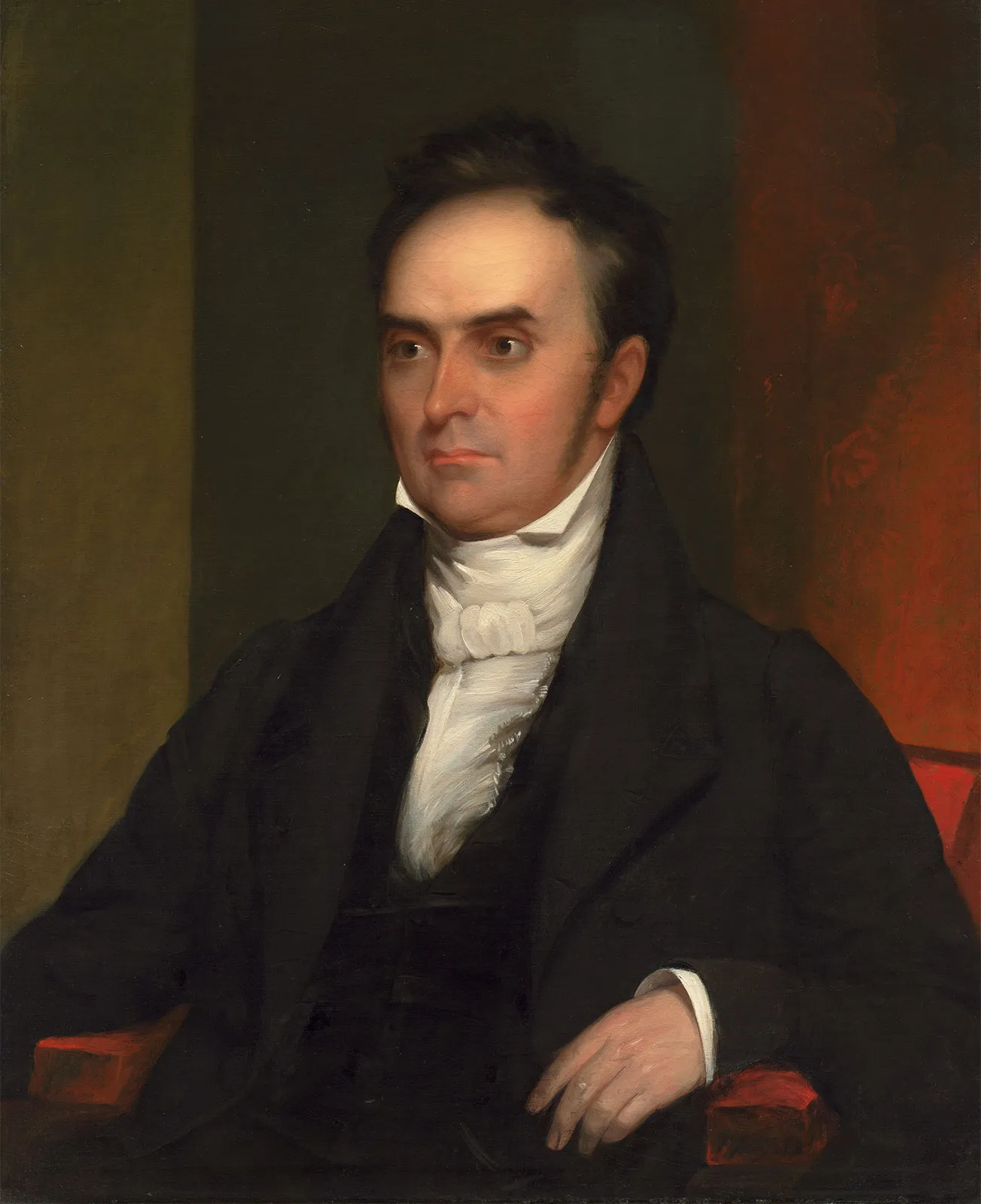
That’s the label Daniel Webster campaigned under in 1814.
His country was in a war he thought was senseless. His neighbors felt unheard in Washington DC, and his home was becoming impoverished under the heavy costs of war.
So when he ran for re-election to the U.S. House, he wanted everyone to know where he stood, fixed and immovable: Peace Party!
You can soak up a lot of wisdom studying Daniel Webster’s forty year career in U.S. politics.
This man of New England served as a congressman, a U.S. senator, and as Secretary of State under three presidents.
He believed in the United States Constitution as he understood it, and when he would argue in its defense on the Senate floor, audience members in the gallery would weep at the beauty of his words.
Odds are you’ve heard me quote Webster before, when he advised just after that 1814 election that, “It will be the solemn duty of the state governments to protect their own authority over their own militia, and to interpose between their citizens and arbitrary power [by the federal government].”
That’s the logic behind our cornerstone piece of legislation, Defend the Guard.
After twenty years of the Global War on Terror, where multiple presidents have deployed our soldiers into more than half a dozen unconstitutional wars, it’s time for state governments to defend the integrity of their National Guard.
“It must be admitted to be the clear intent of the Constitution, that no foreign war should exist without the assent of Congress. This was meant as a restraint on the executive power,” Webster articulated in 1847.
He knew that no president of any party had a right “to go out of our limits, and declare war for a foreign occupation of what does not belong to us.”
When such action is committed by the executive, it’s done out of malice, ego, and the aggrandizement of personal power, because “no man is ignorant that the Constitution of the United States confers on Congress the power of making war.”
And the day that a president does foment war for his own agenda, involves his country in a permanent foreign occupation of lands not our own, and Congress proves unable or unwilling to stop this illegal war making, “then the whole balance of the Constitution is overthrown, and all just restraint on the executive power, in a matter of the highest concern to the peace and happiness of the country, entirely destroyed.”
David Hume referred to “the three fundamental laws of nature, that of the stability of possession, of its transference by consent, and of the performance of promises,” noting,
It is on the strict observance of those three laws, that the peace and security of human society entirely depend; nor is there any possibility of establishing a good correspondence among men, where these are neglected. Society is absolutely necessary for the well-being of men; and these are as necessary to the support of society.
Libertarians make a self-defeating mistake in assuming that their fundamental principles differ radically from most other people’s principles. Think how much easier it would be to bring others to the libertarian position if we realized that they already agree with us in substantial ways.
What am I talking about? It’s quite simple. Libertarians believe that the initiation of force is wrong. So do the overwhelming majority of nonlibertarians. They, too, think it is wrong to commit offenses against person and property. I don’t believe they abstain merely because they fear the personal consequences (retaliation, prosecution, fines, jail, lack of economic growth). They abstain because they sense deep down that it is wrong, unjust, improper. In other words, even if they never articulate it, they believe that other persons are ends in themselves and not merely means to other people’s ends. They believe in the dignity of persons. As a result, they perceive and respect the moral space around others. (That doesn’t mean they are consistent, but when they are not, at least they feel compelled to rationalize.)
That’s the starting point of the libertarian philosophy, at least as I see it. I am not a calculating consequentialist, or utilitarian, but neither am I a rule-worshiping deontologist. Rather, I am most comfortable with the Greek approach to morality, eudaimonism, which, as Roderick Long writes, “means that virtues like prudence and benevolence play a role in determining the content of justice, but also — via a process of mutual adjustment — that justice plays a role in determining the content of virtues like prudence and benevolence.” In this view, justice, or respect for rights, like the other virtues, is a constitutive, or internal, means (rather than an instrumental means) to the ultimate end of all action, flourishing, or the good life.
Libertarians differ from others in that they apply the same moral standard to all people’s conduct. Others have a double standard, the live-and-let-live standard for “private” individuals and another, conflicting one for government personnel. All we have to do is get people to see this and all will be well.
“Liberals” keep folks alive, “Conservatives” keep lazy moochers — including more dangerous Wiindigo, Kunlangeta, psychopaths and permanent leaders — from weakening the group by depleting its resources.
If liberals are all heart and no brain and conservatives are all brain and no heart, how would you describe libertarians?
How about, “Clearly libertarians are the perfect balance between the two.”
Here’s why that’s a pretty accurate assessment – – –
Long before history was enabled by writing, like us, our pre-historic small-group ancestors lived primarily by their brains, not their brawn.
Unlike other animals, they — like us — were born pretty much, as Rousseau and others put it, tabula rasa. That is, as “blank slates” with relatively few built-in instincts, drives, and other in-born behaviors.
For example, while hoofed animals can walk within a few minutes of birth and run soon after, it takes us approximately three months to learn to merely crawl.
The advantage to this lack of hard-wired behavior is that it gives us humans an unprecedented flexibility, allowing us to live everywhere from the icy Arctic to the steaming jungles of Ecuador to the burning sands of the Kalihari. And, in the space station, even in “outer” space. Even, perhaps, on Mars, etc.
However, because of our innate “blank slates,” like us, nearly all our ancestors’ key knowledge, skills and behaviors had to be acquired by experience, or, preferably, by learning from someone else, thus avoiding the many dangers of learning by experience.
The fact that we don’t genetically inherit most of our key knowledge, skills, information, and behaviors means that each one of us becomes a depository of different, often unique, information, skills, knowledge — and particularly, experience. And these exist only in our individual brains. This dispersion of unique knowledge and experience means the essential human data-base — and operating system — is spread out among all the individuals around us.
But our ancestors had a problem we don’t have: They were indeed pre-historic — that is, they existed before writing was available to write his-story down in black and white. So, like the book-people in Fahrenheit 451, our ancestors were each-others’ only reference-library and internet.
Madrigal knows which herbs help heal wounds — and how to find and use them. Gaud can always find that hidden water-hole during the semi-annual desert crossing. The loss of either could be catastrophic to everyone. Ditto the loss of other group members and their special knowledge and information.
Mother Nature wasn’t oblivious to this problem and so gave us an appropriate and nearly unique set of behaviors which prod us to keep each other alive. By convention, folks call these behaviors “altruism.”
It means that libertarians should cease putting all their judicial eggs in the basket of hoping to get good guys, like Richard Epstein or Alex Kozinski, on the Supreme Court. Far more important is getting rid of federal judicial tyranny altogether, and to decentralize our polity radically—to return to the forgotten Tenth Amendment.”
Like most of us who write for LewRockwell.com, I’m opposed to the Supreme Court’s pro-abortion Roe v.Wade decision. If the leak proves to be accurate and the decision is reversed, I’d be glad. As the great Dr. Ron Paul says, “All who support limited, constitutional government should support overturning Roe. The Constitution does not give any branch of the federal government authority to decide what does, and does not, constitute murder. Therefore, federal courts — including the Supreme Court — have no jurisdiction to decide what the penalty should be for performing an abortion.
Overturning Roe would not create a nationwide abortion ban. Instead, it would return to the individual states responsibility for deciding what, if any, restrictions to place on abortion.
If supporters of abortion ‘followed the science,’ they would have to admit that abortion is the taking of human life. A fetus with a heartbeat is developing, but is also still a human with a right to life.
The Biden Justice Department is supporting efforts to overturn the Texas heartbeat law in federal court. President Biden is also supporting the repeal of the Hyde Amendment, which forbids the use of federal funds for abortions. If Biden and Congress are going to use tax dollars to support abortions, then they should allow anti-abortion taxpayers to withhold the percentage of their taxes that would be used to support abortion. The same should go for those with moral objections to America’s militaristic foreign policy that forces US taxpayers to subsidize the killing of innocent men, women, and even children. . . To ensure pro-life Americans are not forced to subsidize abortions — either directly or indirectly, it could be forbidden for organizations that promote or perform abortions to receive any federal funds. Denying federal funds to international organizations that promote or perform abortions might help reduce resentment of the US in other countries.
It is no coincidence that Roe v. Wade came at a time when respect for natural rights of life, liberty, and property was on the decline. Roe contributed to the decline in respect for rights and the rise in public and private immorality. These changes have led to violent crimes, people believing they have a moral claim — that must be enforced by the government — to the property of their neighbors, and acceptance of torture and ‘preemptive’ war. The way to reverse these developments is to restore respect for the inalienable right to life, liberty, and property of all human beings, both born and unborn. The cause of life is inseparable from the cause of liberty.”
Some pro-abortionists, especially so-called “left libertarians,” criticize us in this way. “You claim to be Rothbardians, but Murray Rothbard supported abortion. You are going against Rothbard!” As usual, these phonies have it all wrong. Murray supported reversal of Roe v. Wade. As you would expect, he gives a brilliant argument for reversal.
Rothbard says something few other people would think of. Even if you are “pro-choice,” you should still favor overturning Roe v. Wade. “But even apart from the funding issue, there are other arguments for a rapprochement with pro-lifers. There is a prudential consideration: a ban on something as murder is not going to be enforceable if only a minority considers it as murder. A national prohibition is simply not going to work, in addition to being politically impossible to get through in the first place. Pro-choice paleo-libertarians can tell the pro-lifers: ‘Look, a national prohibition is hopeless. Stop trying to pass a human life amendment to the Constitution. Instead, for this and many other reasons, we should radically decentralize political and judicial decisions in this country; we must end the despotism of the Supreme Court and the federal judiciary, and return political decisions to state and local levels.’ Pro-choice paleos should therefore hope that Roe v. Wade is someday overthrown, and abortion questions go back to the state and local levels—the more decentralized the better. Let Oklahoma and Missouri restrict or outlaw abortions, while California and New York retain abortion rights. Hopefully, some day we will have localities within each state making such decisions. Conflict will then be largely defused. Those who want to have, or to practice, abortions can move or travel to California (or Marin County) or New York (or the West Side of Manhattan.)” https://www.rothbard.it/articles/religious-right.pdf
Many “pro-choice” people oppose reversal because if abortion is left to the state or local community to regulate, then a poor woman who lives in an area where abortion isn’t allowed would have to travel to another area. She might not have the funds to do so, For that reason, they say, leaving abortion up for popular decision is an undue “hardship” on her. Rothbard skewers this so-called “argument:” “The standard rebuttal of the pro-abortionists that ‘poor women’ who haven’t got the money to travel would be deprived of abortions of course reverts back to a general egalitarian redistributionist argument. Aren’t the poor ‘deprived’ of vacation travel now? Again, it demonstrates the hidden agenda of the proabortionists in favor of socialized medicine and collectivism generally”
Murray also opposes forcing taxpayers to subsidize pro-abortionist physicians and counselors. “An unfortunate act of President-elect Clinton was to reverse the Bush policy of not funding physicians who counsel abortions. Leftists cleverly distorted this action as an ‘invasion of the free speech of physicians.’ But no ‘freedom of speech’ was involved. People should be free to speak, but this does not mean they must be shielded from the consequences of such speech. No person, and hence no physician, has a ‘right’ to receive taxpayer funding. Everyone may have the right to say whatever they like, but not the right to say whatever they like and still be funded by the taxpayers. And just as taxpayers should not be forced to fund abortions, neither should they be forced to fund people who counsel abortions.”
As always with Murray, he sees things in their broader context. It isn’t enough to reverse Roe v. Wade, Our target should be the whole system of federal judicial tyranny. “A commitment to radical decentralization means that pro-choicers should give up the Freedom of Choice Act, which would impose abortion rights by the federal government upon the entire country. It means that libertarians should cease putting all their judicial eggs in the basket of hoping to get good guys, like Richard Epstein or Alex Kozinski, on the Supreme Court. Far more important is getting rid of federal judicial tyranny altogether, and to decentralize our polity radically—to return to the forgotten Tenth Amendment.”
The so-called “left libertarians” don’t like Murray’s answer. They aren’t Rothbardians in any sense. We are the true Rothbardians, and we agree with Murray on this vital issue.
As he closed his essay Hayek confessed that since the word liberal had been corrupted, thanks to the French Revolution and other forces, by “overrationalis[m], nationalis[m]” and socialis[m],” it had ceased to a good label for his political outlook, which he shared with Tocqueville and Acton: “What I should want is a word which describes the party of life, the party that favors free growth and spontaneous evolution. But I have racked my brain unsuccessfully to find a descriptive term which commends itself.”
At all times sincere friends of freedom have been rare, and its triumphs have been due to minorities, that have prevailed by associating themselves with auxiliaries whose objects often differed from their own; and this association, which is always dangerous, has sometimes been disastrous, by giving to opponents just grounds of opposition. [Emphasis added.]
Who among true liberal advocates of individual liberty and free social evolution — aka libertarians — would deny the truth of that observation?
Hayek had European conservatism in mind when he wrote his essay, and for years, American conservatives, who still had affection for true liberalism, hastened to point this out. As Hayek wrote:
Conservatism proper is a legitimate, probably necessary, and certainly widespread attitude of opposition to drastic change. It has, since the French Revolution, for a century and a half played an important role in European politics. Until the rise of socialism its opposite was liberalism. There is nothing corresponding to this conflict in the history of the United States, because what in Europe was called “liberalism” was here the common tradition on which the American polity had been built: thus the defender of the American tradition was a liberal in the European sense.
Later in his essay, he elaborated that “in the United States it is still possible to defend individual liberty by defending long-established institutions. To the liberal they are valuable not mainly because they are long established or because they are American but because they correspond to the ideals which he cherishes.”
But he noted that “This already existing confusion [over labels] was made worse by the recent attempt to transplant to America the European type of conservatism, which, being alien to the American tradition, has acquired a somewhat odd character.” The confusion was compounded, Hayek wrote, when socialists began to call themselves liberals.
Many still suffer from this confusion today. But change has been afoot because the illiberals of the left and right increasingly want no part of true liberalism or the label — and in a way, that’s good. Those on the left who call themselves progressives or socialists don’t like the label liberal (or neo-liberal) because they associate it with the current permanent bipartisan prowar regime beholden to special corporate interests (so we liberals still have work to do), and virtually all conservatives eschew the label because they don’t want to be mistaken for libertarians. That’s also good.
So Hayek’s essay has new relevance for America. Would Hayek have been surprised? He would have distinguished national conservatism from neoconservatism because of the latter’s cosmopolitanism. But how could he embrace as bonafide allies people who view imperialist war as a way to create “national greatness” and social solidarity, as the neocons do? Hayek would have agreed with Abraham Bishop who said in 1800 that “a nation which makes greatness its polestar can never be free; beneath national greatness sink individual greatness, honor, wealth and freedom.”
Let’s look at Hayek’s problem with conservatism. For him, the “decisive objection” is that “by its nature,” conservatism can do no more than slow down the change that progressives have initiated. That’s not good enough: “What the liberal must ask, first of all, is not how fast or how far we should move, but where we should move.” He acknowledged that although the liberal’s differences with the “collectivist radical” are greater than his differences with the conservative, the latter “generally holds merely a mild and moderate version of the prejudices of his time.” Thus “the liberal today must more positively oppose some of the basic conceptions which most conservatives share with the socialists.”





 MCViewPoint