MCViewPoint

Opinion from a Libertarian ViewPoint

Posts Tagged ‘Libertarians’

bionic mosquito: Reflections

Posted by M. C. on July 13, 2020

I suggest we start by reducing the number of laws on the books – eliminate all laws against non-violent offenses. Second, demilitarize; almost every department has SWAT teams and the like that are supplied like military invaders of Afghanistan.

After that, we can talk about defunding the police.

https://bionicmosquito.blogspot.com/2020/07/reflections.html

A few items rattling their way through my brain. Time to get rid of these.

History

We have seen statues come down, statues not only of slaveholders (which would require the removal of most statues around the world of anyone born before around 1830 and a few born since), but statues of those who worked to free slaves and those who were slaves. The point isn’t slavery; the point is history.

As many have noted, and I have recently written about, a nation without a story is not a nation. This is the endgame of removing all statues – more accurately, removing the symbols that reflect the history of the nation. Who does this benefit? If we can judge by the people who are tearing down the statues, it doesn’t benefit what might be described as civil society.

I have done my own share of tearing down statues, so to speak. Call it revisionist history. My contribution is meager compared to many who have done the same. I wonder: what is different about what I have done compared to what is done when statues are torn down?

I guess I would say: my work was with the aim of exposing false narratives in our history, of giving some evidence in history that would alter the narrative. It strikes me that such work can only help strengthen the nation by placing its history on firmer footing; it can strengthen the nation by properly reflecting on and recognizing its past sins.

But is this just rationalization on my part? Is this not what today’s (physical) revisionists would say?

This got me to thinking: a nation whose official historical narrative is compiled of many lies might inherently be headed down the road of its statues being torn down. Building a narrative of lie upon lie merely opens the door for those who wish to question the foundation – and rightly so, it seems to me.

We read in Proverbs 19: 5 “A false witness shall not be unpunished, and he that speaketh lies shall not escape.” Perhaps tearing down statues is America’s comeuppance for building one false narrative on top of the other.

Anyway, returning to my question: what’s the difference of the work I have done vs. the tearing down of the statues today? I guess I can say my work was in search of truth – open to someone revising what I described; the physical revisionists are only able to tear down, regardless of narrative: slaveowner, slave trader, abolitionist, or slave. It is a task solely of destruction, with no attempt at leaving truth in its wake.

Such as these are not facing history honestly. I guess, ultimately, this is the difference of my work and theirs. Whether I am furthering truth or not is the task of the next revisionist to decide. But approaching it honestly? I believe so.

Secession

Why didn’t I cheer on CHAZ or CHOP or whatever name they wanted to use? Three years or so ago, Catalunya was voting on secession. I wrote then, and have written since: cheer on every opportunity for secession; if those in the seceding group do not wish to secede, then support their secession from this group.

So, why not cheer on CHAZ? What’s different? I guess I can answer it with a quote from Jeff Deist, writing at the time of the vote in Spain:

For libertarians, self-determination is the highest political end. In political terms, self-determination is liberty. In an ideal world, self-determination extends all the way to the individual, who enjoys complete political sovereignty over his or her life. The often misused term for this degree of complete self-determination is anarchy.

So, first there is the question of self-determination.

In an imperfect world, however, libertarians should support smaller and more decentralized governments as a pragmatic step toward greater liberty. Our goal should be to devolve political power whenever possible, making states less powerful and easier to avoid. Barcelona is less ominous than Madrid. The Legislature in a US state is less fearsome than Congress in Washington DC.

It seems correct to me – ever-smaller levels of government bring governmental leaders closer to the community, and give those in the community more opportunities to find a situation better suited to their preferences. But this only works to advance liberty if the higher governmental institution does not continue usurping life and property from those who have now seceded. So this is a second consideration.

But then we have this line:

Street gangs are bad, but they can be avoided in ways Uncle Sam cannot.

So, why did I not cheer on the street gang in Seattle as I did the secessionists in Catalunya? I guess for a few reasons – and I suspect Deist would concur: first, it is not clear that there was any “self-determination” by those who lived and worked and owned businesses in the district on this matter; from what I can understand, it was kind of the opposite. Maybe I am wrong one this.

Second, the higher levels of government didn’t leave those inside alone: still obligated for taxes, still obligated to the laws (well, not the armed thugs, but those whose homes and businesses were destroyed). The only way that these people were left alone was in the only function the higher entity owed them: defense of life and property.

Which brings me to the third reason: until we come to a stateless society, should we not expect those in government and authority to do their jobs? By “jobs,” I don’t mean spying and flying drones over wedding parties and the like. I mean protect life and property – the only proper role of a government if there is to be a government. This clearly didn’t happen in Seattle. In fact, it was the opposite.

Those looting and destroying were left free by the government that was supposed to protect from such thuggery. Imagine what would happen if a private citizen-victim of these looters did the government’s job in the stead of those who had the obligation. This defender of his property would have been the one sent to the gallows.

So, I guess my point is this: this event in Seattle was no secession. It was a militarized invasion, with those responsible for defense abandoning their duty while leaving illegal the possibility of defense by those whose property and lives were jeopardized. Which brings me to…

Pulling the Plug

Would libertarians be happy with pulling the plug on the existing state structures, confident that freedom would then ring – that eventually things would work out? Working through this question in the past is one of the reasons I concluded that a proper cultural foundation is necessary before one can consider anything like liberty – or consider anything like pulling the plug.

If I was a resident in the CHAZ district of Seattle, I suspect I would feel even more confident of this view than I did before.

And, Finally…

In the absence of my free ability to properly defend my property (as all legal risk and all laws are against those who will do so), and in the absence of my ability to secure the services of a private and competing defense agency (which would be cost prohibitive for many reasons and would also open me up to the liabilities of a criminal), what are we to do with today’s police? Defund them? Spit on them?

I suggest we start by reducing the number of laws on the books – eliminate all laws against non-violent offenses. Second, demilitarize; almost every department has SWAT teams and the like that are supplied like military invaders of Afghanistan.

After that, we can talk about defunding the police.

Be seeing you
Posted in Uncategorized | Tagged: , , , , , , | Leave a Comment »

5 Things I Learned Debating the Harvard Prof Who Called for a ‘Presumptive Ban’ on Homeschooling | The Libertarian Institute

Posted by M. C. on June 28, 2020

https://libertarianinstitute.org/articles/5-things-i-learned-debating-the-harvard-prof-who-called-for-a-presumptive-ban-on-homeschooling/

by | Jun 21, 2020


It’s not just about homeschooling.

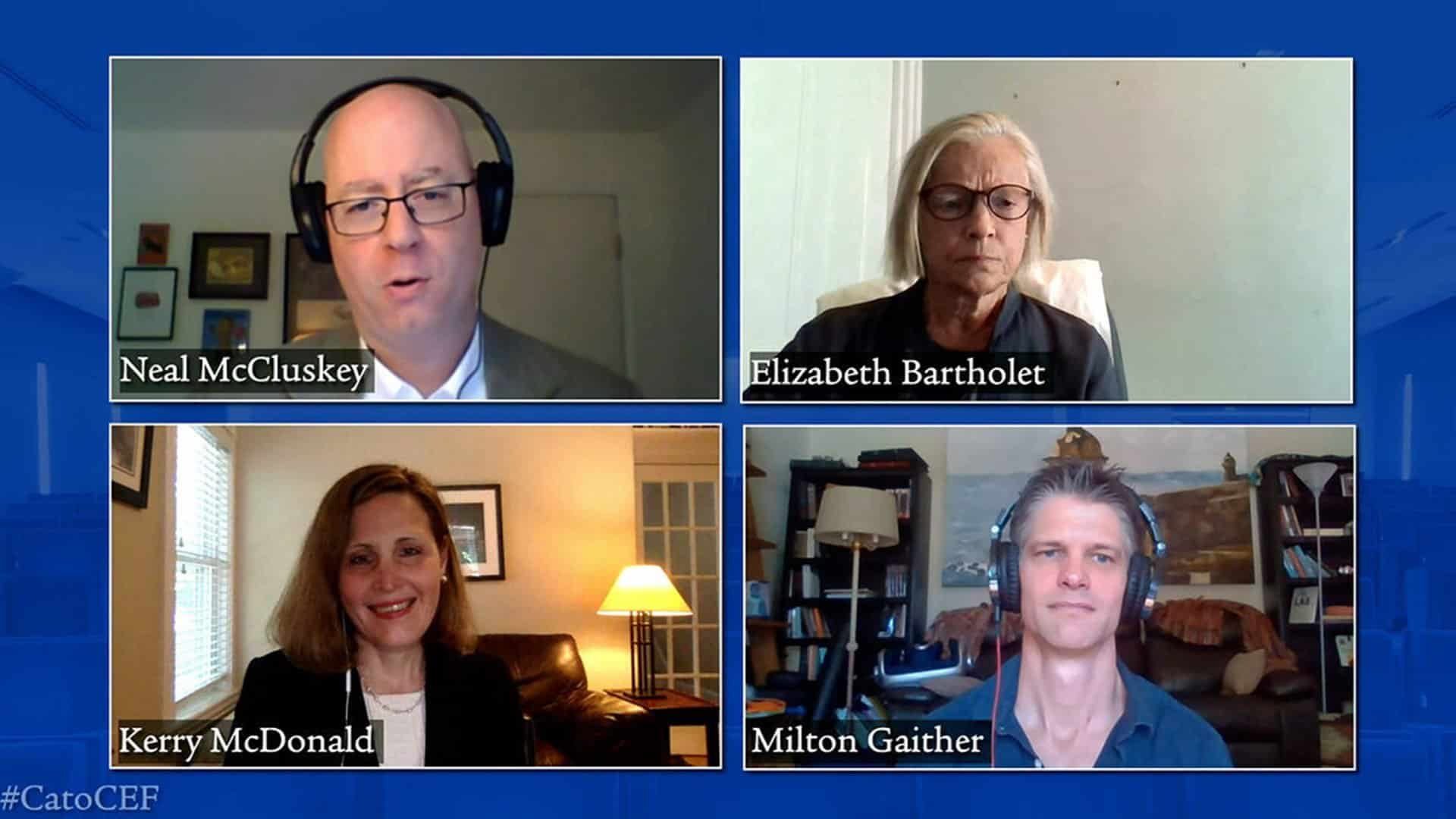
On Monday, I debated the Harvard professor who proposes a “presumptive ban” on homeschooling. Thousands of viewers tuned in to watch the live, online discussion hosted by the Cato Institute. With 1,000 submitted audience questions, the 90-minute webinar only scratched the surface of the issue about who is presumed to know what is best for children: parents or the state. Here is the replay link in case you missed it.

Last week, I outlined much of my argument against Harvard Law School professor Elizabeth Bartholet that I incorporated into our debate, but here are five takeaways from Monday’s discussion:

While this event was framed as a discussion about homeschooling, including whether and how to regulate the practice, it is clear that homeschooling is just a strawman. The real issue focuses on the role of government in people’s lives, and in particular in the lives of families and children. In her 80-page Arizona Law Review article that sparked this controversy, Professor Bartholet makes it clear that she is seeking a reinterpretation of the US Constitution, which she calls “outdated and inadequate,” to move from its existing focus on negative rights, or individuals being free from state intervention, to positive rights where the state takes a much more active role in citizens’ lives.

During Monday’s discussion, Professor Bartholet explained that “some parents can’t be trusted to not abuse and neglect their children,” and that is why “kids are going to be way better off if both parent and state are involved.” She said her argument focuses on “the state having the right to assert the rights of the child to both education and protection.” Finally, Professor Bartholet said that it’s important to “have the state have some say in protecting children and in trying to raise them so that the children have a decent chance at a future and also are likely to participate in some positive, meaningful ways in the larger society.”

It’s true that the state has a role in protecting children from harm, but does it really have a role in “trying to raise them”? And if the state does have a role in raising children to be competent adults, then the fact that two-thirds of US schoolchildren are not reading proficiently, and more than three-quarters are not proficient in civics, should cause us to be skeptical about the state’s ability to ensure competence.

I made the point on Monday that we already have an established government system to protect children from abuse and neglect. The mission of Child Protective Services (CPS) is to investigate suspected child abuse and punish perpetrators. CPS is plagued with problems and must be dramatically reformed, but the key is to improve the current government system meant to protect children rather than singling out homeschoolers for additional regulation and government oversight. This is particularly true when there is no compelling evidence that homeschooling parents are more likely to abuse their children than non-homeschooling parents, and some research to suggest that homeschooling parents are actually less likely to abuse their children.

Additionally, and perhaps most disturbingly, this argument for more state involvement in the lives of homeschoolers ignores the fact that children are routinely abused in government schools by government educators, as well as by school peers. If the government can’t even protect children enrolled in its own heavily regulated and surveilled schools, then how can it possibly argue for the right to regulate and monitor those families who opt out?

Of all the recommendations included in the Harvard professor’s proposed presumptive ban on homeschooling, the one that caused the most uproar among both homeschoolers and libertarians was the call for regular home visits of homeschooling families, with no evidence of wrongdoing.

In my remarks during Monday’s debate, I included a quote from a Hispanic homeschooling mother in Connecticut who was particularly angry and concerned about imposing home visits on homeschooling families. (According to federal data, Hispanics make up about one-quarter of the overall US homeschooling population, mirroring their representation in the general US K-12 school-age population.) She made the important point that minority families are increasingly choosing homeschooling to escape discrimination and an inadequate academic environment in local schools. She also pointed out that, tragically, it is often minorities who are most seriously impacted by these seemingly well-meaning government regulations. Writing to me about Professor Bartholet’s recommendation, she said:

“To state that they want to have surveillance into our homes by having government officials visit, and have parents show proof of their qualified experience to be a parent to their own child is yet another way for local and federal government to do what they have done to native Americans, blacks, the Japanese, Hispanics, etc in the past. Her proposal would once again interfere and hinder a certain population from progressing forward.”

Anyone who cares about liberty and a restrained government should be deeply troubled by the idea of periodic home visits by government agents on law-abiding citizens.

Despite the landmark 1925 US Supreme Court decision that ruled it unconstitutional to ban private schools, there remains lingering support for limiting or abolishing private education and forcing all children to attend government schools. Homeschooling is just one form of private education.

In her law review article, Professor Bartholet recommends “private school reform,” suggesting that private schools may have similar issues to homeschooling but saying that this topic is “beyond the scope” of her article. Still, she concludes her article by stating that “to the degree public schools are seriously deficient, our society should work on improving them, rather than simply allowing some parents to escape.”

The government should work to improve its own schools, where academic deficiencies and abuse are pervasive. But it should have no role in deciding whether or not parents are allowed to escape.

Some advocates of homeschooling regulation suggest that requiring regular standardized testing of homeschoolers would be a reasonable compromise. In her law review article, Professor Bartholet recommends: “Testing of homeschoolers on a regular basis, at least annually, to assess educational progress, with tests selected and administered by public school authorities; permission to continue homeschooling conditioned on adequate performance, with low scores triggering an order to enroll in school.”

During Monday’s debate, I asked the question: By whose standard are we judging homeschoolers’ academic performance? Is it by the standard of the government schools, where so many children are failing to meet the very academic standards the government has created? I pointed out that many parents choose homeschooling because they disapprove of the standards set by government schools. For example, in recent years schools have pushed literacy expectations to younger and younger children, with kindergarteners now being required to read. If they fail to meet this arbitrary standard, many children are labeled with a reading deficiency when it could just be that they are not yet developmentally ready to read.

Indeed, as The New York Times reported in 2015: “Once mainly concentrated among religious families as well as parents who wanted to release their children from the strictures of traditional classrooms, home schooling is now attracting parents who want to escape the testing and curriculums that have come along with the Common Core, new academic standards that have been adopted by more than 40 states.”

A key benefit of homeschooling is avoiding standardization in learning and allowing for a much more individualized education. And it seems to be working. Most of the research on homeschooling families conducted over the past several decades, including a recent literature review by Dr. Lindsey Burke of the Heritage Foundation, finds positive academic outcomes of homeschooling children.

There are very few movements today that bring together such a diverse group of people as homeschooling does. Families of all political persuasions, from all corners of the country, reflecting many different races, ethnicities, classes, cultures, values, and ideologies, and representing a multitude of different learning philosophies and approaches choose homeschooling for the educational freedom and flexibility it provides. Homeschoolers may not agree on much, but preserving the freedom to raise and educate their children as they choose is a unifying priority. In times of division, homeschoolers offer hope and optimism that liberty will prevail.

Reprinted from FEE.

Be seeing you

Posted in Uncategorized | Tagged: , , , , , , | Leave a Comment »

Rioting: Everyone Has Lost Their Minds – LewRockwell

Posted by M. C. on June 2, 2020

Somehow we’ve come to live in a world in which obvious moral truths are now expressions of right-wing extremism.

https://www.lewrockwell.com/2020/06/thomas-woods/rioting-everyone-has-lost-their-minds/

By

From the Tom Woods Letter:

Some libertarians tell me: there’s no such thing as left and right; this is a made-up distinction meant to divide us.

Not so, and I can prove it.

I can tell the difference with one question.

“Are rioting and looting wrong?”

One side will say yes. The other will give you a speech. Works every time.

(Michael Malice has a similarly formulated question, unrelated to riots, which inspired mine.)

Remember how we were supposed to be terrified of three dozen right-wing extremists with no funding and no foothold in media, entertainment, or academia? And the left were just “anti-fascist” activists innocently pursuing justice?

Seems pretty dumb today, doesn’t it?

(It seemed pretty dumb then, too.)

The left — and plenty of libertarians, to their profound shame — can’t seem to decide between two ways they want to spin what is currently happening:

(1) Riots are the language of the unheard, and we should try to understand people participating in them even if we (rather tepidly) disapprove.

(2) It’s outside agitators spurring the riots, so we shouldn’t blame the peaceful protestors.

But if riots are basically understandable, why this rush to assure me that they’re being instigated by outsiders? Didn’t you just tell me this is an understandable if unfortunate display by the unheard? Pick one!

I’ve devoted numerous episodes of the Tom Woods Show to the problems with police, and I’ll be linking them all on one page when tomorrow’s episode (#1664) with Eric July comes out.

The police are a monopoly with all the drawbacks we normally admit are the result of monopolies.

I’ve never understood the conservative devotion to the police. They’re for “limited government” and claim to detest 90+% of what the state commands. But the enforcement arm of the state and its commands? Why, that’s awesome and to be saluted!

And in tomorrow’s episode we’re going to list nine specific things that would make a serious dent in police misconduct of all kinds, from the trivial to the gruesome.

But not for a second am I going to look for reasons that terrorizing people and destroying unrelated property is in any way an understandable response to a political grievance, or put a “but” in my statement — as in, “Looting is bad, but….”

I am hearing plenty of this: look, sure, it’s bad that some people are destroying businesses and stealing what other people worked for, but they’re really angry. On some level you have to sympathize with them.

Nope. I don’t.

“I have suffered; therefore, other innocents should suffer” — which of the saints lived by such a monstrous code?

If your child is mistreated and takes his frustration out on my child by randomly beating the hell out of him, I will not gaslight my child by explaining that what happened is sort of understandable on some level.

Screw that.

Somehow we’ve come to live in a world in which obvious moral truths are now expressions of right-wing extremism.

Be seeing you


Posted in Uncategorized | Tagged: , , , , , | Leave a Comment »

Four things only libertarians can see about COVID-19

Posted by M. C. on April 7, 2020

What is unseen are the variety of harms that occur because people have been denied freedom of association and movement.

Second, don’t overlook the harm caused by government actors.

No matter the doomsday scenario, it’s hard to imagine a single governor (or president) outsmarting millions of people.

The Principle of Human Respect is a natural, cause-and-effect relationship. If I rob you at gunpoint, your happiness decreases. Social harmony and prosperity are diminished too.

https://www.theadvocates.org/2020/03/four-things-only-libertarians-can-see-about-covid-19/

A new form of political correctness has spread, like a virus, across the fruited plain. Libertarians are taking heat – getting angry responses for criticizing governors who have used the spread of COVID-19 to issue edicts that shutter businesses and impose martial law-like schemes.

coronavirus covid-19 libertarians politics

Still, libertarians find they cannot keep quiet. Their philosophy of self-government is forged in an understanding of consequences. Libertarians are the only members of society who can see – even foresee – the following four things about the State’s edicts and regulations…

The seen and the unseen

First, libertarians can visualize the Unseen.

What is seen is that which is obvious to us. In the present case, it’s easy for us to see the way the virus is spreading and how the healthcare system is overrun in Italy.

What is unseen are the variety of harms that occur because people have been denied freedom of association and movement. Politicians are using wartime powers and preening before TV cameras. There will be short-term and long-term effects stemming from their actions. Nearly everyone, especially the regime media, is overlooking these costs.

The proper way to analyze this situation is to take all of the effects into account.

Libertarians are just like you; they’re sheltering and practicing physical distance. But let’s be clear, not everyone has that luxury. There’s no way that a governor could anticipate, let alone solve all of these sticky issues. Edicts are “one size fits all.” Each person understands their unique situation better than a politician in a distant capitol could. There are many scenarios to consider. Here’s a sampling…

  • Right now, families are trapped in a home with an abuser. Perhaps the abuser’s workday was a time of relief, or the victim’s school or work was an escape path to safety.
  • Suicides will increase during the crisis.
  • Addiction will worsen because the sense of purpose or even mere interruption that occupational work provides has been stolen away.
  • Businesses that were operating on a thin margin will fold, crushing dreams, resulting in unemployment, and even reducing supply. Supply reductions will fuel price increases for all of us.

Notice State failures

Second, don’t overlook the harm caused by government actors. For example, Donald Trump’s aides were afraid to give their reelection-minded boss any bad news until it was too late. And the sudden, jarring, gubernatorial edicts have caused fear, uncertainty, and doubt – provoking shortages.

In a libertarian world, reliable tests would already be for sale! And if the tests were universally available, the crisis would’ve been far smaller and Americans would be back to work.

There are two reasons tests are not already on the market.

  1. Political suppression of information. If they had gotten the signal earlier, then entrepreneurs, inventors, and existing businesses would’ve started delivering tests by now. We know there was sufficient time because a handful of U.S. Senators were briefed in January. After seeing the impending crisis, they sold off their stocks.
  2. Ironically, regulations are supposed to make us safer. What they do instead is create barriers which increase delays and costs. Frequently, the innovator realizes that no action is profitable, choosing not to invent (another unseen effect). The FDA has been in the way of tests getting to market.

Wisdom of the crowd

Third, self-government is the best solution to the Knowledge Problem. No matter the doomsday scenario, it’s hard to imagine a single governor (or president) outsmarting millions of people.

No matter how brilliant the governor and his or her advisors are, he or she lacks the capacity to win a problem-solving contest against tens of millions of people.

Worse, political acts are prone to cause injuries (which tend to be unseen and unreported). The miracle of “stuff” arriving on our store shelves involves millions of micro-decisions. Sudden edicts have replaced that. Shortages result because the governor deploys unanticipated force. Consider…

Restaurants who planned menus suddenly have too much food. Grocery stores, who thought people would be at restaurants, find that they have new customers instead. The restaurant owner takes a bath.

Even with nearly-empty shelves, stores need to make sure they don’t over-order in response. Grocers know these effects are temporary, but they don’t know when they will end. They don’t want to end up like the restaurants, stuck with too much stock on hand. Uncertainty prevails. Shortages will remain a problem until governors back out of the equation.

Human respect

Fourth and most important of all, is the matter of Human Respect. The libertarian uniquely recognizes that everyone seeks happiness and that no one person can make everyone happy.

The Principle of Human Respect is a natural, cause-and-effect relationship. If I rob you at gunpoint, your happiness decreases. Social harmony and prosperity are diminished too.

Since this is a principle, even governors cannot violate it. Bans and edicts are ultimately enforced by armed men and women. These are not acts of persuasion; they are threats to achieve a desired result. When anyone, be they a criminal or your governor, coerces another human being, they never increase happiness. And in the present situation, the bans have obviously decreased social peace and material prosperity.

The damage to prosperity is already so obvious that no one is contesting it.

And before the governors started acting, we had peaceful cooperation. Most people were already practicing physical distancing. We also witnessed allegedly greedy corporations voluntarily sacrificing many millions of dollars. To prevent the spread of COVID-19 the NCAA closed events to the public. Then, the NBA suspended its season and Disney closed its parks. Like falling dominoes, tons of businesses followed.

AFTER that, governors forced the holdouts to close. Libertarians began raising important questions like the four you’ve just reviewed. They’re getting accused of wanting to clog hospitals and increase the death toll. Therefore, consider the role politicians are playing. Are their acts increasing harmony or did they introduce new divisions into our society?

Be seeing you


Posted in Uncategorized | Tagged: , , , , , , , , , , , , | Leave a Comment »

I Endorse ‘OK, Boomer,’ And So Should You – LewRockwell

Posted by M. C. on November 26, 2019

If you want to be right-wing, knock yourself out. But don’t be dumb-guy right-wing, speaking and thinking in slogans that sound like they were hammered out in the boardroom of a D.C. marketing firm.

https://www.lewrockwell.com/2019/11/thomas-woods/i-endorse-ok-boomer-and-so-should-you/

By

Tom Woods Show

From the Tom Woods Letter:

So the youngsters are using “OK, boomer” as a dismissive retort these days.

The reference is to the generation born roughly between 1946 and 1965 — though the set of beliefs I personally associate with the phrase is not confined to people from that age group.

I’ve seen some libertarians (and of course conservatives) object to this.

Why, these youngsters should respect authority!

But you know what?

No matter how the expression is being used in practice, in principle it’s a great idea that I wholeheartedly endorse.

And yes, I will of course lose subscribers today. (I’ll live.)

Boomers should be exercising some kind of leadership role today, as our elders. They should be giving us something to look up to.

Instead, even the Boomers who consider themselves cheeky and anti-Establishment just repeat slogans and talking points handed to them by talk radio or the Heritage Foundation.

(Boomerism as I conceive of it is more a set of ideas than it is an age range.)

With every possible resource available to them online at the push of a button they’re still thinking in 1980s Republican Party platitudes?

They’re still portraying presidents they like as heroic defenders of Jesus?

They’re still worked up when people object to the Pledge of Allegiance? They still haven’t encountered anyone or anything that makes them wonder about “one nation, indivisible” as an American principle?

They’re still comparing American soldiers to Jesus Christ?

They still use the expression “my president”?

They’re still saying, “If you won’t stand behind the troops, feel free to stand in front of them”?

After all the police abuse, which takes a multitude of forms, they’re still repeating slogans with all the sophistication of a third-grade book report?

So no, I won’t be shedding any tears if we have a dismissive response to this contemptible intellectual laziness.

If you want to be right-wing, knock yourself out. But don’t be dumb-guy right-wing, speaking and thinking in slogans that sound like they were hammered out in the boardroom of a D.C. marketing firm.

Be seeing you

A Baby Boomer's Belated Blog to George Will | HuffPost


Posted in Uncategorized | Tagged: , , , | Leave a Comment »

What Is It That Libertarians Don’t Get about the Military? – LewRockwell

Posted by M. C. on September 17, 2019

https://www.lewrockwell.com/2019/09/laurence-m-vance/what-is-it-that-libertarians-dont-get-about-the-military/

By

I expect to get negative responses from conservatives when I write articles about the U.S. military. I don’t expect to get them from libertarians.

In response to my recent article, “Should We Honor Military Personnel?,” I received e-mails from two libertarians. Perhaps there were others. I never assume that everyone who contacts me after I write an article for LewRockwell.com is a libertarian. One, not everyone who reads LRC is a libertarian. I myself, a libertarian, read many conservative and liberal websites. And two, many times my LRC articles are reposted by a variety of websites. I never know if someone read my article on LRC or some other website.

Both libertarians who wrote me took issue with the basic premise of my article: military personnel who actually defend the country like they are supposed to shouldn’t be honored any more than a cook at Waffle House. I didn’t address the issue of honoring military personnel who don’t actually defend the country like they are supposed to. My position on that has been consistently and vehemently negative since I began writing about the warfare state after the United States invaded Iraq…

What is it that libertarians don’t get about the U.S. military?

Here are ten things about the U.S. military that I have mentioned scores of times over the years in my articles about the U.S. military:

  1. The U.S. military is the president’s personal attack force.
  2. The U.S. military doesn’t defend our freedoms.
  3. The U.S. military carries out a reckless, belligerent, and meddling U.S. foreign policy.
  4. The U.S. military goes places it has no business going.
  5. The U.S. military kills people it has no business killing.
  6. The U.S. military engages in offense, not defense.
  7. The U.S. military fights unjust and immoral wars.
  8. The U.S. military bombs countries that were no threat to the United States.
  9. The U.S. military creates terrorists, insurgents, and militants because of its actions.
  10.  The U.S. military is a global force for evil.

These ten things are more than enough.

No member of the military should be honored no matter where or why he “served.” Individual soldiers should be blamed for the misdeeds (and they are not perceived; they are real) of the military because (1) individual soldiers joined of their own freewill and (2) individual soldiers are the ones who commit the misdeeds. The fact that they took an oath to defend the Constitution means nothing if they don’t actually defend it. No soldier should have to be sent away from his family for extreme lengths of time or prepare himself mentally, emotionally and spiritually to lay down his life if necessary. Not if he was actually engaged in defending the country against real threats instead of fighting foreign wars.

The huge embarrassment to libertarianism is for anyone who calls himself a libertarian to honor U.S. military personnel just because they “served” when, even in their best state, they should not be honored any more than a cook at Waffle House.

Be seeing you

napalm


Posted in Uncategorized | Tagged: , , | Leave a Comment »

Immigration Tyranny and Cruelty Come Home – The Future of Freedom Foundation

Posted by M. C. on May 16, 2019

Not all Libertarians favor open borders. Some of us believe no border, no country.

We already have a mans of legally entering the US. Flawed though it may be.

Some Libertarians believe that if there is a job or some sort of private support waiting it is OK to make a home here. Otherwise taxation and theft of private property is the result (ie taxation and government using otherwise public and/or private land and property to house and support illegals).

The arrest of the lady helping people in distress – that is simply a AGW (armed government worker) who is either/or low on his quota and exercising his power. I am betting on a power play.

image_511

https://www.fff.org/2019/05/14/immigration-tyranny-and-cruelty-come-home/

by

I can’t help but wonder if what has happened to Theresa Todd will cause conservative-leaning libertarians to abandon their support of immigration controls, the system of immigration central planning, cruelty, and tyranny that both conservatives and progressives have unfortunately foisted upon our land.

Todd lives in West Texas. One night she was driving down a highway when she was flagged down by three young Central American migrants — Carlos, 22, his brother Francisco 20, and their sister Esmeralda, 18.

The three of them had fled El Salvador years ago and had been living with an aunt in Guatemala. Two of Carlos’s friends had been murdered by Guatemalan gangs and a gang leader wanted Esmeralda to be his girlfriend. The three of them decided to flee to the United States. They entered the U.S. by crossing a remote desert.

When Todd encountered the three, Esmeralda was suffering from starvation, extreme dehydration, and infected wounds from cactus spines and rhabdomyolysis, a grave illness that sometimes leads to kidney failure. According to William Kitts, the local sheriff in Jeff Davis County, Texas, where the incident took place, Esmeralda would have died if Todd had not stopped to help her.

And Todd did stop to help, a decision that has ended up costing her immensely. Why? Because while the three migrants were sitting in Todd’s vehicle as she began making telephone calls, a deputy sheriff drove up and then immediately summoned the Border Patrol, who proceeded to arrest not only the three migrants but also Todd herself.

Todd hasn’t yet been formally charged and there is still a possibility that federal officials will think twice before prosecuting her, especially since the 53-year-old woman serves as both the city attorney of Marfa, Texas, and the county attorney of Jeff Davis County. If she is charged, the likely offense will be “harboring” illegal immigrants, which is a felony.  A conviction would likely result in the revocation of her law license.

That’s what Todd gets for stopping to help those three young people, one of whom was on the verge of death.  As she put it,

I honestly don’t feel like I ever did anything wrong: I stopped to help some kids. It’s been pretty transformative for me, to be perfectly honest. To have devoted my life to public service, and then to be Mirandized, detained and investigated as if I’m a human smuggler. The whole thing was really, really, very surreal. It was like a “Twilight Zone.”

At the risk of belaboring the obvious, under a system of open borders, which is the system that we libertarians favor, Carlos, Francisco, and Esmeralda would not have been entering the country by crossing a lonely and dangerous desert…

Be seeing you

La-Raza-Founder (1)

…from the USA


Posted in Uncategorized | Tagged: , , , , | Leave a Comment »

Why School Compulsory-Attendance Laws? – The Future of Freedom Foundation

Posted by M. C. on May 10, 2019

No one should be forced to attend church. By the same token, no one should be force to submit to a state-approved education. For that matter, no one should be forced to fund a state-approved school any more than he should be forced to fund a state-approved church. The state has no more business in education than it does in religion.

https://www.fff.org/2019/05/09/why-school-compulsory-attendance-laws/

by

Imagine if Congress were to enact a law that required everyone to attend church on Sundays. The overwhelming majority of Americans would go up in arms. The concept of religious liberty is so deeply ingrained in our American heritage that there is no way that people, including devout Christians, would accept such a law. That heritage was enshrined in the First Amendment, which prohibits Congress from enacting such a law.

Now, suppose things had been the exact opposite. Suppose that from the beginning, the Constitution had authorized Congress to enact compulsory church-attendance laws. Suppose that immediately after the Constitution called the federal government into existence, Congress had enacted a law requiring parents to send their children to church, in order to be educated on religious, moral, ethical, and Biblical principles. Suppose that we had been living with that national compulsory church-attendance law for the entire history of the United States.

Now suppose we libertarians were to advocate the repeal of the church-attendance law, which would enable families to decide for themselves whether to send their children to church or not. Can you imagine the outcry?

“Are you libertarians crazy? If we let families make that decision, no one would send their children to church. Most parents are just too irresponsible. How could we be certain that children would receive the right education and training when it comes to morality, ethics, and religion? Wouldn’t some parents teach their children to be atheists or, even worse, to worship Satan? No, you libertarians are all off base. People aren’t ready for that type of freedom. Repealing the church-attendance law would destroy the moral, religious, and ethical foundation of American society.”

After all, isn’t that the mindset of many Americans when they hear libertarians calling for the repeal of compulsory school-attendance laws? Don’t they say that people just aren’t ready for that type of freedom — that parents are too irresponsible — that children wouldn’t get educated — and that a free-market educational system would destroy America?

But the fact is that there is no difference in principle between religious liberty and educational liberty. Just as people shouldn’t be forced to send their children to church, they shouldn’t be forced to send their children to a state-approved organization for secular education and training. Families have the natural, God-given right to make educational decisions for their children without state interference or meddling, just as they do with respect to religious decisions…

Be seeing you

public vs private primary schools


Posted in Uncategorized | Tagged: , , , | Leave a Comment »

The Little House on the Prairie of Laura Ingalls Wilder – The Future of Freedom Foundation

Posted by M. C. on April 2, 2019

In real life, Wilder and Lane came to share a deep political connection through their mutual rejection of Franklin D. Roosevelt’s New Deal policies. In her book Libertarians on the Prairie: Laura Ingalls Wilder, Rose Wilder Lane, and the Making of the Little House Books, Christine Woodside explained, “They both hated the New Deal. They thought the government was interfering in people’s lives, that individuals during the Depression were becoming very whiny and weren’t grabbing hold of their courage. The climate of America was really irritating them.

https://www.fff.org/explore-freedom/article/the-little-house-on-the-prairie-of-laura-ingalls-wilder/

by

Prairie Fires: The American Dreams of Laura Ingalls Wilder by Caroline Fraser (Metropolitan Books, 2017); 625 pages.

Prairie Fires: The American Dreams of Laura Ingalls Wilder, by Caroline Fraser, is one of the finest biographies I have read, and a fully deserving winner of the 2018 Pulitzer Prize for Biography. Prairie Fires is the definitive depiction of Laura Ingalls Wilder (1867–1957), author of the world-renowned series of eight children’s books that are collectively known as The Little House on the Prairie. The best-selling novels recount Wilder’s childhood and her family’s life on the Western frontier during the 1870s and 1880s. In simple but compelling prose, Wilder invites readers to become part of a loving family who survive through poverty, hunger, blizzards, droughts, locusts, crop-killing hailstorms, and other hardships that are almost unimaginable to modern readers. But the novels are far from depressing; they are inspiring. Wilder makes the past come alive and readers experience the heroism of perseverance, the strength of family bonds, and the sheer beauty of nature, as seen through young Laura’s eyes and Wilder’s simple eloquence.

Fraser captures it all.

The need for Prairie Fires

Wilder’s ability to evoke vivid images and feelings is part of why Fraser’s book is necessary. Millions of people around the world grew up with Wilder. They know her almost as a friend, because her novels draw them into her life vicariously. They believe the stories are accurate depictions of her childhood. Wilder encouraged this belief by repeatedly stating that the books contained unvarnished truth. The claim itself is untrue. The broad framework of her works is undoubtedly an accurate portrayal of her past, and the sincerity of her style cannot be manufactured. But some incidents depicted did not occur, while others were materially altered, omitted, or romanticized. The blurring of Wilder’s real childhood was accelerated by the extremely popular television show Little House on the Prairie, which ran from 1974 to 1982 and introduced a generation to an almost entirely false vision of Laura, her family, and pioneer life…

Be seeing you

Gov. Gavin Newsom in drag


Posted in Uncategorized | Tagged: , , , , | Leave a Comment »

The Right Not To Testify – LewRockwell

Posted by M. C. on March 11, 2019

https://www.lewrockwell.com/2019/03/murray-n-rothbard/the-right-not-to-testify/

By

This originally appeared in Libertarian Review in November 1978

Libertarians surely favor freedom of speech, that is, the right to speak without being hampered by the government. But the right to speak implies the right not to speak, the right to remain silent. Yet libertarians have themselves been strangely silent on the many instances of compulsory speech in our society.

The most flagrant example of continuing compulsory speech takes place in every courtroom in our land: the compulsory bearing of witness. Now surely each person is the absolute owner of his or her own body; as the owner of his own body, only the individual should decide on whether or not to speak in any given situation, and there should be no compulsion upon him to talk or not to talk. And yet in every court, witnesses are dragged in by force (the subpoena power) and compelled to bear witness for or against other people.

The Fifth Amendment, as we all know, prohibits the government from forcing a person to testify against himself: “nor shall any person … be compelled in any criminal case to be a witness against himself.” Excellent. But why should an accused criminal possess a right not also granted to admittedly innocent persons? In short, by what right does a government compel someone to testify against another? Here is a flagrant invasion of liberty, a flagrant abuse against the rights of the individual, and an initiation of force and violence against an innocent person. Yet where are the libertarians to raise their voices against this practice?

There is also something peculiarly monstrous and anti-libertarian about the way in which courts, i.e. judges, move against such “crimes” as non-testimony. In every other criminal case, whether real or victimless, the defendant is duly charged, indicted, and prosecuted, and is allowed to plead his case before third parties: judges or juries who are not involved in the dispute. Yet with the “crime” of failing to testify, all such procedures and safeguards go by the board. The judge is the prosecutor – charging the defendant with “contempt of court” – and also the decider of the defendant’s guilt (in this “crime” against himself). The judge is the plaintiff, prosecutor, judge, and jury all wrapped into one…

Be seeing you

Big Gov

I am from the government and am here to help.


Posted in Uncategorized | Tagged: , , | Leave a Comment »