The minimum wage has been used as a tool to buy votes, under the guise of providing a “living wage.” However, what politicians don’t tell you is that every time the minimum wage increases, available job openings for entry level, or low skill positions decrease.
July 4th will always be remembered as the day that would-be Americans shed the shackles of abusive taxation and their dominance by an oppressive government, risking everything to found what would become the most prosperous and free nation ever created. Throughout the month of July, the Libertarian Party will be counting down the 31 greatest threats to liberty, as voted on by our membership. We encourage sharing these themes on social platforms, debating the order and magnitude of each threat, and of course demanding course-correction and eradication of these threats.
The minimum wage has been used as a tool to buy votes, under the guise of providing a “living wage.” However, what politicians don’t tell you is that every time the minimum wage increases, available job openings for entry level, or low skill positions decrease. Minimum wage laws make large businesses contract, and hurt small businesses even more, who can’t afford to pay wages to hire desperately needed help for start-ups that have razor thin profits or aren’t even breaking even. Laws passed to impact wages in big cities with high costs of living are forced upon businesses in small towns that can’t possibly afford to pay them. They do not discriminate, they simply mandate. Increasing the minimum wage is no magic bullet to cure poverty, or enrich anyone. It doesn’t pay a “living wage” no matter the increase. This is because every product made, every good and service, every ounce of food bought, must cost more due to a forced increase in wages. This means we are simply staying even at best, but in almost every case, costs outpace wages, so we are actually poorer, in a market that now has fewer jobs.
The state in a free society should not have power to crush individual liberty based on what they might consider to be “hate.” That many tolerate such encroachments on liberty is a sign that we no longer live in free states.
In tyrannical societies, the state uses its monopoly of violence to dictate what citizens are permitted to say, activities they are permitted to engage in, and cultural symbols they are permitted to celebrate or display. Anyone who violates such edicts can be arrested and imprisoned. Given the tendency of states to become increasingly dictatorial and to trample on their citizens’ liberties with impunity, Murray Rothbard argued that the state itself, by its very nature, is a threat to liberty. In The Anatomy of the State, he argues that the state is a predator: “The State provides a legal, orderly, systematic channel for the predation of private property” including predation of all the liberties that emanate from self-ownership.
Even for those who support the minimal state, they would support state power only on the basis that the state’s monopoly of force will be limited to protecting and defending the rights of citizens, by designating violations of rights as crimes and taking the steps necessary to punish criminals. For example, in his book Restoring The Lost Constitution: The Presumption Of Liberty, Randy Barnett argues that the state has power to enact laws that are “both necessary to protect the rights of others and proper insofar as they do not violate the rights of the persons whose freedom they restrict.”
Western democracies have strayed far from these ideals of liberty. In many countries the state has conferred upon itself the power to tell citizens which heritage symbols they are permitted to display, and to punish them for celebrating any heritage that the state deems to be “hate.”
Anti-Hate Laws
Fueled by critical race theories and the concept of “antiracism,” many once-free jurisdictions are now trending rapidly towards tyranny, expanding their prohibitions of what they refer to in the relevant legislation as “hate.” This takes the form of laws prohibiting hate speech, hate crimes and hate symbols.
In the case of New York, the city has established an office for the prevention of hate crimes. Under “local laws on hate crimes” that office has power to designate hate crimes including the duty to:
Create and implement a coordinated system for the city’s response to hate crimes. Such system shall, in conjunction with the New York city commission on human rights’ bias response teams, the police department, and any relevant agency or office, coordinate responses to hate crime allegations.
The office for prevention of hate crimes designates certain symbols as “hate symbols.” Under Senate Bill S8298B this includes the Confederate battle flag.
Another example of a legally-designated “hate symbol” is the old South African flag. In support of an application to ban the flag, the South African Human Rights Commission argued that displays of that flag are analogous to displays of the Confederate battle flag:
Arguing in support of the ban, the South African Human Rights Commission referred to the case of Dylann Roof, the white man convicted and sentenced to death for the 2015 racist killings of nine Black church members in Charleston, South Carolina, as an example of how the apartheid-era flag retained clear connections to violent white supremacists. Roof once appeared in a photograph wearing a jacket with the flag on it.
On that basis, the South African Equality Court banned public displays of the flag. It was only by a narrow margin (following an appeal by the civil rights organization AfriForum) that South Africans avoided having private displays of the flag also being banned.
The ADL, an enthusiastic proponent of designating other people’s cultural icons as “hate,” also added the old South African flag to its hate list.
“Endowed by their creator?” That won’t play well in Hollywood, or any big city in America 2.0. This was the basis of the Bill of Rights, which made the Constitution tolerable. How many Americans understand that we are born free; that our rights come from God, not from any government
As I’ve noted before, I was fascinated by history as a very young boy. And no part of history caught my attention like the founding of this nation. The American Revolution, the War for Independence- call it what you will. The Boston Tea Party. The Minutemen. Paul Revere’s midnight ride. The shot heard around the world.
I know that our Founders weren’t perfect. Thomas Paine, the brilliant writer who produced Common Sense, the pamphlet that helped ignite patriotic fervor in the colonies, wound up hating George Washington, who did indeed seem to have forgotten his invaluable contributions to the movement for independence. Shockingly and inexplicably, the location of most of Paine’s remains are unknown, as I detailed in Crimes and Cover-Ups in American Politics: 1776-1963. Washington’s actions regarding the Whiskey Rebellion besmirch his reputation. He also was unfortunately swayed by the dastardly future Black Broadway star Alexander Hamilton, instead of Hamilton’s ideological foe Thomas Jefferson. This would have a huge negative impact on the future of the young republic.
And then there was Benjamin Franklin, who was a member of the blasphemous Hellfire Club. In the 1990s, some human bones were found in his one-time London home. The court historians were quick to declare that there was nothing sinister about this, and blamed it on a young medical student renting a room from Franklin, who went on to die very young, interestingly enough. But Franklin was an undeniably brilliant man, who discovered electricity among other things. And you have to love someone who said “There is no such thing as a good war or a bad peace.” Not to mention his very clever pickup line, which he used on the fair damsels of eighteenth century Paris, “Would you care to join me in the pursuit of happiness?” That’s way better than “you got any fries to go with that shake?”
Our Founding Fathers were the wealthiest men of their time. The One Percent if you will. Can we picture any One Percenter today like John Hancock, who is said to have written his name so large on the Declaration of Independence in order for King George to read it without his glasses? Think of Bill Gates, and Warren Buffet, and other billionaires meeting surreptitiously in small taverns, passing out radical pamphlets, all for the cause of human liberty. There wasn’t a eugenicist in the bunch. Well, maybe Alexander Hamilton. If he were actually around today, and not just a fake Black Broadway star, he’d be invited to Bilderberg and Bohemian Grove. But the rest of them would be relegated to appearing on humble little podcasts like mine.
Those who signed the Declaration of Independence did truly pledge their lives, their fortunes, and their sacred honor. Quoting from my Crimes and Cover-Ups in American Politics: 1776-1963: “Seventeen of those who signed the Declaration lost everything they owned. Nine of these men lost their lives in the conflict. Rhode Island’s William Ellery’s estate was burned to the ground during the war. William Floyd of New York suffered the same fate. Fellow New Yorker Frances Lewis saw his estates destroyed by fire as well, and he was imprisoned and died during his incarceration. One of the richest of all those who signed, William Livingston, died impoverished a few years after the war. John Hart of New Jersey risked not only his fortune, but his family ties. His wife was dying as he signed the Declaration, and he was forced to flee from the British when he headed home to say goodbye. He never saw his thirteen children again, and died in 1779. New Jersey Judge Richard Stockton was another British prisoner, and he too died a pauper. Wealthy banker Robert Morris gave away his fortune in an effort to finance the revolution. He also died penniless….Virginia’s Thomas Nelson, in a perhaps implausible anecdote, allegedly turned a cannon on his own home, which had become General Cornwallis’s headquarters, and destroyed it. He, like so many of the others, died in poverty. South Carolina’s Thomas Lynch, along with his wife, simply disappeared at sea.”
The very wealthy George Washington led his troops in battle. Picture one of our countless chicken hawk political warriors, like Lindsey Graham, subjecting themselves to anything more dangerous than a game of Risk. The American Revolution was a revolt of the One Percent. They weren’t rebelling against any homegrown aristocracy, but the yolk of British rule. They didn’t want to be under the thumb of royalty. Their guiding principles of consent of the governed and no taxation without representation were watershed concepts in human history. The whole consent of the governed thing was shattered by Abraham Lincoln, whose despotism contradicted the intentions of the Founders. As for taxation without representation; does your congressional representative represent you? And are you taxed?
Could there be any bolder words than these? “We hold these truths to be self-evident, that all men are created equal, that they are endowed by their Creator with certain unalienable Rights, that among these are Life, Liberty and the pursuit of Happiness.–That to secure these rights, Governments are instituted among Men, deriving their just powers from the consent of the governed, –That whenever any Form of Government becomes destructive of these ends, it is the Right of the People to alter or to abolish it, and to institute new Government, laying its foundation on such principles and organizing its powers in such form, as to them shall seem most likely to effect their Safety and Happiness.” Thomas Jefferson’s unique intellect shines through here, and his thoughts remain relevant, almost 250 years later.
“Endowed by their creator?” That won’t play well in Hollywood, or any big city in America 2.0. This was the basis of the Bill of Rights, which made the Constitution tolerable. How many Americans understand that we are born free; that our rights come from God, not from any government? Pay particular attention to the very clear statement that the People have a right to alter or abolish “any Form of Government” when it no longer suits their needs. Jefferson would be arrested and prosecuted as an “insurrectionist” for such Thought Crimes in America 2.0. He’d be given a small cell, alongside all those January 6 defendants, who’ve been denied all due process. To understand his present reputation, look at his demeaning character in the Broadway play Hamilton. To millions of Americans, he’s the “racist” who “raped” Sally Hemings.
As inhabitants of the most corrupt society in the history of the world, this passage should resonate with all of us: “But when a long train of abuses and usurpations, pursuing invariably the same Object evinces a design to reduce them under absolute Despotism, it is their right, it is their duty, to throw off such Government, and to provide new Guards for their future security.–Such has been the patient sufferance of these Colonies; and such is now the necessity which constrains them to alter their former Systems of Government. The history of the present King of Great Britain is a history of repeated injuries and usurpations, all having in direct object the establishment of an absolute Tyranny over these States.” Do those “long train of abuses and usurpations” sound familiar? Just imagine the list we could compile.
The Gadsden flag was further vilified by the New York Times–spurred 1619 campaign to paint the American Revolution as a vast conspiracy to perpetuate slavery. This notion is popular with journalists who have never read a book that was published before 2010. Denouncing the Founders as racists absolves wokesters from having to learn anything about the “slavery by Parliament” that Britain sought to impose…
The Colorado hubbub occurred because many school officials and students are even more ignorant of American history than freshmen members of Congress.
Thanks to savvy, thoughtful retorts by Jaiden’s mother in a video showdown at the school, the incident spurred a fierce backlash around America. Less than a week later, the school district raised the white flag on its assault on the Gadsden flag.
The flag’s real history
That flag, with its yellow background and coiled rattlesnake, helped rally Americans to vanquish the British Army and Navy almost 250 years ago. As the Encyclopedia Brittanica noted, “The rattlesnake symbol originated in the 1754 political cartoon “Join, or Die” published in Benjamin Franklin’s Pennsylvania Gazette. The cartoon, which depicted the colonies divided as segments of a cut-up snake, exhorted the colonists to unite in the face of the French and Indian War (1754–63). The symbol was later used to represent unity during the Revolutionary War.” The flag became one of the most iconic symbols of the American Revolution, venerated far and wide until recent years.
Where did the Gadsden flag go wrong? Tea Party activists waved the “Don’t Tread on Me” banner during anti-Obama protests. According to the liberal media, regardless of Obama’s oppressive, intrusive policies, any opposition to his presidency was automatically racist. Thus, the Gadsden flag was irrevocably tainted by association.
The Equal Employment Opportunity Commission added fuel to this fire:
On January 8, 2014, a U.S. Postal Service maintenance mechanic in Denver, Colorado filed a complaint of discrimination based on race (African American) and reprisal for prior EEO activity when: (1) beginning in the fall of 2013, a coworker repeatedly wore a cap to work with an insignia of a flag with a rattlesnake ready to strike and slogan “Don’t Tread on Me,” (2) the coworker continued to wear the cap after management had assured Complainant that they would tell the coworker not to, and (3) on September 2, 2013, a coworker photographed him on the work room floor without Complainant’s consent. According to the federal sector process, that complaint was filed with the employing agency — the U.S. Postal Service.
On January 29, 2014, the U.S. Postal Service dismissed the complaint for failure to state a cognizable claim of discrimination. On June 20, 2014, the EEOC Office of Federal Operations reversed the agency’s dismissal, determining that Complainant had raised a cognizable claim of harassment, and ordered the agency to investigate the claim…. The U.S. Postal Service argued that the previous decision clearly erred because the Gadsden Flag and its slogan do not have any racial connotations.
But the EEOC insisted that the flag could justify a harassment complaint. The EEOC decreed that
while the Gadsden Flag originated in a non-racial context, it has since been “interpreted to convey racially-tinged messages in some contexts,”… Importantly, the Commission did not find that the Gadsden Flag in fact is a racist symbol. Rather, the Commission found only that the complaint met the legal standard to state a claim under Title VII, and therefore should have been investigated by the agency rather than dismissed.
The EEOC has a long history of knuckle-headed decrees, including its 2012 ruling that made it a federal crime not to hire ex-convicts. (The chief of the EEOC repeatedly publicly denounced my articles in the 1990s, but I don’t hold a grudge.)
The EEOC’s prattle was “close enough for government work” for commentators to howl that the Gadsden flag had been condemned by federal civil-rights watchdogs.
The flag ain’t woke
The Gadsden flag was further vilified by the New York Times–spurred 1619 campaign to paint the American Revolution as a vast conspiracy to perpetuate slavery. This notion is popular with journalists who have never read a book that was published before 2010. Denouncing the Founders as racists absolves wokesters from having to learn anything about the “slavery by Parliament” that Britain sought to impose — the mass confiscation of firearms and other private property, the sweeping censorship, the total destruction of privacy, and the suppression of jury trials.
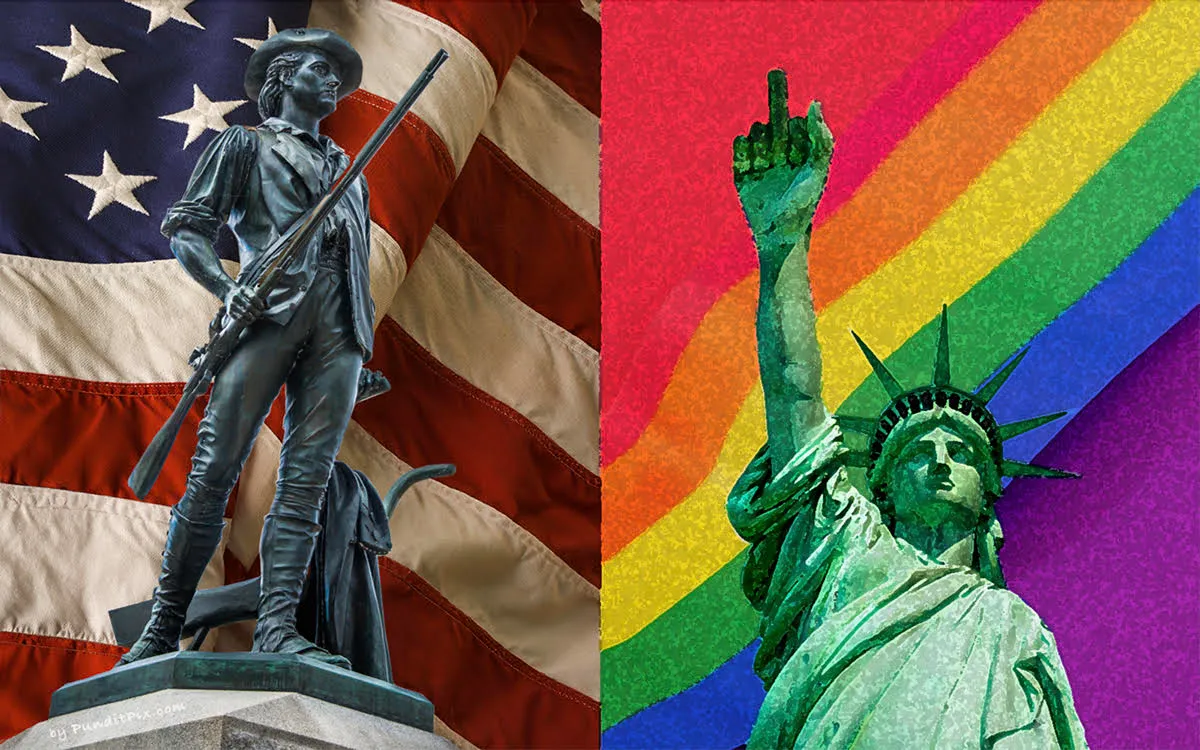
The Colorado Springs school district declared that the flag was an “unacceptable symbol” linked to “white-supremacy.” It further claimed that the Gadsden flag had its “origins with slavery” because it was designed in 1775 by a South Carolinian who owned slaves. By the same standard, the Declaration of Independence, Constitution, and Bill of Rights could all be condemned since Thomas Jefferson, James Madison, and George Mason were slaveowners. Do the wokesters want to condemn and expunge all of American history prior to the creation of the LGBT rainbow flag?
The Colorado hubbub occurred because many school officials and students are even more ignorant of American history than freshmen members of Congress. Former Supreme Court Justice Sandra Day O’Connor groused in 2014 that fewer than 20 percent of high-school seniors “can say what the Declaration of Independence is, and it’s right there in the title.” Americans’ ignorance of history helps explain their docility nowadays.
Rights originate from the society and are constrained by what contributes to the greater good of the society;
Individuals exist to serve society and not themselves;
In that context, the primary role of government is not the protection of individual rights as defined by the concept of individual freedom. In the collectivist viewpoint, every individual has rights which are determined to contribute to the greater good, as determined by the state, or more accurately, those in control of the state. Of course, private property is restricted—assuming it exists at all. In this type of society, the individual’s production exists to be distributed as determined by the government and not as determined by the individual. It is the role of government to distribute wealth produced by the workers so that all share equally in the wealth produced.
Today, governments in Europe have a broad answer to the question, “What is the role of government?” A culture of interventionism incrusted over many years convinced European governments that everything can be solved with more money, more bureaucrats, and more plans. Needleless to say, with this mindset governments always ask and obtain more power and it’s never assumed that they could become too large. No longer is the government managing the affairs of the State, because all of life is now an affair of the State. Governments have plans about what to do with the life of thier citizens, and opportunely ignore that individuals are planning for their own futures themselves.
The the level of the European Union (EU), bureaucrats, controlling an administrative juggernaut out of reach from national citizens, quietly continue to design new regulations aimed at transforming European societies and every aspect of the life of the “European citizens.” To that end, to what was once the Europe of free trade was added the Europe of standards, regulations, barriers to entry and lobbying, the Europe of common agricultural policy and its quotas, and the Europe of tax harmonization from above. These new regulations are commonly used by governments to strengthen their control over the life of their citizens using as a shelter the need to integrate national laws within the EU regulatory framework.
The institution of the European Union was certainly influenced by how notions of government and its duties regarding the rights and freedom of its citizens evolved over time. Major differences exist on these matters between the United Kingdom, now a former EU member, and the continental European powers. This divergent viewpoint emerges from two ideas of liberty; the modern liberty, as defended in the UK in the nineteenth century, and an old vision of liberty, promoted almost simultaneously by French revolutionaries.
To clarify what makes those two ideas of liberty different—if not literally antagonist—it is worth remembering the political and philosophical context at the end of the eighteenth century and the first half of the nineteenth century. At that time, in many places around Europe, people were looking to escape from absolutism and tyrannical forms of government. British philosophers were thinking about how to move away from the tyranny of absolute monarchy so that rights of citizen could be protected, persevered, and promoted. They came with the modern notion of liberty whose cornerstones were individual freedom and private property rights. The concept of rights were defined such that:
Rights originate in individuals and nothing constrains them but the rights of other individuals;
Every individual has the right to take any action that does not interfere with the rights of another individual;
Individual rights may only be transferred by the individual’s right of consent;
Modern liberty, being all about the rights of the individuals, had a tremendous impact on how government and its duties were defined. Governments should exist to protect the rights of the individual and act as a servant of the people who consent to be governed. Moreover, the moral rights of government can never be greater than the moral rights of the individuals who delegated to government its power.
Philosophers were always concerned by the fact that government could always grow too much and, while taking more power, could become a threat to the people’s rights which it aimed to protect.



 MCViewPoint