MCViewPoint

Opinion from a Libertarian ViewPoint

Posts Tagged ‘market economy’

TGIF: Efficient Bureaucracy?

Posted by M. C. on January 10, 2025

The real bosses, in the capitalist system of market economy, are the consumers. They, by their buying and by their abstention from buying, decide who should own the capital and run the plants. They determine what should be produced and in what quantity and quality. Their attitudes result either in profit or in loss for the enterpriser. They make poor men rich and rich men poor. They are no easy bosses.

https://libertarianinstitute.org/articles/tgif-efficient-bureaucracy/

by Sheldon Richman

bureaucracy

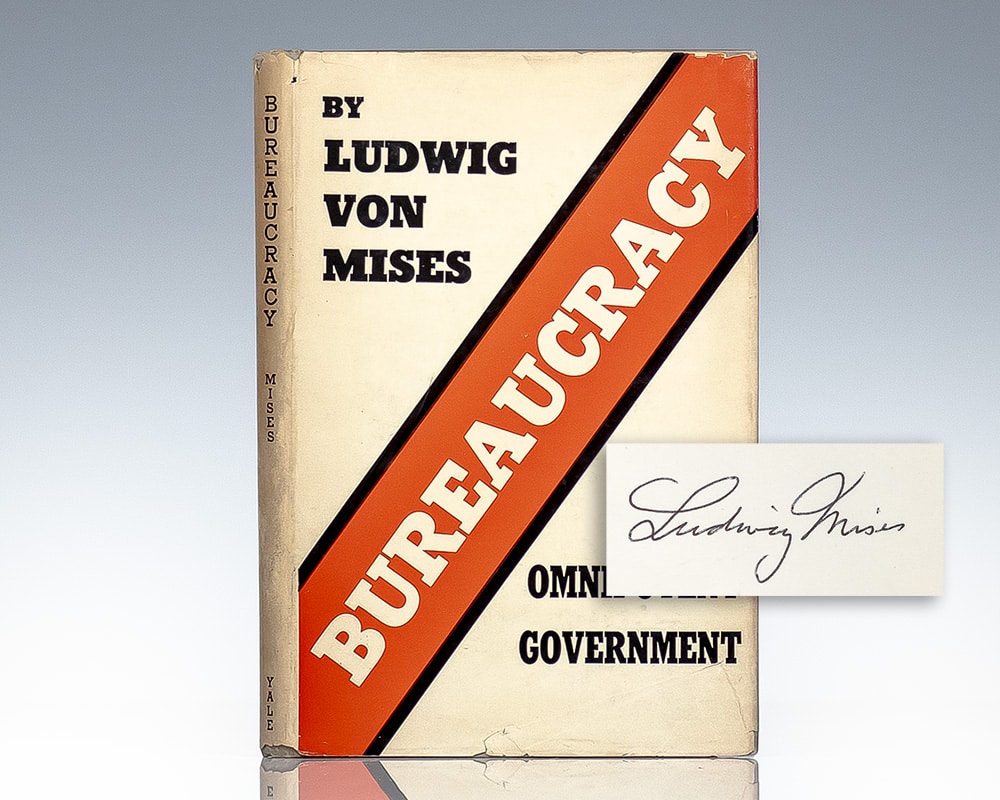
With all the talk about government efficiency, it would be useful to remind ourselves why bureaucracies differ radically from for-profit businesses. Ludwig von Mises devoted a short but enlightening volume to this subject in 1944, Bureaucracy. Elon Musk and Vivek Ramaswamy, who will co-chair the nongovernmental Department of Government Efficiency, should do some homework by reading that book.

Mises, as an advocate of limited government, did not argue that bureaucracy has no place in a free society. In contrast to anarcho-capitalists, he thought government and therefore some bureaucracy was necessary to protect what he valued most: peaceful social cooperation through the division of labor—that is, the market economy. Violence against persons and property was clearly antithetical to the continuing welfare-enhancing collaboration we call the market process. But Mises did not want bureaucracies trying to do what free, private, and competitive enterprises could do better. Moreover, if the government went beyond its mere peacekeeping duties, it would undermine the market process and make us all less well off despite any good intentions.

Mises began by reminding readers (or perhaps teaching them from scratch) what the free market is and what it accomplishes. It’s a great primer for those who lack the time to read his longer works. He wrote:

Capitalism or market economy is that system of social cooperation and division of labor that is based on private ownership of the means of production. The material factors of production are owned by individual citizens, the capitalists and the landowners. The plants and the farms are operated by the entrepreneurs and the farmers, that is, by individuals or associations of individuals who either themselves own the capital and the soil or have borrowed or rented them from the owners. Free enterprise is the characteristic feature of capitalism. The objective of every enterpriser—whether businessman or farmer—is to make profit.

The uninitiated might ask who runs things. He replied: “The capitalists, the enterprisers, and the farmers are instrumental in the conduct of economic affairs. They are at the helm and steer the ship.”

However, let’s not jump to conclusions about who really runs things, Mises advsed:

But [the capitalists, etc.] are not free to shape [the ship’s] course. They are not supreme, they are steersmen only, bound to obey unconditionally the captain’s orders. The captain is the consumer.

Neither the capitalists nor the entrepreneurs nor the farmers determine what has to be produced. The consumers do that. The producers do not produce for their own consumption but for the market. They are intent on selling their products. If the consumers do not buy the goods offered to them, the businessman cannot recover the outlays made. He loses his money. If he fails to adjust his procedure to the wishes of the consumers, he will very soon be removed from his eminent position at the helm. Other men who did better in satisfying the demand of the consumers replace him.

All the conventional controversy about bosses and workers overlooks the critical point:

See the rest here

Be seeing you

Posted in Uncategorized | Tagged: , , , | Leave a Comment »

Liberty is Married to the Market Economy – w/ Dr. Walter Block

Posted by M. C. on July 17, 2024

Be seeing you

Posted in Uncategorized | Tagged: , , | Leave a Comment »

Political Paternalism, Not Free Markets, Cause Economic Shocks

Posted by M. C. on May 2, 2022

by Richard M. Ebeling

One of the political paternalist tricks is to insist that any economic policy failure is more “proof” of the bankruptcy of the market economy. Once again, this worn-out device is employed by Columbia University professor and Nobel Prize-winning economist Joseph E. Stiglitz. Any and all such presumed market “failures” are placed by Stiglitz under the umbrella term, “neoliberalism.”We are facing the consequences of the interventionist and regulatory state.
[Click to Tweet]

Neoliberalism has become one of the most elastic terms in the political paternalist lexicon. It amounts to whatever the paternalist dislikes or to any interventionist welfare-state policy that has turned out badly from his own point-of-view, but which cannot be admitted to have been caused by some aspect of his own policy agenda. Never having to say you are sorry for your own social engineering failures is central to this mindset.

In a recent article at Project Syndicate, Stiglitz calls for “Shock Therapy for Neoliberals.”(April 5, 2022). He insists that for the last several decades. America and indeed the world have been caught in the mesmerizing grip of the idea that free markets work. And even worse, the free-market ideology has guided and directed U.S. economic policy from Ronald Reagan to the present.

This may come as a surprise to some who lived through the Bill Clinton and Barack Obama administrations and considered especially Obama’s to be committed to a fairly “progressive” agenda, a capstone of which was the (un)Affordable Care Act and its many false promises. In addition, for many limited-government conservatives and classical liberals, the two Bush administrations, along with Donald Trump’s, seemed far from any noticeable free-market agenda as well.

Stiglitz says recent crises all caused by neoliberalism

Stiglitz points, in particular, to the financial crisis of 2008-2009, the coronavirus crisis of the last two years, and now the war in Ukraine as all examples of the failure of free market-based neoliberalism to be able to steer clear of instability and to restore and maintain economic balance. In Stiglitz’s reading of 21st-century history, you would never know that for the five years before the financial crisis of 2008, the Federal Reserve had artificially manipulated key interest rates down to near zero and, when adjusted for inflation, were actually in the negative range for most of that time. This had been made possible with a nearly 50 percent increase in the money supply (M-2) during this half-decade.

Matching this had been a heavily government-created housing boom. Two federal agencies, Fannie Mae and Freddie Mac, had guaranteed and bought up huge portions of the home-mortgage market. The private sector home-mortgage lenders were told by Fannie Mae and Freddie Mac that they could loan with reckless abandon, with these agencies bearing most or even all the risk if any home loans went delinquent or general bad times were to set in. Fannie Mae and Freddie Mac ended up “covering” about half of all the outstanding mortgages in the United States.

The financial and housing crisis of 2008-2009 had been made in Washington, D.C. The instability and discovered imbalances in the financial and housing markets had on them the fingerprints of the Federal Reserve System and the federal agencies that created the “moral hazard” of unsustainable home mortgages once the bubble burst. A free market had nothing to do with it because these markets were (and remain) hostages of governmental control and manipulation. (See my article, “Ten Years On: Recession, Recovery and the Regulatory State”.)

Coronavirus crisis was made by restrictive government planning

Turning to the Covid-19 disaster of 2020, Stiglitz refers to the U.S “economies’ lack of resilience. America, the superpower, could not even produce simple products like masks and other protective gear, let alone more sophisticated items like tests and ventilators.” I fear that Stiglitz is starting to suffer from short-term memory loss, at least when it comes to economic policy. It is only two years since the federal and state governments decided to follow the Chinese totalitarian model of extensive lockdowns and shutdowns in the attempt to stop the spread of the virus. This brought production and employment to a grinding halt over many parts of the American economy. It was a perverse system of government central planning designed to bring society to an intentional standstill to assure no one came closer than six feet from any other human being.

Furthermore, it was the Centers for Disease Control and Prevention (CDC) and the Food and Drug Administration (FDA) that brought about the delays and hindrances to entrepreneurially innovative responses to the medical crisis. These government agencies prohibited private enterprises from marketing improvised, but no less effective, substitutes for more standard ventilator equipment, face masks, hand sanitizers, and testing kits.

No matter how serious the medical and related healthcare and equipment shortages, nothing could be supplied without the slow-motion approvals of the restrictive regulatory gate-keepers. More lives were put at risk or lost, medical needs were left unsatisfied for a longer period of time, and human suffering and anxiety were increased precisely because resilient and robust competitive market responses to the coronavirus crisis faced the impenetrable and shut doors of the American regulatory bureaucracy for many months in 2020. (See my articles, “To Kill Markets is the Worst Possible Plan” and “Leaving People Alone is the Best Way to Beat the Coronavirus“and “The Conquest of America by Communist China“.)

War and government sanctions are causing new disruptions

See the rest here

Be seeing you

Posted in Uncategorized | Tagged: , , | Leave a Comment »

What “Climate Justice” Really Means | Mises Wire

Posted by M. C. on September 27, 2019

https://mises.org/wire/what-climate-justice-really-means

…To sum up quickly, a carbon tax will be introduced for gas, starting with €10 per ton of CO2 in 2021, but increasing to €35 in 2025. This is not necessarily high when one looks at the greater debate on how high a carbon tax could be, and yet, it will have an effect for car owners, who will have to pay 12 cents per liter more in the end, increasing gas prices that are already three to four times as high as in the US. In addition, the car tax will be increased for cars that pollute significantly and domestic flights — or as they are also called, “dumping flights” — will cost at least €30 more. The quasi-state-run train company, which is known for its notoriously bad service and delays and gets outcompeted even by private bus services at this point (not to mention private train companies in neighboring countries), will get some additional subsidies.

Of course, the German government did its best to make it seem as though this reform package would not just mean higher costs. Commuting allowances would be increasing starting at a commute of 21 kilometers (13 miles), meaning a tax break for those traveling a longer way to get to work (talking about setting wrong incentives “for the environment”). Almost 75 percent of Germans have a commute of less than 21km, though, meaning the tax break is only useful for a minority. At the same time, the electricity prices are supposed to be reduced by around €30 a year — but it is difficult to see this as anything other than a nice, small tweak on the abhorrently high electricity prices which came into being due to some other ill-conceived environmental activism by the government…

What the climate apostles of today want instead goes much farther. They want to attain climate justice, something which sounds similar to another famous weasel term, namely social justice, and in fact is even more similar than one thinks at first. As Robert Colvile, the Director of the British Centre for Policy Studies, showed, reaching this goal includes a complete abandonment of nuclear power and fossil fuels by 2030 — a rather costly endeavor to say the least. The climate goals also require the rejection of new technologies such as geoengineering and carbon capture and storage. “Justice” requires massive financial transfers from the industrialized to the developing world. “Justice” demands food sovereignty (“culturally appropriate food markets”), and “agro-ecology,” which means “an explicit focus on social and economic dimensions of food system” as well as “a strong focus on the rights of women, youth and indigenous peoples.”

[RELATED: “Fear Global Warming? Markets Offer Our Best Chance for Survival“]

Worst of all, “non-market approaches” are the only ones deemed worthy of being taken into consideration. Indeed, the market economy itself has to be abolished to stop global warming. As Colvile puts it, “the ideas behind the climate strike movement are fundamentally illiberal.”

Luckily, though, environmentalism doesn’t have to be socialist. Nothing is wrong with wanting to protect natural wonders and trying to alleviate climate processes that would destroy these wonders and the livelihood of millions, if not billions of people. It is understandable that Greta and others want to protect this world.

For this, however, they perhaps should consider the market economy, their own declared enemy, as the lifeboat of the world. It is not only that we can fight environmental degradation while we can keep our capitalist system alive (as far as it still exists). This capitalist system may actually be helpful in that very fight. And in contrast to government-mandated “climate justice,” innovation and technological progress thanks to entrepreneurs wouldn’t bring with it mass unemployment and major economic distress, but greater prosperity.

Be seeing you

Australia’s Most Unpopular Tax – The Carbon Tax | A Daily Thought

Posted in Uncategorized | Tagged: , , , , , | Leave a Comment »